Maine
Editorial: Vote yes on Question 3 to invest in Maine’s past, and future


The BDN Editorial Board operates independently from the newsroom, and does not set policies or contribute to reporting or editing articles elsewhere in the newspaper or on bangordailynews.com.
Do you favor a $10 million bond issue to restore historic buildings owned by governmental and nonprofit organizations, with funds being issued contingent on a 25 percent local match requirement from either private or nonprofit sources?
Treasured pieces of Maine’s history are on the ballot this election. And no, we’re not referring to the debate around replacing Maine’s flag.
Question 3 would approve a $10 million bond to help restore historic government and nonprofit buildings across the state. The question requires a 25 percent local match from either private or nonprofit sources.
These are structures and sites like old meeting houses, town halls, public libraries, museums, grange buildings, old forts, homesteads, and other sites that might otherwise fade into memory without restoration efforts.
The government entities or nonprofits responsible for these buildings might not have the resources available to prioritize this needed work. Some funding through the Maine Historic Preservation Commission and other organizations is meant to aid these valuable projects, which help ensure that Maine’s history remains an active part of our future. Though survey results from the people doing this work indicate that consistent state funding that matches the statewide need has been elusive.
Passing Question 3 would help address this, even a one-time infusion of $10 million represents just part of the statewide need. A previous bond of this type was passed back in 1985, when voters approved $2 million.
This newest iteration was proposed by two Republican state lawmakers, Rep. Sawin Millett and Sen. Rick Bennett. Its original amount of $25 million was paired back when the bond question was reviewed and approved by the Legislature.
Though the amount matches neither the original proposal nor the existing preservation needs across the state, it remains a sensible down payment to protect parts of Maine’s history. The Maine Historic Preservation will oversee the award of funding to various projects with this funding, as it has before, in a process that can safeguard Maine’s past while also supporting current community cohesion and economic activity.
“Studies show that investment in historic preservation supports small business and good paying jobs, improves property values, keeps money circulating in local economies, and catalyzes additional investment,” said Tara Kelly, executive director of the nonprofit Maine Preservation, and Sarah Hansen, the executive director of Greater Portland Landmarks, in testimony before the Legislature last year. “The rehabilitation of historic buildings can be labor intensive, creating high-paying jobs. In a soon-to-be-finalized economic impact analysis of historic preservation in Portland, it is estimated that these projects create 218 direct jobs and an additional 217 indirect and induced jobs every year.”
While we would prefer to see increased and consistent support for these preservation efforts built into the state budget rather than be subject to bonding — and the interest that comes with it — the unfortunate fact remains that such a consistent funding source has yet to materialize. In its absence, this bond is a prudent if insufficient public investment. The longer some of these projects wait for support, the more likely that these structures and sites degrade beyond repair.
Julia Gray, the executive director of the Wilson Museum in Castine, offered strong rationale for supporting this bond question in legislative testimony last year.
“Maine’s historic buildings are an irreplaceable part of our civic infrastructure,” Gray said. “They are often part of a community’s identity, a highly visible symbol of local history, places of memory that span generations.”
We agree, and we hope Maine voters will too. Question 3 deserves a yes vote.



A Massachusetts photographer was seriously injured when he was stabbed during a wedding reception last month in Raymond, Maine.
Donald Halsing, 26, was hospitalized for five days after the stabbing on May 23. NBC affiliate News Center Maine reported that 26-year-old Andrew Manderson was arrested and charged with elevated aggravated assault.
Still recovering, Halsing told NBC10 Boston the attack came out of nowhere — one moment, he was snapping photos on the dance floor, while the next, he was searching for help as blood spilled onto his camera.
“I was sitting there in that chair thinking, ‘There’s a real possibility I could die here,’” Halsing said. “Immediately, I put my hand on my chest here to try and stop the bleeding, get some pressure on it, and started yelling for help.”
Halsing was working at the reception at the Kingsley Pine Campgrounds. He took his last photo at 9:01 p.m., minutes before the stabbing.
“One of the wedding guests came up to me and started asking questions about our business,” he said.
Halsing said it was nothing out of the ordinary, and he tried to explain his photography business to the inquiring guest through the pulse of the DJ booth and celebrating guests.
“I thought he was going to reach in his back pocket for his phone, and instead, he didn’t pull out his phone — he pulled out a pocket knife and stabbed me,” he said.
Manderson, who faced a judge days later, is a cousin of the bride.
“There was this look in his eyes that he wasn’t quite all there,” Halsing said.
Halsing’s fiancée, Ashley Wall, was feet away as he struggled to stay awake. She has been his photography partner for eight years since they met at Framingham State University, and she was helping him work the wedding.
“People who were around me, they asked, ‘What can we do to help you? What do you need?’ And I said, ‘Please go check on Ashley. Please go check on my fiancée,’” he recalled.
Halsing spent five days in the hospital suffering from two lacerations to his liver, ultimately developing a blood clot in his left leg. But the road to recovery exceeds his physical wounds as he contemplates his mental state when he resumes photography next year.
“I’m also worried about what lingering effects there might be,” he said. “If we get out on the dance floor and I start remembering what happened, I don’t know how I’m going to react.”
Halsing still doesn’t know why he was attacked.
Manderson was released on $50,000 bail and is due back in court in October.
When BDN shines a light, policymakers act. Make a gift to help our reporters keep Maine’s leaders informed. Make a donation now.
This story will be updated.
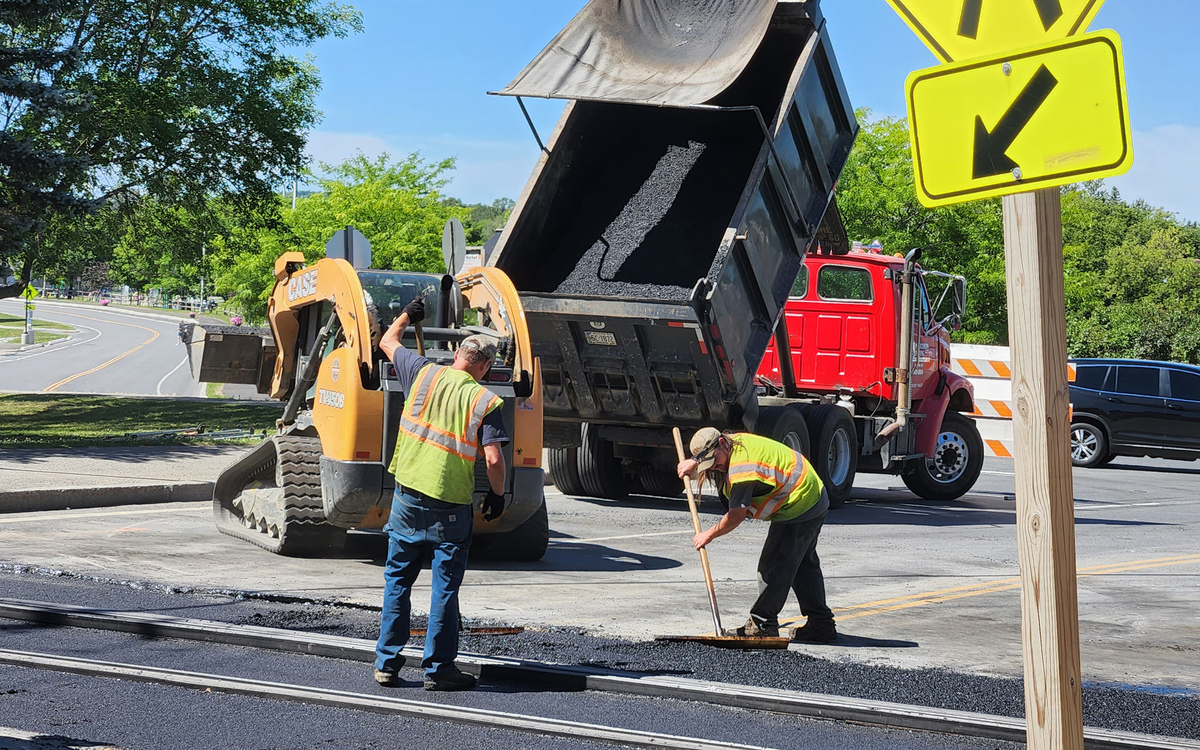
The Maine Department of Transportation is moving to slash up to $400 million in projects from its agenda, a shocking and abrupt cutback that is rattling the state’s construction industry at the start of building season.
Roughly $50 million across six pavement projects have already been delayed, according to a memo exclusively obtained by the Bangor Daily News. The agency plans to cut or delay another $150 million in bridge, highway, intersection and multimodal projects later this month. A further $200 million or more in cuts are planned in the next three-year work plan.
Those figures were outlined by Transportation Commissioner Dale Doughty in the May 18 memo to Gov. Janet Mills that has since circulated widely in the transportation sector, which has been getting drip-by-drip details on the wide scope of the cuts over the past three weeks.
It comes at the beginning of the state’s relatively narrow construction season. Companies have hired workers and ordered materials for projects they expected to begin this summer. The severity of the transportation budget problems was not raised to lawmakers during the 2026 legislative session.
Kelly Flagg, executive director of the Associated General Contractors of Maine, called the shortfall “deeply troubling” in a statement.
“We stand ready to work with policymakers, stakeholders, and industry partners to identify both immediate and long-term solutions,” Flagg said. “Maine cannot afford to fall further behind.”

Insiders saw this first.
This story was broken in Maine Politics Insider, the BDN’s daily premium newsletter for the most ardent political news followers. If you are a new BDN subscriber, you can sign up here. Current subscribers can contact our customer service team to upgrade.
The cuts stem from a structural funding gap of at least $130 million in the state’s current work plan, according to Doughty’s memo. Losses are magnified because state money from the gas tax and other revenue sources is matched by federal funds. Lawmakers have long grappled with politically difficult long-term problems with the state’s transportation budget.
A Mills spokesperson said Wednesday morning that the administration was working on a response to questions from the BDN. The department says it needs roughly $240 million more in state capital funding annually to maintain the existing system, and that anything less than $200 million will erode it over time.
Doughty’s memo the only near-term solution is a series of bonds beginning as soon as possible. Lawmakers would have to return to Augusta to authorize that if one is going to appear on the November ballot.

The BDN Opinion section operates independently and does not set news policies or contribute to reporting or editing articles elsewhere in the newspaper or on bangordailynews.com
Michael Capeci is the former chairman of the Bangor GOP.
Let’s be honest about Maine’s current state.
For many families, the cost of living has become unsustainable. Housing is out of reach for many young people. Energy bills keep rising. Many small businesses are struggling under taxes and regulations that make it harder to grow. Rural hospitals are under strain and despite years of increased state spending, the results are not showing up in people’s daily lives.
Concurrently, Maine continues to lose young workers to other states. That is not a statistic, it is a warning sign.
To me, the question in this Republican primary for governor is not about slogans. It is whether we continue with a political approach that has failed to reverse these trends, or whether we nominate someone with new ideas. I think that someone is Owen McCarthy.
Owen is not a political insider. He is an entrepreneur from Patten, a small town where opportunity is not assumed, it is built. He grew up in a working-class family, became the first in his family to graduate from college graduating from the University of Maine, and founded MedRhythms, a healthcare technology company focused on neurological treatment.
He didn’t just talk about opportunity. He built it. That distinction matters, because Maine’s problem is not a lack of debate it is a lack of results. We have seen the trajectory: higher costs, slower growth, and a steady outmigration of young workers. I believe Owen McCarthy represents a break from that pattern.
His Maine 2040 plan focuses on creating 50,000 new jobs in sectors where Maine has real advantages — maritime and defense, advanced forest products, and life sciences. These are export-driven industries tied directly to Maine’s workforce, geography, and institutions. What sets Owen apart is not only what he proposes, but how he approaches governing.
He prioritizes modernizing permitting so projects do not stall. He supports using technology to reduce costs and increase efficiency. He focuses on making it easier to build, hire, and expand in Maine.
That same practical mindset extends to healthcare. Expanding telehealth, strengthening EMS systems, improving provider flexibility, and shifting toward earlier intervention are not abstract reforms. They are system upgrades designed to improve access while controlling costs.
Maine voters consistently respond to competence. They reward candidates who understand problems and present plans to solve them. I believe they are tired of rhetoric that does not translate into results, and skeptical of politics that prioritizes messaging over execution.
Owen’s approach is grounded in solving the issues that shape daily life — affordability, healthcare access, job creation, and government efficiency. That is not just policy positioning. It is a governing model that speaks directly to voters.
Some will point to his lack of political experience. But I believe Maine’s core problems are not the result of insufficient political experience; they are the result of policies that have failed to deliver measurable improvement. Experience inside a broken system, by itself, is not a solution.
If Republicans want to win, this primary must be taken seriously. From my perspective, it is not about choosing a nominee for governor who can energize the base. It is about selecting someone who can compete in a broader electorate that is frustrated and looking for change.
That requires a candidate who can speak beyond the base, not by abandoning principles, but by demonstrating competence and a credible plan to address Maine’s challenges. I believe Owen McCarthy offers that combination. He represents a shift away from managed decline and toward economic execution.
This is not just another primary. It is a decision about whether Republicans position themselves to win Maine or whether they remain trapped in a cycle of repeating the same strategies and expecting different outcomes.
If Republicans want to compete for Maine’s future, they cannot afford to nominate a candidate who only motivates part of the electorate. They need someone who expands it.
I believe Owen McCarthy is that candidate.
And if the goal is to win Maine, then the choice should be unmistakable
-
 Politics7 minutes ago
Commentary: Bass clears first hurdle, but if Pratt holds off Raman, the mayoral race could be a holy war
-
 Sports15 minutes ago
The Ball brothers’ head coach at Chino Hills, Steve Baik, is the new coach at Calabasas
-
World25 minutes ago
Social media operation linked to Iran manipulated public through fake Irish and Scottish profiles
-
 News52 minutes ago
National Guard has done little to reduce violent crime in D.C., a new study finds
-

 Los Angeles, Ca2 hours ago
Man claiming to be armed robs Culver City bank, gets away with $10,000
-

 Detroit, MI2 hours ago
Fired Detroit TV anchor Taryn Asher files sex discrimination lawsuit against old station, claims new GM protected men
-

 San Francisco, CA3 hours ago
San Francisco family devastated as they face nearly 90% rent increase
-

 Dallas, TX3 hours ago
Wings’ top pick Azzi Fudd hosts clinic as Cash App donates to Dallas nonprofit

