Washington, D.C
Congress left D.C. with little done. They’ll be back Nov. 12 to give it another try. – Maryland Matters


WASHINGTON — When members of Congress left Capitol Hill last month to focus their attention on the campaign trail during the weeks leading up to Election Day, they left much of their work unfinished.
The Republican House and Democratic Senate are scheduled to remain on recess until Nov. 12, though the urgent needs created in the wake of Hurricane Helene, which are fully funded for the moment, could bring the chambers back into session before then.
When lawmakers do return to Washington, D.C., they’ll need to address the must-pass legislation they’ve left on autopilot instead of negotiating new bipartisan compromises.
So far this year, lawmakers have pushed off the hard work of brokering agreement on must-pass measures like the farm bill as well as this year’s batch of government funding bills and the annual defense policy legislation.
Kids’ online safety, radiation exposure
There are also a handful of measures that have passed one chamber with broad bipartisan support, but haven’t been taken up on the other side of the Capitol, which leadership could decide to move forward during November or December.
For example, an interesting combination of senators, led by Connecticut Democrat Richard Blumenthal and Tennessee Republican Marsha Blackburn, are advocating for House Republican leaders to hold votes on a pair of online safety bills designed to better protect children from the darker side of the internet.
The rail safety bill drafted by a bipartisan group of senators from Ohio and Pennsylvania after the train derailment in East Palestine remains unaddressed following more than a year of intransigence.
And legislation to reauthorize the Radiation Exposure Compensation Act, or RECA, which passed the Senate on a broadly bipartisan vote earlier this year, sits on a shelf collecting dust in the House.
Cancer victims, Indigenous communities and many others have pressed House GOP leadership to hold a vote to reauthorize the program after it expired this summer, but House members have avoided it due to cost.
Five-week lame duck
Lawmakers interviewed by States Newsroom and congressional leaders all indicated the outcome of the November elections will have significant sway on what Congress approves during the five-week lame-duck session that spans November and December.
All interviews took place before Hurricane Helene made landfall and Israel was directly attacked by Iran, both of which are likely to be at the top of congressional leaders’ to-do lists.
Senate Minority Whip John Thune said it’s “hard to say” what, if anything, Congress will approve during the lame-duck session.
“I think a lot will be shaped by what happens in November,” the South Dakota Republican said.
House Minority Leader Hakeem Jeffries, D-N.Y., said just a day before Hurricane Helene made landfall that Democrats would advocate for passing natural disaster response funding previously requested by the Biden administration.
“Extreme weather events are on the rise and they affect everyone — in blue states, purple states and red states,” Jeffries said. “This is not a partisan issue, it’s an American issue in terms of being there, in times of need for everyday Americans, who have had their lives and livelihood upended.”
Other House Democratic priorities during the lame duck include approving the dozen full-year government funding bills that were supposed to be completed before Oct. 1, the defense policy bill that had the same deadline and the farm bill, which is more than a year overdue.
Missouri GOP Sen. Josh Hawley said he “sure hopes” the RECA reauthorization bill reaches the president’s desk before the end of the year. He didn’t rule out lobbying to attach it to a must-pass government funding bill, but said the real hurdle is House GOP leaders.
“It doesn’t need help in the Senate. It just needs the House,” Hawley said. “I’ve had good, productive conversations with Speaker (Mike) Johnson in the last few weeks, and I appreciate his personal engagement on this, and I hope that that will lead to action.”
Hawley said the House allowing RECA to expire, preventing cancer victims who qualify for the program from receiving benefits, was “outrageous.”
Defense priorities, farm bill
Senate Armed Services Chair Jack Reed, a Rhode Island Democrat, said staff would work during October to bridge the differences between the two chambers on the annual defense policy bill, called the National Defense Authorization Act. Those staff-level talks will lay the foundation for Republicans and Democrats to meet once they return to Capitol Hill after the elections.
“We have to be ready when we come back to go right to the ‘Big Four’ meeting,” he said, referring to the top leaders in both chambers. “That’s our objective.”
Reed said many of the differences between the House and the Senate aren’t typical Defense Department policy issues per se, but are “more political, cultural, social.”
Congress may begin to debate additional military and humanitarian assistance to Ukraine this year, though that’s more likely to happen next year, Reed said.
Senate Agriculture Committee Chair Debbie Stabenow, D-Mich., said she was making a “big push” for the House and Senate to reach agreement on the farm bill in the months ahead, though she cautioned talks don’t actually constitute a conference.
“I wouldn’t call it a conference; technically to have a conference, you have to have a bill passed by the House and a bill passed by the Senate, which will not happen,” Stabenow said.
“But I believe that there is a way,” Stabenow added. “I believe there’s a way to get a bipartisan bill.”
Arkansas Sen. John Boozman, the top Republican on the Agriculture panel, said lawmakers didn’t need the election results to “start working through our disagreements” on the farm bill, adding there’s some new momentum in talks.
“I think what’s changed is that there is a recognition among members, all members, how difficult it is right now as a farmer,” Boozman said. “So that’s really what’s changed in the last three or four months. It’s developing a real sense of urgency for these folks.”
Iowa Republican Sen. Joni Ernst said the election outcome could influence what lawmakers choose to accomplish during the lame-duck session.
“There’s any number of scenarios, whether it’s NDAA, whether it’s farm bill, whether it’s anything else,” she said. “But it comes down to Leader Schumer.” New York Democrat Chuck Schumer is the majority leader in the Senate.
Virginia Democratic Sen. Tim Kaine said he expects Congress will broker some agreement on government funding legislation and the NDAA, but not necessarily anything else.
“In an odd way, the better the Dems do on Nov. 5, the more we’ll get done,” Kaine said. “Because I think if the House is going to flip back to Dem, I think the Rs will say, ‘Well, let’s get a whole lot of stuff done before the House goes down.’ So I think the better we do, the more we’ll get done in the lame duck.”
Kaine said if Democrats do well in the elections, they might not need to approve additional aid for Ukraine this Congress, since that funding can last into next year.
“If we don’t do well in the (elections), we might need to do it in the lame duck,” Kaine said. “So that’ll all depend.”



WASHINGTON – Washington, D.C., mayoral candidate Kenyan McDuffie on Thursday conceded the Democratic primary race to Janeese Lewis George.
Although the official certification of the primary race is continuing, McDuffie said in a statement that “it is clear that the voters have chosen a different path.” The former member of the D.C. council said he had contacted Lewis George and congratulated her. He thanked his supporters and urged them to continue working for the city.
“The campaign may be over, but the work of building a safer, more affordable, more prosperous city continues.”
The Associated Press has not declared a winner in the race. Lewis George had a little less than 53% of the vote Thursday morning, which is just a few percentage points above the 50% threshold to avoid ranked choice voting.
The city is scheduled to release preliminary ranked choice voting results on Sunday. AP will call the race before then if it is clear that the ranked choice process will be avoided.
Lewis George has pledged to aggressively stand up to federal intervention into Washington, D.C.’s, affairs, setting up a potential showdown with President Donald Trump over his administration’s moves to challenge the city’s limited autonomy.
If the results stand, Lewis George is likely to win November’s general election in the heavily Democratic city. The winner in the general election will replace Muriel Bowser, who decided not to run again after three terms.
Lewis George would join Robert White Jr., who won the Democratic primary for the district’s delegate to Congress, as the top local officials who likely will contend with the federal government’s intentions for the city. They each campaigned on a promise to take a harder line than their predecessors against the Trump administration’s moves on the district, including its deployment of the National Guard on an ongoing, open-ended mission meant to fight crime.
“As mayor, I will work with anyone who makes D.C. safer,” Lewis George told a crowd of cheering supporters Tuesday night, “but I will also stand up to Trump.”
Washington has limited autonomy and federal leaders retain significant control over local affairs, including approval of the budget and laws passed by the D.C. Council.
Trump further encroached on that autonomy last year when he briefly federalized the city’s police force and deployed an ongoing law enforcement surge that included the National Guard. His efforts to downsize the federal government also roiled the capital region, costing thousands of people their jobs. And he has been reshaping the city by renovating storied landmarks and putting his name or image on buildings.
Lewis George, a self-described democratic socialist and a member of the D.C. Council, has already come under fire from Trump, who last week threatened to place the city under federal control if she won.
“Maybe we’d take back Washington, run it on the federal basis,” he said.
Lewis George, 38, and a third generation Washingtonian, has vowed to overrule an executive order by the city’s police chief permitting local law enforcement to cooperate with Immigration and Customs Enforcement agents. Lewis George argued the order “hurt the trust of our community.”
She also pledged to use any levers available to her through the city’s home rule compact to resist what she called authoritarian infringements on the district’s local governance.
“We have legal tools we can use to fight back,” she told the AP in an interview before the vote. “And we know that when we have gone to court, we’ve won.”
Bowser found herself walking a fine line between staying in Trump’s good graces and responding to the concerns of constituents, many of whom said she didn’t push back hard enough on Trump’s actions. Eleanor Holmes Norton, the 18-term, 89-year-old delegate to Congress, meanwhile, faced mounting concern from critics who said she wasn’t forcefully pushing back on the Trump administration’s moves against the city.
Copyright 2026 The Associated Press. All rights reserved. This material may not be published, broadcast, rewritten or redistributed without permission.
Darren Lyn
18 June 2026•Update: 18 June 2026
Democratic socialist Janeese Lewis George currently leads the vote tally as of Wednesday versus six other candidates in the Washington, DC Democratic mayoral primary, and if victorious, could be following in the footsteps of the most notable democratic socialist in the United States — New York Mayor Zohran Mamdani.
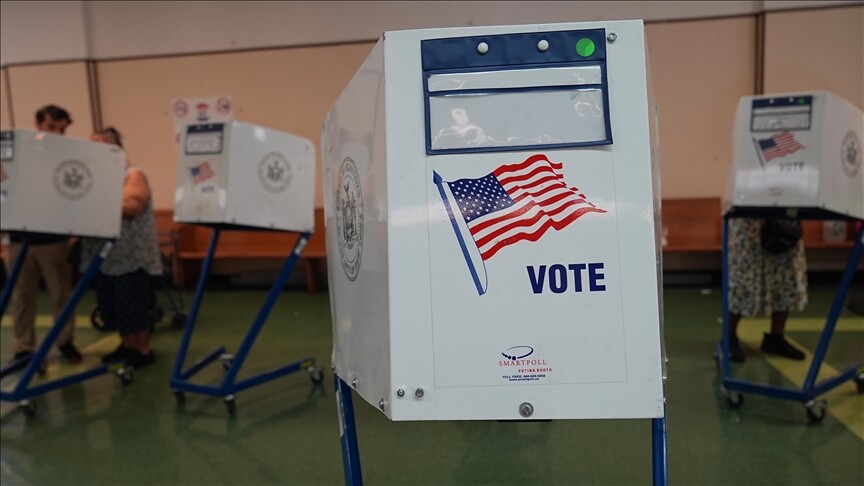
With 73% of the ballots counted since Tuesday’s primary election in the nation’s capital, the Associated Press (AP) has Lewis George leading with 52.9% of the vote. Her closest challenger is Kenyan McDuffie, who currently holds 36.5%.
The mayor’s office in the District of Columbia has traditionally been a Democratic stronghold, and political experts have said that any Republican challenger is not expected to put up meaningful competition for the mayor’s seat in the general election.
If Lewis George keeps her current lead and wins the majority, she will head to the November election as the favorite to replace three-term Mayor Muriel Bowser, who decided not to run for a fourth term.
A victory for Lewis George would be to the ire of US President Donald Trump, who told reporters that he could attempt a federal takeover of Washington if she won the mayor’s race, according to local media reports.
“We won’t put up with it,” Trump told reporters at a news conference.
Yet Trump has already seen a democratic socialist take power in America’s largest city, with the election of Mamdani as mayor of New York City.
Not to be outdone, the race for the mayor’s office in Los Angeles, California — the second largest city in the US by population — has a democratic socialist, Nithya Raman, in the runoff to vie for the position in November’s general election. Raman will face incumbent Democratic Mayor Karen Bass, who narrowly edged out Raman in the primary 34.3% to 29.0%.
In California’s 14th congressional district, two candidates will head to a runoff election to replace former US Rep. Eric Swalwell, who resigned from Congress in April amid allegations of sexual assault, including rape.
Aisha Wahab secured the first runoff spot on Tuesday with 38.3% of the vote, with the AP on Wednesday calling the second position to go to Melissa Hernandez, who tallied 17.2%.
The runoff election will be held on Aug. 18, with the winner finishing out the rest of Swalwell’s term.

At time of writing, the Associated Press estimates that around 64% of votes have been counted. Races where no candidate wins a majority of first choices will proceed to a ranked choice voting count – most likely the at-large Council and Ward 1 Democratic primaries. With RCV, all nominees will have support from a majority of their party – as will the winner in an at-large Council special election.
Mayor
In the closely watched mayoral race, Councilmember Janeese Lewis George leads with 52.8% of voters’ first choices, followed by former Councilmember Kenyan McDuffie at 36.6%. If Lewis George remains above 50% as the remaining votes are counted, a ranked choice tabulation will not be necessary to determine the winner.
Congressional delegate
Five candidates ran in the Democratic primary to succeed retiring Delegate Eleanor Holmes Norton. Councilmember Robert White won that election with 63.2% of first choices. Councilmember Brooke Pinto came in second with 21.5% of first choices.
At-large Council Democratic primary
Nine candidates ran for the Democratic nomination to succeed at-large Councilmember Anita Bonds. No candidate has won a majority of first choices. Oye Owolewa leads with 33.8%, followed by Lisa Raymond at 15.2% and Kevin Chavous at 13.8%. The result will likely be determined by a ranked choice voting count.
| Candidate | Share of first choices |
| Oye Owolewa | 33.8% |
| Lisa Raymond | 15.2% |
| Kevin B Chavous | 13.8% |
| Greg Jackson | 11.0% |
| Candace Tiana Nelson | 7.7% |
| Dwight Davis | 6.0% |
| Fred Hill | 5.4% |
| Dyana N. M. Forester | 3.7% |
| Leniqua’dominique Jenkins | 3.0% |
| Write-in | 0.4% |
In a choose-one election, Owolewa would have won the nomination despite 66% of voters voting for another candidate. In 2022, for instance, Councilmember Anita Bonds won the Democratic primary for this seat with only 36% of first choices. Now, ranked choice voting will ensure the nominee – whether Owolewa or someone else – has majority support.
At-large Council special election
In the special election for at-large Council, former Councilmember Elissa Silverman is leading with 54.8% of first choices, followed by appointed Councilmember Doni Crawford and Board of Education President Jacque Patterson, with 25% and 19% respectively. If Silverman maintains a majority of first choices, there will be no ranked choice tabulation.
Ward 1
In the competitive Democratic primary for Ward 1 councilmember, Aparna Raj leads with 47% of first choices. Depending on remaining ballots, Raj may win with a majority of first choices, or the winner may be determined by a ranked choice voting count.
Candidate
Share of first choices
Aparna Raj
46.7%
Michael Trindade Deramo
20.3%
Rashida Brown
17.2%
Jackie Reyes Yanes
10.0%
Terry Lynch
5.8%
Write-in
0.1%
Notably, in three Council races – the at-large Council Democratic primary, at-large Council special election, and Ward 1 Democratic primary – candidates cross-endorsed each other, asking voters to rank each other on their ballots. Past elections show that voters often listen to cross-endorsements by candidates they support, so it’s possible candidates who cross-endorsed will benefit when their races go to RCV tallies.
DC’s ranked choice voting elections offer a sharp contrast with the District’s recent past, in which candidates regularly won key primaries without majority support. Since 2012, every districtwide office and six of the eight wards have seen Democratic primaries won with less than 50% of the vote. Since 2020, Ward 2 and Ward 7 have had Democratic Council primaries won with less than 30% of the vote.
FairVote will post more analysis of the DC election over the coming week. In the meantime, visit Grow Democracy DC to learn more about RCV in DC.
-

 Nebraska2 minutes ago
Nebraska Dept. of Agriculture proposes ban on food and beverages containing any amount of THC
-

 Nevada5 minutes ago
WOW Carwash touts year-round water conservation with recycling tech in Southern Nevada
-

 New Hampshire10 minutes ago
Concord celebrates 237 years of Constitution ratification with festivities – Concord Monitor
-

 New Jersey17 minutes ago
Is ICE giving up on Roxbury detention center? NJ leaders laud report
-

 New Mexico20 minutes ago
New Mexico leaders push funding to fight screwworm after 1 local case
-
North Carolina25 minutes ago
Rare whale shark sighting off North Carolina coast
-

 North Dakota32 minutes ago
NDSU, Dickinson State partner to expand nursing education
-
Ohio35 minutes ago
Court orders Ohio restrictions on kids’ use of social media restored


