Midwest
Divers find 130-year-old shipwreck with intriguing past hidden in Lake Michigan

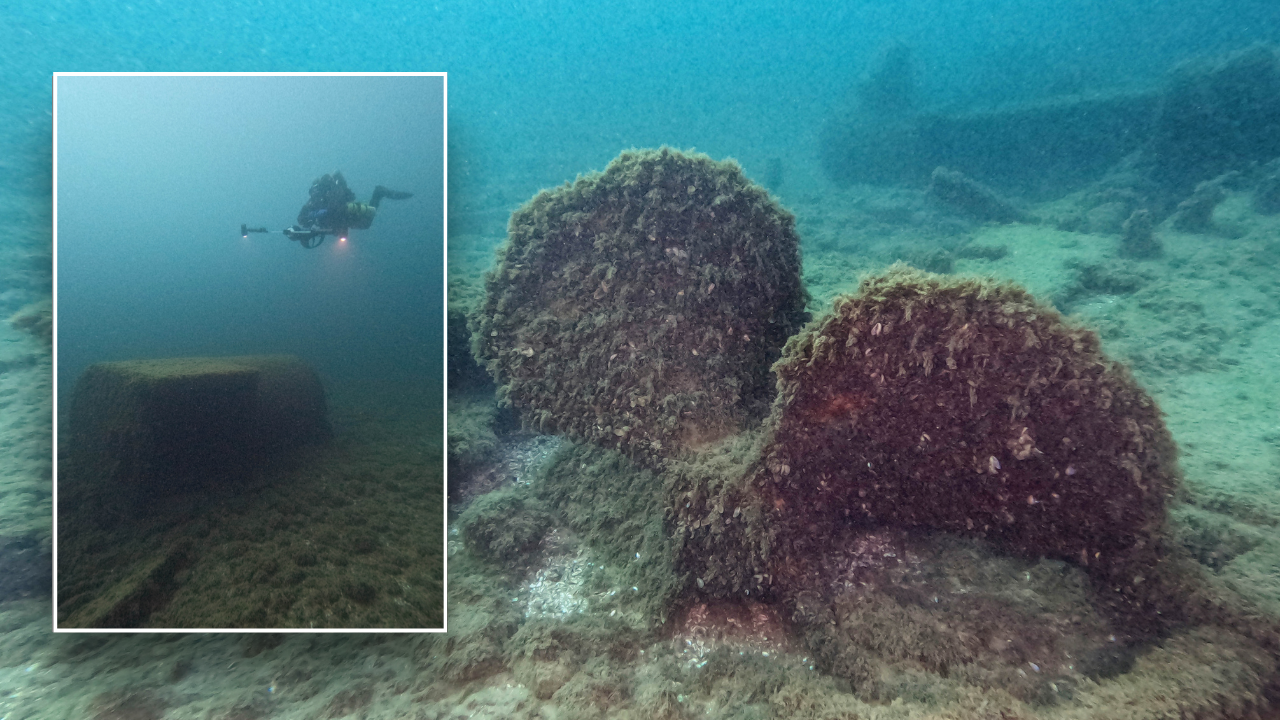
A long-lost shipwreck hidden in the depths of Lake Michigan has recently been discovered by a team of maritime experts — nearly 130 years after it sank.
The Wisconsin Historical Society (WHS) announced the discovery of the John Evenson, a tugboat built in 1884, in a Facebook post on Sept. 20. The vessel sank during an ill-fated trip in June 1895.
The WHS told Fox News Digital on Saturday that two maritime historians named Brendon Baillod and Robert Jaeck had initially discovered the shipwreck.
The two used historical newspaper accounts and sonar images that eventually led them to the shipwreck, which sat 42 feet below the surface.
WOMAN OUT FOR WALK STUMBLES UPON ONCE-IN-A-DECADE DISCOVERY
Maritime experts Brendon Baillod and Robert Jaeck recently found a long-lost shipwreck. (Wisconsin Historical Society)
Before becoming a shipwreck itself, the John Evenson was used to locate and salvage wrecked ships, in addition to towing other vessels and breaking ice.
“The ship was not a cargo ship, it was actually a tugboat,” maritime archaeologist Tamara Thomsen explained. “It would have been used to tow vessels into Sturgeon Bay, break ice or assist stranded ships.”
The WHS explained that on the fateful day, the ship was sailing after receiving some repairs when its captain “thought it would be more profitable for the tug to return to work.”
EXPERTS STUNNED AFTER CORPSE OF MEDIEVAL CATHOLIC SAINT IS UNCOVERED, FOUND IN REMARKABLE CONDITION
The John Evenson was built in 1885 before sinking in 1895. (Milwaukee Public Library)
“They waited outside the Sturgeon Bay Ship canal for the next vessel that required a tow into the canal,” the WHS described. “The steambarge I. Watson Stephenson with two barges in tow signaled for a tug.”
“The John Evenson ran out to the ship, and while attempting to take the line, crossed the Stephenson’s bow. The Stephenson was traveling fast and hit the Evenson’s stern, which swung the tug across its bow flipping it over.”
The John Evenson sank in a mere three minutes. The tugboat only carried five people in total, and four of the crew members were able to escape.
No artifacts were recovered from the John Evenson shipwreck, but extensive underwater photos were taken. (Wisconsin Historical Society)
Only one person was killed, the ship’s engineer — and his remains were found not long after.
“He washed ashore about a month later, so his remains are not associated with the site,” Thomsen told Fox News Digital.
For more Lifestyle articles, visit www.foxnews.com/lifestyle.
The recent discovery is not the first time that divers have searched for the ruined ship. The ship’s owners once tried to find it, but they abandoned their mission for insurance purposes.
“[The owners] vowed to raise and salvage their former tugboat, but they quickly ran into trouble,” the WHS explained in its Facebook post. “They had surrendered the ship as a total loss and already received the insurance payout. If the Laurie Brothers raised the tug, the insurance underwriters could claim ownership.”
The intact engine of the John Evenson was found by divers. (Wisconsin Historical Society)
“Because of this, the Evenson was left on the bottom of Lake Michigan.”
Read the full article from Here

Michigan
Whitmer says she will pull Michigan National Guard from D.C. if troops used in Trump’s Safe and Beautiful Mission

Michigan Gov. Gretchen Whitmer says that the Michigan National Guard soldiers heading to Washington, D.C., will only support the America 250 Mission and threatens to pull them if they participate in patrols under President Trump’s Safe and Beautiful Mission.
In a letter to Maj. Gen. Paul Rogers on Monday, Whitmer urges Rogers to “take all necessary measures” to ensure that soldiers only provide public safety and security during events celebrating the 250th anniversary of the United States.
“If the National Guard is unable or unwilling to ensure the Michigan National Guard is only supporting the America 250 Mission, appropriately defined – and is unable or unwilling to communicate consistent with that fact – then I will end Michigan’s support for the America 250 mission,” Whitmer wrote to Rogers.
The Safe and Beautiful Mission was created under the Trump administration to deploy the National Guard to D.C. in August 2025 as part of a push to crack down on crime in the nation’s capital, despite data showing that crime had declined in recent years.
At the time, local police data showed that violent crime in the area had been declining after a spike in 2023. However, Mr. Trump criticized that data, calling them “phony numbers.”
The deployments drew criticism from officials who opposed the federal government sending the National Guard to multiple cities. In one case, Illinois and Chicago sued the Trump administration to block the deployment of troops. That suit has since been dismissed, with a judge declaring the administration’s orders to no longer be operational.
“Several governors have deployed their National Guard soldiers to support this [Safe and Beautiful] mission. As you know, I have not deployed – and will not deploy – the Michigan National Guard to support the D.C. Safe and Beautiful Mission,” Whitmer said.
CBS News Detroit reached out to the Joint Task Force for comment on Monday and has not heard back.


What to know about PCBs and their impact on the Great Lakes, Wisconsin
PCBs are a class of more than 200 chemicals that are known to cause cancer.
An invasive shrimp is swimming in Lake Superior. This is the last Great Lake to be invaded — all five Great Lakes now are infested by the crustaceans..
Researchers for the first time have confirmed a breeding population of an invasive Black Sea-native shrimp in Lake Superior.
The number and extent of the shrimp’s spread in Lake Superior is not clear. However, there is a breeding population in the Duluth.
The findings by researchers at the University of Minnesota-Duluth, Lake Superior Research Institute at the University of Wisconsin Superior, and the Hobart and William Smith Colleges in New York, published in the Journal of Great Lakes Research in April, found that the shrimp are now reproducing and surviving year-round in the Duluth-Superior Harbor, the farthest west the European species has been confirmed.
“Samples we collected in 2025 from two locations in the Duluth-Superior Harbor, a major inland shipping port in the Great Lakes, contained juveniles, adult males, and (pregnant or with young) adult females, indicating a self-sustaining population. Additionally, we document earlier evidence from 2018 samples we collected in the harbor that contained two juvenile specimens,” the article in the Journal said.
In an interview on the CBC’s “Superior Morning” show with Mary-Jane Cormier on June 10, lead researcher Donn Branstrator, of the University of Minnesota, said studies in the Duluth-Superior Harbor this spring after ice was off the lake found adult males and females.
“It’s pretty clear evidence of overwintering,” Branstrator told Cormier. “It would be very unlikely for the population to extinguish (at this point).”
Branstrator told Cormier ongoing bi-weekly research in the harbor, and along the Lake Superior shoreline will exam those questions.
According to the research, the non-native shrimp, about a quarter to half inch long, were first detected in the lower Great Lakes in 2006 in lakes Michigan and Ontario. By 2008, they were found in lakes Huron and Erie as well.
“It has also spread to Oneida and Seneca Lakes in New York … as well as the St. Lawrence River and various canals in northern New York State,” the research said.
Branstrator said the Black and Caspian sea region natives, also have spread throughout Europe into areas they were not native. He said they likely hitchhiked with ballast or bilge water, but the exact mechanism will never be known.
What we know about bloody red shrimp.
What is a bloody red shrimp?
Bloody red shrimp are small crustaceans native to the Black Sea and Caspian Sea region of Europe. They are adapted for fresh and brackish water.
This freshwater shrimp can be ivory-yellow in color or translucent, but exhibits pigmented red pigment cells in the carapax and tail, according to the USGS.
The quarter to half inch long shrimp feed on both phytoplankton and zooplankton at various stages of life.
While relatively small, they are among the larger creatures in the Great Lakes feeding on those food sources.
“They are very large bodied, at the upper end of what we consider zooplankton,” Branstrator said.
Branstrator said the shrimp live in near-shore environments and like to hide in crevices during the day, making use of dock pilings, breakwaters and other human-made structures.
They come out at night and “swarm” together in groups of up to 135 per square foot, the University of Wisconsin Sea Grant said.
Bloody red shrimp have a lifespan of about nine months, grow to adults in just 45 days, and an produce up to four generations per year. Females have been documented to carry up to 66 eggs in a clutch. Broods carried by females in the Muskegon population ranged from two to seven.
Where have the shrimp been found?
The shrimp have spread throughout Europe and now have been found in all five Great Lakes, as well as some locations away from the lakes.
The recent study found a breeding population in the Duluth, Minnesota, harbor, the first in Lake Superior.
According to the research, the non-native shrimp, about a quarter to half inch long, were first detected in the lower Great Lakes in 2006 in lakes Michigan (near Muskegon) and Ontario. By 2008, they were found in lakes Huron and Erie as well.
A single specimen was found in Duluth in 2017, and two were found in 2018. It wasn’t until 2025 that the researchers found a sustaining population when they captured 81 individuals.
How did the shrimp arrive in the Great Lakes?
The shrimp likely hitched a ride in the ballast water of ocean-going vessels, although Branstrator noted during an interview on CBC’s “Superior Morning” that we will never know for certain.
He added that the shrimp have multiple opportunities to hitch rides with vessels during the shipping season.
What impact will the shrimp have on Lake Superior and the Great Lakes?
Branstrator said that question hasn’t been answered. They feed on the same sources as other water-dwelling creatures, but they are large enough that small fish may find them to be a new food source.
Are any shrimp native to the Great Lakes?
The opossom shrimp is a Great Lakes native and looks similar to the bloody red shrimp.

Missouri sportsbooks took $256,364,814 in wagers in May 2026, the lowest monthly handle since the market launched, yet operators posted their strongest revenue month yet at $21,250,814 on an 8.29% hold. The state collected $2,131,872 in tax. Six months after going live on December 1, 2025, Missouri has flipped the usual relationship between volume and revenue: handle keeps settling while revenue keeps climbing, because hold has risen steadily as the launch-period promotions fade. Online betting made up $252,593,427, or 98.53% of all wagers. Figures come from the Missouri Gaming Commission.
Missouri Sports Betting by Month, Since Launch
| Month | Handle | Online | Retail | GGR | Hold | State Tax |
|---|---|---|---|---|---|---|
| December 2025 | $543,039,131 | $538,881,520 | $4,157,612 | $20,758,443 | 3.82% | $521,201 |
| January 2026 | $385,138,868 | $380,412,197 | $4,726,670 | $6,703,555 | 1.74% | $137,873 |
| February 2026 | $277,005,418 | $273,285,304 | $3,720,114 | $10,301,007 | 3.72% | $1,214,627 |
| March 2026 | $329,355,588 | $324,060,170 | $5,295,418 | $20,757,550 | 6.30% | $2,178,985 |
| April 2026 | $273,397,863 | $269,884,804 | $3,513,059 | $20,284,270 | 7.42% | $2,028,427 |
| May 2026 | $256,364,814 | $252,593,427 | $3,771,387 | $21,250,814 | 8.29% | $2,131,873 |
Six Months In, Revenue Sets a Record
May marks a milestone worth pausing on. Missouri’s revenue reached its highest point yet even though its handle sank to a new low, a sign the market has moved past the giveaway-heavy launch phase and into steadier economics. Across its first six months, the state has now taken roughly $2.06 billion in total wagers, produced about $100.1 million in operator revenue, and delivered $8.2 million in tax. Crossing $100 million in cumulative revenue in half a year underlines how quickly Missouri established itself as a mid-sized market.
Handle Settles as the Launch Surge Fades
The volume side keeps normalizing. December’s $543 million opening was inflated by launch-day demand and heavy sign-up promotions, and handle has stepped down almost every month since, landing at $256.4 million in May, less than half that peak. Part of the decline is seasonal, with the sports calendar thinning as the basketball and hockey postseasons wind down and football stays months away. Part is simply the novelty wearing off. Mobile sportsbooks in Missouri continue to carry the market almost entirely, at 98.53% of May handle, a share that has held above 98% in every month since launch.
The Hold Keeps Climbing
The defining trend is the win rate. Hold ran at 3.82% in December, bottomed at 1.74% in January, then rose in four straight steps to 3.72%, 6.30%, 7.42%, and 8.29% in May. That climb is the engine behind the record revenue: as operators pull back the free bets and bonus play that suppressed early margins, more of each wagered dollar sticks. An 8.29% hold is still below the double-digit figures common in older markets, which suggests Missouri’s margin has further room to firm up as the market matures.
Compare All U.S. States
-

 Louisiana12 minutes ago
Police chief admits guilt in Louisiana visa scam; all 5 defendants have now pled guilty
-

 Maine15 minutes ago
How SCOTUS striking limits on party spending could impact Maine’s Senate race
-

 Maryland20 minutes ago
Wes Moore’s military record: what’s known, what isn’t
-

 Michigan27 minutes ago
Whitmer says she will pull Michigan National Guard from D.C. if troops used in Trump’s Safe and Beautiful Mission
-

 Massachusetts30 minutes ago
Massachusetts dad on ‘adventure of a lifetime’ left fighting for his life in Fiji after noticing bug bite
-

 Minnesota35 minutes ago
Invasive ‘bloody red shrimp’ reach Lake Superior
-

 Mississippi42 minutes ago
Mississippi Lottery Mississippi Match 5, Cash 3 results for June 30, 2026
-

 Missouri45 minutes ago
Missouri Sports Betting May 2026: $256.4M Handle, Record $21.3M Revenue

