Connect with us

News

Ukraine’s Kursk offensive has triggered doubts among Russian elite, spy chiefs say

Published

on

Ukraine’s Kursk offensive has triggered doubts among Russian elite, spy chiefs say

Watch the FT Weekend festival session here.

Ukraine’s Kursk offensive has dented Vladimir Putin’s war narrative and triggered “questions” among the Russian elite about the point of the war, two of the world’s leading spy chiefs have said.

CIA director Bill Burns said Kursk was “a significant tactical achievement” that had boosted Ukrainian morale and exposed Russia’s weaknesses. It has “raised questions . . . across the Russian elite about where is this all headed”, he said.

He was speaking at the Financial Times’ Weekend festival in London on Saturday alongside MI6 chief Richard Moore.

Moore said the Kursk offensive was “a typically audacious and bold move by the Ukrainians . . . to try and change the game” — although he cautioned it was “too early” to say how long Kyiv’s forces would be able to control the Russian territory they had seized.

Advertisement
MI6 chief Richard Moore, left, and CIA director Bill Burns speaking at the FT weekend festival on Saturday © Em Fitzgerald/FT

It is the first time the two heads have appeared together at a public event in the history of their agencies’ 77-year intelligence sharing partnership. It also represents the latest move by the US and British spy agencies to come out of the shadows to warn the countries they serve about the mounting dangers that the world faces.

The spy chiefs spoke about what they called an unprecedented range of threats to the international world order, from Putin’s war in Ukraine and Russia’s campaign of sabotage operations across Europe to the rise of China and rapid technological change.

One area of particular focus is the conflict in the Middle East.

Asked whether there was going to be a deal to release Israeli hostages held in Gaza, Burns, who has been deeply involved the negotiations, said: “This goes to a question of whether or not leaders on both sides are prepared to recognise that enough is enough, and that the time has come for them to make some hard choices and some difficult compromises.”

Burns said that, while he could not say the talks were going to be a success, “I also cannot tell you how close we are right now”. A potential deal between Israel and Hamas was “90 per cent” there and “the last 10 per cent” was always the hardest part.

Advertisement

A more detailed proposal would come in “the next several days . . . [and] my hope is that they [the Israeli and Hamas leaders] will recognise what is at stake here”.

Burns also stressed that a two-state solution was central to securing a lasting peace, as it was “crucial to offer some sense of hope for the day after, not just for Gaza, but for all Palestinians and Israelis”.

“It is a very elusive goal . . . but the only thing I would say is: show me what’s a better alternative,” he said.

Burns, 68, is a career diplomat now working as a spy, and Moore, 61, is a career intelligence officer who has previously worked as a diplomat. Both are Oxford university graduates who have led parallel professional lives working on Russian, Middle Eastern and Asian affairs.

On Russia, both men said there was no sign that Putin’s grip on power had lessened. But it would be wrong to “confuse a tight grip on power with a stable grip”, Moore said, especially as the Kursk incursion had “brought the war home to ordinary Russians”.

Advertisement

Both also said it would be wrong to take Putin’s threats of nuclear escalation lightly but that the west should not be unnecessarily intimidated. “Putin is a bully and is going to continue sabre-rattling from time to time,” Burns said.

Asked whether Iran had shipped short-range ballistic missiles to Russia, Burns said that doing so would “mark a dramatic escalation”.

Moore said that if Russia did use Iranian missiles in Ukraine, alongside the drones that Tehran had already supplied, it would be “very obvious”.

CIA director Bill Burns and MI6 chief Richard Moore
It was the first time the heads of MI6 and the CIA have appeared together at a public event in the history of their agencies’ 77-year intelligence sharing partnership © Em Fitzgerald/FT

Recent Russian sabotage operations across Europe were “reckless”, Moore said, describing Russian intelligence as “having gone a bit feral”. But “in the UK that is not new”, he added, referring to the attempted assassination of Russian double agent Sergei Skripal in Salisbury in 2018.

Asked if Russian intelligence might be conducting similar sabotage operations against the US by abetting illegal migration across the Mexico border, Burns said: “It’s something we are very sharply focused on. Part of that is a function of so many Russian agents [being] kicked out of Europe. So they are looking for somewhere to go instead.”

Despite the threat posed by Russia and the risk of conflagration in the Middle East, both Burns and Moore stressed that their biggest challenge was China’s rise.

Advertisement

Burns said the funds that the CIA devoted to China had tripled over the past three years to 20 per cent of the agency’s budget, and that he had travelled twice to China over the past year for talks to “avoid unnecessary misunderstandings”.

Moore described regular contact with his Chinese counterparts as “essential”.

Burns and Moore said one aim of their joint appearance was to underscore the strength of the UK-US relationship at a time of unprecedented global risks.

“The international world order . . . is under threat in a way we haven’t seen since the cold war,” both spy chiefs wrote in an article published on Saturday in the FT. Combating that risk “is at the very foundation of our special relationship . . . [which] can be relied upon into the next century,” they said.

The closest comparable occasion to their rare joint performance on Saturday was a news conference given by Ken McCallum, the head of British domestic intelligence MI5, and his US counterpart, Christopher Wray, the head of the FBI, in London in July 2022. 

Advertisement

News

Graham Platner makes it official in Maine, submitting paperwork to leave Senate race

Published

on

Graham Platner makes it official in Maine, submitting paperwork to leave Senate race

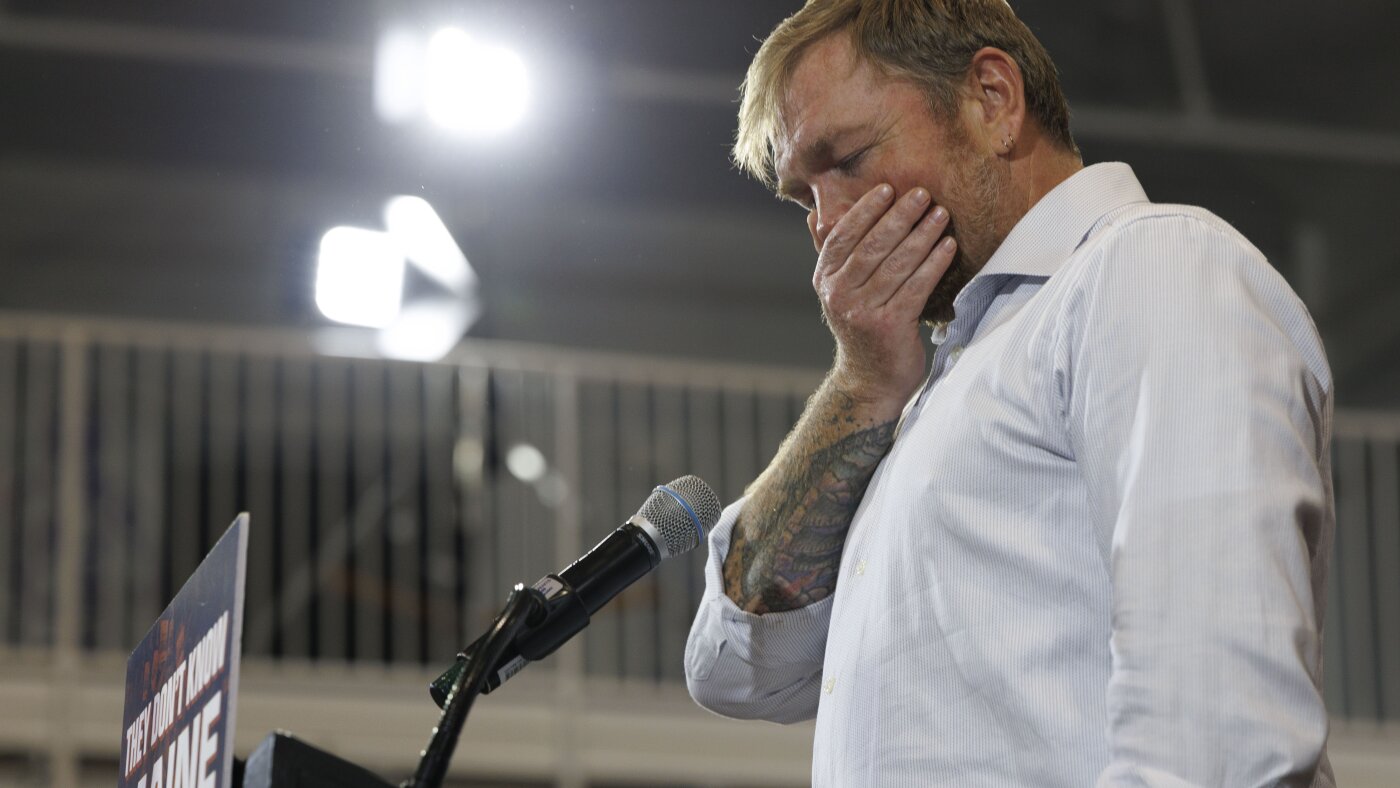
Now-former Democratic Senate candidate Graham Platner speaks at his primary election night event on June 9 in Blue Hill, Maine. Platner officially dropped out of the race July 10 following rape allegations from a former romantic partner that he denies.

CJ Gunther/Getty Images


hide caption


toggle caption

Advertisement

CJ Gunther/Getty Images

Graham Platner, Maine’s Democratic nominee for Senate, is officially out of the race.

The Maine Secretary of State said Platner filed the necessary paperwork to withdraw his candidacy two days after he announced he planned to do so following an accusation of rape by a former romantic partner. Platner denies the allegation.

The Maine Democratic Party has until July 27 to pick Platner’s replacement.

Advertisement

In his withdrawal notice, Platner said “people are desperate for change” and that’s why they voted “for a new kind of politics” by making him the Democratic nominee. He expressed gratitude for those who supported his campaign and said that he will continue to fight for “the movement we have built together and the future we believe in.”

He ended his notice with a strong statement aligned with the progressive platform.

“F*ck ICE. Free Palestine. Up the Hearts.”

Platner announced his plan to withdraw from the race in an 11-minute video he posted to social media on July 8. He said he had no choice but to suspend his campaign, citing it was no longer viable financially.

Advertisement

“We are going to lose our ability to fundraise. We are going to lose our ability to access voter data. We are going to lose all of the things that any campaign needs on the basic level simply to function,” he said.

Platner added that dropping out was not an admission of guilt. Rather, the decision, he said, is to keep the progressive movement in Maine alive to defeat Republican Sen. Susan Collins in November. Platner blamed the “political establishment” for his downfall and argued the goal was to force him out of the race.

“We built a campaign. We engaged in electoral politics. We motivated people. We banded together. We did it the way that we were told we are supposed to make change and we won. And now they are not going to let us have it. Not if it’s me,” he said.

Continue Reading

News

Waymo called the cops on teen riders, raising privacy concerns

Published

on

Waymo called the cops on teen riders, raising privacy concerns

A Waymo robotaxi drives in San Francisco’s North Beach neighborhood this week.

Heather Diehl/Getty Images


hide caption


toggle caption

Advertisement

Heather Diehl/Getty Images

Police in San Mateo, Calif., posted Monday on social media that they had apprehended a pair of teenagers from a Waymo driverless robotaxi after the company alerted authorities to suspected criminal activity. It’s the latest incident involving video surveillance of passengers and others by autonomous vehicles — raising questions about the limits of privacy in such vehicles.

The Facebook post by the San Mateo County Police said: “Parents do you know where your teens are? @waymo does!”

The 15-year-olds were allegedly drinking alcohol and shooting toy guns from the car, according to the police. They said Waymo’s systems detected behavior that then triggered a safety response, after which the company disabled the vehicle and contacted police.

Advertisement

Waymo’s cars, equipped with an array of cameras, microphones and other sensors to monitor passengers and other nearby vehicles, are becoming more common in cities across the United States. Experts say the detention of the two teens in San Mateo highlights a potential — but not inevitable — trade-off between privacy and convenience. It also questions the extent to which companies similar to Waymo are required to hand over private data, including audio and video of passengers, in situations where a crime is suspected.

NPR reached out to Waymo, which is owned by Alphabet, the parent company of Google, for comment on the details of the San Mateo incident and how the company responded, but did not hear back. But on its website, the company says that as many as 29 cameras in its autonomous cars provide an all-around view and “are designed with high dynamic range and thermal stability, to see in both daylight and low-light conditions, and tackle more complex environments.”

“There already exist laws that govern duty to report or even duty to protect” for carriers such as Waymo, according to Alessandro Acquisti, a professor of information technology at the MIT Sloan School of Management. “The privacy problems arise when and if driverless carrier companies used such laws or ethical obligations as a pretext for blanket, indiscriminate accumulation of identifiable data for unspecified future purposes.”

That includes not just monitoring people inside the cars, but outside too. Take, for example, a hit-and-run investigation last year in Los Angeles. Media reported that the police inquiry was aided by video captured by a Waymo taxi that had a clear view of the crime. Critics suggested at the time that authorities were using the company’s vehicles as a mobile surveillance platform. And during 2025 protests in Los Angeles against Immigration and Customs Enforcement crackdowns, demonstrators vandalized Waymos, apparently angry that video recorded by the vehicles could be used by police, although there is no evidence that happened.

Continue Reading

News

Trump fires last members of election commission, inciting fears of midterm ‘chaos’

Published

on

Trump fires last members of election commission, inciting fears of midterm ‘chaos’

Donald Trump has terminated the remaining members of the independent, federal commission that assists election administration officials nationwide just a few months before the midterm elections, multiple outlets reported Thursday.

The remaining three commissioners of the four-member bipartisan commission ⁠were forced out on Thursday in different ways. The one Republican appointee resigned and the other ⁠two, Democratic appointees were notified of their terminations via email from ​the White House presidential personnel office.

“On ‌behalf of President ‌Donald J Trump, I am writing to inform you that your position ‌as Commissioner of the Election Assistance Commission is terminated, effective immediately. Thank you for your service,” the email, seen by Reuters, said.

The White House did not immediately respond to a request for comment.

The Election Assistance Commission serves as a “national clearinghouse of information on election ‌administration”, accredits testing laboratories and certifies voting systems, and maintains the national mail-voter registration form developed by the National ​Voter Registration Act of 1993, according to the commission’s website. The terminations follow Trump and top administration officials’ advocacy to change vote-by-mail requirements and investigations into the 2020 election outcome, which Trump lost to Democrat Joe Biden.

Advertisement

“It is ⁠irresponsible and dangerous that this Administration remains dead set on ​causing chaos for ​our election officials across this ​country,” Arizona secretary of state Adrian Fontes said in a ​Thursday statement. “This ‌move undermines the integrity ​of nonpartisan ​election administration.”

The 2002 law that established the commission, the Help America Vote Act, states the president can appoint replacements to the commission.

It is unclear how Trump will move ahead with the commission.

Reuters contributed reporting

Advertisement
Continue Reading
Advertisement

Trending