Get the latest Boston sports news
Receive updates on your favorite Boston teams, straight from our newsroom to your inbox.

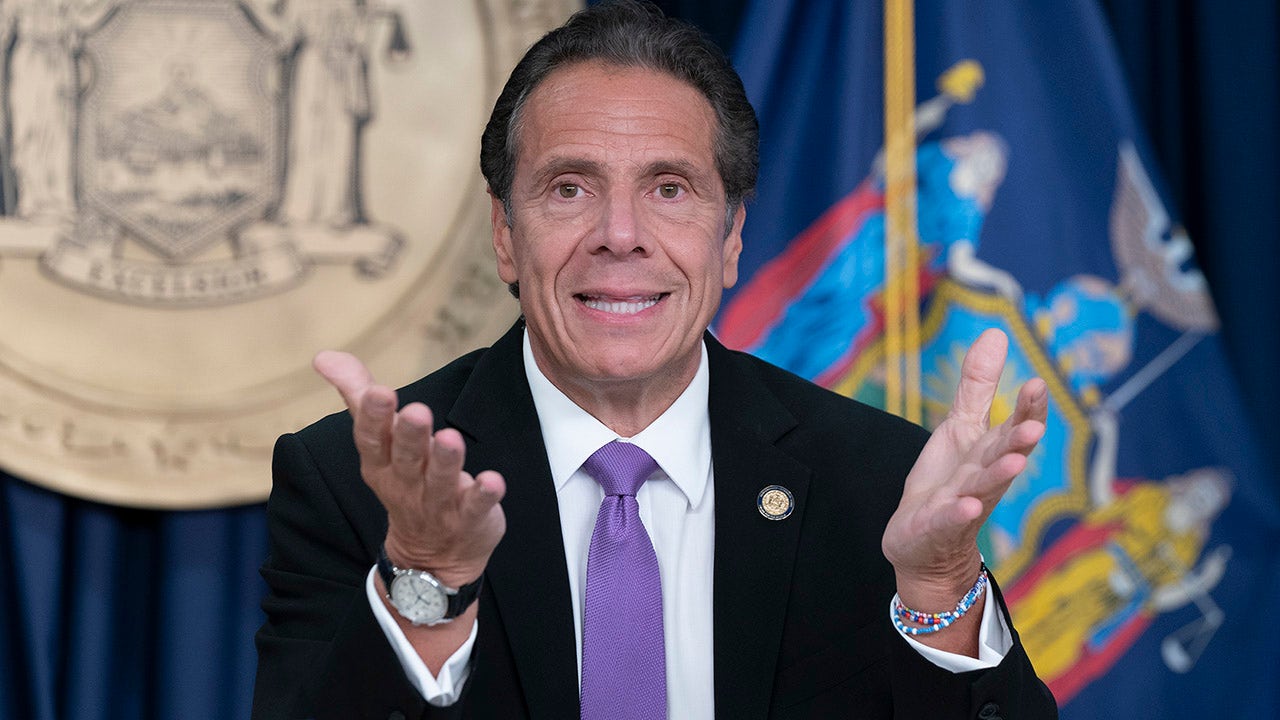
Former New York Gov. Andrew Cuomo will sit for a hearing Sept. 10 before the congressional subcommittee tasked with probing the coronavirus pandemic, the panel announced Tuesday.
Cuomo, one of the most visible governors during the height of the pandemic, was lambasted for implementing stringent social and economic restrictions throughout the Empire State.
He also was blamed for thousands of COVID-related deaths that occurred in nursing homes, which a 2023 report from the NYS Department of Health calculated to be 826 in Suffolk County, 813 in Erie County – which includes Buffalo — and 623 in Queens County.
“Mr. Cuomo will be questioned about his Administration’s issuance of unscientific guidance that forced New York nursing homes and long-term care facilities to admit COVID-19 positive patients,” an announcement for the hearing read.
CUOMO ALLEGATIONS HAVE NEW YORK DEMOCRATS GOING AFTER EACH OTHER ‘MORE THAN THE ROYAL FAMILY’: GAETZ
Former New York Gov. Andrew M. Cuomo. (Getty Images)
Cuomo, a Democrat, previously sat for a seven-hour transcribed interview with the subcommittee. The panel also interviewed Cuomo’s former secretary, Melissa DeRosa, and then-NYS Health Commissioner Dr. Howard Zucker.
Rep. Nicole Malliotakis, R-N.Y., a Staten Island lawmaker who sits on the subcommittee, said in an interview Tuesday that Cuomo still refuses to take responsibility for his orders and their repercussions.
She recounted how no one in Albany could point to exactly where the order partitioning nursing home patients came from.
“We still don’t know who approved that directive because the governor saying he didn’t know about it, he’s claiming that [Zucker] knew about it before it went out. And yet somehow they’ve been unable to identify who the person was that approved it and issued it, which is so negligent for a directive like that to go out without the health commissioner approving it at minimum,” she said.
The New York lawmaker also pointed to then-President Donald Trump dispatching a military medical ship to New York Harbor, the Jacob Javits Center, and the availability of a mental hospital in her district for the purposes of treating and partitioning serious COVID-19 patients.
“They weren’t being used. So why you have that directive in place, forcing the nursing home to take the COVID positive patients, even when you had alternatives? That was a big failure because at that point he was very clear about this directive.”
SUNUNU NAMES THE TWO GOVERNORS ALL THE OTHERS ‘HATE’
Representative Nicole Malliotakis, a Republican from New York, will be one of the lawmakers questioning former New York Gov. Andrew Cuomo next week. (Susan Walsh/AP Photo/Bloomberg via Getty Images)
When asked how people in her district feel about the situation, Malliotakis said many had lost loved ones during the pandemic from “preventable deaths.”
“They were a result of putting COVID-positive patients in nursing homes. And that was based on a directive and mandate by the Cuomo administration. And the buck stops with him, and he needs to be held accountable,” she said.
“[He blamed] everybody but himself. No apology, no accountability. No remorse… the public deserves answers, and we’re going to push for them at this hearing.”
However, a Cuomo spokesman told Fox News Digital, “the facts speak for themselves” when it comes to the former governor’s handling of COVID, calling congressional Republicans’ oversight a “master class in gaslighting.”
“New York had a lower nursing home death pro-rata than all but 11 states,” said Rich Azzopardi.
The New York Capitol building is seen, June 30, 2023, in Albany, New York. (AP Photo/Ted Shaffrey, File)
Azzopardi called the committee a “farce” and criticized it for being comprised of a “foot doctor” – referring to Chairman Brad Wenstrup, R-Ohio, — “Trump’s personal physician” – former White House doctor; current Rep. Ronny Jackson, R-Texas, and “a representative with a Ph.D. in QAnon,” in regard to Rep. Marjorie Taylor Greene, R-Ga.,
“[The committee] refuse[s] to look in the mirror at their own anti-science policies that caused hundreds of thousands of unnecessary deaths or call the one witness who is most relevant and was supposed to lead the entire effort: Donald Trump,” Azzopardi said.
While in office, Cuomo was at times questioned by the press on the matter. In one notable exchange during a July 2020 press conference, the governor was asked about a state report on nursing homes and why an independent investigator was not appointed.
“I don’t believe your characterization is correct – I believe it is a political issue,” Cuomo shot back at the reporter.
Cuomo then went on to blame the New York Post and Fox News, as well as political motivations, for the issue’s prominence.
“People died in nursing homes. That’s very unfortunate. Just on the topline, we are number 35th in the nation in percentage of deaths in nursing homes. Go talk to 34 other states first.”
Cuomo was also criticized for interviews during the pandemic with his brother, Chris, on CNN. In one exchange, the siblings shared a laugh after Chris brandished two comically-large nasal swabs to suggest Andrew has exceptionally large nostrils.
Read the full article from Here


Nearly two decades have passed since “The Wire” ended, yet Jamie Hector’s haunting turn as the drug kingpin Marlo Stanfield still resonates. Jay-Z recently referred to the character during a freestyle at the Roots Picnic.
“I respect the fact that artists find time to appreciate another artist in that way,” Mr. Hector said. “I consider the work that we do at the highest level with great art. His is literary. His is over a track, making you feel, and mine was visual.”
Mr. Hector, 50, also a director, producer and children’s book author, has devoted much of his life to the arts as one of television’s most compelling, understated figures, currently seen in Apple TV’s “Cape Fear.”
He splits his time between his family, dramatic roles, his own projects and shepherding the next generation of artists. Mr. Hector spent a recent blistering Thursday in Brooklyn with The New York Times.

Boston Red Sox
Are the Boston Red Sox back?
They’re certainly on the right track.
Boston won its seventh consecutive game Friday night, 6-2, in its series opener against the New York Mets. The victory improved its record to 44-48, which moved the club even closer to .500 on the year.
On top of that, the win was the Red Sox’ 12th in their last 14 games.
Immediately after the final out was recorded, Boston found itself 1.5 games back of the American League’s third wild-card spot.
The win was even sweeter considering the team’s severe issues they experienced in attempting to reach Citi Field.
After they were supposed to have departed Chicago at 9:45 p.m. Eastern Time on Thursday night following their series sweep of the White Sox, the Red Sox’ team plane was grounded until 3 p.m. ET on Friday. Weather delays on Thursday kept them at their gate, and then mechanical problems on Friday prolonged their stay on the tarmac well into the afternoon.
Friday’s game with the Mets was originally scheduled to begin at 7:15 p.m., but was pushed back until 7:50 due to Boston not landing at LaGuardia Airport until shortly after 4:30 p.m.
Starting pitcher Sonny Gray did not travel to New York ahead of time, which some starters do to get settled before their outing.
Nevertheless, the Red Sox de facto ace continued his stretch of utterly dominant pitching.
Gray tossed six innings of one-run ball, struck out three, and walked one on 91 pitches (53 strikes). He added an 11th win to his personal record in what has been an excellent season for the veteran right-hander.
Boston’s bullpen was nails, too — Tyron Guerrero, Garrett Whitlock, and Greg Weissert finished the game off in the final three innings after Gray exited. Weissert allowed New York’s second and final run in the ninth on a solo home run, but that was all she wrote in the runs column.
Offensively, the Red Sox’ bats stayed hot in what has been an unprecedented turnaround by the entire team at the plate.
Masataka Yoshida got things going in the first inning with a two-run double, but Boston was quiet until the seventh when Anthony Seigler broke things open. He hit a two-run homer to extend the lead, his second of the year, and was fired up as he rounded the bases.
After the game, Apple TV’s Heidi Watney asked Seigler how he had so much energy following the travel issues the team encountered earlier in the day. He said the club simply knew they would have to persevere, and they did just that on the diamond.
“I think that’s just how we are. It’s this whole team. It doesn’t just start with one person. I think it’s just everybody in the locker room,” Seigler said. “We were dealt some adversity today, obviously. But it doesn’t matter. We knew we were gonna come out here and handle our business, and we did.”
He even said he felt like he could suit up for another game immediately after the win.
“I mean, I feel like we could go another nine (innings) if we needed to, honestly, with how we’re going,” Seigler said with a smile.
Seigler, who came to Boston in the Caleb Durbin trade in February, has been a total, albeit unlikely, spark plug since joining the team last month. Through 20 games, he’s slashing .292/.378/.477 with an .855 OPS, and has hit at the top of the order.
Wilyer Abreu joined in on the fun with a two-run shot of his own in the ninth to cap the Red Sox’ scoring. He finally got a hold of one after coming within feet of hitting a homer in the fifth inning.
Boston’s offensive surge couldn’t have come at a better time. The front office has yet to decide whether they will be buyers or sellers at next month’s trade deadline; the team’s hot streak could prevent chief baseball officer Craig Breslow from blowing the roster up entering the second half.
The Red Sox are still four games below .500, but capping off the first half of what was a tumultuous start to the season with a win streak and multiple series sweeps could be just what the doctor ordered with the dog days of summer looming.
“We’re just putting great at-bats together, the whole lineup from top to bottom,” Seigler said of what’s gone right lately. “Our starter, Sonny, all of them, they just speak for themselves. And then our bullpen does a great job coming in behind them.
“It’s just fun to be around everybody. We believe in each other. Everything’s contagious. We’re all bringing high energy every day.”

Receive updates on your favorite Boston teams, straight from our newsroom to your inbox.
Get everything you need to know to start your day, delivered right to your inbox every morning.

An oversized poster board tracks the deep cleaning happening across Pittsburgh’s Mount Washington neighborhood. All of the yellow highlights denote the streets already adopted.
“We got all the streets on Grandview [Avenue] and we’re still working on a few on Duquesne.”
It’s the brain of Helen Oldfield, who told KDKA-TV that her recent move from the West Coast left something to be desired at first.
“I was very depressed and shocked by the amount of dirt and litter everywhere,” said Oldfield, creator of the Adopt-A-Block program.
She started volunteering for the large cleanups along Grandview Avenue and loved seeing people rappel down the sides to collect the accumulated trash.
“It’s the iconic street in Pittsburgh. It needs to be clean and look nice, but what about the rest of Mount Washington? When people wandered back through the streets, it was just horrible; it was a mess,” Oldfield said.
It was from that idea that Oldfield’s Adopt-a-Block program was born. Now she’s more than 60 volunteers deep and trying not to just clean but shift attitudes.
“I think a lot of the mess that accumulates up here on Grandview, unfortunately, is due to groups of young people collecting in the evening and just hanging out,” she said. “And it’s a cool place to hang out, so why not? They come with their motorbikes, and they come with their fast cars, and they drink, and they eat fast food, and then they chuck it all over the edge. I don’t believe the trash is due to any local residents or any visitors or sightseers.”
Volunteers Barbara and Paul Franklin say this is part of their life now.
“We’ve been here about a year, and we moved back to Pittsburgh after being away for 37 years, and we noticed there’s just a lot of trash out there,” Paul Franklin said.
The couple is now donning yellow safety vests, using an embroidery hoop to keep the trash bags open, and using grabbers to snag cigarette butts, cans, and even gum wrappers.
“When we do McCardle Roadway on Sunday mornings, I feel really good about that,” Barbara Franklin said.
The volunteers keep on coming, snapping pictures of themselves getting their steps in and making a difference, block by block.
“There is still a long way to go, and we are getting there, and I feel the motivation going here,” said Oldfield.
The Franklins told KDKA-TV that it’s addicting, and now they notice trash everywhere. They hope people will see this story and spread it beyond Mt. Washington.
“We’re proud of this city, we’re proud of this neighborhood, and we want to show it in its best light, and we think we’re helping to do that,” said Paul Franklin.
Oldfield said she hopes to secure some funding to continue supplying her volunteers with much-needed gear. She’s currently receiving some money from the community organization Neighbors on the Mount to purchase the vests and grabbers.
She’s soon applying for grant money in the form of a Neighborhood Economic Development grant and told KDKA-TV that she hopes the city will consider her group for the funds to keep this going.


How ‘The Wire’ Star Jamie Hector Spends a Hot Day in Brooklyn


Burglars ransack Sherman Oaks condo building during fumigation


Metro Detroit weather forecast, July 10, 2026 — 11 p.m. Update


Classical music series helps reconnect downtown San Francisco community


Dallas police officers, paramedics recall saving woman stuck in a ravine for days;


Red Sox win 7th straight game just hours after landing in New York

One tree at a time: Denver nonprofit works to close shade gap as heat dome threatens neighborhoods


VIDEO: West Seattle Summer Fest 2026 day 1, evening report

