Politics
California is racing to combat deepfakes ahead of the election

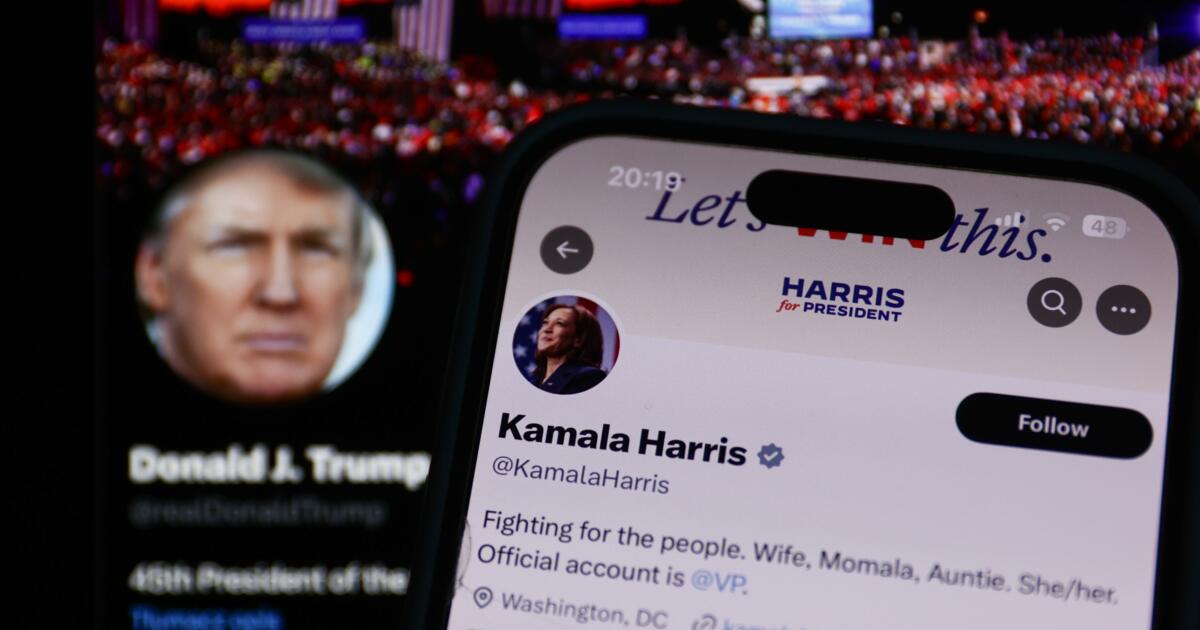
Days after Vice President Kamala Harris launched her presidential bid, a video — created with the help of artificial intelligence — went viral.
“I … am your Democrat candidate for president because Joe Biden finally exposed his senility at the debate,” a voice that sounded like Harris’ said in the fake audio track used to alter one of her campaign ads. “I was selected because I am the ultimate diversity hire.”
Billionaire Elon Musk — who has endorsed Harris’ Republican opponent, former President Trump— shared the video on X, then clarified two days later that it was actually meant as a parody. His initial tweet had 136 million views. The follow-up calling the video a parody garnered 26 million views.
To Democrats, including California Gov. Gavin Newsom, the incident was no laughing matter, fueling calls for more regulation to combat AI-generated videos with political messages and a fresh debate over the appropriate role for government in trying to contain emerging technology.
On Friday, California lawmakers gave final approval to a bill that would prohibit the distribution of deceptive campaign ads or “election communication” within 120 days of an election. Assembly Bill 2839 targets manipulated content that would harm a candidate’s reputation or electoral prospects along with confidence in an election’s outcome. It’s meant to address videos like the one Musk shared of Harris, though it includes an exception for parody and satire.
“We’re looking at California entering its first-ever election during which disinformation that’s powered by generative AI is going to pollute our information ecosystems like never before and millions of voters are not going to know what images, audio or video they can trust,” said Assemblymember Gail Pellerin (D-Santa Cruz). “So we have to do something.”
Newsom has signaled he will sign the bill, which would take effect immediately, in time for the November election.
The legislation updates a California law that bars people from distributing deceptive audio or visual media that intends to harm a candidate’s reputation or deceive a voter within 60 days of an election. State lawmakers say the law needs to be strengthened during an election cycle in which people are already flooding social media with digitally altered videos and photos known as deepfakes.
The use of deepfakes to spread misinformation has concerned lawmakers and regulators during previous election cycles. These fears increased after the release of new AI-powered tools, such as chatbots that can rapidly generate images and videos. From fake robocalls to bogus celebrity endorsement of candidates, AI-generated content is testing tech platforms and lawmakers.
Under AB 2839, a candidate, election committee or elections official could seek a court order to get deepfakes pulled down. They could also sue the person who distributed or republished the deceptive material for damages.
The legislation also applies to deceptive media posted 60 days after the election, including content that falsely portrays a voting machine, ballot, voting site or other election-related property in a way that is likely to undermine the confidence in the outcome of elections.
It doesn’t apply to satire or parody that’s labeled as such, or to broadcast stations if they inform viewers that what is depicted doesn’t accurately represent a speech or event.
Tech industry groups oppose AB 2839, along with other bills that target online platforms for not properly moderating deceptive election content or labeling AI-generated content.
“It will result in the chilling and blocking of constitutionally protected free speech,” said Carl Szabo, vice president and general counsel for NetChoice. The group’s members include Google, X and Snap as well as Facebook’s parent company, Meta, and other tech giants.
Online platforms have their own rules about manipulated media and political ads, but their policies can differ.
Unlike Meta and X, TikTok doesn’t allow political ads and says it may remove even labeled AI-generated content if it depicts a public figure such as a celebrity “when used for political or commercial endorsements.” Truth Social, a platform created by Trump, doesn’t address manipulated media in its rules about what’s not allowed on its platform.
Federal and state regulators are already cracking down on AI-generated content.
The Federal Communications Commission in May proposed a $6-million fine against Steve Kramer, a Democratic political consultant behind a robocall that used AI to impersonate President Biden’s voice. The fake call discouraged participation in New Hampshire’s Democratic presidential primary in January. Kramer, who told NBC News he planned the call to bring attention to the dangers of AI in politics, also faces criminal charges of felony voter suppression and misdemeanor impersonation of a candidate.
Szabo said current laws are enough to address concerns about election deepfakes. NetChoice has sued various states to stop some laws aimed at protecting children on social media, alleging they violate free speech protections under the 1st Amendment.
“Just creating a new law doesn’t do anything to stop the bad behavior, you actually need to enforce laws,” Szabo said.
More than two dozen states, including Washington, Arizona and Oregon, have enacted, passed or are working on legislation to regulate deepfakes, according to the consumer advocacy nonprofit Public Citizen.
In 2019, California instituted a law aimed at combating manipulated media after a video that made it appear as if House Speaker Nancy Pelosi was drunk went viral on social media. Enforcing that law has been a challenge.
“We did have to water it down,” said Assemblymember Marc Berman (D-Menlo Park), who authored the bill. “It attracted a lot of attention to the potential risks of this technology, but I was worried that it really, at the end of the day, didn’t do a lot.”
Rather than take legal action, said Danielle Citron, a professor at the University of Virginia School of Law, political candidates might choose to debunk a deepfake or even ignore it to limit its spread. By the time they could go through the court system, the content might already have gone viral.
“These laws are important because of the message they send. They teach us something,” she said, adding that they inform people who share deepfakes that there are costs.
This year, lawmakers worked with the California Initiative for Technology and Democracy, a project of the nonprofit California Common Cause, on several bills to address political deepfakes.
Some target online platforms that have been shielded under federal law from being held liable for content posted by users.
Berman introduced a bill that requires an online platform with at least 1 million California users to remove or label certain deceptive election-related content within 120 days of an election. The platforms would have to take action no later than 72 hours after a user reports the post. Under AB 2655, which passed the Legislature Wednesday, the platforms would also need procedures for identifying, removing and labeling fake content. It also doesn’t apply to parody or satire or news outlets that meet certain requirements.
Another bill, co-authored by Assemblymember Buffy Wicks (D-Oakland), requires online platforms to label AI-generated content. While NetChoice and TechNet, another industry group, oppose the bill, ChatGPT maker OpenAI is supporting AB 3211, Reuters reported.
The two bills, though, wouldn’t take effect until after the election, underscoring the challenges with passing new laws as technology advances rapidly.
“Part of my hope with introducing the bill is the attention that it creates, and hopefully the pressure that it puts on the social media platforms to behave right now,” Berman said.


President Trump is trying to use the levers of the federal government, along with personal influence over state and local lawmakers, to reshape the rules governing the 2026 midterms and future elections in extraordinary ways.
Many of these efforts have been blocked by courts, stymied by the Constitution or stopped in Congress. But the relentless assault by the president on the electoral process — both administratively and rhetorically — is likely to sow doubt and lay groundwork for extensive challenges to election results.
Agencies and officials across the federal government have, at the direction of Mr. Trump, undertaken dozens of actions grounded in novel strategies and aimed at insulating Republicans from potential losses in November. Those actions fall into six major categories (and some fall into more than one).
Taking steps to nationalize elections
The United States Constitution puts control over elections in the hands of the states and grants Congress the ability to pass federal election legislation. It gives no explicit authority to the executive branch.
But in early February, Mr. Trump said he wanted the Republican-led federal government to “nationalize” or “take over” the running of elections. “A state is an agent for the federal government in elections,” he said.
Mr. Trump had already, in March 2025, signed an executive order seeking broad authority over elections. The order required documentary proof of citizenship to register to vote and mandated the return of mail ballots by Election Day. Those were almost universally blocked by courts, which found that the order clearly violated the separation of powers and exceeded the president’s authority.
But another provision, which instructed the U.S. attorney general to hunt for and prosecute election crimes, has been used to justify sprawling efforts by the Justice Department related to elections.
The Justice Department began demanding the complete voter files — state databases of registered voters that include sensitive personal identifying information — from every state as it worked to compile the largest set of national voter roll data it has ever collected.
More than half the states — many under Democratic control but some run by Republicans, too — have resisted this effort. In response, the Justice Department has sued at least 30 states and territories, seeking to force them to turn over their unredacted voter rolls. At least 16 states have provided or indicated an intention to turn over their lists, according to tracking from the Brennan Center for Justice.
In January, Pam Bondi, then the attorney general, requested that Minnesota turn over its voter rolls to “bring back law and order” amid protests against the Trump administration’s immigration crackdown. Minnesota officials dismissed the request as “outrageous.”
Though the Justice Department has yet to win a single lawsuit — it has lost at least 10 so far, as well as one federal appeal — election officials and Democrats fear the battle over voting records may be used in a post-election effort to challenge, discredit or spread disinformation about midterm results.
Acting on the same executive order, the Department of Homeland Security has been combing voter rolls for noncitizens who have voted. It has not found evidence of widespread fraud, and a federal judge barred the administration from letting states use a federal citizenship data tool to screen their voter rolls.
In March 2026, Mr. Trump signed a second executive order regarding voting policy, this time seeking to create state-by-state lists of citizens that would be used to determine voting eligibility and restrict the use of mail ballots. It was immediately challenged by nearly half the states and multiple voting rights groups. A federal judge sided with the states’ argument, blocking key provisions of the executive order.
Before that court decision, the United States Postal Service proposed a rule that would allow the agency to refuse to deliver mail ballots in states that didn’t turn over voter rolls to the federal government. The postmaster general has said the service will abide by any court order.
Separate from the executive orders, senior Justice Department officials last year began exploring whether they could bring criminal charges against state or local election officials if the administration determined they had not sufficiently safeguarded their computer systems.
Democrats fear that the president could weaponize federal agencies on or after Election Day. Mr. Trump told The New York Times last year that he regretted not seizing voting machines after the 2020 election.
Abigail Jackson, a spokeswoman for the White House, defended the president’s actions and policies regarding elections.
“President Trump is committed to ensuring that Americans have full confidence in the administration of elections, and that includes totally accurate and up-to-date voter rolls free of errors and unlawfully registered noncitizen voters,” she said in a statement. Ms. Jackson also pointed to a few specific examples of noncitizens who were charged with illegal voting and noted other ongoing investigations. She reiterated the president’s desire to pass federal voting legislation that would enshrine many of his voting objectives into law.
“Noncitizens voting is a crime,” Ms. Jackson said. “Anyone breaking the law will be held accountable.”
Trying to tighten voting restrictions
While Mr. Trump’s attempts to use executive orders to change elections have been largely blocked by courts, the president and his allies have found other avenues to add new restrictions to voting that are designed to help them win at the ballot box.
Soon after Mr. Trump took office, the Justice Department dropped or halted all of its open voting rights lawsuits that preceded Mr. Trump’s inauguration, easing the path for partisan gerrymanders and voting laws to withstand legal scrutiny. That included dropping a lawsuit against a voting law in Georgia.
The number of lawyers working in the voting-rights arm of the Justice Department, one of the government’s critical bulwarks against civil rights abuses in voting and elections, has dwindled from about 30 at the end of the Biden administration to the single digits after resignations, cuts and reassignments.
Last year, the Trump administration joined a lawsuit filed by the Republican National Committee against Mississippi that said the state’s policy of accepting mail and absentee ballots that were postmarked by Election Day but arrived in a short period afterward violated federal election law. (Far more Democrats than Republicans vote by mail.)
On Monday, the Supreme Court upheld Mississippi’s grace period.
The president has also sought to force Congress to pass voting legislation that would codify many parts of his executive orders into federal law. The legislation, called the SAVE America Act, would, among other things, require documentary proof of citizenship to register to vote as well as photo identification to vote. It would also require states to submit their voter rolls to the Department of Homeland Security.
Republicans lack the votes to overcome a Democratic filibuster and pass the legislation, but the president has continued to pressure Republicans to force a vote, threatening not to sign any nonbudgetary bills until it is passed.
Pushing for mid-decade redistricting
Perhaps no strategy embraced by Mr. Trump was more explicitly designed to prevent a midterm loss than the mid-decade redistricting wars of the past year.
Last summer, Mr. Trump and his allies at the White House began encouraging Texas Republicans to take the rare step of redrawing their congressional maps to try to save the party’s endangered majority.
By November, forcing Republican-led states to redraw their maps was at the center of Mr. Trump’s strategy to win the midterms and prevent Democratic control of the House of Representatives.
Texas, North Carolina and Missouri quickly redrew their congressional maps, netting seven new Republican-leaning districts. Ohio redrew its map as required by state law, adding as many as two new Republican-leaning districts.
Democrats responded by introducing aggressive gerrymanders in California and Virginia, which appeared to bring the redistricting wars to a draw — until the Supreme Court weakened a key component of the Voting Rights Act in April. After the ruling, Tennessee redrew its maps to eliminate the lone Democratic-held seat in the state, and Louisiana and Alabama quickly followed with new maps that would each eliminate another Democratic-controlled district.
At the same time, the Virginia Supreme Court struck down the Democratic gerrymander in the state, effectively eliminating four new Democratic-leaning districts and handing Republicans a multi-seat structural advantage heading into the midterms.
Cutting election security
The Trump administration has gutted key elements of the nation’s election security infrastructure. Experts warn that the changes could reduce visibility into nationwide cyberattacks and foreign influence campaigns while making it more difficult for state and local election officials to coordinate defensive operations.
Early in his second term, Mr. Trump signed two directives that administration officials have used to justify the dismantling of these programs.
The administration has weakened the Cybersecurity and Infrastructure Security Agency, terminated an F.B.I. task force aimed at combatting foreign influence in U.S. elections and ended a program responsible for sharing threat intelligence with state and local officials.
The actions are rooted in longstanding grievances from Mr. Trump and his allies, who have argued that, under the guise of fighting misinformation and disinformation, the Biden administration infringed on free speech.
In his first budget request to Congress, Mr. Trump proposed eliminating CISA’s disinformation offices, accusing them of “conspiring against the First Amendment rights of President Trump and his supporters.”
Mr. Trump’s attacks on CISA also reflect his animosity toward Christopher Krebs, the agency’s former director who oversaw efforts to secure the 2020 election and infuriated Mr. Trump by publicly debunking his lies about that election.
Undermining faith in the electoral system by questioning previous results
Mr. Trump refuses to concede that he lost the 2020 election and has used the White House to both legitimize and seek evidence supporting his debunked conspiracy theories.
On his first day back in office, he granted clemency to the nearly 1,600 people charged in connection with the attack on the Capitol on Jan. 6, 2021. Later, he introduced a page on the White House website falsely accusing Democrats of promoting a “gaslighting narrative” in their efforts to certify the “stolen election.”
Mr. Trump also ordered Tulsi Gabbard, then the director of national intelligence, to help manage an F.B.I. investigation of his baseless claims of voting irregularities in Fulton County, Ga. The move came after a team led by Ms. Gabbard seized voting machines from Puerto Rico to examine them for vulnerabilities.
The administration has also issued subpoenas for 2020 election records in Maricopa County, Ariz.; requested access to voting equipment used in Missouri; and, based on disproven allegations about the 2020 election, demanded 2024 election records from Wayne County, Mich. Last month, the top federal prosecutor in Los Angeles broke with decades of precedent in predicting election fraud charges related to California’s primary races while votes were still being counted.
In May, the Justice Department announced it was setting up a $1.8 billion fund to compensate people who claimed to be victims of government “weaponization,” which would most likely include people who stormed the Capitol in 2021. Todd Blanche, the acting attorney general, said on June 2 that the fund would not move forward, but Mr. Trump later said he still loved the idea.
Mr. Trump has stocked his second administration with people who are sympathetic to his denial of the 2020 election results. These officials have been put into positions where they could play a role in undermining this year’s and future elections.
Where Trump has installed election deniers in government
Punishing those who have worked against election denialism
While Mr. Trump has long used grievance as a political tool, retribution against his perceived enemies has become a centerpiece of his second administration. Much of that retribution has targeted anyone who has investigated the Jan. 6 attack or pushed back on his 2020 election denial.
Within hours of retaking office, Mr. Trump signed an executive order asserting that the Biden administration had engaged “in a systematic campaign against its perceived political opponents” and directing federal agencies to seek evidence that it did so.
The administration has purged F.B.I. agents and government attorneys who worked on investigations of Mr. Trump or his allies, revoked security clearances from dozens of people as punishment for alleged misconduct and opened investigations into Mr. Trump’s supposed “enemies.”
It has also sought to target ordinary citizens. In April, the Justice Department issued a federal grand jury subpoena demanding the identities of every person who worked on the 2020 election in Fulton County, Ga. The county’s motion to block the subpoena characterized it as intended “to target, harass and punish the president’s perceived political opponents.” The effort remains tied up in the courts.
As the only president in United States history to seek to overturn an election result, Mr. Trump has spent years using social media and campaign rallies to sow doubt about the integrity of U.S. elections. He continues to do so, but now he also wields the authority to direct his cabinet secretaries and other political appointees to implement his agenda. All of Mr. Trump’s directives underlying the above agency actions are based on several debunked election-related conspiracy theories, including:
His claim that undocumented immigrants vote illegally in large numbers.
“They want illegal immigrants to come in, criminals, doesn’t matter because they want to get their votes.”
— Republican fundraiser, March 25, 2026
His spreading of debunked claims of widespread fraud related to mail-in ballots …
“Mail-in ballots are corrupt. Mail-in ballots, you can never have a real democracy with mail-in ballots.”
— White House remarks, Aug. 18, 2025
… and voting machines.
“I am going to lead a movement to get rid of MAIL-IN BALLOTS, and also, while we’re at it, Highly ‘Inaccurate,’ Very Expensive, and Seriously Controversial VOTING MACHINES, which cost Ten Times more than accurate and sophisticated Watermark Paper, which is faster, and leaves NO DOUBT, at the end of the evening, as to who WON, and who LOST, the Election.”
— Truth Social post, Aug. 18, 2025
Broader unsubstantiated claims he has made of widespread voting fraud that include people voting multiple times or assuming dead people’s identities to vote.
“Every day you read in the papers about more and more fraud that’s discovered.”
— White House remarks, April 9, 2025
And finally, his belief in a “deep state” embedded in the government that has worked against him and other Republicans.
“We’re going to find the deep-state actors who have buried into government, fire them and escort them from federal buildings.”
— Campaign rally, Jan. 28, 2023
While many of Mr. Trump’s directives have been blocked or delayed by the courts, election experts say that their potential harm remains significant, and that some of the efforts have already eroded faith in the process.
“The point of so much of this campaign is not actually to change policy because they know they don’t actually have the authority to change policy,” said Sean Morales-Doyle, director of the Brennan Center’s Voting Rights and Elections Program. “It’s to inject distrust and confusion into our elections, both to discourage people from participating and to lay the groundwork for calling elections into question after the fact.”

NEWYou can now listen to Fox News articles!
The Trump administration is set to unveil a sweeping overhaul of federal appliance efficiency rules that officials say will end “Green New Scam” appliance mandates, restore consumer choice, and block future federal crackdowns on gas stoves, fluorescent lightbulbs, HVAC systems, and other household appliances.
“In America, you should be able to choose between a drying machine that takes multiple cycles to dry your clothes and one that does it on the first try — unfortunately, past administrations thought otherwise,” Department of Energy Secretary Chris Wright told Fox News Digital.
The Department of Energy is expected to propose a sweeping rewrite of federal appliance regulations that would change how energy-efficiency standards are written, creating what the Trump administration says is a permanent safeguard against future efforts to regulate household appliances. The proposal was viewed by Fox News Digital.
TRUMP ADMIN AXES TIES TO DOZENS OF PROGRESSIVE GROUPS IN ‘DIRECT OPPOSITION’ TO MISSION: ‘DECISIVE ACTION’
The Trump administration plans a sweeping overhaul of federal appliance efficiency rules. (Adobe Stock)
“For too long, the American people paid the price for mandates that restricted consumer choice and drove up costs. President Trump promised to end this nonsense and that is exactly what we are doing. This proposed rule will preserve the American people’s ability to choose home appliances and equipment that actually work — at prices they can afford. It’s called commonsense.”
Officials said previous Obama and Biden administrations interpreted Energy Policy and Conservation Act (EPCA) standards as requiring increasingly stringent efficiency standards that made some appliances more expensive or less functional.
Biden-era changes in 2021 and 2024 that loosened the Trump administration’s 2020 rules by making the procedures non-binding and removing several provisions, including a significant energy savings threshold and other procedural requirements.
FAMOUS LANDMARKS SLASH VISITING HOURS AS DEADLY HEAT WAVE THREATENS TOURISTS
Energy Secretary Chris Wright says past mandates drove up consumer costs. (Jakub Porzycki/NurPhoto via Getty Images)
The proposal is open for public comment for 30 days before being made an official rule. It comes as the U.S. and Europe face a major heat wave.
Paris Deputy Mayor Audrey Pulvar recently released a statement blaming the United States for the deadly heat wave over France by saying the issue is climate change – not the lack of air conditioning in Europe.
“Dear American journalists and social media ‘influencers’: for days, some of you have been criticizing and making fun of Paris because the city does not have A/C in every room. OMG, this is so rich!” she wrote on Instagram.
BIDEN-HARRIS STILL HATE YOUR GAS STOVE, YOU WON’T BELIEVE HOW MUCH
People cool off in the Trocadero Fountain next to the Eiffel Tower in Paris as temperatures rise during a heatwave affecting a large part of France. (Abdul Saboor/Reuters)
Due to regulations, only 20% of households have air conditioning compared to 88% in the U.S., according to the U.S. Energy Information Administration.
CLICK HERE TO DOWNLOAD THE FOX NEWS APP
She added, “As the second-largest emitter of greenhouse gas emissions in the world, you bear a significant amount of responsibility for global warming and the consequences we, in France, are experiencing. Your cities ‘90% air-conditioned’ are not unrelated to this. In Paris, we take responsibility.”
Fox News Digital’s Lindsay Kornick contributed to this report.

WASHINGTON — As America’s 250th birthday arrives this weekend, President Trump’s mark is clearly visible on Washington.
Visitors to the nation’s capital are being met with cranes hanging over the White House and construction at the site of the demolished East Wing. Fences crisscrossing the National Mall to hem in the Great American State Fair have blocked the famed sightline from the U.S. Capitol to the Washington Monument to the Lincoln Memorial.
Some fountains newly sparkle as a result of Trump’s renovations. National Guardsmen patrol the sidewalks. The partisan flavor of the Trump-aligned Freedom 250 organization’s events is on display, and the fireworks show Saturday will feature a rally-style speech from Trump, with fireworks reportedly pushed back to 11 p.m.
President Trump examines the maintenance work Wednesday on the exterior of the White House.
(Alex Wong / Getty Images)
The memorial’s Reflecting Pool, where fireworks will be set off Saturday, was barricaded from the public earlier than usual after onlookers flocked last week to see the algae and peeling paint that followed Trump’s renovation, and Trump accused vandals of tampering with it.
“You don’t have a sense of ‘land of the free’ here,” said Melissa McFarlane, 61, standing along the fencing on the Mall. She said she was born in Silver Spring, Md., and she grew up watching July 4 fireworks on the Mall with her parents.
She recalled the nation’s 200th anniversary celebrations as “open and inviting” but said this year’s “heavy-duty fencing” and the presence of National Guardsmen made it feel different.
“It’s majorly disorganized, which is weird for our country,” McFarlane added.

A sign outside Lafayette Park near the White House.
(Julia Demaree Nikhinson / Associated Press)
Trump has fixated on making changes to the nation’s capital in his second term, declaring in an early executive order that his administration would make the district “safe and beautiful.” Some of the renovations have been successful; fountains are running anew, including the long-dormant cascading water feature at the city’s popular Meridian Hill Park.
Interior Secretary Doug Burgum said Sunday on “Fox & Friends” that more than 50 parks and circles have been restored and 22 fountains, along with repairs to lights on the National Mall.
“President Trump should be thanked for all he is doing to leave things better than he found them for the good of our great nation,” an Interior Department spokesperson said in a statement. “D.C. residents and visitors are experiencing working fountains, clean parks and safe streets across the district for the first time in decades, all thanks to President Donald J. Trump.”
But Trump’s growing slate of projects has drawn legal challenges from preservationist groups and raised questions about the cost to taxpayers. The $14.7-million repainting of the Reflecting Pool became particularly controversial last month after algae overtook the renovated pool and the new paint appeared to peel off.
On Sunday, the president took a tour of some of his construction sites, walking through Lafayette Park with Burgum before traveling to the East Potomac golf club he plans to renovate, which sits on federal land. Trump walked part of the property and inspected blueprints in view of reporters; he was then driven by the site where he wants to erect a marble arch.
Over the weekend, he posted on Truth Social about his improvements to the city in a post about D.C. mayoral candidate Janeese Lewis George, casting it as a “Safe and Prestigious Community” that is now at risk of being “destroyed” by Lewis George.
“I have worked too hard to make Washington, D.C., the Envy of the World, with almost No Crime, and a Beautification process that has been second to none,” Trump wrote.

Construction crews build scaffolding outside the Kennedy Center on June 13 before removing President Trump’s name from the venue’s exterior.
(Tasos Katopodis / Getty Images)
Involvement by presidents in the city’s plan goes back to George Washington, said Matthew J. Bell, an architecture professor at the University of Maryland. That is not unusual, nor is it strange for cities, including Washington, to change over time, he said.
“It’s probably more a matter of timing in terms of inconvenience for people coming for the Fourth,” Bell said of the ongoing construction. “If there had been a more coordinated plan for some of these things … it probably could’ve been managed better.”
At the National Mall, the fencing design for the state fair drew head shakes and confusion from some tourists. Visitors are corralled into a walkway by the Freedom 250-branded fencing on one side and low metal barriers on the other.
It’s normal for fencing to be used to control foot traffic for events on the mall, said Charles A. Birnbaum, chief executive of the Cultural Landscape Foundation, but he perceived the problem as slapdash placement, including of the Ferris wheel, which was put on the mall’s axis.
“Things are being plopped down,” said Birnbaum, whose organization sued the administration over the repainting of the Reflecting Pool. “It speaks to what Trump is doing at the ballroom, what he’s proposed [with] the arch — he’s just plopping these things down in major view sheds that have major historical and cultural significance.”

People walk past the Ferris wheel at the Great American State Fair on the National Mall.
(Jen Golbeck / Associated Press)

The fountains in Lafayette Park are running again near the White House on June 23.
(Andrew Harnik / Getty Images)
The state fair itself has drawn relatively few crowds, though some attendees have been enthusiastic.
On Monday, McFarlane and two friends were outside the fencing, leaning against the metal barriers in front of the Department of Agriculture, which faces the National Mall.
“It’s a little too secure,” said one of them, John, 60, who was visiting from Burbank and declined to give his last name.
He gestured over the barrier to a manicured plot with shady benches. “Here’s the People’s Garden,” he said, reading its sign, “and we can’t go in.”
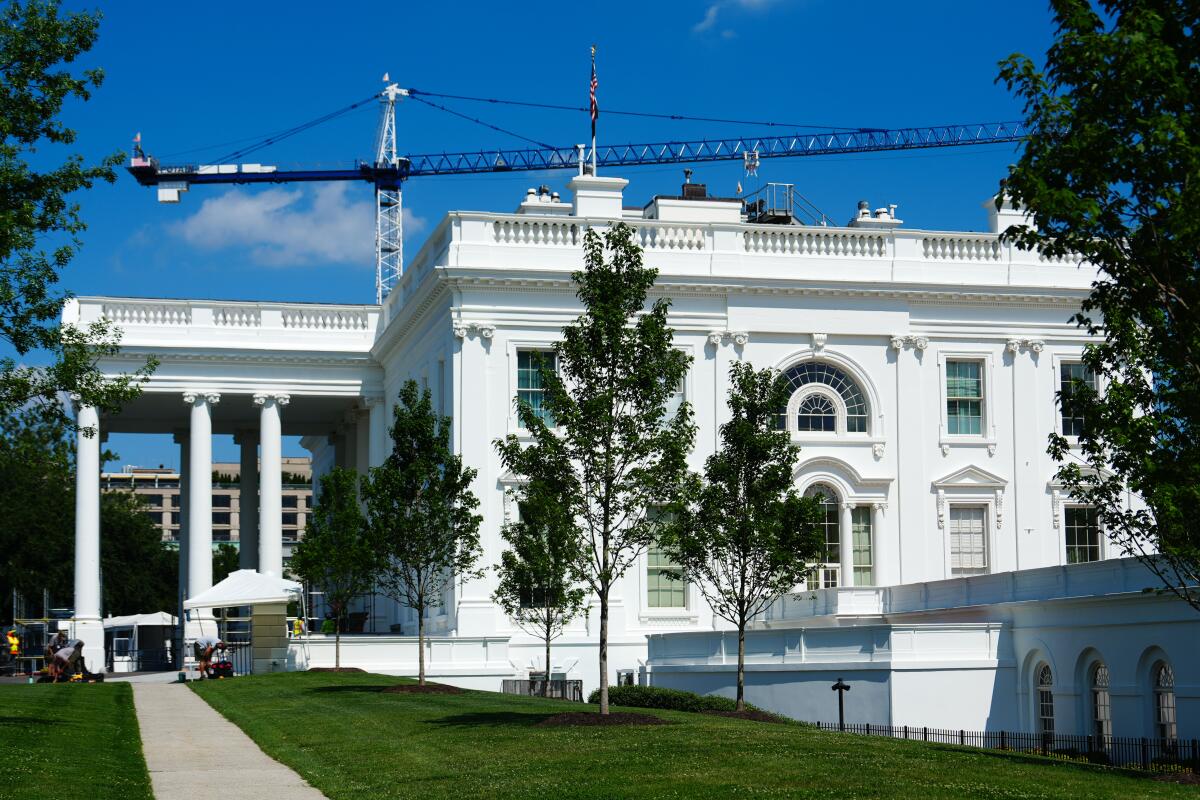
A construction crane works on the White House ballroom on Monday.
(Julia Demaree Nikhinson / Associated Press)
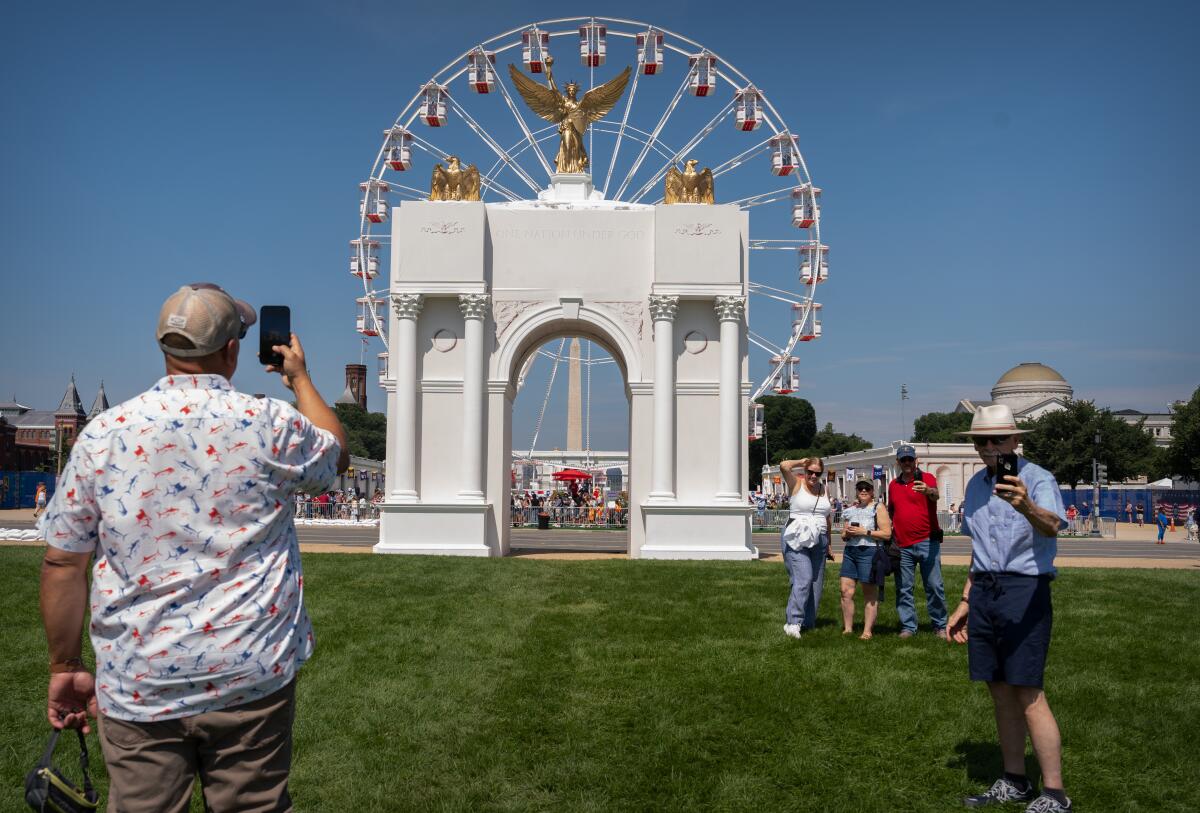
Visitors take photos Tuesday of a model of President Trump’s proposed marble arch at the Great American State Fair on the National Mall.
(Mark Schiefelbein / Associated Press)

Early-morning joggers observer the refilling of the Lincoln Memorial Reflecting Pool on June 5.
(John McDonnell / Associated Press)
The anniversary celebrations also come on the heels of the reflecting pool controversy. Last week, after chunks of paint were spotted in the water, Trump blamed vandals for tampering with the pool and said people had been arrested at the site. Two dead ducks were found in a pond about 250 feet away from the pool.
The area last week was surrounded by surveillance cameras and patrolled by National Guardsmen as lifelong resident John Cates strolled the area.
“It’s kind of creepy,” Cates said about the security cameras mounted around the pool. “It is unnecessary that we have to have this pond deemed a high security risk. That is weird.”
The area was fenced off at the end of last week. Fencing normally occurs in preparation for the July 4 fireworks show, but it went up “a couple days early to protect the pool,” Burgum said in the Fox News interview. He said seven people had been arrested in connection with the pool.
Tom Ayers, 34, was disappointed to find the fences already up on Monday. He traveled with his father from Wisconsin for the 250th, but they were finding it difficult to get around the Mall and they were upset to see the East Wing gone.
When they reached Lafayette Park, where the fencing had yet to be removed, they were again disappointed by the obscured view of the White House. Ayers’ father recalled a different scene in 1976, when he visited as a child for the nation’s bicentennial.
“I was kind of hoping for a summer similar to that,” Ayers said, “but overall, it seems nowhere close.”
Times staff writer Ana Ceballos in Washington contributed to this report.
-

 California8 seconds ago
What’s open, closed for Independence Day weekend in California?
-

 Colorado7 minutes ago
MAP: Where Colorado wildfires are burning
-

 Connecticut10 minutes ago
Local priest dies after crashing car into tree in West Hartford, police say
-

 Delaware15 minutes ago
County councilman says Newark data center plan paused after deal
-

 Florida22 minutes ago
Outrage over ‘cruel’ Florida move to ban undocumented students from college
-

 Georgia25 minutes ago
Georgia officials urge drivers to add emergency contact to license record
-

 Hawaii30 minutes ago
Concert in the Sky anchors Kauai’s July Fourth mix of celebration and care | Honolulu Star-Advertiser
-

 Illinois40 minutes ago
Prevent plant claims likely in soaked southeastern Illinois – Brownfield Ag News

