Entertainment
Gena Rowlands, the unsung lady of independent cinema and wife of late director John Cassavetes, has died

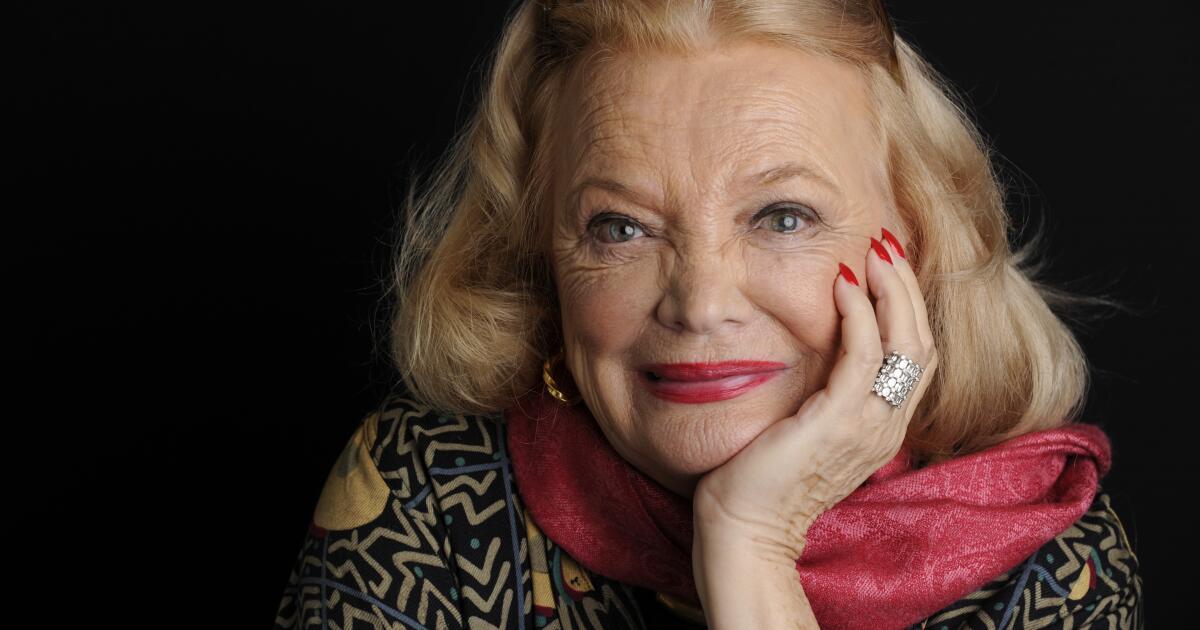
Award-winning actor Gena Rowlands, whose appearances in “A Woman Under the Influence,” “Gloria” and “The Notebook” were among her many celebrated collaborations with her late husband, John Cassavetes, and their son, Nick, died Wednesday at her home in Indian Wells after a years-long battle with Alzheimer’s disease. She was 94.
Rowland’s death was confirmed by the office of Danny Greenberg, Nick Cassavetes’ agent at WME. No other details are available at this time.
An often unsung actor of quality and consummate talent, Rowlands earned glowing reviews for her film and TV work — which spanned six decades — especially the projects she worked on with her husband — earning Oscar nominations for her leading roles in his acclaimed 1974 drama “A Woman Under the Influence” and the 1980 crime thriller “Gloria” — and two films directed by her son, “Unhook the Stars” and “The Notebook.”
Rowlands embodied tough cookies, glamour girls and grandes dames, with suburban housewives in between. She shifted easily between John Cassavetes’ shoot-from-the-hip style of filmmaking and the tightly controlled world of network television.
“What’s great about being an actress is you don’t just live one life, you live many lives,” Rowlands said on accepting her honorary Oscar in 2015. “You are not just stuck with yourself all of your life.”
Toward the end of her life, Rowlands battled Alzheimer’s disease and its characteristic dementia. In June 2024, while commemorating the 20th anniversary of “The Notebook,” Nick Cassavetes revealed his mother’s illness.
“For the last five years, she’s had Alzheimer’s,” he said at the time, adding, “She’s in full dementia.”
Despite a lengthy string of widely praised performances, Rowlands never became a superstar and never appeared — and, perhaps, never wished to have appeared — in a blockbuster film. Just the same, many critics and contemporaries regarded her as one of the era’s finest actors.
“I really think she’s the finest film actress of her generation or any other generation,” director Arthur Allan Seidelman told The Times in 2014. “Every moment she gives you is totally truthful and comes from insight into a character. She has the ability of really putting herself in that character.”
Not surprisingly, her career was entwined with the work of her husband, whom she met at the American Academy of Dramatic Arts in New York in 1951 and married three years later. Their decades-long union yielded 10 films and three children before John Cassavetes’ death in 1989.
“When I met John, I didn’t know whether he was actually taken by me or the red velvet strapless dress I was wearing,” she told The Times in 1996. “But from there, we went on to have 31 fantastic years, three children, a wonderful working relationship. We lived the way we wanted to.”
Rowlands and Cassavetes teamed up for the first time in 1955’s “Time for Love,” she playing a humble small-town girl, he a traveling salesman who sweeps her off her feet. In another appearance with Cassavetes, “Won’t It Ever Be Morning?” she portrays a jazz singer who finds herself on the witness stand when her devoted manager is wrongly accused of murder.
As a ranking member of Cassavetes’ informal company of actors, which included Peter Falk, Ben Gazzara and Seymour Cassel, Rowlands often was the face of her husband’s films at a time when many roles for women were reserved for blond bombshells.
Together they were hailed as independent-cinema royalty, operating outside the controlling and predictable studio system. The couple mortgaged their Hollywood Hills home again and again to finance his films, she said, in an effort to remain independent from the tight reins of Hollywood.
After Cassavetes died in 1989, at age 59, her son asked his mother to star in a film he was making, 1996’s “Unhook the Stars,” in which she played a middle-aged woman finally free of her family obligations.
Her late husband “wrote wonderful parts for women, and of course, I got them,” she told The Times at the time. “So it is very emotional and satisfying to have a son who puts a script in my lap and says, ‘Mother, let’s make this movie.’”
“Mom was hip,” Nick Cassavetes wrote in a 2000 piece for the L.A. Times Magazine. “God, she was beautiful. With her skinny little legs and her Ungaro outfits and the big Jackie O sunglasses. And the hair. Dad used to call her ‘Golden Girl.’”
Born Virginia Cathryn Rowlands in Madison, Wis., on June 19, 1930, the actor was the daughter of Edwin Rowlands, a Wisconsin state senator, and Mary Allen Neal, a homemaker. Her older brother, David Rowlands, also was an actor. Later in life, her mother launched a stage career using the name Lady Rowlands.
Rowlands attended the University of Wisconsin before moving to New York City to study drama. She met John Cassavetes after an audition for the American Academy at Carnegie Hall.
She also worked in repertory theater and made her Broadway debut opposite Edward G. Robinson in “Middle of the Night” in 1956. She made her big-screen debut in Jose Ferrer’s 1958 drama “The High Cost of Loving.”
Reading is what initially drew Rowlands to the dramatic arts. She was a sickly child and used her idle time to read voraciously. The lives of the characters she read about made her want to act. She found such a character in Mabel Longhetti, the increasingly erratic housewife in “A Woman Under the Influence” who struggles to hang onto her delicate mental equilibrium.
The drama is considered by many to be the greatest triumph of the Cassavetes-Rowlands collaborations, and it earned Oscar nominations for both.
“It was sort of a difficult role,” Rowlands said. “But I like difficult roles.”
Though she was forever associated with the Cassavetes projects — “Faces” and “Love Streams” among them — she worked with other directors as well, including Woody Allen in “Another Women,” and on various TV projects, such as “An Early Frost” and “The Betty Ford Story,” for which she won an Emmy. She also won Emmys for “Face of a Stranger” and “Hysterical Blindness.”
She won a Daytime Emmy for her role in “The Incredible Mrs. Ritchie.” In 2007, she appeared in “Broken English,” an independent film directed by her daughter Zoe Cassavetes.
The opportunity to play embattled First Lady Betty Ford in the 1987 TV movie also offered Rowlands the type of challenge she appreciated. “I like to play people who have a very strong emotional commitment to something,” she told The Times in 1987.
Rowlands won an honorary lifetime achievement Oscar in 2015. Her son presented her with the award. The Los Angeles Film Critics Assn. honored her with a career achievement award the next year.
Rowlands also endeared herself to a new generation of fans with her brief appearance in “The Notebook,” her son’s 2004 adaptation of the weepy Nicholas Sparks love story starring Rachel McAdams and Ryan Gosling.
“I didn’t think it would have that kind of impact,” Rowlands said of the film in a 2016 Variety interview. “I think it was such a big hit because it was about the realization that love can last your whole life. You don’t see it depicted that way a lot. In most films you don’t get to see a story like that go from the beginning to the end with the possibility that love can be, perhaps, eternal.”
Besides her son, Rowlands is survived by second husband Robert Forrest, daughters Alexandra and Zoe and several grandchildren. Her brother, David Rowlands, died in 2000.

Movie Reviews
Movie Review: ‘Minions & Monsters’ is a very yellow mash note to Hollywood – Sentinel Colorado

-

This image released by Universal Pictures shows a scene from Illumination’s “Minions & Monsters.” (Universal Pictures via AP) -

This image released by Universal Pictures shows minions with the alien character Goomi, voiced by Trey Parker, right, in a scene from Illumination’s “Minions & Monsters.” (Universal Pictures via AP) -

This image released by Universal Pictures shows minion Henry, voiced by Pierre Coffin, left, and Goomi, voiced by Trey Parker, in a scene from Illumination’s “Minions & Monsters.” (Universal Pictures via AP) -

This image released by Universal Pictures shows a scene from Illumination’s “Minions & Monsters.” (Universal Pictures via AP)
Every once in a while, Hollywood gets high on its own supply and makes a love letter to moviemaking. It happened recently with Steven Spielberg’s “The Fabelmans” and George Clooney’s “Jay Kelly.” Now it’s time for the unlikeliest of love-letter writers: canary-yellow, gibberish-speaking, overall-wearing mini-monsters.
“Minions & Monsters” — the third chapter in the ongoing standalone adventures of the “Despicable Me” pint-sized enablers — is about the sheer greatness of moviemaking, and it’s a navel-gazing misfire. Few industries — maybe journalism, sure — is as enamored at making its profession seem heroic.
The Minions this time find themselves at the dawn of both the movie business in Hollywood and the last push by suffragists to get the vote. It’s a weird confluence that writers Brian Lynch and Pierre Coffin fumble.
The movie has playful references to old screen gods — Harold Lloyd dangling from the hands of a clock and Charlie Chaplin swallowed by the gears of a mechanical system — along Hollywood nods to “Casablanca” and the punny title “The Good, the Bad and the Stupid” — but the kids in the audience won’t get them and their parents are just too tired. Harold Lloyd jokes don’t hit as hard in 2026.
Two of the legion of faceless Minions step forward this time — best friends James and Henry, creative misfits amid a smear of yellow drones — to unite and make a movie. (Who knew there was a Minion counterculture?)
Things go very well at first — turns out adding a Minion or two to a cowboy or a heist movie makes them instant kings of the box office — and they soon move into a Beverly Hills mansion and become insufferable. James dreams of winning an Oscar, which in this case is a statuette of a gold banana, a Minion obsession.
But they hit a wall when silent movies turn to talkies. And since they spout nothing but nonsense — “Fantastico” “miso soup” and “vamos” — can’t make the transition. They’re dumped out of the studio system.
That’s when James and Henry finally get the plot going: Make their own killer monster movie by conjuring up real monsters. The first one they try turns out a little weird: The gigantic, fearsome octopus-dragon they request turns out to be a cute green Funko Pop-like critter called Goomi, voiced by Trey Parker. Goomi promises to find them some real monsters. But should we trust him?
Coffin, making his first solo directing effort after co-helming all three “Despicable Me” films and the first “Minions,” voices all the Minions — he must be fun to have at parties — and is an assured hand. The violence levels are a little high for PG, including a beheading and various impalings, plus the usual senseless mayhem.
The screenwriters have included a romantic subplot involving a suffragette voiced by Zoey Deutch who falls for a robot-alien (standout work by Jesse Eisenberg) in a storyline that makes less and less sense. And the framing device — a museum tour guide explaining how Minions shaped Hollywood — sags awkwardly.
Adults can keep awake looking for the Easter eggs Coffin has left for serious cinephiles: “20,000 Leagues Under the Sea,” “Steamboat Bill, Jr.,” “A Trip to the Moon,” “Metropolis,” “Citizen Kane” and “The Blob.” Maybe the best moment in the movie is almost a throwaway: Director George Lucas, appearing as himself.
“Hooray for Hollywood” is on the soundtrack and that might have been the subtitle for the movie itself. There are some people whose eyes get moist thinking about picking up a film camera and following their muse, having their work play in a dark theater to cheers. And then there are others who just want to get on with it already. “Vamos!”
“Minions & Monsters,” a Universal Pictures release that opens in theaters July 1, is rated PG by the Motion Picture Association for “violence/action, language, and rude/macabre humor.” Running time: 90 minutes. One and a half stars out of four.
Related
NEW YORK — Manhattan was sweltering at 100 degrees and preparing to mark 250 years since the United States declared independence from Great Britain.
But on Friday, the city seemed transfixed by what might be the closest the country gets to a royal wedding: The nuptials of pop superstar Taylor Swift and Kansas City Chiefs tight end Travis Kelce.
The two were married Friday night, but the party is expected to continue into the morning. Swift’s publicist confirmed the marriage to several news organizations.
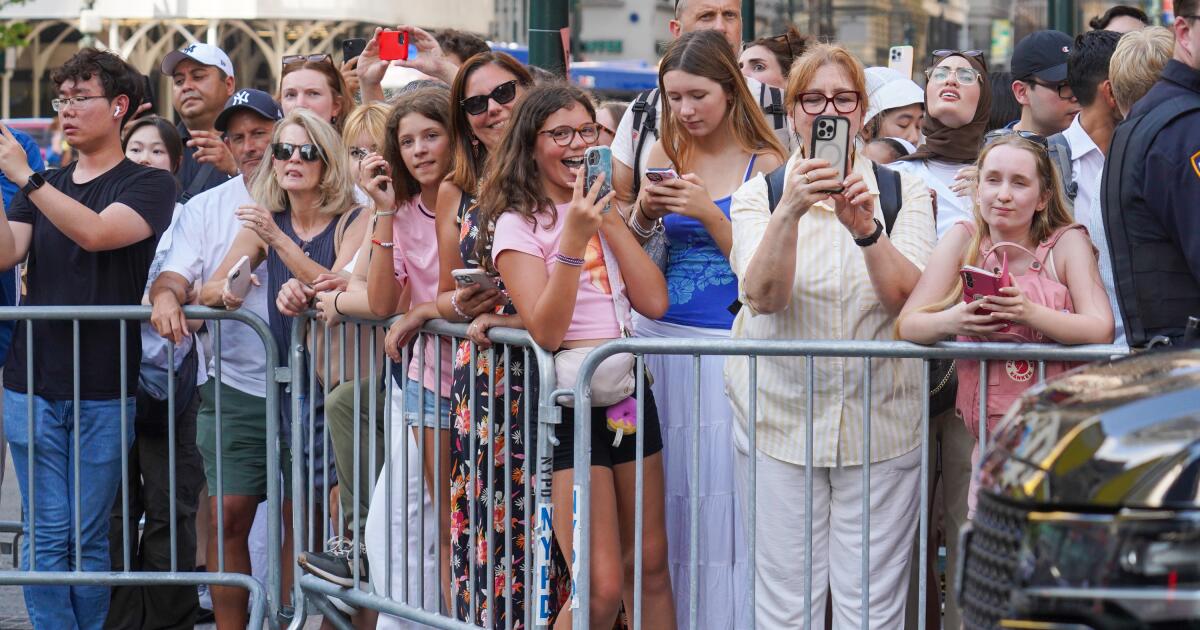
Madison Square Garden and its surrounding streets — 31st and 33rd streets toward 6th and 8th avenues — were blocked off as guests arrived for the event. Fans craned their necks for any views they could get from the street.
The world-famous arena was reportedly set to transform into a “massive castle,” surrounded by a garden fit for pop culture’s royal couple, both 36. While the complete event details and guest list have been kept a secret, the Associated Press reportedly obtained a city permit showing Friday’s wedding event was set to start at 5 p.m. Eastern time and could last until 4 a.m.
Secrecy surrounding the event is so tight that the reported venue has been cordoned off with privacy tents, tarps and barricades. But neither those measures nor Friday’s sizzling temperatures stopped fans from gathering in hopes of sneaking a peak at their longtime idol and sending Swift their well wishes.
“I heard we won’t be able to see her either way because the spot that they picked is going to be covered,” said Sarah Shrestha, 21, an Anaheim resident visiting friends in Manhattan.
Madison Square Garden was a good venue for the couple’s nuptials because “in interviews, [Swift] said she wanted to be able to invite everybody to the wedding so it’s still a good venue for that,” she added.
Ellie Kitschke, 13, and her mother, Mymy Nguyen, 38, were visiting New York City from Adelaide, Australia.
Ellie said she thought it was a weird choice for the venue.
“It’s like a stadium. I get that no one can come inside but I think it’s a bit much blocking up the roads,” added Ellie, who attended the Eras tour in Sydney with her mom.
The two said they also thought it was odd Swift didn’t choose a venue or date that included her lucky number, 13, saying it “didn’t add up.”
“If she does get married, we wish her well,” Nguyen said. “We’d love to see her.”
Emma Rasco, 19, was also surprised by the choice in wedding venue.
“When I heard it, I was like, that’s definitely a choice,” Rasco said. “It’s a little unconventional and very forward-facing.”
Swift and Kelce announced their engagement in August after two years of dating, to much fanfare. “Your English teacher and your gym teacher are getting married,” Swift wrote in the caption of her Instagram post.
While the Swift camp didn’t release a guest list, various news organizations staked out local hotels and Madison Square Garden and began counting bold-face names headed to the event. The New York Times obtained a schedule for the wedding, which included a cocktail hour followed by a 5 p.m. wedding and reception. The event was set to end at 2 a.m.
The AP reported the guests included Hugh Grant, Ethan Hawke and Jason Sudeikis, Karlie Kloss and Kareem Hunt.
The couple were first linked in July 2023, when Kelce mentioned his desire to meet the pop superstar on his podcast, “New Heights,” and made their relationship public that September. Their coupling instantly captured the attention and hearts of fans around the world, and Swift’s presence at Chiefs games was even credited with bolstering female interest in NFL football.
Kelly, 36, is a longtime Swift fan who said she grew up listening to her music. She came from her apartment on the Upper West Side to 33rd Street to see if she could catch a glimpse of Swift entering the stadium.
“I feel like I was the same peer group growing up with her, and am just so happy that she had her happy ending,” she said. “I want to see what a royal American wedding looks like.”
Kelly said she admires Swift and Kelce for donating to charity. The couple donated a combined $26 million to 20 local and national charities ahead of their nuptials, Swift’s publicist told Business Insider.
“They really are a positive influence,” she added.
Kelly said Madison Square Garden made sense as a venue for the privacy and security of guests.
“It’s not an ideal wedding venue but they’re both creative and have their own stages in a way,” she added.
By mid-afternoon Friday, dozens of fans clustered near MSG as black SUVs and vans with tinted windows, presumably filled with wedding attendees, turned the corner toward the stadium.
New York Police Department sources told The Times that streets will be blocked off all Friday and should return to normal by Saturday morning.
In October, Swift told TV host Graham Norton that she was casting a wide net with the guest list, joking that she would invite “anyone I’ve ever talked to.”
“I shouldn’t have said any of that,” she added.
Pulling off an event of this magnitude — which many described as America’s “royal wedding” — required considerable preparation, with a particular emphasis on privacy. Guests were reportedly required to sign nondisclosure agreements before receiving any event details (although the NDAs were said not to have included any penalties for violating the terms).
The couple were also linked to wedding planner Mark Seed, who previously orchestrated the 2023 wedding of Jack Antonoff and Margaret Qualley and the 2019 wedding of Jennifer Lawrence and Cooke Maroney. Seed is known for his elaborate event builds and notable discretion.
On the Tuesday before the event, workers were photographed installing a red carpet outside of MSG, which one individual reportedly said was for “a wedding,” according to Page Six. It was quickly removed that same day.
Lin reported from New York; Garcia and Rollins-Fife from Los Angeles.

Obsession, dir. Curry Barker
Obsession is the debut feature from director Curry Barker, which follows Bear (Michael Johnston), an awkward teenager desperately in love with his friend Nikki (Inde Navarrette). When he is given a mystical chance to make one wish come true, he decides to make Nikki fall head-over-heels in love with him, unaware of the horrific consequences that will arise. A twisted tale of entitlement and regret, Obsession is eager to let audiences sit with the discomfort it offers.
The film’s cast is mostly made up of unknown actors (Andy Richter not included) who bring life and levity to an, at times, very heavy script. Michael Johnston’s puppy dog eyes and tender demeanour make him apt for this tortured lead, especially as we watch him descend deeper into the hell of his own making. However, Inde Navarrette’s gutting portrayal of Nikki is Obsession’s standout performance, as she carries the weight of the film on her shoulders with seeming ease. Navarrette captures the vacancy and lifelessness that this character requires, with moments of lucidity and terror that will undoubtedly make this a horror performance discussed for years to come.
Obsession is a mean film at its heart — one that does not let the audience feel comfortable at any moment, and that thrives in its grime and dimness. The “hero” of the story is hateable and places every character around him into terrible scenarios, leaving the audience to squirm as he tries to make things right. Barker’s direction provides palpable suspense for moments of sudden intensity and horror, yet the film remains comedic in its efforts to relieve tension. I, however, left this screening with a pit in my stomach. Highly recommend!
Dead Lover, dir. Grace Glowicki
Presented at my screening in sickly “Stink-O-Vision,” Dead Lover is the sophomore feature of writer, director, and actress Grace Glowicki. Inspired by works of Gothic horror like Frankenstein and The Cabinet of Dr. Caligari, Dead Lover is a gloriously grotesque, goofy, and grody romantic horror-comedy that centres a smelly gravedigger (Glowicki) who goes to monstrous and comedic extremes to reanimate her one true love (Ben Petrie) after he perishes at sea.
Though the film is co-written by her partner and frequent collaborator, Ben Petrie, Dead Lover feels like Glowicki’s brain-child, harnessing her aptitude for the cartoonish and the outrageous. This is best exemplified through its use of Stink-O-Vision, a scratch-and-sniff technology seen previously in John Waters’ “Odorama” for Polyester, placing these filmmakers in conversation for their vulgarity, comedic stylings, and embracement of camp.
Dead Lover, shot entirely on black-box stages over the course of two weeks, uses only four actors playing multiple parts in heightened makeup and costumes, evoking the feeling of a filmed stage show. The film employs over-the-top performances, handcrafted sets, stage props, and colourful, high-contrast lighting reminiscent of German expressionism. Indeed, Glowicki’s directorial vision seems to be heavily inspired by the handmade aesthetics and experimentalism of independent theatre and silent-era filmmaking, akin to the work of fellow Canadian, Guy Maddin.
Dead Lover’s plot is more of a contrivance to get to the next excellent set piece, disgusting smell, or gonzo performance, though still remaining full of twists and tenderness. While the film may grate at times and the sickly scents conjured by the scratch-and-sniff cards were certainly gag-inducing, Dead Lover carries an infectious sense of fun and delight that keeps audiences laughing. Recommend!
-

 Utah3 minutes ago
Utah Jazz sign defensive wing to roster
-
Vermont10 minutes ago
VT Lottery Mega Millions, Gimme 5 results for July 3, 2026
-

 Virginia12 minutes ago
Virginia Lottery Mega Millions, Pick 3 Night results for July 3, 2026
-

 Washington18 minutes ago
Review: ‘Young Washington’ is an imperfect film perfect for kicking off the 4th of July
-

 Wisconsin25 minutes ago
NAVY NEWS: USS Wisconsin submarine replica on display in Madison
-

 West Virginia27 minutes ago
Iconic country music band Alabama takes stage for West Virginia’s America 250 celebration
-

 Wyoming33 minutes ago
Election Q&A: Steve Harshman for Wyoming superintendent of public instruction
-
Crypto40 minutes ago
Trump made money off his meme coin, did its investors?


