Midwest
Viral Harris-Walz camo hat raises $1 million, draws NRA scorn

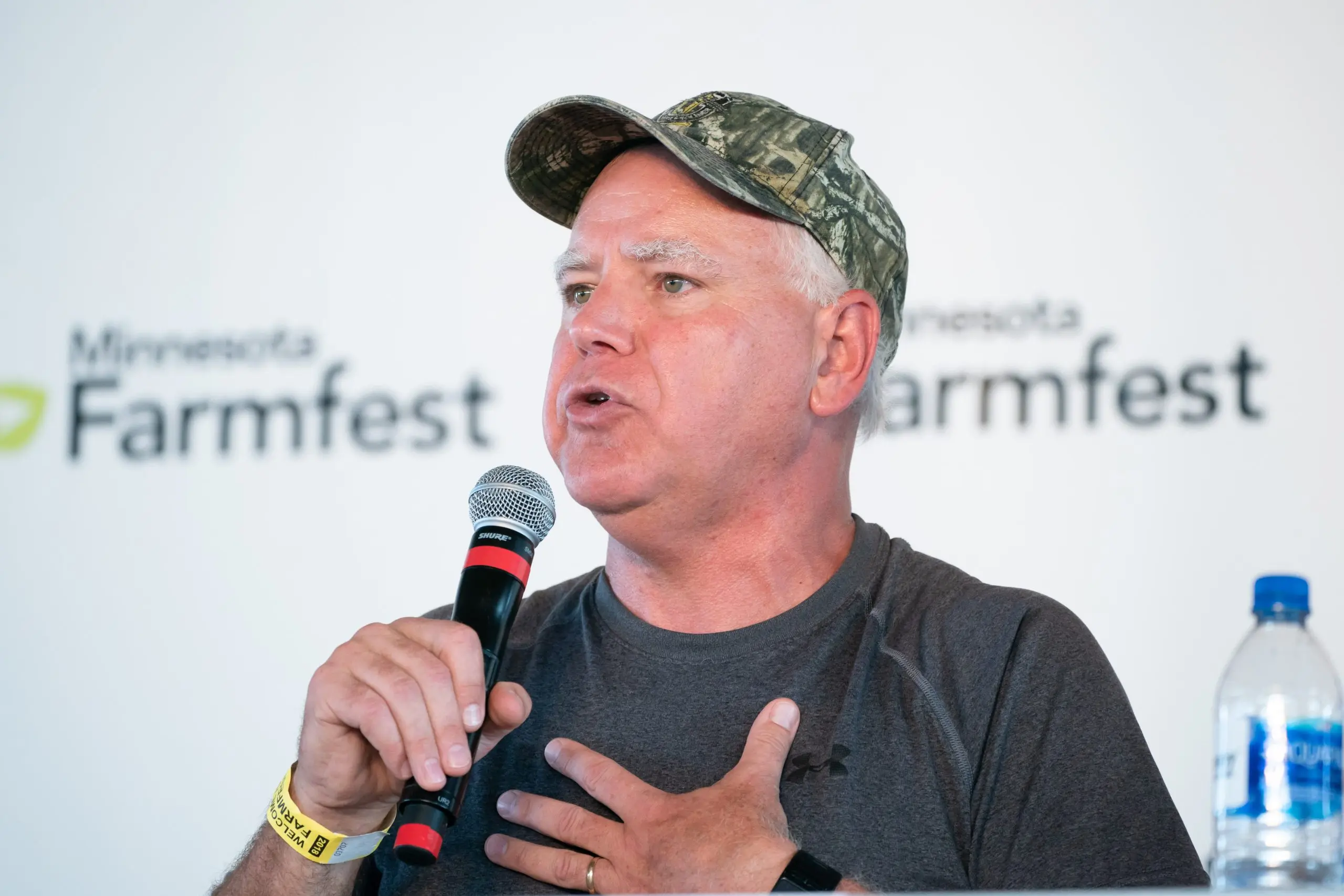
The viral camouflage hat sported by Minnesota Gov. Tim Walz shortly after he accepted the nomination has raised close to $1 million for the Harris campaign.
A camouflage hat with orange embroidery spelling out “Harris/Walz” hit the official Harris campaign store after Walz was pictured wearing it Tuesday, selling out its initial inventory of 3,000 hats in a half hour and raising nearly $1 million for the campaign, according to a report in the Washington Post.
Walz, who has long publicly touted his hunting ability, has made numerous public appearances over the years sporting a camo hat, making the item a natural fit for the campaign store. The hat also signals the strategy of the Harris campaign, which has sought to highlight Walz’s Midwestern persona in an attempt to solidify support in key swing states and appeal to its rural voters.
‘NEVER WENT TO WAR’: WALZ RIPPED FOR SAYING HE WANTS TO BAN GUNS HE ‘CARRIED IN WAR’
Minnesota Gov. Tim Walz (Glen Stubbe/Star Tribune via Getty Images)
But the hat has also drawn the scorn of critics such as the National Rifle Association (NRA), with the executive director of the NRA Institute for Legislative Action telling the Washington Post that “a camo hat can’t camouflage the fact that Kamala Harris and Tim Walz are gun-grabbing radicals who support confiscating firearms from law-abiding hunters and gun owners.”
Despite his hunting background, Walz has long advocated for stricter gun laws, and as governor he signed a bill that featured universal background checks and a red-flag law. Vice President Harris has also been a longtime advocate for stronger gun control, including a Rose Garden speech last year in which the vice president called for “passing reasonable gun safety laws.”
HARRIS, WALZ MADE UNPRECEDENTED ABORTION CLINIC VISIT PRIOR TO PRESIDENTIAL TICKET TEAM-UP
Democrat presidential nominee Kamala Harris and her running mate, Minnesota Gov. Tim Walz, attend a campaign rally in Philadelphia on Aug. 6, 2024. (AP Photo/Matt Rourke)
“President Biden and I believe in the Second Amendment, but we also know commonsense solutions are at hand,” Harris said at the time.
Nevertheless, Emily L. Newman, a professor of art history and liberal studies at Texas A&M University at Commerce, told the Washington Post that the viral hat pairs well with the Walz persona the campaign is trying to highlight, arguing that it lends more credit to his argument for gun regulation.
Minnesota Gov. Tim Walz (AP Photo/Abbie Parr/File)
“I thought it was a great campaign move to cash in on what Walz brings to the campaign, which is this Midwestern sensibility,” Newman said. “He’s talked about being a hunter, but then he’s such a staunch advocate for gun control that it’s a great thing to play up for the Democrats.”
Get the latest updates from the 2024 campaign trail, exclusive interviews and more at our Fox News Digital election hub.
Read the full article from Here


MILWAUKEE — As Venezuela continues to recover from devastating earthquakes, support from Milwaukee’s “United for Venezuela Emergency Relief Campaign” is soon heading to the disaster-stricken country.
The basement of Blessed Sacrament Catholic Church is filled to the brim with donations ticketed for Venezuela, the culmunation of a week of community generosity.
From food to clothing and toys, the outpouring has been remarkable said Father Norberto Sandoval, who is from Venezuela and serves as associate pastor of Blessed Sacrament.
“This [has been] overwhelming,” said Sandoval. “I mean, if you can see [the basement], you were able to get in on Monday. Now we [are not] able to walk.”
(Spectrum News 1/Blake Dietz)
Aura Escobar, who is also from Venezuela, has been doing whatever she can to help her home country, including packing donations. She described the support from friends, coworkers, and strangers as something special to witness.
“In my Venmo, I had three thousand dollars in less than 24 hours,” Escobar said. “And I was able to buy stuff to donate. It’s been amazing. It’s very heartwarming to have so many people that care about Venezuela.”
Due to limited storage capacity and the logistical planning required to transport the supplies to those who need them most, organizers have decided to stop accepting donations after Friday afternoon.
“We have more than a thousand boxes right now. We are expecting two semi-trucks either to move [Friday] in the afternoon or tomorrow,” Sandoval said.

(Spectrum News 1/Blake Dietz)
He acknowledged that corruption in times of trauma is a long-standing concern in Venezuela. For that reason, the trucks will take the local donations to Miami, where a Venezuelan organization he fully trusts will handle the final distribution.
“We have already the person and it’s going to be [done] free. It’s going to be directly to a group of religious groups in Venezuela. So, in that way people will get the donations,” he said.
Sandoval and other organizers are putting out one final plea for volunteers to help load the semi-trucks on Friday and Saturday.

What does it look like to carry your culture with you? When Minneapolis architect and photographer Patricia Mutebi posted a casting call on TikTok in December, she was looking for a way to map how immigrants and diaspora communities in Minnesota keep their heritage close.
She initially planned to photograph Twin Cities residents in their homes, but Operation Metro Surge, the federal immigration enforcement crackdown in Minnesota, forced her to reconsider the safety of her subjects.
“I didn’t think that people would feel comfortable letting a stranger into their home, trying to take pictures of them,” Mutebi said. “From January all through April, I photographed those who were comfortable coming into the downtown [Minneapolis] area.”
The result is “Threads of Us,” a portrait exhibit featuring 20 Hmong, Thai, Indian, African, Pakistani and Indigenous people who have built a life in the Twin Cities.
After seeing the exhibit, spend the rest of the weekend at the annual Taste of Minnesota, revisit soul music of the 1990s at the Dakota or watch Saturday’s World Cup matches at a street fair in Minneapolis.
Finding home in Minnesota
In “Threads of Us,” Mutebi asked each person she photographed the same question: What does home look like after you’ve left it behind?
“Each person I photographed taught me something new about perseverance and resilience,” Mutebi said. “They’ve come into a new place that doesn’t necessarily welcome them openly, but they’re choosing to show up as their authentic self regardless. Nothing could honestly beat that.”
Mutebi understands the feeling. She was born in Uganda, studied architecture in Kenya, and moved to Minnesota in 2019.
“I have friends here who have families that know how to cook Kenyan food, and whenever I go visit them, there’s a smell that just hits me, and I’m taken back to a time when I was an undergrad,” she said. “In the first house that I bought, I have this gallery wall that shows the journey I’ve traveled. It has art from Kenya, from Uganda, and pictures of friends and family. That’s the most treasured thing I have.”
She also draws inspiration from architects like Burkinabé-German designer Diébédo Francis Kéré, whose work centers on Indigenous materials and community-led design across Africa.
He “didn’t try to bring the Western world with him,” Mutebi said. “He was designing for the culture — where it sat, and using the materials they have to help people understand that we have these resources already.”
For “Threads of Us,” participants arrived in traditional clothing — from Hmong vests and Ethiopian habesha dresses to Ghanaian kente cloth and Pakistani shalwar kameez. They brought meaningful objects, including wedding garments, family heirlooms, Oromo beadwork, Somali incense burners and Ethiopian coffee ceremony sets. Each item served as a tangible bridge to their families and homelands.
“I found people who have photographed cultures in the most beautiful way and have captured joy without trying to modernize the culture,” Mutebi said. “I want to photograph people where they’re at and how they move through life without trying to change them one way or another.”
Threads of Us, now on view at The Residency by Modern Day Me in Minneapolis, is Mutebi’s first exhibit — but she’s already thinking about what comes next. She was recently selected for the cohort of the Little Africa residency program, where she will partner with local African-descent business owners to tell their stories through photography.
“Unless you’re Indigenous, you came from somewhere,” Mutebi said. “I want people to take the time to think about what it means to them and how they can show up in the places they are now.”
Date: Friday, July 3 through Friday, July 17.
Time: 10 a.m. to 5 p.m. Monday through Friday
Location: The Residency by Modern Day Me, 401 N. 1st Ave., Minneapolis
Cost: Free
For more information: Visit patriciamutebi.studio/portfolio/threadsofus

Taste of Minnesota
Spend your Fourth of July weekend at the Taste of Minnesota, where 18 local musicians and more than 100 food vendors will take over downtown Minneapolis for the annual two-day festival.
The main stage will feature grunge-pop band Gully Boys, hip-hop artist Nur-D, singer-songwriter Dessa, and DJ Sophia Eris. The North Star Stage will spotlight emerging acts, including Frankie Torres, Adam David Bohanan, and Solana and the Sunsets.
Date: Friday, July 3 and Saturday, July 4
Time: 4 to 10 p.m. on Friday. Noon to 10 p.m. on Saturday
Location: At the intersection of Nicollet Mall and Washington Avenue
Cost: Free. RSVP here.
For more information: Visit tasteofmn.com
A night of ’90s soul
If music from the 1995 film “Waiting to Exhale” still has a place on your playlist, head to the Dakota this Friday for the Ladies of Soul tribute show.
Local singers Solorah, Ashley Commodore and Monique Blakey will perform the soundtrack from start to finish, revisiting songs by Whitney Houston, Toni Braxton, Mary J. Blige, Brandy and Aretha Franklin.

World Cup watch party
Catch the knockout rounds between Canada and Morocco and Paraguay and France at the World Cup Street Fair in Minneapolis this Saturday.
Utepils Brewing will show both games on large indoor and outdoor screens, while the street fair will feature food trucks, art vendors, mini soccer games and DJ sets between kickoffs.

IMPD Chief Chris Bailey gives briefing following mass shooting
IMPD Chief Chris Bailey addresses the problem of youth with guns downtown following a mass shooting that killed two teens and injured 5 on July 5, 2025.
Two years ago on the Fourth of July, an 11-year-old visiting Indianapolis was struck in the back by a bullet fired into the air. Jataevious Ragsdale – who recovered quickly – was visiting family in Indianapolis for the holiday.
Had he been struck differently by the bullet, Ragsdale may not have had the chance to experience Fourth of July again. Falling bullets have killed other children, like 13-year-old Noah Inman in Hammond in 2017 and 4-year-old Marquel Peters in Atlanta in 2010.
Holidays like Fourth of July and New Year’s Eve often prompt individuals to celebrate by firing their gun in the air, something the Indianapolis Metropolitan Police Department strongly advises against doing.
“Every bullet that goes up comes down,” Downtown District Commander Shane Foley said. “So if people think that’s not dangerous, they’re wrong.”
This story continues below the image.
Those who choose to fire their gun into the air can risk causing serious damage, Foley said, and doing so can lead to an arrest and prosecution. Criminal consequences for firing into the air include criminal recklessness, battery, vandalism and even homicide depending on the damage done.
“People think of it as a harmless act, but those bullets coming down may very well hurt somebody, damage property, hurt animals,” he said.
Bullets shot into the air can travel more than a mile before falling. Smaller rounds can fall at roughly 300 feet per second and larger rounds can descend at nearly 500 feet per second. Speeds of 150 to 170 feet per second can break skin, while 200 feet per second can penetrate a human skull. That’s what happened to 4-year-old Marquel, who was sitting next to his mother in an Atlanta church for New Year’s Eve services.
IMPD respects Hoosiers’ Second Amendment rights, Foley said, but says people must handle firearms safely so others don’t get hurt.
While it may be hard to distinguish gunfire from fireworks during the Fourth of July weekend, Foley said, anyone who sees someone firing a gun in the air should immediately call police.
The simple advice he offers to those thinking of shooting their gun in the air on the Fourth of July?
“Don’t do it. It’s illegal.”
This story continues below the image.
Holiday comes in the wake of last year’s mass shooting
Fourth of July 2026 follows a mass shooting in downtown Indianapolis on July 5, 2025 that happened hours after thousands gathered for a fireworks show. Two teenagers died and five other people were injured in the shooting. Police arrested at least 11 individuals throughout the night for charges ranging from weapons possession, criminal recklessness and battery.
“Reckless or disruptive behavior will not be tolerated” during Indianapolis holiday festivities, Deputy Chief Matthew Thomas said.
Foley said there will be a “very strong public safety presence downtown” over the weekend. Officers will patrol on foot, bikes and undercover, using safety cameras and drones to monitor what’s happening in the city.
“We will not allow the actions of a few individuals to negatively impact the experience of thousands of families,” Thomas said.
Mia Thurow is the breaking news and criminal justice reporting intern for the Indianapolis Star. She can be reached at mthurow@gannett.com.
-

 San Francisco, CA3 minutes ago
Marina braces for Golden Gate Bridge fireworks show, massive crowds
-

 Dallas, TX5 minutes ago
Maradona’s ‘Hand of God’ ball heads to auction in Dallas
-

 Miami, FL11 minutes ago
Miami-Dade sheriff urges residents to celebrate Fourth of July safely
-

 Boston, MA18 minutes ago
Jaylen Brown says Celtics showed ‘lack of respect’ after trade to 76ers – The Boston Globe
-

 Denver, CO20 minutes ago
Who are the Top 5 offensive linemen in Denver Broncos history?
-

 Seattle, WA26 minutes ago
Seattle’s Lake Union to light up with big July 4 fireworks show for America’s 250th
-

 San Diego, CA33 minutes ago
New training program grants tribal members access to reservation land during emergencies
-
Milwaukee, WI36 minutes ago
Leaders of ‘United for Venezuela Emergency Relief Campaign’ grateful for support


