Midwest
Michigan man serving jail time after repeatedly telling judge 'kiss my a–'

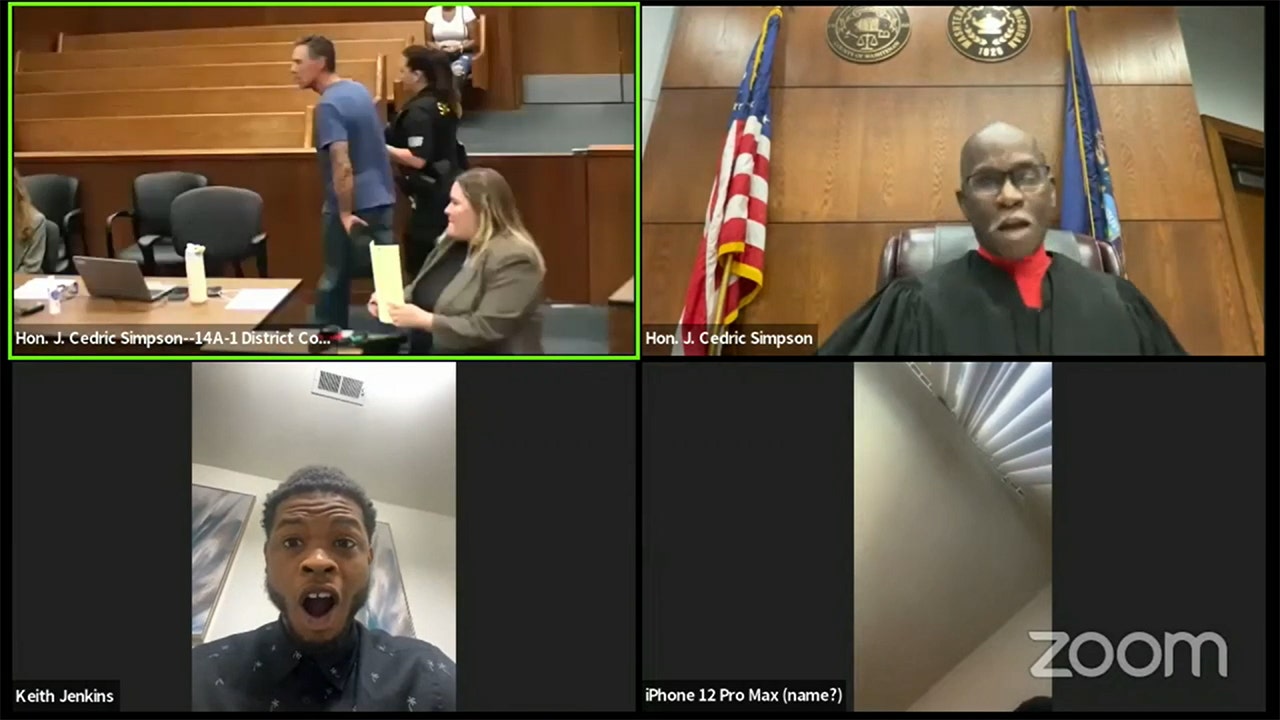
A man in Michigan is facing months of jail time after repeatedly shouting expletives at the judge overseeing his trial.
Darrell Jarrell appeared in a Washtenaw County court on Wednesday in the case of a simple misdemeanor trespassing charge.
However, just before Judge Cedric Simpson adjourned the court, Jarrell spoke up: “I’m tired of this state, I’m ready to leave this state as soon as possible.”
MICHIGAN JUDGE ASTONISHED AT HOW MAN SHOWS UP TO VIRTUAL HEARING FOR DRIVING WITH SUSPENDED LICENSE CHARGE
Defendant Darrell Jarrell launched into a series of profanities in a Michigan courtroom before Judge Cedric Simpson could adjourn. (YouTube/Hon J Cedric Simpson)
Jarrell added, “You guys can kiss my a–.”
Simpson attempted to restore order despite the disgruntled defendant’s outburst, warning him against further comments.
“F— you!” Jarrell shot back.
Simpson told Jarrell that he was in contempt of court and immediately issued a misdemeanor charge for 93 days.
Jarrell repeated the profanity, to which Simpson repeated the misdemeanor charge. This happened multiple times until the bailiff physically removed Jarrell from the courtroom.
JUDGE REVEALS ANOTHER TWIST IN THE CASE OF MICHIGAN VIRAL ZOOM VIDEO DRIVER WHO PLEADED CLERICAL ERROR
The two exchanged retorts a total of six times, which would add up to 558 days in prison.
Simpson then proceeded to the next case without concern, telling the waiting defendant that he shouldn’t be concerned about the other man’s outburst.
Simpson dealt with a similarly bizarre defendant earlier this year when Corey Harris, 44, who was charged with driving with a suspended driver’s license, dialed into a virtual court hearing while behind the wheel of a car.
Judge Cedric Simpson dismissed concerns of a defendant in a separate trial who watched the debacle unfold over a virtual connection. (YouTube/Hon J Cedric Simpson)
“Mr. Harris, are you driving?” Simpson asked the defendant.
“Actually, I’m pulling into my doctor’s office actually,” Harris said. “Just give me one second. I’m parking right now.”
“OK, so maybe I don’t understand something. This is a driving while license suspended [case],” Simpson told the public defender. “And he was just driving, and he doesn’t have a license.”
“I don’t even know why he would do that,” the judge said. “So, the defendant’s bond is revoked in this matter.”
Simpson ordered Harris to turn himself in to the Washtenaw County Jail by 6 p.m. that day.
Fox News Digital’s Louis Casiano contributed to this report.
Read the full article from Here


Lansing — Michigan lawmakers worked through the night into Friday morning on a new state budget that will use an array of spending cuts and funding maneuvers to close a $1 billion tax revenue gap.
The plan will increase the state’s investment in basic per-student support for Michigan schools and will feature $125 million for special projects sought by legislators. However, 10 state departments will get less money than they had the year before, and a variety of state initiatives, such as the arts and culture program, Pure Michigan and the Office of Global Michigan, will see cuts.
Senate Appropriations Chairwoman Sarah Anthony, D-Lansing, described the new budget, which authorized somewhere around $84 billion in spending, as one “full of compromises.”
“This was a very challenging budget negotiation, mainly because of the $1 billion deficit that we had to ensure to address,” Anthony said. “But being able to do so without reducing any benefits for folks who are receiving Medicaid or food assistance is probably the proudest thing … that comes out of this process.”
The Legislature convened throughout the night Thursday into Friday morning, when the state Capitol would normally have been closed for the Fourth of July holiday weekend.
Under state law, the Republican-led House and Democratic-led Senate are supposed to approve a new budget by July 1 each year. The first of the funding bills wasn’t unveiled this week until about 3:13 a.m. Friday morning, two days after the deadline.
Lawmakers would likely have a few hours to read the bills before the final votes, which were expected later Friday.
On Thursday afternoon, Sen. John Damoose, R-Harbor Springs, said Senate Republicans had no information about what was in the budget blueprint. He labeled the process playing out in the Legislature “nonsense.”
Likewise, Sen. Jim Runestad, R-White Lake Township, said lawmakers had about 30 to 40 minutes between being briefed on the budget and when they had to vote on it.
“We have no idea what’s in these bills,” Runestad said.
In February, Jen Flood, Whitmer’s budget director, said the state was facing a $1.8 billion financial gap. Health care costs had jumped, the Legislature had dedicated more tax dollars to roads, and the federal government, led by Republican President Donald Trump, had forced states to pay for a larger share of costs associated with food assistance for low-income families.
Whitmer initially proposed an $88.1 budget for next fiscal year, which begins Oct. 1. She sought a bevy of new taxes on smokers, gamblers and digital advertising. Michigan House Speaker Matt Hall, R-Richland Township, refused to go along with the tax hikes.
The new budget will be somewhat close to the current budget in overall amount of approximately $84 million.
Hall and Senate Majority Leader Winnie Brinks, D-Grand Rapids, had been working for weeks to create the new funding plan. Hall announced a final deal had been reached Thursday.
The ultimate agreement involved dozens of other bills that were tied to the budget’s approval, including a long-sought measure by some Democrats that would double the cap on the state’s transformational brownfield program, which allows businesses behind large developments to keep income tax and sales withholdings resulting from their projects, from $1.6 billion to $3.2 billion.
The incentive is expected to be used to spur the redevelopment of Detroit’s riverfront Renaissance Center. The Senate approved the brownfield bill in December. The House voted 82-26 in favor of it early Friday.
The Senate also took up early Friday a House-backed proposal to ban former lawmakers from being paid to lobby for two years after leaving office. The bill passed in a vote of 29-7.
How will schools be funded?
Sen. Darrin Camilleri, D-Trenton, acknowledged lawmakers were shifting a larger amount of School Aid Fund money, which would normally go to K-12 schools, toward higher education and community colleges.
The number appeared to rise from about $1.3 billion in the current year to about $2 billion in the fiscal year beginning Oct. 1, setting a new record. Whitmer had proposed using $1.7 billion from the School Aid Fund to support the operations of universities and community colleges.
The moves effectively free up money in the General Fund, where tax dollars are currently tight, for other needs.
“It’s too much,” Camilleri said of the shifts. “But we’re dealing with a divided Legislature with different priorities, and we all needed to fill the budget gap.”
Robert McCann, executive director of the K-12 Alliance of Michigan, blasted the approach lawmakers took.
“Nothing in this budget justifies it once again being done late,” McCann said. “There is little in it focused on supporting Michigan’s schools, even as it raids nearly $2 billion from the School Aid Fund to pay for data centers and corporate tax handouts.”
The K-12 budget went down from $21.3 billion to $19.8 billion, a 7 percent drop in federal funds on paper.
But the plan appears to allow the federal funds not included in the tally to be spent, so it wasn’t clear how much total spending there would actually be under the legislation.
Lawmakers are increasing the base per-pupil foundation allowance for schools by about 2.5% from $10,050 to $10,300. They are also investing $50 million in high-impact tutoring and instituting a long-term plan for a so-called weighted funding formula, which would tie extra support to economically disadvantaged students and students who are learning English.
House Appropriations Chairwoman Ann Bollin, R-Brighton, touted the weighted funding formula, which will be phased in over the next 15 years.
“This is a transformational school budget, where we are making record investments,” Bollin said.
For Michigan’s public universities, overall funding increased by 12% from $2.3 billion to $2.6 billion, with more money for operations and scholarships.
What were the cuts and projects?
Lawmakers’ final plan also cut $8 million in funding for the Pure Michigan tourism campaign, which received $17 million in support in the current year. The Office of Global Michigan got $500,000 less, dropping its total to about $41.4 million. And the arts and culture program got $685,200 less, dropping its total to $8 million.
Among state departments, the Department of Environment, Great Lakes and Energy saw the largest percentage drop in funding of 31%, going from $967 million to $671 million. The decrease was largely due to the reduction of money for a federal sewage and stormwater program.
Lawmakers did provide $125 million for special projects around the state.
There was $3 million for the Schoenherr Road Bridge Reconstruction in Shelby Township, $1.4 million for the Rochester Community House expansion and renovation, $3.7 million for water main replacements in Utica and $2 million for a fire station project in Waterford Township, according to the spending plan.
cmauger@detroitnews.com
Minnesota
Where to watch Minnesota Lynx vs New York Liberty on July 3: TV channel, start time and streaming
The WNBA has returned with a brand new collective bargaining agreement and a league full of loaded rosters as the 2026 season tips off.
A rookie class headlined by Dallas Wings top pick Azzi Fudd, Minnesota’s Olivia Miles and Washington’s Lauren Betts is ready to make a mark in the pros while the defending champion Las Vegas Aces look to keep their dynasty alive with a fourth title in five years.
As the the season gets going under a new media rights deal, it can be tough to figure out which channel each team is playing on every night. Here’s everything you need to know to tune in when the New York Liberty host the Minnesota Lynx on Friday.
What time is Minnesota Lynx vs New York Liberty?
Tip off between the New York Liberty and Minnesota Lynx is scheduled for 7:30 p.m. (ET) on Friday, July 3.
How to watch Minnesota Lynx vs New York Liberty on Friday
All times Eastern and accurate as of Friday, July 3, 2026, at 6:18 a.m.
- Matchup: MIN at NYL
- Date: Friday, July 3
- Time: 7:30 p.m. (ET)
- Venue: Barclays Center
- Location: Brooklyn, New York
- TV: ion
- Streaming: ion
Watch the WNBA all season on Fubo
WNBA scores and results
See scores, results for all of today’s games .
See WNBA scores, results from July 2
Odds for WNBA games today
The latest WNBA odds can be found below from the best sports betting apps . Some odds may include games scheduled on future dates.
Missouri
Most Missouri state and Columbia offices closed Friday; Columbia parking meters will not be enforced during Fourth of July weekend | 93.9 The Eagle

Most Missouri state and county offices are closed Friday to observe the Fourth of July holiday.
Most state offices are closed except emergency services like the Missouri State Highway Patrol. The Fourth of July is one of Missouri’s 13 state holidays. County courthouses are also closed today, so there is no court.

Most Columbia city offices are closed as well, except emergency services like police and fire. Columbia sanitation employees will be collecting residential and commercial trash Friday morning, and the landfill will be open to the public with normal operating hours.
Columbia’s Go COMO bus system will operate on its normal schedule on Friday. While Go COMO won’t operate fixed-route or paratransit service on Saturday, they will run shuttles between downtown Columbia parking garages and Stephens Lake park Saturday evening from 5-11 pm for the Fire in the Sky celebration.


Parking enforcement in city parking garages and at on-street parking spaces is suspended from Friday through Sunday.
What it means: The Fourth of July is one of Missouri’s 13 official state holidays. The holiday will be observed on Friday, since the 4th is on a Saturday this year.
-

 Maine5 minutes ago
Magalloway Conservation Project in western Maine nearing completion
-
 Maryland8 minutes ago
Baltimore Gas and Electric seeks $8 monthly rate increase for Maryland customers
-

 Michigan13 minutes ago
Michigan lawmakers work through the night on ‘compromise’ budget
-

 Massachusetts20 minutes ago
Massachusetts city imposes curfew ahead of historic World Cup match
-
Minnesota23 minutes ago
Where to watch Minnesota Lynx vs New York Liberty on July 3: TV channel, start time and streaming
-

 Mississippi28 minutes ago
List of Jackson area events to celebrate July 4th before firework shows
-

 Missouri35 minutes ago
Most Missouri state and Columbia offices closed Friday; Columbia parking meters will not be enforced during Fourth of July weekend | 93.9 The Eagle
-

 Montana38 minutes ago
Dodging rocks and chasing memories on Montana’s Smith River

