Science
Outbreak of neurotoxin killing unprecedented number of sea lions along California coast

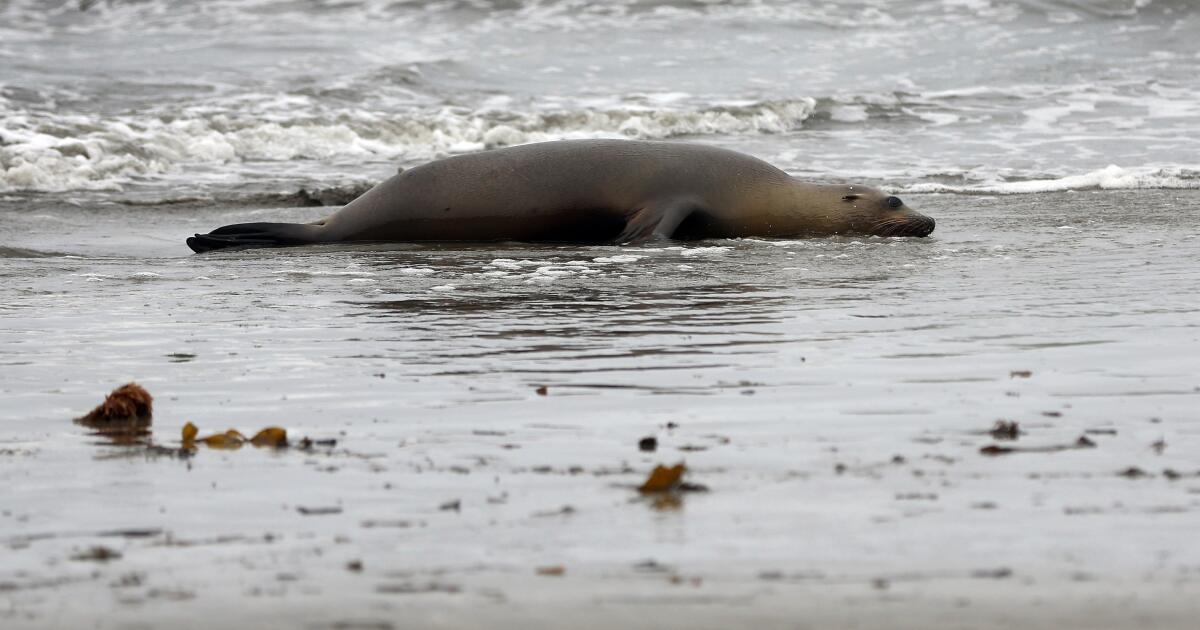
By the time the rescue squad got to her, a small crowd had formed around the agitated California sea lion. As the team crept toward her — carrying large wooden shields and a giant net — the animal’s head weaved, craned and rocked back and forth in frenzied rhythms.
Lucille — as she was later named by the Marine Mammal Center’s Morro Bay field office — had barely registered her captors’ approach as the team of five animal rescue volunteers pounced on her. A small struggle ensued as the creature’s body went rigid with seizures, but the team managed eventually to push her into an XXL portable dog crate.
“It’s really hard when they’re not acting like sea lions,” said Jake Roth, a 22-year-old volunteer who helped with the rescue.
It was the first of dozens of frantic rescue phone calls made by horrified beachgoers that day, as an acute domoic acid outbreak continued to wreak havoc along the San Luis Obispo and Santa Barbara coasts this summer.
“The levels we’re finding inside these animals is off the charts,” said Giancarlo Rulli, a spokesman for the Sausalito-based Marine Mammal Center. “It’s all hands on deck.”
Domoic acid is a neurotoxin released by Pseudo-nitzschia, a common phytoplankton species found in coastal waters. Sea lions — and other marine mammals — become poisoned when they eat large amounts of fish or invertebrates that have been chowing on the contaminated diatoms.
Symptoms include lethargy, vomiting, unusual behavior, seizures, loss of pregnancy and death.
Marine Mammal Center volunteer Cris Lewis guides a sick sea lion into a crate during a rescue at Cayucos State Beach.
(Justin Sullivan/Getty Images)
Domoic acid, which is an amino acid, is not always produced by the phytoplankton. It is only manufactured under certain conditions — ones which scientists are still trying to determine. But upwelling of seawater seems to be a common factor — and strong upwelling of cold, nutrient-rich water is currently hugging the Central California coastline.
The outbreak has been at crisis levels since late July.
“One of the things that has come out again and again in a lot of our studies… is that, yes, when you get upwelling — which is typified by colder water temperatures and lots of nutrients — you will stimulate a bloom of diatoms,” said Clarissa Anderson, director of Southern California Coastal Ocean Observing System and the Cooperative Institute for Marine, Earth, and Atmospheric Systems, which are operated out of UC San Diego’s Scripps Institution of Oceanography.
“But then the bigger question — the one we’ve not been able to totally wrap our heads around — is, when does it produce the toxin? What is the mixture of conditions that requires that? Because this organism is around all the time,” she said.
Domoic acid outbreaks are not new. They have been happening for decades, if not millennia. And although it wasn’t identified in California waters until 1991, it is believed to have been behind outbreaks before that — including the 1961 “invasion” of chaotic sea birds in Capitola that partly inspired Alfred Hitchcock’s 1963 film, “The Birds.”
What has changed, said Anderson, are the frequency, timing and location of the events.
“We know that upwelling season in California has always been a great time to expect a Pseudo-nitzschia bloom and potentially a domoic acid event, and that can start as early as March,” she said. As a result, scientists had associated springtime with domoic acid outbreaks.
“But now we’re starting to see something different: These past three summers there have been these intense, long, lasting blooms,” she said.
And while Monterey and Humboldt Bay had been considered the classical hot spots, it’s Southern California that has been clobbered since 2022.
She said climate change is likely playing a role in these changes — but not necessarily because of warm water temperatures.
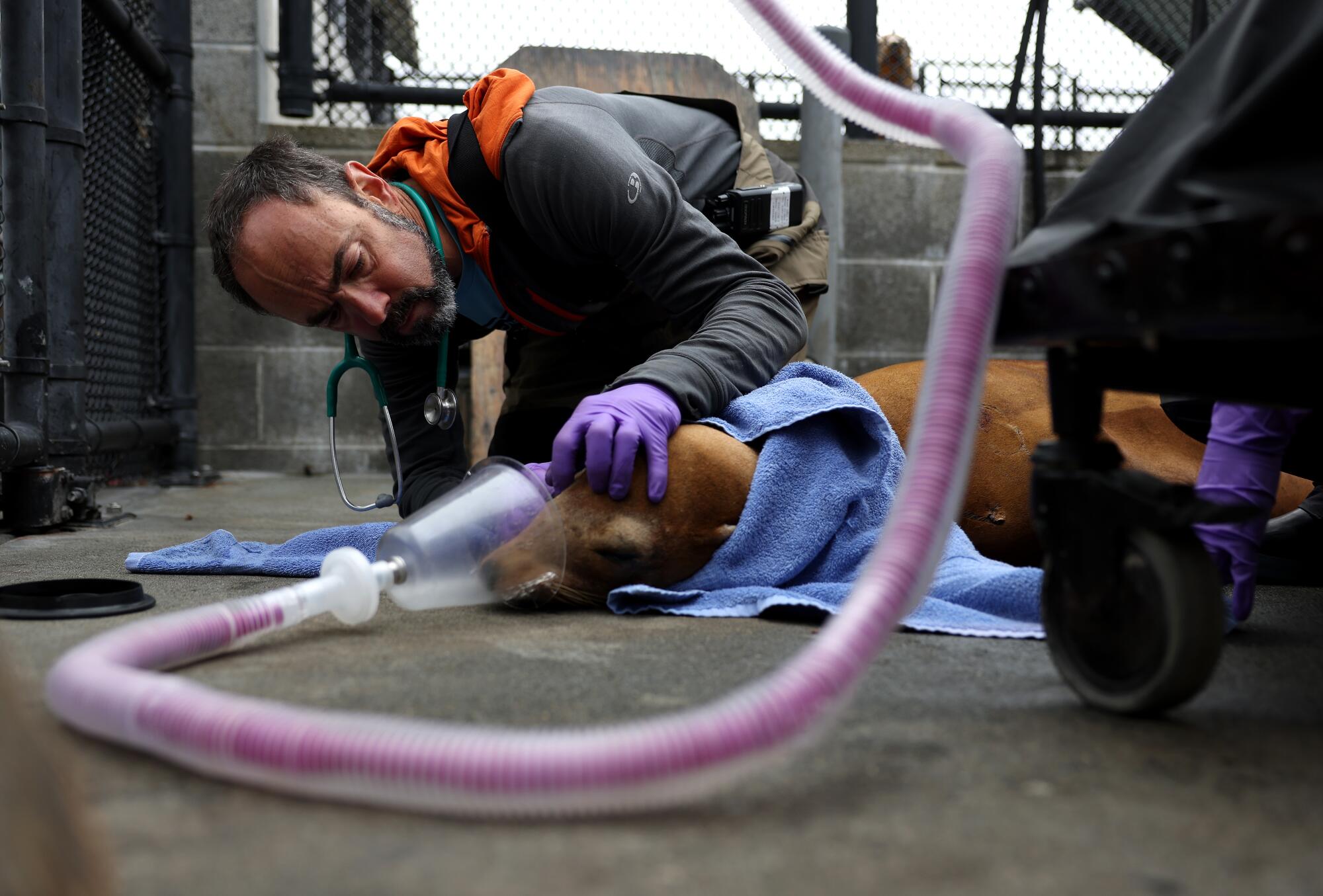
Marine Mammal Center veterinarian Greg Frankfurter inspects a newly admitted California sea lion that was rescued from a beach showing signs of domoic acid poisoning in Sausalito.
(Justin Sullivan/Getty Images)
“One of the things we have seen in our years and years and years of data is that it’s the mixture of nutrients that come with upwelling that is potentially responsible for turning the toxin on or off,” she said. “And that mixture of nutrients may be impacted by global climate change, because climate change is changing ocean circulation physics at the basin scale — like the Pacific Ocean scale — and that can have ramification on what kinds of water — the flavor of water — that is upwelling onto the coast in California.”
Raphe Kudela, a professor of ocean science at UC Santa Cruz, said there might also be a connection to heat and runoff from inland rivers.
He said in the last few years, really wet winters have contributed to an increase in river runoff — and a resulting dump of nutrients into California’s coastal waters.
“So you get a pulse of upwelling, which brought some cool water with even more nutrients to the surface, and then everything warmed up. That’s just absolutely perfect conditions for a bloom like this,” he said.
It’s also a perfect recipe for creatures like sardines and anchovies, who feast on the diatoms, algae and phytoplankton in these cool, nutrient-rich waters. And those fish bring in predators, such as sea lions, dolphins, fur seals, birds and other fish that then proceed to feast on these “toxic bullets.”
Anderson said people will occasionally ask her if they, too, could get sick from eating anchovies.
“I’m like, are you planning on eating as many anchovy as a sea lion?” she said, noting that sea lions eat roughly 5% to 8% of their body weight per day. For a 150-pound person, that would be 7.5 to 12 pounds of anchovy.
And that’s part of the tragedy of this latest outbreak.
Barbie Halaska, a necropsy specialist with the Marine Mammal Center, showed visitors the milk-rich tissue enveloping the single six-inch incisions she had made in the chests of six of the dead sea lions that had died at the Morro Bay center.
All six were adult, lactating females, she said, with thick layers of fat.
“You can see how big she is. She’s gorgeous,” said Halaska, pointing at the dead but otherwise healthy-looking animal. “They’ve got a great food supply. It just happens to be tainted. When they’re lactating, and they find a good food stock, they just go and go and go. Unfortunately, that means the neurotoxin just bioaccumulates.”
She said female sea lions tend to give birth around June 15 — “we call it sea lion birthday” — which means these females most likely had a young, dependent pup with them before they were stranded. Sea lion pups are dependent on their mothers until they are about 9 months old.
Research shows that pups growing inside contaminated pregnant females suffer brain damage. Milk from contaminated females also carries the toxin, suggesting it could be transmitted to pups.
By early afternoon, Lucille and three other sea lions were being treated for domoic acid poisoning.
Lucille was passed out, snoring on the cement floor of the pen. Soon after she arrived, a center staff member had delivered a shot full of phenobarbital and midazolam into her back haunch, to control the seizures. Staff then hooked her up to an IV bag of fluid to help flush the toxin out of her body.
But one of the three newer arrivals, a large, adult female named Yippee, arrived with a broken and dislocated jaw. Staff concluded she’d die if she was returned to the wild. They made the hard decision to medically euthanize her.
She struggled to flee from the small team that came in to deliver the shot, but was finally backed into a corner and succumbed. Her breathing slowed and within a few minutes, she was still.
Rulli said such episodes are always painful, and the center works hard to support staff who respond to these events. Repeated encounters with suffering animals can take a toll.
Roughly 30% of the animals that have come to the center in this latest outbreak — which began at the end of July — have died, said Aliah Meza, operation manager of the Morro Bay field office.
Farther south, where staff from the Channel Islands Marine Wildlife Institute are responding to animals along the Santa Barbara and Ventura coasts, the number exceeds 50%, said Sam Dover, founder and chief veterinarian of Channel Islands Marine and Wildlife Institute.
To keep these facilities running and these teams operating, both institutions rely on donations and some level of state and federal funding.
State funding was nearly pulled last year when the governor’s office struck $2 million in funding from the state budget. For smaller operations, such as Dover’s, that would have been a 50% hit on its operating budget. The groups were able to convince lawmakers to replace the funding.
“I don’t envy the sharpened pencil and eraser work that they were doing,” said Jeffrey Boehm, the marine center’s chief external relations officer, who said he and others went to Sacramento to make the case that their work is in the public interest. “Having an entity that is prepared, skilled and professional to respond to wildlife that might be having a seizure on a public beach, that’s in the public interest. As is the science we advance through doing this work… Because at the end of the day, it’s all just one system.”
Lucille, who recovered from her seizures, was transported to the center’s Sausalito hospital via air-conditioned truck the following day. She died in transport.
Veggie, another sea lion who was rescued the same day, did make it to Sausalito however. She is now undergoing a seven-day protocol at the hospital, where roughly 50 other sea lions are being treated.
Rulli said that two sea lions were recently released back into the wild at Point Reyes National Seashore, where there is no sign of an outbreak and where humpback whales are currently feeding — an indication that there’s plenty of food available.
“Let’s just hope they stay up here,” he said.


new video loaded: NASA Announces Artemis III Crew
transcript
transcript
NASA Announces Artemis III Crew
NASA announced the crew of Artemis III mission, which will fly to low-Earth orbit to test rendezvous and docking maneuvers with one or two lunar landers.
-
“I am excited to welcome you as the next crew in the Artemis journey to successfully return to the moon — this time to stay.” “I’m honored by the role that I’ve been given. I’m also very humbled by the task in front of us. But first and foremost, I’m grateful.” “So with that, the Artemis II crew, comrade, hands you the baton. You got the controls.” “As you know, we had a significant anomaly at our Launch Complex 36A on May 28. We’ve redoubled our efforts and are moving forward.”
By Alisa Shodiyev Kaff
June 9, 2026
Science
Santa Monica Mountains’ last steelhead trout survived the Palisades fire — and even had babies

Scientists feared the Santa Monica Mountains’ last remaining steelhead trout were dead, smothered by debris flows unleashed by the Palisades fire.
But the endangered fish surprised them: A team of biologists recently spotted 30 of the rare trout — and 21 babies — in Topanga Creek.
“There was a lot of happy dancing in the creek,” said Rosi Dagit, principal conservation biologist for the Resource Conservation District of the Santa Monica Mountains, which works with public and private landowners to conserve natural resources.
That’s because the steelhead here are endangered, at both the state and federal levels. Once, they swam in most streams of the Santa Monicas, but their numbers plummeted amid overfishing and coastal development. Increasingly frequent wildfire has further stressed their habitat. Topanga Creek, a biodiversity hot spot, is home to their last known population in the mountains that stretch from the Hollywood Hills to Point Mugu in Ventura County.
The trout that were spotted, including this one, are part of a distinct Southern California population that’s listed as endangered at the state and federal levels.
(RCDSMM Stream Team)
The California Department of Fish and Wildlife spearheaded a complex mission to rescue trout threatened by the Palisades fire that sparked in January 2025.
Time was of the essence. The fire hadn’t yet been fully contained. But rain was on the way, which would sweep massive amounts of sediment from the denuded hillsides into the water. Fish are often killed this way.
Crews stunned the fish with electricity, scooped them up in buckets, trucked them to a hatchery and ultimately moved them to Arroyo Hondo Creek in Santa Barbara County.
Within days, Topanga Creek was choked with mud. Some assumed the fish left behind were goners.
But in March, the conservation district’s team found four. The following month, when water conditions were clearer, they saw more.
“These fish continue to amaze me,” said Kyle Evans, environmental program manager for the state Department of Fish and Wildlife, who had seen the damage to the creek. “I had seen populations get wiped out in similar situations. So when I heard, I was thrilled.”
Evans surmises the fish that survived were in an area of the creek where less charred material and sediment were swept in.
“These fish likely hunkered down, were hiding under some rocks or places to try to get away from the main concentration of flow,” he said. “And luckily they weren’t buried.”
The ones that were spotted were fairly small, around 6 to 14 inches. Rainbow trout and steelhead trout are the same species, but with different lifestyles. If the fish remain in freshwater, they’ll be considered rainbows. However, they can migrate to the ocean and become steelhead, where they typically grow larger before returning to their natal waters to spawn.
Topanga Creek hasn’t fully recovered from the damage it sustained, but scientists say it’s looking better. Surveys last year were “so depressing,” Dagit said, with very few animals, and stretches that were essentially transformed into flat roads from all the sediment buildup. Some of the riparian canopy burned right down to the creek.
Then came 32 inches of rain over the last nine months, scouring out and moving sediment, creating deeper pools. Dagit said they recently found newt egg masses for the first time in years, as well as a few adult newts and many frogs. Plants that provide cover are starting to recover.
She provided photos comparing certain pools last year and this year, some dramatically transformed. In September 2025, the Shrine Pool could have been an overgrown hiking trail. This April, it was filled with shallow water.

The Shrine Pool in September 2025, left, and the same location in April 2026, right, with RCDSMM’s Isaac Yelchin donning a wetsuit.
(RCDSMM Stream Team)
Topanga Creek is home to another endangered fish, the small but hardy northern tidewater goby, often described as cute. Not long before the trout operation, Dagit led a rescue of hundreds of these fish too. Many were repatriated to the lagoon at the mouth of the creek in a moving ceremony last June.
There’s still the matter of what to do with the trout that were moved to Santa Barbara County last year. Evans would like to bring them home to the Santa Monicas at some point, but isn’t sure if it will happen. On one hand, they could bolster the small, genetically isolated surviving population. On the other, they might inadvertently bring in a disease or bacteria. There is some time to decide. Evans estimates the creek still needs to recover for two to three more years.
For now, the fish are functioning fine in their adopted creek. Experts worried the trauma wrought by the move would disrupt their spawning process, but they had babies that spring. This year, they spawned again.

The Pacifica Municipal Pier was shut down and taped off Thursday after city workers noticed cracks running through the landmark structure and concrete chunks falling into the ocean.
It’s just one of many coastal California structures that have recently crumbled under pressure from a rising and relentless ocean.
Officials from the small, beach city south of San Francisco said the pier was closed due to “cracking, separation, and displacement of the concrete walkway and structural elements.”
It will stay closed while structural engineers asses its safety.
Photos taken by city employees show a wide crack that runs from top to bottom and across the structure as well. Other photos show a large horizontal crack under the foundation of a small restaurant on the pier, the Chit Chat Cafe.
The cafe was also shut down.
This is not the first time the 53-year-old pier has shown signs of stress. In 2021, part of it was shut down after handrails along the edge collapsed. And in 2023, after a series of storms pummeled the Central California coast, damaging parts of the pier, the structure was partially closed for more than year.
Those same storms caused extensive damage in Aptos and Capitola, 70 miles south, where piers and waterfront infrastructure were swept away or damaged.
In 2024, a 150- to 180- foot section of the Santa Cruz wharf was ripped off by powerful waves.
At least 10 of the state’s dozens of coastal public piers were closed for part or all of 2024 due to structural damage sustained in winter storms since 2022. At least five others have longer-term upgrades planned to address structural issues.
“These things are costly to maintain,” said Zach Plopper, senior environmental director at Surfrider. “They are a part of our California coastal culture in many ways, but we’re going to need to reckon with, one, the state that they’re in, and two, the continuous and worsening threats they’re going to experience,”
He said most of the piers were constructed in the early 1900s, and they weren’t built to withstand decades of rough seas, storms and rising sea level.
“With this incoming El Niño, which is forecasted to be significant, and this marine heat wave we’re in the midst of, we’re kind of in uncharted waters as far as what this winter could bring in terms of storms and swells to the California coast, and we’re likely going to see a lot more damage,” he said. “Not just piers, but roads and other coastal infrastructure up and down the state.”
There was no storm in Pacifica earlier this week, so no single event could be blamed for the destruction.
However, a 2025 report from an outside engineering firm, GHD, found that several sections of the pier were in “poor” or “serious” condition, and they recommended closure before anticipated storms or events that could “subject the piles to high winds, swells and large waves.”
The firm found several areas of the pier where concrete was missing and rebar was exposed and corroding.
“The pier has continued to experience high winds and large waves in a harsh marine environment,” the engineers wrote in the report, noting that continuous exposure to seawater or marine spray was “detrimental” to the structure.
A 2023 city report estimated it would cost $19 million to repair.
That same year, a state law was enacted to require local governments along the California coast to plan for sea level rise in the coming decades.
Sea level has risen some 8 inches, on average, along the coast in the past 150 years, Plopper said, and researchers anticipate another foot in the next 25 years.
“We’re going to see profound shifts on our coastline, none that we have ever experienced before, and building static structures on the coast just doesn’t work all that well,” he said. “We’re going to have to make some really hard decisions.”
-

 New Jersey36 seconds ago
New Jersey Food Council kicks off nationwide search for new CEO
-

 North Carolina3 minutes ago
4 charged after massive party in Alamance County ends with gunfire, stabbing, fights
-

 New Mexico4 minutes ago
The Battle of Socorro, New Mexico and the Uprising Against AI Data Centers
-

 North Dakota16 minutes ago
North Dakota election results: Latest on US House primary race
-

 Ohio19 minutes ago
$150,000 funding to be voted on for the Lisbon pool
-

 Oklahoma31 minutes ago
Oklahoma primary election guide for Bartians
-

 Oregon34 minutes ago
‘Changed my life’: Portland man warns of Facebook Marketplace dangers after robbery leaves him injured
-
 South-Carolina39 minutes ago
Evette and Wilson advance to runoff for South Carolina governor while Graham clinches nomination

