Science
Olympic boxing controversy sparks fierce debate over inclusivity in women's sports

A Summer Olympics that hoped to champion inclusivity — choosing “Games Wide Open” as its slogan — has become embroiled in loud, angry debates over who should and should not be allowed to compete as a woman.
The dispute has triggered conflicting official statements, pointed comments and unhinged social media posts, all whirling around two athletes in the women’s boxing competition at Arena Paris Nord.
This isn’t about how Imane Khelif of Algeria and Lin Yu Ting of Taiwan identify. By all accounts, they were born as women but appear to have unusual body chemistry that triggered gender tests and caused them to be disqualified from last year’s world championships.
The Olympics, however, have broader eligibility rules.
“I think we all have a responsibility to dial down this and not turn it into some kind of witch hunt,” International Olympic Committee spokesman Mark Adams told reporters. “These are regular athletes who have competed for many years in boxing, they are entirely eligible and they are women on their passports.”
His plea has been overshadowed by a Thursday afternoon bout in which Khelif punched an opponent hard enough to make her quit after 46 seconds. Paris has been lumped in the same category as previous controversies involving South African runner Caster Semenya and U.S. collegiate swimmer Lia Thomas.
This case might be more incendiary because, instead of running or swimming fast, Khelif and Lin are delivering potentially lethal blows. Italian boxer Angela Carini said she conceded to Khelif because “I had to safeguard my life.”
Experts wonder if the sports world has reached an inflection point.
“We really have not come up with a consensus on how we define sex,” said Jaime Schultz, author of a new book titled “Regulating Bodies: Elite Sport Policies and Their Unintended Consequences.” “People have to learn how to talk about this.”
Over the last 24 hours, much of the public discourse has inaccurately described Khelif and Lin as transgender. Former President Donald Trump posted on Truth Social: “I WILL KEEP MEN OUT OF WOMEN’S SPORTS!”
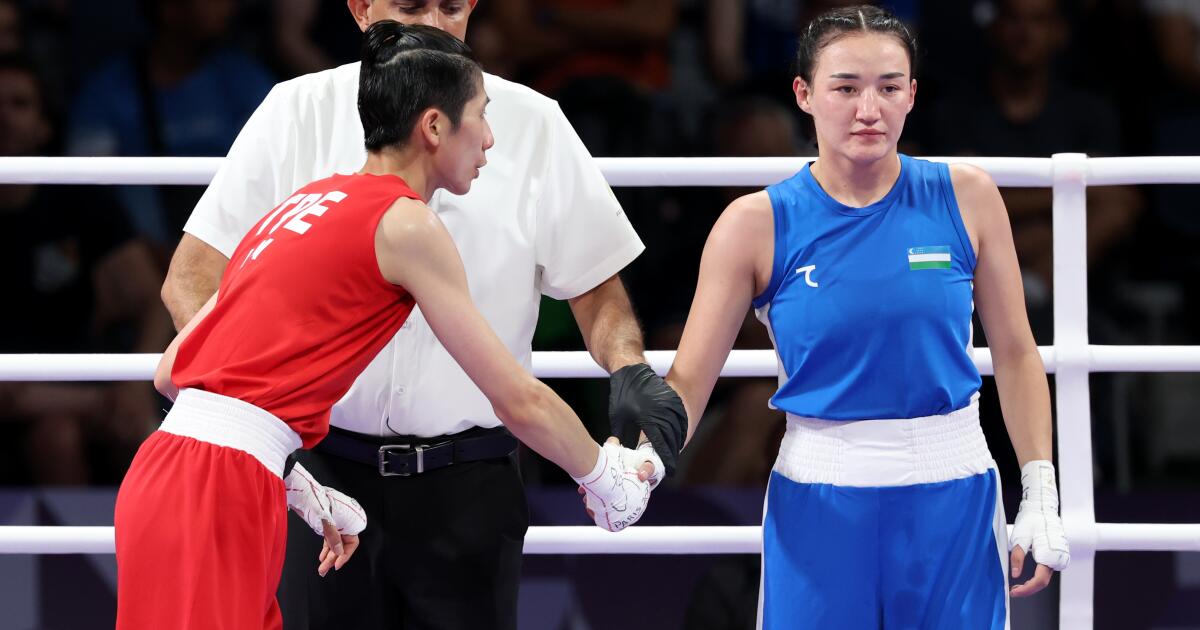
Taipei’s Lin Yu Ting, red, takes a punch from Uzbekistan’s Sitora Turdibekova in the Women’s 57kg boxing match.
(Wally Skalij/Los Angeles Times)
There is no evidence that either boxer is transgender or has chromosomal abnormalities. Though purposefully vague, officials have described what appear to be “differences of sex development,” a designation that applies to women who are androgen-sensitive or have naturally occurring testosterone levels in the male range.
The international track federation used this standard to demand that 800-meter star Semenya either take medication to alter her body chemistry or race against men. She fought the decision, losing in the Federal Supreme Court of Switzerland.
Sports have a long and troubled history with gender testing.
Early on, female athletes were forced to disrobe for physical inspections. Chromosome tests came into fashion for a while but were successfully challenged by Spanish runner Maria Jose Martinez-Patino in the 1980s because they could not account for rare conditions.
Though testosterone is now a common measure, there is continued disagreement over its validity.

Italy’s Angela Carini, left, cries after her loss to Algeria’s Imane Khelif at the Paris Olympics on Thursday.
(John Locher / Associated Press)
“These criteria keep folding under the weight of closer scrutiny,” said Schultz, who is also a kinesiology professor at Penn State. “None of them have held up over time.”
Veterans on the amateur scene, Khelif finished fifth in the 60 kilogram event and Lin finished ninth at 57 kilograms in the Tokyo Olympics in 2021. The Algerian won silver at the International Boxing Assn.’s 2022 world championships. The Taiwanese athlete earned gold at that tournament in 2018 and 2022.
But last year, the IBA took action against both women.
Khelif was disqualified shortly before her gold-medal bout and Lin after her bronze-medal victory. The IBA stated the boxers did not “undergo a testosterone examination but were subject to a separate and recognized test, whereby the specifics remain confidential.”
The situation grew more complicated when the IOC suspended its recognition of the IBA after years of dispute between the organizations. With the IOC temporarily in control of boxing at the Games, Khelif and Lin have had their eligibility restored.
It came as no surprise when Khelif’s bout on Thursday prompted dueling responses.
First the IBA condemned Olympic officials for letting Khelif and Lin compete, stating: “We absolutely do not understand why any organization would put a boxer at risk with what could bring a potential serious injury.”
The IOC fired back by saying: “Every person has the right to practice sport without discrimination.” It further noted the IBA disqualifications were “based entirely on this arbitrary decision, which was taken without any proper procedure.”

Algeria’s Imane Khelif, right, walks beside Italy’s Angela Carini after their women’s 66kg preliminary boxing match.
(John Locher / Associated Press)
On Friday morning, when questioned about the Olympics’ apparent struggle with gender rules, Adams said: “There is still neither scientific nor political consensus on this issue. It’s not a black and white issue. And we at the IOC would be very interested to hear of such a solution, such a consensus on this, and we would be the first to act on this should a common understanding be reached.”
Hours later, the media descended on a bout between Lin and Sitora Turdibekova of Uzbekistan. No devastating blows were landed during Lin’s victory, by unanimous decision, after which both athletes walked through the mixed zone without responding to questions.
Khelif’s next bout — against Anna Luca Hamori of Hungary — figures to attract similar attention on Saturday. The Hungarian Boxing Assn. has reportedly protested Khelif’s participation but Hamori did not seem as concerned. “I am not scared,” the boxer said. “If she or he is a man, it will be a bigger victory for me if I win. So let’s do it.”
Even Carini, who fell to her knees and cried after losing to Khelif, has been magnanimous. Her comments reflect the complexity of the issue.
“I am not in the position of saying this is right or wrong,” she told reporters. “I did my job as a boxer, entering the ring and fighting.”


new video loaded: NASA Announces Artemis III Crew
transcript
transcript
NASA Announces Artemis III Crew
NASA announced the crew of Artemis III mission, which will fly to low-Earth orbit to test rendezvous and docking maneuvers with one or two lunar landers.
-
“I am excited to welcome you as the next crew in the Artemis journey to successfully return to the moon — this time to stay.” “I’m honored by the role that I’ve been given. I’m also very humbled by the task in front of us. But first and foremost, I’m grateful.” “So with that, the Artemis II crew, comrade, hands you the baton. You got the controls.” “As you know, we had a significant anomaly at our Launch Complex 36A on May 28. We’ve redoubled our efforts and are moving forward.”
By Alisa Shodiyev Kaff
June 9, 2026
Science
Santa Monica Mountains’ last steelhead trout survived the Palisades fire — and even had babies

Scientists feared the Santa Monica Mountains’ last remaining steelhead trout were dead, smothered by debris flows unleashed by the Palisades fire.
But the endangered fish surprised them: A team of biologists recently spotted 30 of the rare trout — and 21 babies — in Topanga Creek.
“There was a lot of happy dancing in the creek,” said Rosi Dagit, principal conservation biologist for the Resource Conservation District of the Santa Monica Mountains, which works with public and private landowners to conserve natural resources.
That’s because the steelhead here are endangered, at both the state and federal levels. Once, they swam in most streams of the Santa Monicas, but their numbers plummeted amid overfishing and coastal development. Increasingly frequent wildfire has further stressed their habitat. Topanga Creek, a biodiversity hot spot, is home to their last known population in the mountains that stretch from the Hollywood Hills to Point Mugu in Ventura County.
The trout that were spotted, including this one, are part of a distinct Southern California population that’s listed as endangered at the state and federal levels.
(RCDSMM Stream Team)
The California Department of Fish and Wildlife spearheaded a complex mission to rescue trout threatened by the Palisades fire that sparked in January 2025.
Time was of the essence. The fire hadn’t yet been fully contained. But rain was on the way, which would sweep massive amounts of sediment from the denuded hillsides into the water. Fish are often killed this way.
Crews stunned the fish with electricity, scooped them up in buckets, trucked them to a hatchery and ultimately moved them to Arroyo Hondo Creek in Santa Barbara County.
Within days, Topanga Creek was choked with mud. Some assumed the fish left behind were goners.
But in March, the conservation district’s team found four. The following month, when water conditions were clearer, they saw more.
“These fish continue to amaze me,” said Kyle Evans, environmental program manager for the state Department of Fish and Wildlife, who had seen the damage to the creek. “I had seen populations get wiped out in similar situations. So when I heard, I was thrilled.”
Evans surmises the fish that survived were in an area of the creek where less charred material and sediment were swept in.
“These fish likely hunkered down, were hiding under some rocks or places to try to get away from the main concentration of flow,” he said. “And luckily they weren’t buried.”
The ones that were spotted were fairly small, around 6 to 14 inches. Rainbow trout and steelhead trout are the same species, but with different lifestyles. If the fish remain in freshwater, they’ll be considered rainbows. However, they can migrate to the ocean and become steelhead, where they typically grow larger before returning to their natal waters to spawn.
Topanga Creek hasn’t fully recovered from the damage it sustained, but scientists say it’s looking better. Surveys last year were “so depressing,” Dagit said, with very few animals, and stretches that were essentially transformed into flat roads from all the sediment buildup. Some of the riparian canopy burned right down to the creek.
Then came 32 inches of rain over the last nine months, scouring out and moving sediment, creating deeper pools. Dagit said they recently found newt egg masses for the first time in years, as well as a few adult newts and many frogs. Plants that provide cover are starting to recover.
She provided photos comparing certain pools last year and this year, some dramatically transformed. In September 2025, the Shrine Pool could have been an overgrown hiking trail. This April, it was filled with shallow water.

The Shrine Pool in September 2025, left, and the same location in April 2026, right, with RCDSMM’s Isaac Yelchin donning a wetsuit.
(RCDSMM Stream Team)
Topanga Creek is home to another endangered fish, the small but hardy northern tidewater goby, often described as cute. Not long before the trout operation, Dagit led a rescue of hundreds of these fish too. Many were repatriated to the lagoon at the mouth of the creek in a moving ceremony last June.
There’s still the matter of what to do with the trout that were moved to Santa Barbara County last year. Evans would like to bring them home to the Santa Monicas at some point, but isn’t sure if it will happen. On one hand, they could bolster the small, genetically isolated surviving population. On the other, they might inadvertently bring in a disease or bacteria. There is some time to decide. Evans estimates the creek still needs to recover for two to three more years.
For now, the fish are functioning fine in their adopted creek. Experts worried the trauma wrought by the move would disrupt their spawning process, but they had babies that spring. This year, they spawned again.

The Pacifica Municipal Pier was shut down and taped off Thursday after city workers noticed cracks running through the landmark structure and concrete chunks falling into the ocean.
It’s just one of many coastal California structures that have recently crumbled under pressure from a rising and relentless ocean.
Officials from the small, beach city south of San Francisco said the pier was closed due to “cracking, separation, and displacement of the concrete walkway and structural elements.”
It will stay closed while structural engineers asses its safety.
Photos taken by city employees show a wide crack that runs from top to bottom and across the structure as well. Other photos show a large horizontal crack under the foundation of a small restaurant on the pier, the Chit Chat Cafe.
The cafe was also shut down.
This is not the first time the 53-year-old pier has shown signs of stress. In 2021, part of it was shut down after handrails along the edge collapsed. And in 2023, after a series of storms pummeled the Central California coast, damaging parts of the pier, the structure was partially closed for more than year.
Those same storms caused extensive damage in Aptos and Capitola, 70 miles south, where piers and waterfront infrastructure were swept away or damaged.
In 2024, a 150- to 180- foot section of the Santa Cruz wharf was ripped off by powerful waves.
At least 10 of the state’s dozens of coastal public piers were closed for part or all of 2024 due to structural damage sustained in winter storms since 2022. At least five others have longer-term upgrades planned to address structural issues.
“These things are costly to maintain,” said Zach Plopper, senior environmental director at Surfrider. “They are a part of our California coastal culture in many ways, but we’re going to need to reckon with, one, the state that they’re in, and two, the continuous and worsening threats they’re going to experience,”
He said most of the piers were constructed in the early 1900s, and they weren’t built to withstand decades of rough seas, storms and rising sea level.
“With this incoming El Niño, which is forecasted to be significant, and this marine heat wave we’re in the midst of, we’re kind of in uncharted waters as far as what this winter could bring in terms of storms and swells to the California coast, and we’re likely going to see a lot more damage,” he said. “Not just piers, but roads and other coastal infrastructure up and down the state.”
There was no storm in Pacifica earlier this week, so no single event could be blamed for the destruction.
However, a 2025 report from an outside engineering firm, GHD, found that several sections of the pier were in “poor” or “serious” condition, and they recommended closure before anticipated storms or events that could “subject the piles to high winds, swells and large waves.”
The firm found several areas of the pier where concrete was missing and rebar was exposed and corroding.
“The pier has continued to experience high winds and large waves in a harsh marine environment,” the engineers wrote in the report, noting that continuous exposure to seawater or marine spray was “detrimental” to the structure.
A 2023 city report estimated it would cost $19 million to repair.
That same year, a state law was enacted to require local governments along the California coast to plan for sea level rise in the coming decades.
Sea level has risen some 8 inches, on average, along the coast in the past 150 years, Plopper said, and researchers anticipate another foot in the next 25 years.
“We’re going to see profound shifts on our coastline, none that we have ever experienced before, and building static structures on the coast just doesn’t work all that well,” he said. “We’re going to have to make some really hard decisions.”
-

 New Jersey38 seconds ago
New Jersey Food Council kicks off nationwide search for new CEO
-

 North Carolina3 minutes ago
4 charged after massive party in Alamance County ends with gunfire, stabbing, fights
-

 New Mexico4 minutes ago
The Battle of Socorro, New Mexico and the Uprising Against AI Data Centers
-

 North Dakota16 minutes ago
North Dakota election results: Latest on US House primary race
-

 Ohio19 minutes ago
$150,000 funding to be voted on for the Lisbon pool
-

 Oklahoma31 minutes ago
Oklahoma primary election guide for Bartians
-

 Oregon34 minutes ago
‘Changed my life’: Portland man warns of Facebook Marketplace dangers after robbery leaves him injured
-
 South-Carolina39 minutes ago
Evette and Wilson advance to runoff for South Carolina governor while Graham clinches nomination

