Politics
Ali: What's so hard about mixed-race heritage for Trump to understand?

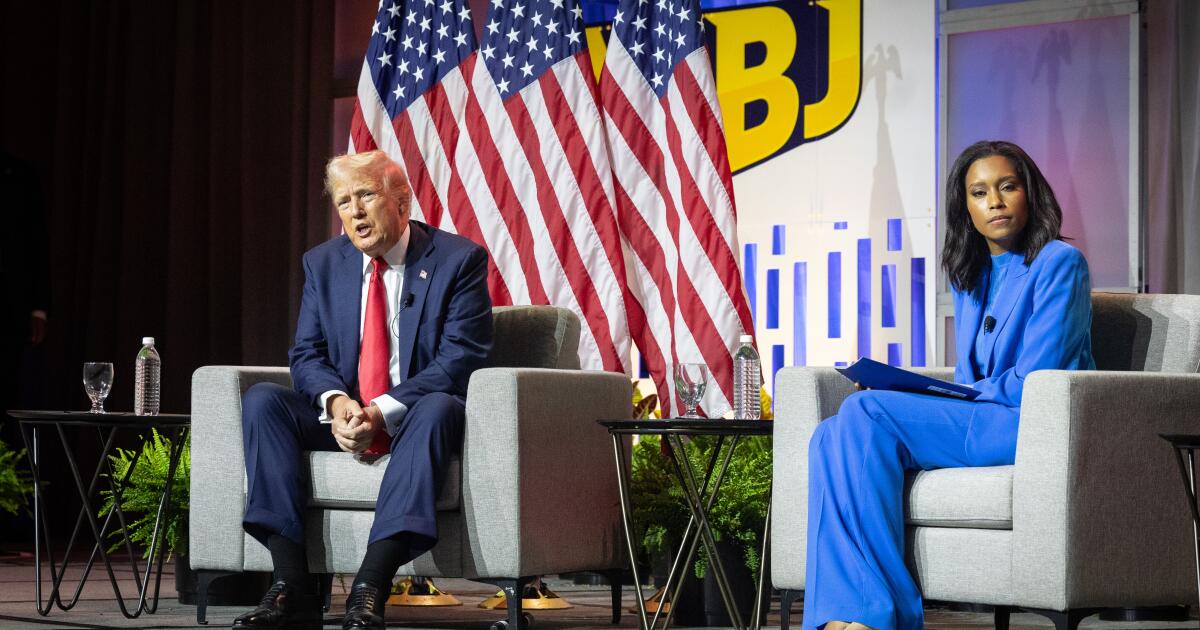
It wasn’t a debate. It was train wreck interview, and no one from Donald Trump’s party has called on him to step out of the presidential race — but they should.
The former president characterized Vice President Kamala Harris as a woman who can’t be trusted based on her mixed racial background during a livestreamed appearance in Chicago for the annual meeting of the National Assn. of Black Journalists.
“[Kamala] was always of Indian heritage, and she was only promoting Indian heritage,” Trump said of his likely opponent in the 2024 presidential election.
Harris’ mother is South Asian and her father is Black. It’s still a bit much for Trump to process, though he tried in real time to weaponize this information for his first big showing since Harris became his probable competition in the presidential race.
“I didn’t know she was Black until a number of years ago, when she happened to turn Black, and now she wants to be known as Black. So I don’t know, is she Indian or is she Black?” he asked. “I respect either one, but she obviously doesn’t, because she was Indian all the way then all of a sudden she made a turn and she went … she became a Black person. I think somebody should look into that too.”
Look into what, exactly? And does this critical investigation require a DNA test, a lie detector test, or both? What is so hard about mixed heritage to understand here?
Trump stopped short of using terms like “half-breed” or “unpure,” but the message was clear: mixed-race folks and those of multiple ethnicities are oddball anomalies, flip-floppers who must pick one identity to be trusted. Even then, their birthplace, citizenship and religious beliefs will be dissected and scrutinized by the birther movement he spearheaded against Barack Obama nearly a decade ago.
Race baiting and hating is nothing new to MAGA, of course, but it was still stunning to hear it come out of a presidential candidate’s mouth on a national stage with such confidence and candor.
For those of us who grew up in “mixed” households, the demand that we stay in one lane is not new, but it’s still absurd. Personally, I’m moving between outrage and disappointment that we’re still having these sorts of midcentury conversations in 2024.
Explaining who or what you are to hostile interrogators (i.e., teachers, school bullies) is exhausting, especially as a kid. It certainly was to me. I hoped the world would change in time for my son, who is Arab, Indian and white.
Portraying Harris as The Other in front of a room full of Black journalists Wednesday backfired big time. His attempt to sow doubt about Harris’ blackness, in front of a predominantly Black audience, didn’t appear to win hearts and minds.
There were groans from the audience when he proclaimed he was the best president for Black people since Abraham Lincoln, and when he accused Rachel Scott of ABC News (one of three female interviewers on stage) of giving him a “very rude introduction.” Her tough first questions about his criticisms of Black journalists, Black prosecutors and communities in general were apparently “nasty.”
That sort of speak is ear-candy in the MAGA-verse, where elected officials resurrect Jim Crow-era descriptors like “colored” and use terms like “DEI hire” to discredit Harris. The latter smear suggests that she was picked for VP not because of her accomplishments as California’s attorney general or as a U.S. senator, but because she checks a few demographic boxes. But the GOP’s desperate scramble for a winning screed against Harris is not taking hold yet, at least not in the same way the age card was used against President Biden when he was in the race.
Still, Trump doubled down on his “You can’t trust her” banter via his Truth Social platform. “Crazy Kamala is saying she’s Indian, not Black,” he wrote. “This is a big deal. Stone cold phony.” Or perhaps it’s that she’s a threat to Trump’s world order.
Harris is the daughter of, wait for it, immigrants! Her father is Jamaican and her mother is Indian. She attended Howard University, a historically Black university and she pledged to the historically Black sorority Alpha Kappa Alpha. As a U.S. senator representing California, Harris was a member of the Congressional Black Caucus.
Harris addressed Trump’s attacks from where she was speaking on Wednesday — the historically African American sorority Sigma Gamma Rho’s 60th International Biennial Boule.
“It was the same old show: the divisiveness, and the disrespect,” Harris said. “We deserve a leader who understands that our differences do not divide us — they are an essential source of our strength.”
Harris is right. Those of us from mixed parentage already know this, even if Trump wants to portray that truth as a weakness.

Politics
DOJ launches grand jury probe into Marxist mogul Neville Roy Singham’s funding of leftist groups

NEWYou can now listen to Fox News articles!
FIRST ON FOX: A federal grand jury is investigating alleged financial crimes by Neville Roy Singham, the China-based tech tycoon whose fortune has funded a sprawling network of socialist, communist and Marxist organizations across the U.S. over the last decade.
According to sources familiar with the matter, the grand jury in Manhattan has issued subpoenas as part of a probe launched by U.S. Attorney Jay Clayton for the Southern District of New York, one of the country’s most powerful districts for federal prosecutions. Acting U.S. Attorney General Todd Blanche authorized the investigation as the Trump administration seeks to crack down on fraud, money laundering and other financial crimes in the multibillion-dollar nonprofit industry.
The grand jury action follows a Fox News Digital investigation published in mid-March, documenting how Singham pumped $285 million from his base in Shanghai into a Goldman Sachs philanthropy fund and two shell corporations that then fed the money into a constellation of nonprofit organizations, media operations and activist groups pushing sectarian division, identity politics and support for socialist politicians.
The investigation is examining the movement of the money in Singham’s financial network and attempting to determine if Singham, the organizations he funded or their leaders committed wire fraud, bank fraud, money laundering or other financial crimes, according to sources familiar with the matter.
HOUSE OF SINGHAM: READ FOX NEWS DIGITAL’S 5-PART INVESTIGATION
On Feb. 14, 2018, Jodie Evans, co-founder founder of CodePink, and Neville Roy Singham, founder of Thoughtworks, attend V20: The Red Party, a 20th anniversary celebration of V-Day and The Vagina Monologues, featuring a performance by playwright Eve Ensler and an after-party at Carnegie Hall in New York City. (Dave Kotinsky/Getty Images)
Prosecutors have presented evidence to the grand jury, which has issued subpoenas seeking bank records and other financial documents from organizations in Singham’s network. Federal prosecutors use grand jury subpoenas as an investigative tool to compel the production of documents and testimony as they determine whether sufficient evidence exists to pursue criminal charges.
Nicholas Biase, spokesman for the U.S. Attorney’s Office for the Southern District of New York, declined to comment.
Showdown with Goldman Sachs
According to sources, Treasury Secretary Scott Bessent traveled to New York City earlier this year for a meeting with Goldman Sachs Chairman and CEO David Solomon. The men discussed the role of a Goldman Sachs philanthropic arm — GS Donor Advised Philanthropy Fund For Wealth Management Inc. — that facilitated the movement by Singham of millions of dollars into a network of U.S. nonprofits.
A Treasury Department spokesman declined to comment. A person familiar with the meeting confirmed that it occurred, saying that Bessent has regular meetings with business leaders, and declined to comment further on the substance of the meeting.
At that meeting, sources said, Bessent delivered a blunt ultimatum: Goldman Sachs could face scrutiny for alleged conspiracy in the funneling of the Singham money and urged Solomon to cooperate with federal investigators.
Like many U.S. companies, Goldman Sachs has had a long business relationship with the Chinese Communist Party, with Solomon participating in a meeting, for example, on Nov. 4, 2025, with He Lifeng, a member of the Political Bureau of the Communist Party of China Central Committee and director of the Office of the Central Commission for Financial and Economic Affairs.
Solomon pledged his cooperation, according to sources.
WALL STREET BANKS HELPED CHINESE MILITARY-LINKED FIRM RAISE BILLIONS DESPITE RED FLAGS, LAWMAKERS FIND
By mid-May, with the Southern District of New York investigation in full throttle, Solomon joined a delegation of powerful American business leaders who accompanied President Donald Trump, Bessent and other administration officials to China to meet with Chinese President Xi Jinping and other leaders of the Chinese Communist Party.
On Nov. 4, 2025, He Lifeng, a member of the Political Bureau of the Communist Party of China Central Committee and director of the Office of the Central Commission for Financial and Economic Affairs, meets in Beijing with David Solomon, chairman and CEO of Goldman Sachs Group. (Cai Yang/Xinhua News Agency via Getty Images)
In a five-part investigative series published earlier this year, Fox News Digital unearthed a four-minute-13-second speech in which Singham stood on a stage at the Golden Tulip Hotel on Nov. 13, 2025, for a conference of the “Global South Academic Forum,” coincidentally just days after the Goldman Sachs’ chief was in Beijing. Tricontinental Ltd., a Singham-funded nonprofit, co-sponsored the event with academic institutions administered by the Chinese Communist Party.
On stage, Singham openly supported a “new world order” promoted by Chinese President Jinping and the Chinese Communist Party. During the speech, he called the United States a “fascist” nation, echoing the propaganda of the Chinese Communist Party now also parroted on the streets by communist, socialist and Democratic Party activists.
WATCH THE NOVEMBER 2025 SINGHAM SPEECH:
The series revealed a 172-page report in which Singham outlined his theory of change, invoking 20th century Chinese communist leader Mao Zedong’s battle plan to wage a “people’s war” to spread communism. Mao was inspired by communist leaders Karl Marx and Vladimir Lenin.
LAWMAKERS RAISE ALARM OVER NEVILLE ROY SINGHAM’S $278M NETWORK SPREADING CCP PROPAGANDA IN THE U.S.
Singham’s rise as a global political financier accelerated after his February 2017 marriage to Jodie Evans, the co-founder of Code Pink, a far-left activist group that has aligned itself with authoritarian regimes including the Islamic Republic of Iran, the Communist Party of Cuba and the Chinese Communist Party. According to sources, Evans is also a target of the investigation, emerging as a board member in the U.S. on many of the organizations that Singham funded.
That same year, Singham sold his company, ThoughtWorks, for an estimated $785 million to a London-based private equity firm, Apax Partners. A spokeswoman for Apax Partners said the company wouldn’t disclose the names of the investors who pumped money into that sale, but sources told Fox News Digital that federal investigators are looking for potential ties to the Chinese Communist Party.
After that sale, Fox News Digital found, Singham began directing large sums of money into a network of organizations that now form part of a broader activist infrastructure in the United States and abroad.
In its investigation, Fox News Digital mapped 223 transactions from 2017 through 2025 that moved $591 million across five continents through 67 core groups in the Singham network. They partner with hundreds of groups worldwide, resulting in a network of about 2,000 groups, amplifying anti-U.S., pro-China messages.
Of that money, Fox News Digital established a documented $278 million flowed directly from Singham into organizations that “sow discord” in the U.S., as House Ways and Means Chair Jason Smith put it earlier this year at a hearing a dynamics called “foreign malign influence.”
Following the Money
In money-laundering investigations, prosecutors typically examine three stages of alleged impropriety called “placement,” “layering” and “integration.” Placement refers to the introduction of funds into the financial system. Layering involves moving money through multiple entities or transactions to allegedly obscure its origin. Integration is the point at which the money reemerges as apparently legitimate funding, grants, payments or organizational support.
Step 1: Alleged Placement
Singham allegedly funneled $278 million from Shanghai into the United States through three key channels — the philanthropic arm of Goldman Sachs and two shell corporations that have since gone defunct.
- $164,040,000 to Mutod LLC, a now-defunct shell corporation established in 2017, based in Chicago.
- $110,376,701 to GS Donor Advised Philanthropy Fund For Wealth Management Inc., a philanthropy arm of Goldman Sachs, based in New York City.
- $3,500,000 to Likewise Conceptions LLC, a now-defunct shell corporation established in 2017, based in Crystal Lake, Ill.
Step. 2: Alleged Layering
The three entities then pumped the $278 million into six nonprofits:
- $167,540,000 to People’s Support Foundation Ltd., a 501(c)(3) nonprofit established with a hotel address in 2017 in Chicago and Singham’s wife, Evans, on the board.
- $68,748,701 to Justice and Education Fund Inc., a 501(c)(3) established with a UPS Store address in 2018 in New York City with self-avowed communists, including Manola De Los Santos, on the board.
- $22,440,000 to People’s Forum Inc., a 501(c)(3) established in 2017 on W. 37th Street in New York City with Evans and De Los Santos on the board.
- $16,760,000 to Tricontinental Ltd., a 501(c)(3) established in North Hampton, Mass., in 2017 by Singham friend and fellow Marxist ideologue Vijay Prashad.
- $1,330,000 to CodePink Women For Peace, a 501(c)(3) established in 2009 in Marina Del Ray, Calif., by Singham’s wife, Evans, and her friend, Susan Medea Benjamin.
- $1,098,000 to Breakthrough BT Media Inc., a 501(c)(3) established in New York City in 2020 at the People’s Forum headquarters with longtime American communist leader Brian Becker’s son, Ben Becker, as editor-in-chief of its pro-communist propaganda outlet, Breakthrough News.
Step 3: Alleged Integration
The six nonprofits then funneled at least $223 million and other forms of support into a global network of organizations including:
- People’s Welfare Association, a 501(c)(4) established in 2019 with the address of a UPS store in Madison, Wisc., today reporting about $12 million in revenues transformed into grants to undisclosed groups around the world.
- Countless unidentified organizations in six regions around the world, including Subsaharan Africa, Central America and even North America, receiving tens of millions of dollars.
- The ANSWER Coalition, a communist organization whose Chicago address has been listed as the location of the Green Mill Restaurant, a regular haunt for 20th century gangster Al Capone, whom federal prosecutor Elliott Ness prosecuted and convicted for tax evasion.
- The Party for Socialism and Liberation, a loosely-structured organization with shared leadership from the House of Singham, like the Becker father-son duo.
FLASHBACK: INSIDE THE POLITICAL MOVEMENT THAT PUT A SOCIALIST IN CHARGE OF NEW YORK CITY
Socialist New York congressional nominees Darializa Avila Chevalier (L), Claire Valdez (C) and Brad Lander. (Michael M. Santiago/Getty Images; Michael Nagle/Bloomberg via Getty Images; Adam Gray/Bloomberg via Getty Images)
Singham and Evans haven’t responded to repeated requests for comment from Fox News Digital. In January, Becker and De Los Santos refused to respond to questions by Fox News Digital outside the People’s Forum headquarters. Benjamin refused to respond to questions during a protest in May.
The ANSWER Coalition, Breakthrough BT Media Inc., CodePink Women for Peace, Justice and Education Fund Inc., Party for Socialism and Liberation, People’s Forum Inc., People’s Welfare Association and Tricontinental Ltd. also haven’t responded to repeated requests for comment. Representatives for Mutod Ltd. and Likewise Conceptions LLC couldn’t be located.
CLICK HERE TO DOWNLOAD THE FOX NEWS APP

WASHINGTON — Licensed gun owners have a right to carry a concealed firearm into stores and other private places unless the owner objects, the Supreme Court ruled Thursday.
The 6-3 decision extends gun rights and strikes down laws in Hawaii, California, New York, New Jersey and Maryland.
Those measures would prohibit carrying guns onto private property that is open to the public unless the owner has expressly authorized them.
“This regime hobbles what the 2nd Amendment protects: the right of Americans to carry arms for self-defense as they go about their daily lives. We hold that the law is unconstitutional,” Justice Samuel A. Alito Jr. said for the court.
The new laws, if upheld, would “impose severe restrictions on the daily activities of residents who have satisfied the state’s rigorous requirements for the issuance of a carry permit. When these permit holders leave home in the morning, … they may also be barred from entering many places that people routinely visit in the course of their daily routines, such as gas stations, convenience stores, restaurants, coffee shops, drug stores, grocery stores, ‘big box’ stores, home improvement stores, barber shops or hair salons, dry cleaners, and laundromats.”
The three liberals dissented, saying the law would protect property owners who don’t want guns in their stores.
“There is no constitutional right to enter private property without the owner’s permission, let alone with a firearm,” said Justice Ketanji Brown Jackson.
Trump administration lawyers had joined a coalition of Hawaii gun owners in urging the court to strike down these blue state laws in the case of Wolford vs. Lopez.
They said the laws, if enforced, would mean “a person carrying a handgun for self-defense commits a crime by entering a mall, a gas station, a convenience store, a supermarket, a restaurant or a coffee shop.”
This litigation is part of much broader debate over where guns may be permitted or prohibited.
Four years ago, the justices ruled that law-abiding persons had a right to obtain a permit to carry a concealed gun when they left home. They also agreed there are “sensitive places” where guns may be prohibited, such as schools, courts and other government buildings.
In response, lawmakers in California and Hawaii adopted their own lists of “sensitive places.” They imposed restrictions on concealed weapons at parks, beaches, playgrounds, places of worship and public transit as well as bars and restaurants that serve alcohol.
Gun owners sued but the 9th Circuit Court refused to block most of those restrictions in a single 83-page opinion covering Hawaii and California. Both states would prohibit carrying guns onto private property open to the public without the owner’s consent.
The 9th Circuit upheld that measure in principle but said California went too far by requiring the owner to post a prominent sign expressly authorizing guns.
“While today’s ruling in Wolford is disappointing, owners still have every right to decide whether firearms are allowed in their stores and businesses,” said Janet Carter, managing director of Second Amendment Litigation at Everytown Law. “The Supreme Court may have changed the default rule, but it cannot take away a private property owner’s authority over their own land.”
The Firearms Policy Coalition said the court had properly protected gun rights and barred states from carving out their “own regional version of the 2nd Amendment.”
“The historical record does not support forcing peaceable people to obtain advance permission before carrying for self-defense in places held open to them,” the group said.
Last week, the court upheld gun rights in a Texas case and said the government may not make it a crime for an “unlawful user” of a drug such as marijuana to own a gun.
Politics
Jacob Frey praises Somali community as Minnesota faces renewed scrutiny over fraud investigations

NEWYou can now listen to Fox News articles!
Minneapolis Mayor Jacob Frey told members of the city’s Somali community over the weekend that they are “our family,” pledging solidarity and praising their contributions to the city during remarks celebrating Somali Independence Day.
Frey’s remarks came as Minnesota continues to face scrutiny over several high-profile fraud investigations and weeks after a Republican-led House Oversight Committee report alleged the Minnesota Governor Tim Walz’s administration failed to act on repeated warnings about widespread fraud in the state’s social services programs.
“Through the most difficult of times and through Operation Metro surge, we all saw that they tried to come for some of us,” Frey told members of the Somali community on Saturday. “And when that happens, we say that you’re coming for all of us.”
BLUE STATE’S ANTI-ICE PLEDGE COLLAPSES AS GOP WARNS OF NEW SANCTUARY ‘CONFEDERACY’
Minneapolis Mayor Jacob Frey speaks during a Somali Independence Day celebration in Minneapolis as attendees stand on stage holding Somali flags. (Credit: Mayor Jacob Frey X Post)
“In Minneapolis, we loved our neighbors. In Minneapolis, we do not see you as immigrants. We see you as our family,” he added. “You are our brothers. You’re our sisters. You have done so much for this incredible city, and for that, we stand with you.”
Frey appeared to reference Operation Metro Surge, the Trump administration’s immigration and public safety initiative in Minnesota.
The operation concluded in February after border czar Tom Homan announced it had resulted in the arrest of more than 4,000 people in the Minneapolis-St. Paul area and had reduced what he described as public safety threats.
BLUE STATE’S ANTI-ICE PLEDGE COLLAPSES AS GOP WARNS OF NEW SANCTUARY ‘CONFEDERACY’
Minneapolis Mayor Jacob Frey speaks to the media at City Hall on Jan. 9. (Aaron Lavinsky/The Minnesota Star Tribune via Getty Images)
Frey shared the video on X, writing, “Happy Somali Independence Day.”
“Here in Minnesota, home to one of the largest Somali communities in the United States, we celebrate the resilience, culture, and leadership that continue to enrich our city and community,” he said.
Earlier this month, a Republican-led House Oversight Committee report alleged Walz’s administration repeatedly failed to act on warnings about fraud involving state social services programs, including the Feeding Our Future scandal.
WALZ ADMINISTRATION IGNORED FRAUD WARNINGS AS BILLIONS VANISHED, HOUSE OVERSIGHT REPORT ALLEGES
Democratic Gov. Tim Walz speaks during a news conference on Tuesday, Jan. 6, 2026, in Minneapolis, Minnesota. (Alex Kormann/Star Tribune via AP)
The committee said more than 110 people have been charged in connection with various fraud schemes in Minnesota, including many defendants identified as members of Minnesota’s Somali immigrant community.
The report also alleged concerns about potential racial discrimination claims contributed to delays in addressing suspected fraud and estimated Minnesota lost roughly $300 million in stolen federal child nutrition funds during the COVID-19 pandemic.
CLICK HERE TO DOWNLOAD THE FOX NEWS APP
Walz administration officials have disputed the committee’s findings.
Fox News Digital’s Adam Pack contributed to this report.
-

 Kentucky5 minutes ago
Northern Kentucky parents sentenced for shooting death of their toddler by his brother
-

 Louisiana12 minutes ago
Gas prices on the fall in Louisiana
-

 Maine15 minutes ago
ICE arrests operator of midcoast Maine market
-

 Maryland20 minutes ago
Southern Maryland Cooling Centers Open As Dangerous Heat Builds Ahead Of July 4 Weekend – The BayNet
-

 Michigan27 minutes ago
60% of traffic restrictions to be lifted in Michigan during Fourth of July travel — what to expect
-

 Massachusetts30 minutes ago
4 shot during World Cup watch party in Massachusetts
-

 Minnesota35 minutes ago
David Doty, Minnesota federal judge who oversaw NFL’s labor disputes for decades, dies at 96
-

 Mississippi42 minutes ago
US Supreme Court endorses grace periods for Mississippi mail-in ballots

