Politics
Why California's surge in immigration is lifting our economy

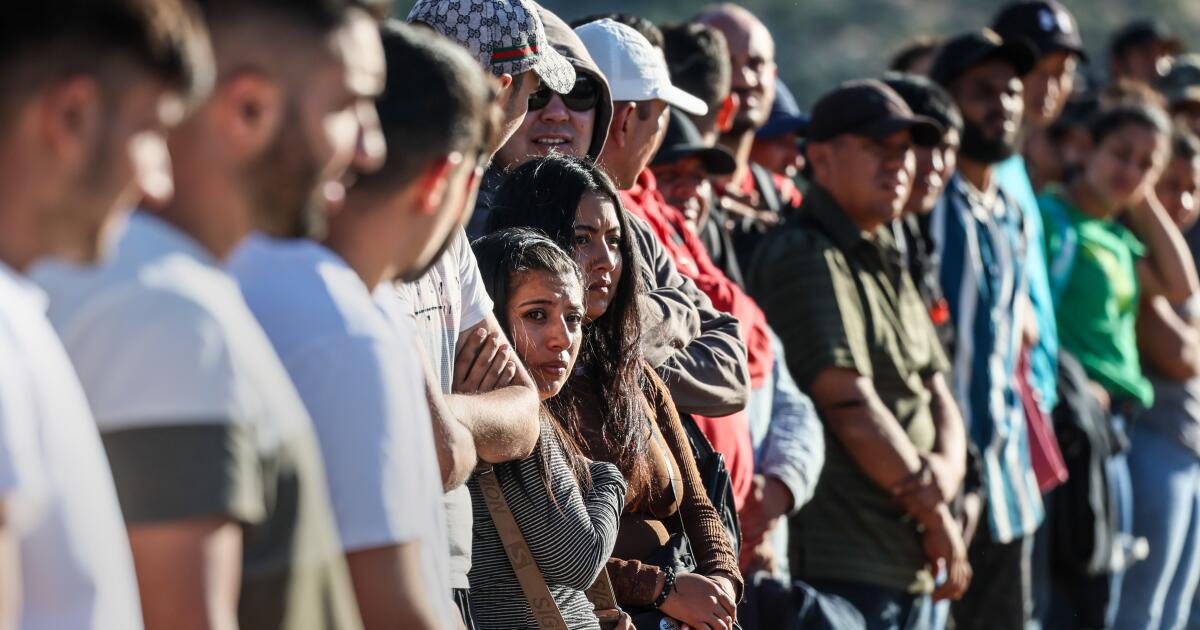
Kamala Harris had no sooner replaced Joe Biden as the presumptive Democratic presidential nominee than Donald Trump began bashing her over the number of immigrants coming into the United States, declaring that they had driven countless American workers from their jobs.
But the data on U.S. employment and the economy overwhelmingly suggest a reality far more beneficial when it comes to immigration than the nightmarish vision the former president has put forth.
The surge of international migrants since 2021 — including refugees, asylum seekers and others entering legally and illegally — has lifted the U.S. and California economies by filling otherwise vacant jobs, helping to keep job creation strong, growing businesses and pumping millions of tax dollars into state, local and federal coffers.
Payroll taxes on immigrant workers have even helped relieve pressure on the nation’s embattled Social Security system.
There are, of course, short-term public costs associated with acclimating so many new arrivals, plus government expenditures on education and health services for immigrants and their families, along with the political and social challenges. Many agree the current immigration system is flawed and chaotic.
But from a budgetary perspective, the additional federal spending on immigrants is projected to pale next to the increase in revenues from the millions more people working, paying taxes and buying goods and services, according to the Congressional Budget Office.
And more than a few economists say that, by easing the shortage of American workers as the U.S. population grows older and birth rates decline — particularly in California — immigrants have played a large and positive role in maintaining a healthy, growing economy.
“This is the hottest labor market that has existed in two generations,” said Michael Clemens, an economist at George Mason University who specializes in international migration. “That means there have never been as many opportunities for immigrants and natives to mutually benefit each other through economic interaction in the last half century.”
Without immigration, California’s workforce would have fallen well short of its needs, especially since the high cost of living, soaring home prices and other factors have fueled a notable outflow of population from the state.
From 2021 to 2023, the population of U.S. citizens 16 years and older living in California fell by 625,000, according to data from the U.S. Bureau of Labor Statistics, while employment increased by 725,000.
Over that period, however, the unemployment rates for native-born and foreign-born Californians fell by similar levels — an indication that immigrants are not taking away American jobs.
Moreover, the recent waves of migrants are filling lower-paying, more physically demanding positions that do not attract as many native-born Americans, at least not at the wages that are offered.
An important source of labor
“Immigrants are a really important source of the labor force for California, in the high end as well as in a lot of jobs that don’t pay as well,” said Hans Johnson, a demographer at the Public Policy Institute of California.
Separate employers’ data from the Bureau of Labor Statistics show that more than 70% of the nearly 400,000 payroll jobs added in California between June 2022 and June 2024 have been in just two industries: social assistance, such as health services for the elderly and child care; and leisure and hospitality, primarily hotels and restaurants.
Both sectors are heavily dependent on immigrant workers.
Employers in construction, another industry reliant on immigrant labor, also added thousands of jobs in that period.
“A lot of what we do is physical — you get on your knees. And Americans don’t do that,” said Tom Straus, owner of Straus Carpets. He’s been in the flooring business in the Bay Area for almost half a century and has regularly hired Latino immigrants. “The work is excellent and strenuous,” he said.
Angie, 28, and her husband and their 6-year-old arrived in Los Angeles last October from a village in Ocaña, Colombia, about 375 miles north of Bogotá. They flew from Bogotá to Cancún, Mexico, and from there to Tijuana. Then the family walked across the border checkpoint into San Diego, receiving provisional entry as migrants seeking asylum.
“It was expensive,” Angie said of the travel costs, money they borrowed from relatives. Given her uncertain status, she didn’t want to provide her last name.
At the border, Angie got a “notice to appear” at immigration court in May 2025, and she can stay in the U.S. legally until at least then. But migrants have to wait 150 days after they formally apply for asylum before they can receive employment authorization.
Angie began working almost immediately upon arrival, first at a clothing business. More recently she found work in housekeeping at a hotel in Los Angeles. Her husband works remodeling houses.
“I feel like I’ve been blessed greatly,” she said.
Angie and her family were among some 3.3 million immigrants who arrived in the U.S. last year, after net immigration of 2.6 million in 2022, according to estimates by the Congressional Budget Office. Those numbers are roughly triple the annual average in the prior decade. A similarly large number is expected this year, although immigration over the long haul is likely to return to around 1 million a year, experts say.
No one knows how many immigrants who arrive in California decide to stay here. Over the years, increasing opportunities in other states and California’s high cost of living have made it less attractive as a final destination. The latest Census Bureau figures, for 2022, show that 27% of California residents are foreign-born, about double the U.S. share.
Most of the immigration increase in recent years has been driven by foreign nationals entering illegally, asylum seekers and hundreds of thousands of people from Ukraine, Venezuela, Haiti and other countries who entered under humanitarian programs and can apply for work authorization.
Since 2021, U.S. border patrol officers have seen a surge of migrants from Mexico, Colombia, Ecuador and Peru — but also from countries such as China and India, whose citizens in the past had rarely sought to come through the southwest border, Department of Homeland Security statistics show.
Over the last few years, about 6 in 10 people crossing unlawfully have been turned away, according to an analysis of DHS data by Clemens, the George Mason professor. Most of those who are detained and not expelled are released in the U.S., many because they have shown credible evidence of fear and a desire to apply for asylum.
Then there’s a whole other large group of people who enter unlawfully and are never encountered by border patrol.
What’s behind the surge at the border?
These migrants are part of an unprecedented international movement of people to the U.S. and other rich countries. While some are fleeing political and economic crises, the relocation is actually less a result of bad conditions at home than of successful development — which brings better health, greater awareness of international options and more income for travel. That allows people to pursue opportunities for better lives in the more prosperous countries such as the U.S., experts say.
And technological advancements in many parts of the world have made the journeys more possible. Mobile phones and social media give almost anyone anywhere the basic information needed to migrate.
In his recent trip to southern China researching international migration, UCLA professor Raul Hinojosa-Ojeda met with people in Yunan province who were preparing to immigrate to the U.S. by entering through Tijuana.
“They saw it on TikTok, how to do it,” Hinojosa-Ojeda said.
The primary magnet attracting record numbers to the U.S. is jobs. Though unemployment has edged up recently as a result of government efforts to curb inflation, there are still 10 job openings for every eight unemployed workers in the U.S., according to government data. For most of the last 2½ years the U.S. jobless rate has been at or just above 3.5%, the lowest since the late 1960s.
Although the labor market isn’t as tight in California, at 5.2% in June, the unemployment rate isn’t far off historical lows for the state. And employers are still adding thousands of jobs a month, with some positions going to workers without legal status.
“They’re getting a worker. The only downside is if they get in trouble for it — and that doesn’t often happen,” said Jamie Wipf, operations manager at the International Institute of Los Angeles, a 110-year-old organization that helps refugees and other immigrants.
The nonprofit’s job placement records show many new arrivals are employed as drivers, security guards, caregivers and warehouse workers. The vast majority earn minimum wage to about $20 an hour.
Where California immigrants work
Many employers in California are reluctant to talk about immigration because of the sensitivities surrounding the politically charged issue, especially in this election year. The California Chamber of Commerce, California Business Roundtable and other industry groups declined to comment for this article.
Yet their member companies depend heavily on immigrants. Foreign-born Californians account for one-third of all workers at restaurants and warehouses; about 40% in home healthcare and child day care; almost 50% at trucking and lodging businesses; and 60% at services for landscaping and cleaning buildings, according to a Times analysis of 2022 Census Bureau data.
Are their large numbers holding back wage gains?
Economists say there is some truth to the claim that a surge of working-class immigrant labor could put downward pressure on certain jobs, such as meatpacking and gardening. But studies have shown that immigration has had no significant negative impact on wages for American workers overall.
Giovanni Peri, an economics professor at UC Davis, said large-scale immigration actually boosts productivity and demand for services, which in turn helps companies to grow and create jobs that are more likely to be taken by native-born workers, such as those in sales and management.
It’s also well documented that immigrants have higher rates of self-employment, whether that means working as an Uber driver, pushing a street food cart or launching an ambitious tech business.
Yaroslav Uchkin and his girlfriend, Ukrainian refugees, moved to Los Angeles in February after several months in the Bay Area, where they had stayed with a host family. They both have work permits. Uchkin has found part-time work as a fitness instructor; his partner works as a food server.
“I have some vision,” Uchkin said of a business he’s looking to start, making sports nutrition products. “Why I’m here in L.A.? I love the place for energy. People love sports, they want to look better.”
Uchkin and his girlfriend recently leased a one-bedroom apartment in Marina del Rey. The arrival of many new immigrants has helped reverse or, in L.A.’s case, stanch the population loss in cities that saw a pandemic-related exodus of residents, according to a study by Brookings Institution demographer William Frey.
“There’s no doubt the economy is better off because of immigration,” said Christopher Thornberg, founding partner at Beacon Economics, a research and consulting firm in Los Angeles.
“At one level, I understand people are nervous about folks coming here in an uncontrolled way,” he said, noting that he fears the anti-immigrant drumbeat is getting louder and louder.
“But our nation desperately needs people,” he said. “People have stopped having babies, and so many are going into retirement. And here we really have an opportunity to help our economy in the long run, and we are turning away from it.”

Politics
Jacob Frey praises Somali community as Minnesota faces renewed scrutiny over fraud investigations

NEWYou can now listen to Fox News articles!
Minneapolis Mayor Jacob Frey told members of the city’s Somali community over the weekend that they are “our family,” pledging solidarity and praising their contributions to the city during remarks celebrating Somali Independence Day.
Frey’s remarks came as Minnesota continues to face scrutiny over several high-profile fraud investigations and weeks after a Republican-led House Oversight Committee report alleged the Minnesota Governor Tim Walz’s administration failed to act on repeated warnings about widespread fraud in the state’s social services programs.
“Through the most difficult of times and through Operation Metro surge, we all saw that they tried to come for some of us,” Frey told members of the Somali community on Saturday. “And when that happens, we say that you’re coming for all of us.”
BLUE STATE’S ANTI-ICE PLEDGE COLLAPSES AS GOP WARNS OF NEW SANCTUARY ‘CONFEDERACY’
Minneapolis Mayor Jacob Frey speaks during a Somali Independence Day celebration in Minneapolis as attendees stand on stage holding Somali flags. (Credit: Mayor Jacob Frey X Post)
“In Minneapolis, we loved our neighbors. In Minneapolis, we do not see you as immigrants. We see you as our family,” he added. “You are our brothers. You’re our sisters. You have done so much for this incredible city, and for that, we stand with you.”
Frey appeared to reference Operation Metro Surge, the Trump administration’s immigration and public safety initiative in Minnesota.
The operation concluded in February after border czar Tom Homan announced it had resulted in the arrest of more than 4,000 people in the Minneapolis-St. Paul area and had reduced what he described as public safety threats.
BLUE STATE’S ANTI-ICE PLEDGE COLLAPSES AS GOP WARNS OF NEW SANCTUARY ‘CONFEDERACY’
Minneapolis Mayor Jacob Frey speaks to the media at City Hall on Jan. 9. (Aaron Lavinsky/The Minnesota Star Tribune via Getty Images)
Frey shared the video on X, writing, “Happy Somali Independence Day.”
“Here in Minnesota, home to one of the largest Somali communities in the United States, we celebrate the resilience, culture, and leadership that continue to enrich our city and community,” he said.
Earlier this month, a Republican-led House Oversight Committee report alleged Walz’s administration repeatedly failed to act on warnings about fraud involving state social services programs, including the Feeding Our Future scandal.
WALZ ADMINISTRATION IGNORED FRAUD WARNINGS AS BILLIONS VANISHED, HOUSE OVERSIGHT REPORT ALLEGES
Democratic Gov. Tim Walz speaks during a news conference on Tuesday, Jan. 6, 2026, in Minneapolis, Minnesota. (Alex Kormann/Star Tribune via AP)
The committee said more than 110 people have been charged in connection with various fraud schemes in Minnesota, including many defendants identified as members of Minnesota’s Somali immigrant community.
The report also alleged concerns about potential racial discrimination claims contributed to delays in addressing suspected fraud and estimated Minnesota lost roughly $300 million in stolen federal child nutrition funds during the COVID-19 pandemic.
CLICK HERE TO DOWNLOAD THE FOX NEWS APP
Walz administration officials have disputed the committee’s findings.
Fox News Digital’s Adam Pack contributed to this report.

For as long as I’ve been a journalist, which is a really long time, public entities have hated public records requests, even while claiming they don’t.
Ask your typical elected or hired official, from the governor to the animal control folks, and they’ll tell you transparency is vital and sunshine in government a key value.
Then turn in the most benign of public records requests — access to a calendar, for example — and prepare for weeks of delays and excuses. Want emails or financial records or, heaven forbid, anything from the police? Months or even years may pass before a single page is delivered, no joke.
That’s why I am deeply concerned about a bill winding its way through the California Legislature that would definitely slow down public records requests and likely make them more difficult and expensive. At its worst, it could push people into costly court battles just for having the audacity to ask for information.
The legislation, Assembly Bill 1821, is authored by Democratic Assemblymember Blanca Pacheco, whose district includes Norwalk, Downey and Bell, where legendary scandals are Example 1 of why public records matter.
Pacheco’s office told me Wednesday that the troubles with the bill are far from what Pacheco set out to do.
“It was never the author’s intention to take away people’s rights to a [Public Records Act] request,” said her chief of staff, Nikki Johnson.
Johnson said the bill was meant to curtail malicious records requests, which do happen, where a citizen goes after copious amounts of records just to be a jerk and cost the government time and money.
It was also meant to address the growing problem of artificial intelligence and other for-profit businesses requesting thousands of records with the intent of using the information to create money-making products — think of sites that already sell publicly available personal information as “background checks.”
I believe Johnson on the good intentions of the bill in addressing those real if nebulous difficulties, but you know what they say about the best-laid plans.
The bill passed through the Assembly recently with ease, largely because most of its problematic portions (I’ll get to those in a minute) were removed — though not all. Even in a watered-down form, which basically gave government more time to answer requests, I found myself in the unlikely position of agreeing with conservative Republican Assemblymember and Trump supporter Carl DeMaio of San Diego, who offered some of the only opposition from elected leaders during the Assembly vote.
“We cannot police the public’s right to know, and we want to err on the side of transparency in how government agencies operate,” DeMaio said.
Amen, brother.
But the Democratic-controlled Assembly erred on the side of secrecy and slowdown instead, and the measure sailed to the Senate, where seemingly out of the blue, a bunch of new provisions were added that fill it with loopholes, vague language and tons of room for abuse.
David Snyder, executive director of the First Amendment Coalition, said the bill as written now was “comprehensively bad for transparency and therefore for government accountability.”
Sean McMorris, transparency, ethics and accountability program manager for the advocacy organization California Common Cause, put it even more forcefully. He pointed out that “public records are the public’s records.”
“They’re not owned by the government,” he said. But this bill would shift that paradigm and make the public “prove why you need them.”
“It’s going to chill people who want to make requests, and it’s going to complicate the process, and it’s just wrong,” McMorris said.
In its new form, the bill basically allows government entities to decide if they feel a public records request is malicious or for commercial gain. If they do, they can petition a court to intervene — potentially sparking both legal costs and new fees associated with fulfilling the request.
It would also, Snyder said, force a requester to explain why they wanted the records — something California law has repeatedly avoided because it gives power to government to treat those it perceives as enemies differently.
In this age of fairness and reason, it’s hard to imagine a government official misusing power to keep secrets, but I’m told it happens. That makes it all the more crucial that people not be forced to explain why they want information, or if they will use it to, say, expose corruption — be it wrongdoing by a single individual or the entire system.
Faced with unintended consequences, Assemblymember Blanca Pacheco (D-Downey), shown in 2023, will seek to scale back the bill to its original form, according to her chief of staff.
(Rich Polk / Getty Images for Equality California)
“I have little doubt that some agencies will use that provision to overburden requesters that they view as political opponents, requesters that they view as just a hassle, requesters that ask for things the government doesn’t want to disclose,” Snyder said. “They can bring the requester into court, and at a minimum, slow down the process, and probably more likely get the requester to simply withdraw.”
As written, the bill also gives a shoddy carve-out meant to protect journalists, but which in reality could be used to curtail requests from freelancers, student journalists and more.
McMorris said access to public records is a “moral issue,” and fixing any problems with the current law requires “a scalpel, not a meat ax.”
This bill, he warned, is a meat ax.
“I don’t discount that there are abusive requests, and that there are requests that really are a burden on government agencies, but the law right now has ways for government agencies to address that,” he pointed out. “Once these laws go into place, they’re going to be hard to roll back.”
It could “fundamentally change” our access to public records, he said.
Johnson, Pacheco’s chief of staff, told me that faced with all these unintended consequences, the Assembly member is going to ask for the amendments to be removed, and for the bill to progress as it was written when it passed the Assembly. That could happen as early as next week, when the bill with the new provisions is scheduled to come up again in a Senate committee for debate.
Reverting to the bill the Assembly voted on would be better, but slowing down public records is in government’s best interests, not the people’s. The bill does nothing to address the problems it seeks to fix, but stretches out the time officials have to simply tell a requester if any records do exist — never mind delivering them.
So even back to its watered-down form, the bill remains a meat ax for a scalpel problem, chopping up transparency with good intentions.

NEWYou can now listen to Fox News articles!
Former President Joe Biden appeared to briefly seek directions before exiting the stage after delivering remarks at a Democratic gala Saturday night, capping his speech with an awkward onstage moment.
After delivering a roughly 10-minute keynote speech at the Maryland Democratic Party’s “Fight Back & Win Gala” near Baltimore, the 83-year-old paused onstage and looked toward the wings before pointing in two different directions, seemingly trying to determine where to exit. After receiving guidance, Biden turned and walked off the stage with his back to the audience.
Unlike several other speakers at the gala, who exited on the opposite side of the stage after their remarks, Biden left in a different direction.
EX-DEM INSIDER REVEALS SHE WILL EXPOSE DEMOCRATS WHO COVERED UP BIDEN’S COGNITIVE DECLINE IN NEW BOOK
Former President Joe Biden exits the stage after delivering remarks at the Maryland Democratic Party’s Fight Back and Win Gala near Baltimore on Saturday. (CSPAN)
The moment came after Biden delivered one of his sharpest public critiques of President Donald Trump since leaving office. During his remarks, Biden defended his own administration’s record while accusing the Trump administration of corruption. He also took aim at what he described as Trump’s “vanity projects,” including renovations to the White House, changes at the Kennedy Center and the ongoing saga with the reflecting pool on the National Mall.
“Whoa, what a loser,” Biden said.
After pausing several times to cough throughout his remarks, Biden concluded with a call for Democrats to “fight back,” saying the country could overcome its challenges by acting together.
“Folks, I guarantee we can do this. And we will. We just remember who in the hell we are. We’re the United States of America,” Biden said. “There’s nothing, nothing beyond our capacity if we act together. So let’s get up and fight back, God darn it.”
The latest onstage moment comes just days after another widely shared incident at the opening of the Obama Presidential Center in Chicago.
WATCH: BIDEN LEFT SEARCHING FOR FAMILY AFTER OBAMA PRESIDENTIAL CENTER CEREMONY
The star-studded ceremony brought together former Presidents Barack Obama, Bill Clinton and George W. Bush, along with former Secretary of State Hillary Clinton, former Vice President Kamala Harris and other political leaders and entertainers. At the conclusion of the event, Biden remained onstage after others had exited before calling out, “Where’s my granddaughter?”
Former First Lady Jill Biden then returned to the stage, took his hand and guided him off.
SIGN UP TO GET THE POLITICS NEWSLETTER
Former U.S. President Joe Biden and Former first lady Jill Biden appear on stage during the dedication ceremony for the opening of the Barack Obama Presidential Center in John Lewis Plaza on June 18, 2026 in Chicago, Illinois. (Scott Olson / Getty Images)
Biden has largely stayed out of the public eye since withdrawing from the 2024 presidential race after facing intense pressure from fellow Democrats to end his reelection bid.
CLICK HERE TO DOWNLOAD THE FOX NEWS APP
The former president has since made only occasional public appearances and recently disclosed that he is undergoing treatment for Stage 4 prostate cancer.
-

 Maryland2 minutes ago
Maryland Lottery Pick 3, Pick 4 results for June 28, 2026
-

 Michigan9 minutes ago
Three U.S. House hopefuls in Michigan own million-dollar D.C. homes
-

 Massachusetts10 minutes ago
Man cited for alleged wrong-way deadly crash
-

 Minnesota17 minutes ago
Minnesota leads all states with 12 draftees – Lets Play Hockey
-

 Mississippi24 minutes ago
Mississippi’s Top High School Quarterbacks: 10 Passers to Watch in 2026
-
Missouri27 minutes ago
Missouri Lottery Pick 3, Pick 4 winning numbers for June 28, 2026
-
Montana32 minutes ago
French Montana, Rick Ross & Max B Turn the BET Awards Into “ – BET Awards 2026 | BET
-

 Nebraska39 minutes ago
"They've Built This": Nebraska commit Barrett Kitrell carries on family football legacy


