Business
Column: What FDR could advise Biden about reforming the Supreme Court — tread lightly

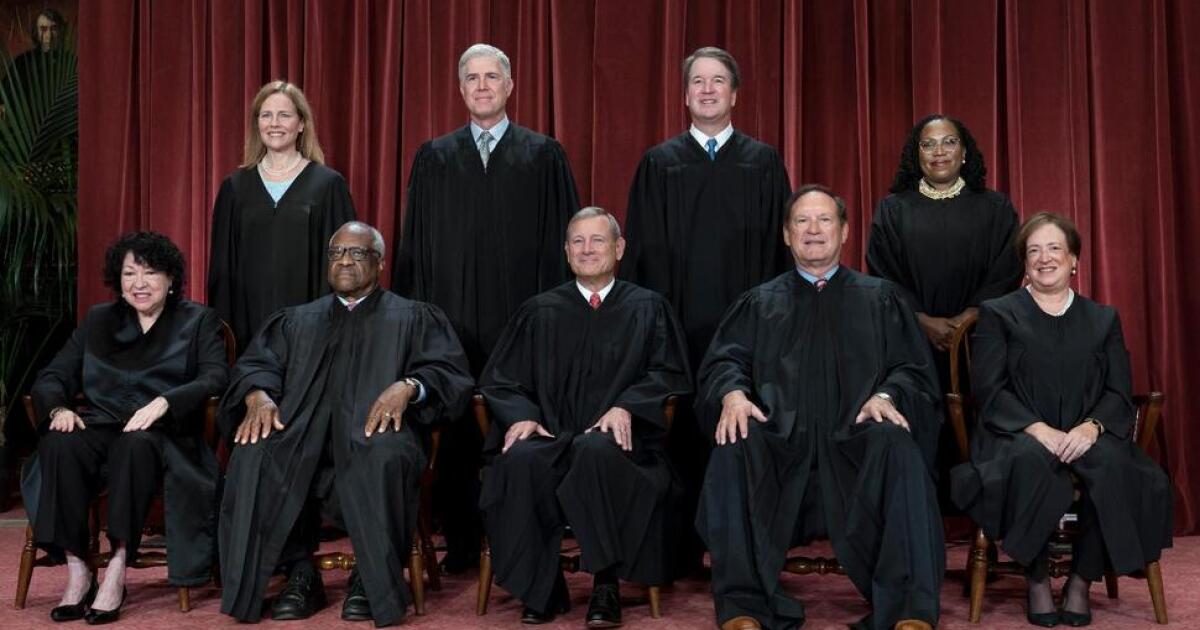
If it’s true that as Mark Twain supposedly said, history doesn’t repeat itself but it often rhymes, then we are about to embark on a poetry slam for the ages, with the Supreme Court as its theme.
President Biden on Monday unveiled a package of proposals to rein in a court that has seen public confidence reach a low ebb not recorded by the Gallup Organization in readings dating back to 1973.
Most significantly, he is calling for 18-year term limits for Supreme Court justices and the imposition by Congress of binding conduct and ethics rules requiring the justices to “disclose gifts, refrain from public political activity, and recuse themselves from cases in which they or their spouses have financial or other conflicts of interest.”
Term limits would… make timing for Court nominations more predictable and less arbitrary; and reduce the chance that any single Presidency imposes undue influence for generations to come.
— President Biden on his Supreme Court reform plan
He is also proposing a constitutional amendment to neutralize a court decision appearing to give former presidents immunity for crimes committed while in office.
The template for these proposals is Franklin Roosevelt’s 1937 plan to “pack” the court by allowing presidents to appoint a new justice when any sitting justice failed to resign or retire within six months of turning 70, up to a maximum of six new justices.
The manifest goal was to dilute the influence of a cadre or conservative justices who had overruled almost every New Deal law or regulation that had come before them, as well as several other measures.
If FDR could counsel Biden today, he might warn him to move carefully; FDR’s court-packing scheme went down in flames amid congressional opposition, cut deeply into the popularity that had brought him a landslide reelection victory in the 1936 election, and brought the New Deal to a screeching halt. It also represented a moment in which FDR lost his unique ability to gauge the popular mood and act upon it.
The politics of Supreme Court reform today resemble those of 1937 in many ways, though as Twain’s supposed quip suggests, there are significant differences. Let’s look at the differences first.
Roosevelt was then at the outset of his second term, riding high on an electoral victory that may have given him a greater sense of his political omnipotence than he actually possessed. Biden, of course, is less than six months away from the end of his presidency. Roosevelt could look ahead at four more years of policymaking; Biden may be more focused on cementing his legacy of progressive achievements by bequeathing the nation a reformed Supreme Court.
Both presidents may have felt they had nothing to lose by taking on what seemed to be the most revered of the three branches of government, albeit for different reasons — Roosevelt because nothing could chip away at his popularity, Biden because his own term in office can’t be affected by the fate of his reform proposals.
Roosevelt was faulted for springing his scheme on an unsuspecting public and Congress. Notwithstanding public discontent with the court, its reform hadn’t been an issue in the presidential campaign recently ended. FDR had not spoken publicly about the court after a series of anti-New Deal rulings in 1935 and 1936 except after one ruling in which he accused the court of relegating the country to “the horse-and-buggy definition of interstate commerce.”
Instead, he blindsided the nation by announcing his plan in a speech on Feb. 5. To his surprise, voters and legislators — including reliable New Deal supporters on Capitol Hill — reacted with fury.
It was not merely the secrecy in which the scheme had been plotted that its critics found dismaying. FDR’s stated rationale, which was that the aging justices were overworked and needed help to manage their docket, was transparently deceptive.
That rationale might have looked superficially reasonable at first, since the oldest member of the court’s so-called Four Conservative Horsemen, Willis Van Devanter, had been born during the administration of James Buchanan, which supposedly rendered him utterly out of step with the politics of the 1930s.
However, the oldest justice on the court, Louis Brandeis, was even older — at 80, he had been born during the administration of Franklin Pierce, Buchanan’s predecessor, but nevertheless was the court’s liberal lion and not an impediment to the New Deal.
Biden seems to have absorbed the lessons of FDR’s failed effort. He has been telegraphing for weeks that he is contemplating Supreme Court reforms. His proposals are not as radical as expanding the court outright, but they address some of the most evident issues driving the court’s public standing into the sub-basement: a conservative majority that has shown no respect for values and rights long cherished by most Americans, and a record of financial grifting and overt partisanship, chiefly by conservative Justices Clarence Thomas and Samuel A. Alito Jr.
As in 1937, there is a sense that the court has taken aim at progressive principles and laws, running roughshod over individual rights.
The court’s direction has been led by a conservative majority including three judges appointed by Donald Trump — among them Neil M. Gorsuch, who slid into a seat kept open by Senate Republicans’ refusal to even consider Barack Obama’s nomination of Merrick Garland to the late Antonin Scalia’s seat; and Amy Coney Barrett, rushed to confirmation by Senate Republicans in October 2020 only 38 days before the election that would unseat Trump and bring Biden to the White House.
Barrett took the seat vacated by the death of Ruth Bader Ginsburg, one of the most liberal justices ever to sit on the court.
The three Trump judges were in the majority that in 2022 overturned Roe vs. Wade, the decision that had protected women’s reproductive health rights since 1973.
It may be useful to compare the court’s behavior in recent years with what provoked FDR into launching his court-packing scheme.
The court’s distaste for elements of the New Deal was assumed as the Roosevelt administration proceeded to remake the U.S. economy. But it didn’t become palpable until it issued three decisions on May 27, 1935, a date that would become known to progressives as “Black Monday.”
In the first decision, the court overturned Roosevelt’s ouster of a reactionary member of the Federal Trade Commission, placing a limit on a president’s authority over executive officers. The court then invalidated a farm mortgage law because it applied to existing mortgages, not just new ones. Then came the court’s invalidation of the National Recovery Administration, through which the government had tried to regiment competition throughout the economy to help dig the country out of the Depression.
All three decisions were unanimous, but they still signaled that a conservative cadre was poised to undermine New Deal initiatives due to come before the justices. In 1936, the court narrowed the authority of the Securities and Exchange Commission and invalidated a relief program for coal companies. Most significantly, it overturned a New York minimum wage law in a decision known as Tipaldo, after its detestable protagonist, the owner of a laundry who had been cheating his laundresses of their legal wages.
Condemnation of the Tipaldo decision came from across the entire political spectrum. “If this decision does not outrage the moral sense of the country, then nothing will,” FDR’s Interior secretary, Harold Ickes, wrote in his diary. Conservatives were dismayed that the decision undercut their argument that labor rights should remain in the hands of the states — how could that be, if the Supreme Court had overturned a state minimum wage law?
Roosevelt and his fellow progressives foresaw that the court would invalidate the entire New Deal. For a time, FDR seemed content to let that happen, reasoning that it would help him get a constitutional amendment enacted that would allow Congress to save any law the court deemed unconstitutional by reenacting it. If the court kept overturning the New Deal, he reasoned, there would be “marching farmers and marching miners and marching workingmen throughout the land.”
In the end, he chose to go with the court-packing scheme, recognizing that it fit within the constitutional provision giving Congress the unquestioned right to dictate the size of the court.
For many Americans today, the court’s Dobbs decision overturning Roe vs. Wade has supplanted its 1857 Dred Scott decision as the worst in its history. By relegating abortion to a state-level decision, Dobbs has spawned a patchwork of punitive state laws that have life-threatening ramifications for pregnant women (among many other shortcomings).
Public distaste for Dobbs, as was the case with Tipaldo, has been manifest. Since it was handed down in June 2022, every single state initiative to protect women’s reproductive rights has prevailed at the ballot box. The chief weapons in the antiabortion camp’s quiver have been efforts to stymie referendum and initiative votes by changing the ballot box rules, as has been tried in Florida and Ohio.
Biden’s proposal to establish staggered 18-year terms for justices has several virtues. One is that it would rebalance a court on which GOP appointees are arguably overrepresented. From 1960 through this year, Republicans held the White House for 32 years and Democrats for 31, almost an even split. But in that period, Republicans have appointed 15 justices and Democrats only ten. Under Biden’s proposal, every president would have the opportunity to appoint two justices during each four-year term.
“Term limits would … make timing for Court nominations more predictable and less arbitrary; and reduce the chance that any single Presidency imposes undue influence for generations to come,” the Biden White House says.
The one flaw in the proposal is that it could require a constitutional amendment. The Constitution states that federal justices may serve “during good behavior,” but expert opinion is divided over whether that bars Congress from imposing any other conditions on their service.
It’s worth noting that the Supreme Court was so unnerved by the groundswell of criticism it faced after Tipaldo that Chief Justice Charles Evans Hughes engineered an about-face, orchestrating a 5-4 opinion upholding a Washington state minimum wage law that was almost identical to the New York law it had overturned, also by 5 to 4. That helped to take the wind out of FDR’s scheme. The change would forever be known as “the switch in time that saved nine.” The court never overturned another New Deal initiative.
But few such opportunities for an about-face are on the horizon. The damage this court has done to individual rights and the rule of law is manifest. Biden’s sense is that the time is ripe for reform, and that this time the public may go along.


Tired of the same old dating apps like Bumble and Hinge, Marie Lansley tried talking to an artificial intelligence matchmaker.
For roughly 15 minutes, she chatted with an AI voice on the dating app Known, answering questions about her upbringing, personality, education, lessons from past relationships and whether she’s looking for a serious relationship or something more casual.
“Divorced at 36. Yea, you’re not here to waste time. The way you build your days matter,” the AI voice told her after Lansley replied she was looking for a serious relationship.
Weeks later, the San Francisco resident got a match along with a written summary of why the pair could be compatible. But the stranger wasn’t her type and she wasn’t keen on paying $15 to meet up.
Startups like Known are roping in new users by hosting in-person dating events in San Francisco.
“I want to be able to use AI to improve efficiency in dating and to help navigate a pretty frustrating dating landscape. But there are just some things that are so deeply human that AI technology cannot capture,” said Lansley, who has posted about her dating experience on social media.
Singles like Lansley are dipping their toes into the wacky world of AI dating but they’re also skeptical if it will make it easier to find love. Online dating is ripe for disruption, and tech companies big and small are turning to AI as a potential solution to find people better matches more quickly and help them improve their chances of landing a date.
For years, people have been frustrated and exhausted by the seemingly endless amount of swiping and small talk that go nowhere on dating apps. They’re turning to in-person options such as running clubs, pickleball and speed dating but finding the right partner is still tough.
Online dating remains a popular way people search for a partner but some are dumping the platforms. Tinder’s monthly active users in March dropped 7% year-over-year, though its parent company Match Group noted that the rate of decline has been slowing as it revamps the app.
West Hollywood-based Tinder, which has roughly 50 million monthly users, has been experimenting with using AI to analyze a user’s camera roll and recommend better matches.

Known, an AI dating app, has its branding plastered on a storefront in the Marina District in San Francisco.
Its rival Bumble — an app that initially stood out for having women message their matches first — saw its paying users drop 21% to 3.2 million in the first quarter this year compared to 2025. The company has been working on AI matchmaking and plans to ditch swiping in the last three months of the year in select markets.
Even dating services that have grown users such as West Hollywood-based Grindr, an app for the LGBTQ+ community, and Facebook Dating, which is included in the main social network, are also leveraging AI more.
And new AI dating startups are popping up in California, New York and other states that could change the way people find a partner online. Former Hinge co-founder and Chief Executive Justin McLeod is working on an AI dating app called Overtone, stating on its website that “AI, if used correctly, can help us invent an entirely new way for people to find their partners that is far more personal, far more efficient, and far more effective.”
Some of those startups started in the San Francisco Bay area, where AI dating apps are hosting parties, speed dating, coffee meet-ups and other in-person events to rope people into using their new service.

Singles who downloaded the Known dating app mingle over drinks at Left Door, a cocktail lounge in San Francisco, on Thursday.
On one recent Thursday night, dating app startup Known hosted a dating event at a swanky San Francisco cocktail lounge for people who completed their matchmaking call on the app. The event’s description said attendees would be greeted with “champagne, caviar bumps, and a mysterious envelope” that reveals who the AI matchmaker paired them up with.
Known Chief Executive and co-founder Celeste Amadon, who dropped out of Stanford University to create the AI dating app, said Americans are spending more time alone at home as online services have made it more convenient to do everything from getting food delivered, online shop and date. Young people complain about traditional dating apps yet they’re also still on them.
“The more I understood today’s dating apps, the more clear it became that they have been for the better part of two decades now, designed, tweaked, redesigned, rebuilt, to not work,” she said.
1

2

3

1. A sign that reads, “I love my AI boyfriend” hangs in a San Francisco window. 2. Known, an AI-driven dating app, has their branding plastered on a store front in the Marina District in San Francisco. 3. Celeste Amadon, CEO of Known, poses for a portrait.
The company charges per date to ensure people show up but the startup also has a business incentive to find people a match they actually want to meet, she said. Known plans to expand to San Diego in July, she said. Amadon said she expects the AI matching technology to become more accurate over time.
Known hasn’t shared its user numbers or revenue figures. Founded in 2025, the startup launched the dating app in February and has raised roughly $10 million from investors such as Coelius Capital, Forerunner Ventures and NFX, according to PitchBook.
Grindr is learning more about how much users are willing to use and pay for AI features.
The company has been testing a subscription tier called “Edge” in Australia, New Zealand, the United States and Canada that includes AI tools that recap meaningful chats, display personalized profile recommendations and show users who they’re likely to match with.
Unlike other dating apps, Grindr users don’t swipe through profiles. The app displays a grid of people who are nearby that they’re able to chat with. Grindr has expanded beyond casual dating, allowing people to find friends, travel companions and others in the LGBTQ+ community.
Grindr’s Chief Product Officer AJ Balance said the company is still testing subscription pricing for Edge but some users are willing to pay $350 per month because they’re “seeing a lot of value” and saving time.
“We view AI and new paradigm shifts like it as opportunities to build great, new product experiences that haven’t been developed before,” he said. “Our approach is really to leverage AI, like we did with mobile, to facilitate better conversations, deeper connections, ultimately more success in dating in the real world.”
Other popular dating services aren’t charging for AI matchmaking features. On Facebook Dating, which has more than 21.5 million daily users worldwide, users can use AI to write their profile intro and chat with an dating assistant for free.

AI dating startups are popping up in California, New York and other states that could change the way people find a partner online.
The AI assistant can recommend people looking for a serious relationship, someone with common hobbies or even above a certain height or age. Roughly 1 million people use Facebook Dating’s AI assistant daily in the United States and Canada, Meta said.
Facebook Dating product manager Neha Kumar said AI can help combat “swipe fatigue” facing online dating users.
“You’re sifting through a bunch of profiles. It’s really hard to understand and find somebody that’s compatible for you based on your specific types of preferences,” she said. “We really wanted to think about leveraging AI to solve this growing pain point.”
Technology is also a double-edged sword. The rise of AI tools means people can use technology to easily manipulate photos and craft messages on dating apps that might make them seem much more attractive or charismatic than they are in person. Some people are even turning to AI chatbots for companionship.
“How do we maintain human authenticity and human connection through an AI world? I don’t have a perfect answer to that. I think we’re still figuring it out,” Kumar said.
Lansley, the online dating user, said apps do make dating more convenient but it’s much more interesting to meet people face-to-face. She worries people will rely too much on AI as a “crutch” to replace human intimacy or emotional judgment.
“Chemistry,” she said, “is always going to be analog.”

Los Angeles County saw job gains in May, likely driven in part by rebuilding after the January 2025 wildfires, which destroyed or damaged more than 18,000 structures.
Construction added 2,300 jobs since April, while postings for new jobs in the industry jumped 45% over a year ago —indicating rebuilding in Pacific Palisades, Altadena and nearby is helping boost the local economy, according to a report by the Los Angeles County Economic Development Corp.
“This is consistent with the possibility that wildfire rebuilding activity is increasing construction labor demand in the area,” Max Chomas, an economist at the LAEDC Institute for Applied Economics, said at a presentation this week based on California Employment Development Department and other data.
Motion picture and sound recordings also added 2,800 jobs during the month, despite a deep downturn in Hollywood caused by a reduction in streaming filming, runaway production and other factors. The industry lost 6,700 jobs compared with a year ago.
Still, the job growth since April in construction and Hollywood were among the highlights of a month that saw total county payroll jobs — excluding agriculture and certain other sectors — grow by 9,000 jobs, to 4,618,400. Employment was virtually flat from the same time a year ago.
“May was a relatively good month for employment growth,” Chomas said.
The biggest monthly job gainers were the hotel and restaurant industries, which added 3,700 jobs.
Manufacturing, which has been hit by job losses over recent years, added 400 jobs since April. It also saw a 15% increase in job postings compared with a year ago.
That could reflect the resurgence in Southern California’s aerospace and defense industries, which have seen a sharp rise in startups.
Postings for all new jobs were up 1,134, or 2.4%, since a year ago. Chomas noted that May was only one of five months over the last three years that saw year-over-year growth in job postings.
The gains helped stabilize the county’s unemployment rate at 5.2%, matching April’s rate and down from 5.4% in May 2025.
Still, that is higher than May’s 4.3% national unemployment rate, and it masked some weakness in the local economy.
The rate is calculated by a household survey to determine which members are working, looking for work or no longer seeking employment.
It found 18,000 workers had dropped out of the county labor force in May, artificially driving down the unemployment rate, according the California EDD.
Similarly, California recorded a 5.3% unemployment rate in May, on par with April, despite a drop in the labor force.
That rate is higher than every state other than Delaware. In May, California only added 3,100 non-farm jobs month-over-month — a job growth rate that lags behind the nation, according to an analysis by the Inland Empire Economic Partnership and the Lowe Institute of Political Economy at Claremont McKenna College.
The LAEDC’s report also examined the potential effects the growth in artificial intelligence has been having on L.A. County jobs “exposed” to AI, meaning they are vulnerable to AI replacement.
California has been hit hard by thousands of AI-related layoffs in Silicon Valley as the software has been integrated into the tech workplace — even though there is fierce competition for software engineers with skills and expertise in the field.
The report found that since July 2023, job listings in Los Angeles County for AI-exposed positions — such as clerical and translation positions — have lagged behind other jobs. However, it is unclear whether businesses have replaced or are waiting to replace those workers with AI.
It may be that employers overhired for those positions during the COVID-19 pandemic and are now shedding them, since there is a correlation between AI-exposed positions and those jobs that can be completed from home, Chomas said.
The report also examined macroeconomic trends and policy decisions affecting the national, state and Los Angeles County economies — which have been hit by tariffs, the crackdown on immigrant labor and high energy costs, among other factors.
Nevertheless, consumers continue to spend despite affordability strains, and employers continue to hire selectively amid higher interest rates to battle inflation, said institute economist Shannon Sedgwick.
“During the previous decade, we experienced extraordinarily low inflation, near zero interest rates, relatively stable globalization, and abundant capital. So those conditions may have conditioned us to think that environment was normal,” she said.
“But historically speaking, today’s world of higher rates, greater geopolitical uncertainty and tighter labor markets, they may actually be closer to that long-run average,” Sedgwick noted.

A proposal to build a truck parking lot near the Port of Los Angeles is facing backlash from nearby residents.
Port officials say the parking lot would provide much-needed designated space for cargo trucks waiting to pick up loads from the port, helping to ease congestion in the area.
But some neighborhood groups say the proposed staging area would only increase traffic and air pollution in Wilmington.
Gina Martinez, chair of the executive board of the Wilmington Neighborhood Council, said the land in question provides a vital buffer between port activity and residential communities.
“It’s been a bad deal from the beginning,” Martinez said in an interview. “We want open space because we’ve been promised for decades a clear separation from port activities.”
The Los Angeles Harbor Commission signed off on the project in a meeting on June 11, but it was vetoed by the Los Angeles City Council this week.
The veto does not permanently ban the project, but allows for more time to discuss the implications for stakeholders and the community.
Los Angeles City Councilmember Tim McOsker, who introduced a special motion to halt the truck plans, said he was acting on behalf of community residents. McOsker represents Harbor City, Harbor Gateway, San Pedro, Watts, and Wilmington.
“Generally, folks in the community would say, ‘we don’t want the port industrial properties to creep into neighborhoods. We want them to retract or hold the line,’” McOsker told The Times.
The John S. Gibson Truck & Chassis Parking Lot, which was originally proposed in 2023 by the Port of Los Angeles, would cover 18 acres of privately owned land and include 393 truck and chassis parking stalls.
The land is currently designated as open space, though it’s undeveloped and not available for any recreational use. The completion of the parking lot would require a Port of Los Angeles master plan amendment to switch the land’s designation from open space to maritime support.
Martinez said the land should have never been sold to private developers because it’s included in the California State Lands Commission’s tidelands trust, which says certain land near the ocean must be available for public enjoyment.
Building a truck and chassis waiting lot on that space would increase congestion on the freeways and in Wilmington neighborhoods, add particulate matter into the air and increase already-problematic noise pollution from the port, she said.
“Of all the things Wilmington needs, it is not another parking lot for trucks,” Martinez said at a Los Angeles Harbor Commission meeting earlier this month. “It is not the responsibility of our community to take on every single truck that runs through the port.”
At the same meeting, Noel Gould of the Coastal San Pedro Neighborhood Council said the council is supporting the project after working closely with the developers to reach compromises.
The parking lot would prevent port-bound trucks from idling near schools and parks, he said. The lot would also include landscaping with native coastal plants.
“We didn’t start out in a position of support, but we worked very closely with them to get to a place where we felt it was really something that would benefit the community,” Gould said at the meeting.
In an interview, McOsker said there is already space set aside for trucks to wait to access the port.
At the Los Angeles City Council meeting Wednesday, the council unanimously approved what’s known as a 245 motion, which gives the council authority to temporarily veto certain actions taken by city boards and commissions.
“The 245 gives us the opportunity to meet and confer and see if there are revisions or additions or mitigation that can better protect the full community,” McOsker said.
The motion sends the project proposal back to the Harbor Commission for further review.
Supporters of the parking lot say the land is currently uninhabited and requires consistent police presence to deter criminal activities.
The Port of Los Angeles also clashed with coastal communities last year over the possible raising of the Vincent Thomas Bridge. The bridge was already slated to be redecked by the California Department of Transportation, but Port of Los Angeles executive director Gene Seroka proposed raising the bridge height as well.
Raising the bridge would allow larger cargo ships to pass under its deck, helping create jobs and keep the port relevant, Seroka said at the time. Most painfully for local commuters and businesses, it would mean the bridge will be closed for around 28 months rather than the originally planned 16 months.
Last December, the California State Transportation agency rejected the proposal to raise the bridge.
-

 Pittsburg, PA31 seconds ago
Cincinnati Reds vs. Pittsburgh Pirates Game Delayed on Sunday
-

 Augusta, GA7 minutes ago
CSRA Death Cafe holds gathering at Augusta church
-
 Washington, D.C10 minutes ago
Trump lashes out at Washington, DC, mayoral nominee
-

 Cleveland, OH15 minutes ago
1 dead, 1 hospitalized after early morning crash: Cleveland EMS
-

 Austin, TX22 minutes ago
Big changes to the drought in recent weeks
-

 Alabama25 minutes ago
Alabama football 2027 commit shuts down recruitment
-
 Alaska30 minutes ago
Mat-Su Initial Attack Responding to Fire in Flat Lake
-

 Arizona37 minutes ago
NFL power rankings: Arizona Cardinals are in lowest tier

