Science
Science of Simone: The forces behind her iconic Yurchenko double pike


The most decorated gymnast ever sprints down the vault runway. She tumbles gracefully onto the springboard, flings herself backward onto the vault table and pops off the surface. Soaring through the air, she folds her body in half and grabs the back of her legs for two head-over-heels flips.
The crowd erupts when Simone Biles stomps her feet into the mat.
Another successful Yurchenko double pike.
“It just makes your mouth drop open every time,” said UCLA gymnastics coach Janelle McDonald, who sat in the front row next to the vault landing area at the U.S. Olympic trials, where Biles competed her signature vault.
Of the five skills in the International Gymnastics Federation (FIG) code of points named after Biles, her most recent vault — the Yurchenko double pike — has become the most iconic.
It’s the first major leap in vault innovation for women’s artistic gymnastics in two decades. When leveling up the sky-high event used to mean extra twists, Biles flipped the game upside down. She was the first woman to attempt her double-flipping skill in competition and completed it in international competition for the first time at the 2023 World Championships, earning its name as the Biles II.
“Simone made impossible an opinion with that vault,” NBC analyst John Roethlisberger said on the telecast during the U.S. Olympic trials.
In a sport that blends power and grace, Biles’ Yurchenko double pike is at the center of its own Venn diagram: athletic feat, scientific marvel and artistic genius all in six seconds.
The entry
Biles begins with a sprint down the runway and reaches her hands toward the ground while cartwheeling her legs over her head. The roundoff turns her momentum forward to backward.
(Kenzo Tribouillard / AFP via Getty Images)
The height, the rotation and the landing earn the most gasps from the fans who follow Biles’ every move on the competition floor. But for her peers who continue to marvel at the 27-year-old’s revolutionary talent, the most impressive part of the vault happens before Biles even contacts the table.
“Your Yurchenko entry has to be so technically perfect and so consistent,” said 2016 Olympic gold medalist Kyla Ross. “You have no doubt coming off the table that you’re going to hit the double pike.”
The Yurchenko entry — a roundoff onto the springboard and a back handspring onto the vault table — is named after former Russian gymnast Natalia Yurchenko, who debuted her eponymous skill in 1982. Since the FIG replaced the vault horse — which resembled a pommel horse without handles and was about 5 feet long and 1 foot wide at the top — for a tongue-shaped vault table in 2001, the Yurchenko vault has become more common for elite female gymnasts. Athletes can still harness the power generated from the unique entry while having a larger, safer surface area for their hands.

2024 Paris Summer Olympic Games
Biles begins with a sprint down the runway and reaches her hands toward the ground while cartwheeling her legs over her head. The roundoff turns her momentum forward to backward. Slamming her feet down on the springboard, Biles compresses the springs that then uncoil and transfer energy back into her body as she reaches up and backward for the vault table.
The key to vault liftoff is how Biles contacts the equipment to transfer her momentum.
“Pre-springboard, all of their motion is forwards,” said Emily Kuhn, a physics PhD student at Yale who was a level 10 gymnast. “After the springboard, some of their motion is upwards. And so [the board is] really helpful for converting the rotational energy from that roundoff into an upwards velocity that is used to get the height on the vault.”
In an instant, Biles arches backward toward the vault table. Her body whips back in a lightning-fast handspring that leaves even the best athletes in the world in the dust.
“She gets that power because of how quick-twitched her roundoff-back handspring is, technically speaking,” said 2008 Olympic silver medalist Samantha Peszek. “No one is as quick-twitch as Simone.”
The block
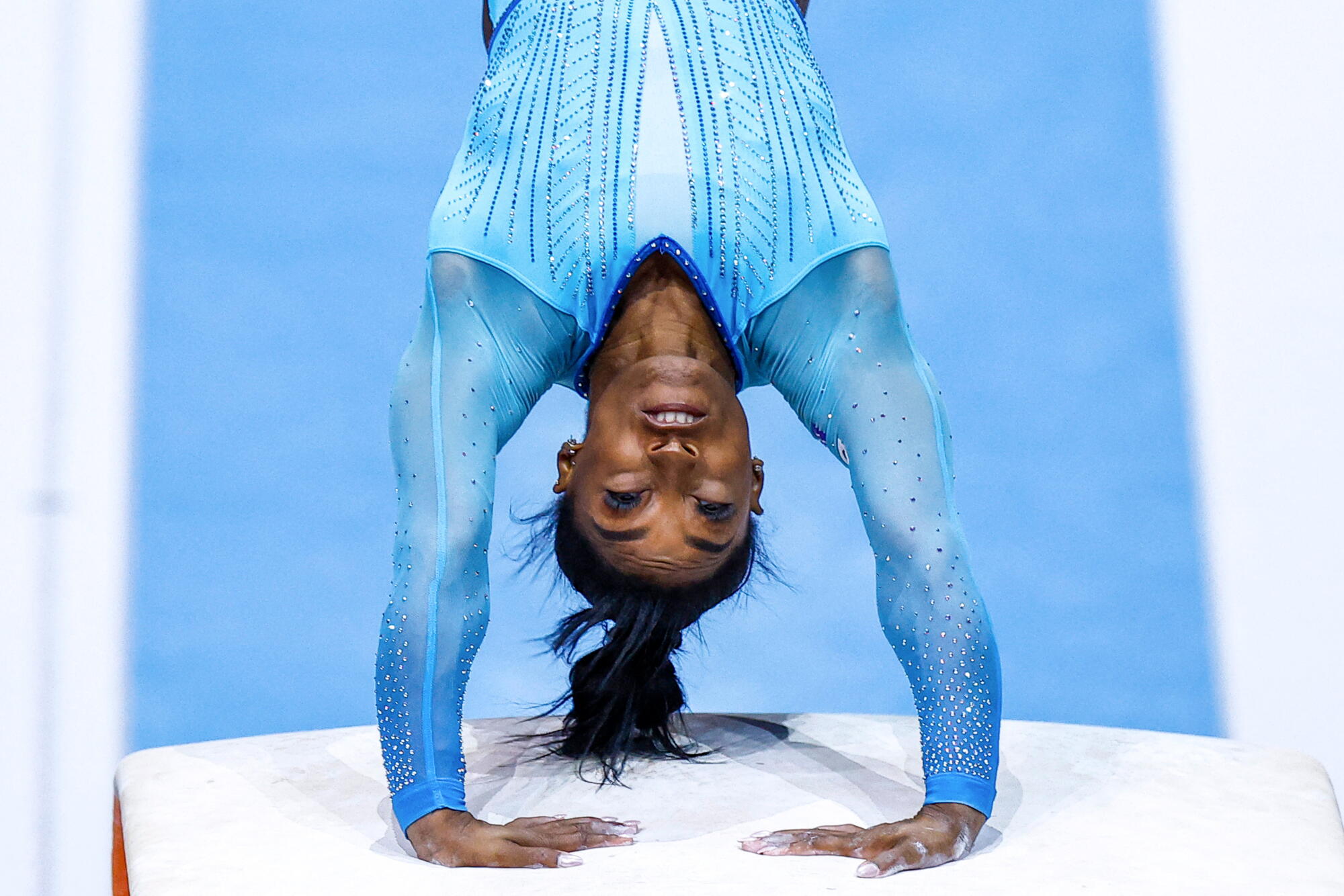
During the block, the moment Biles’ hands strike the table, she extends through her shoulders in a motion that’s barely detectable in real time. The micro-movement lasts a tenth of a second as Biles applies force to the vault that is then returned in equal and opposite measure.
(Kenzo Tribouillard / AFP via Getty Images)
Aly Raisman had a front-row seat to the world’s best vaulters. The two-time Olympian watched 2012 Olympic teammate McKayla Maroney nail a nearly perfect two-and-a-half twisting Yurchenko in the team final. Raisman was also the team captain in 2016 when Biles won Olympic gold on vault. Both standouts shared a key ability that helped them soar above the competition.
“When you look at her elbows on the table, they’re always very straight,” Raisman said. “Their body was so tight when their arms hit the table that it just helps them get so much air.”
The moment Biles’ hands strike the table, she extends through her shoulders in a motion that’s barely detectable in real time. The micro-movement lasts a tenth of a second as Biles applies force to the vault that is then returned in equal and opposite measure. Keeping every muscle contracted during the split second on the table is vital to transferring energy efficiently for maximum height.
“The force gets dispersed in bad form,” said Gina Pongetti, a physical therapist with more than 20 years of experience working with college, national team and elite gymnasts. “[The muscles] are all tight at one time so that nothing gives, nothing buckles. Because of that, all of that force, or as much as possible, goes into the vault [and] goes back to her to transfer to height and rotation.”
NBC estimated that Biles’ feet reach about 12 feet in the air at the peak of her vault when she is upside down.
Former UCLA gymnast Nia Dennis knows the feeling. The three-time U.S. national team member trained a Yurchenko double tuck — with her knees bent and legs pulled toward her chest — into the foam pit during her elite career, eventually stacking up soft mats to be equal to competition height. While she is best known for her viral, energetic floor routines, Dennis loved vault the most. She still recalls the intoxicating feeling of hitting the perfect block that fired her into the air.
“I just felt like a cannon,” Dennis said.
The flips
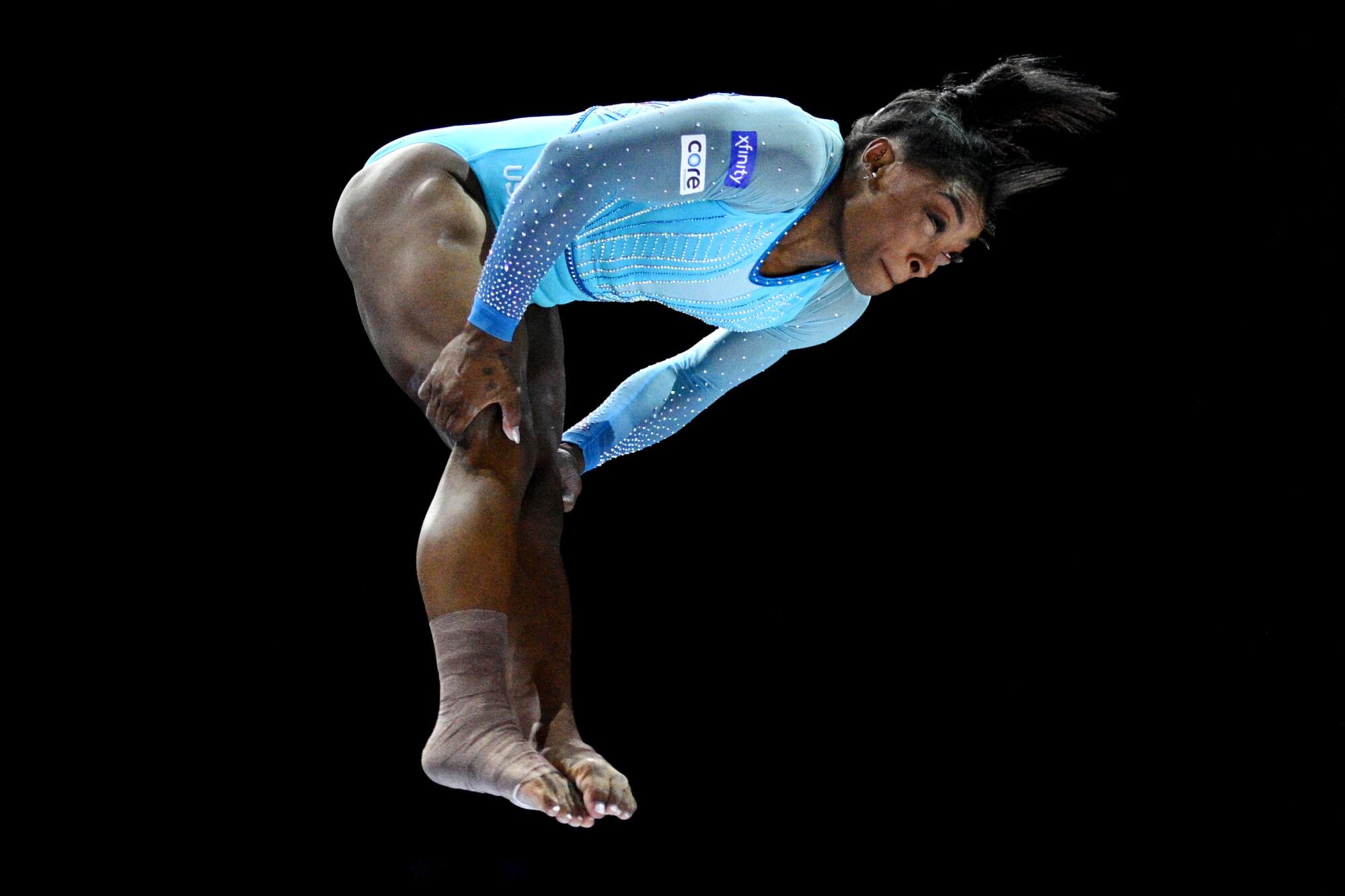
After Biles blocks off the vault, she is just a projectile.
(Matthias Hangst / Getty Images)
Searching for ways to upgrade her vault difficulty, Dennis wanted to buck the trend of adding additional twists to her Yurchenko. She was always more of a flipper than a twister, and Dennis sometimes landed on her neck from over-rotating her warm-up drills. One day, her coach encouraged her to pull all the way around onto her feet for an additional flip.
“It was just straight power,” Dennis said. “All I had to do was run and close my eyes, for real. Just block really hard, close my eyes really hard and pull really hard.”
For Dennis, the daring skill was fun. Her former UCLA teammate Ross did not share the sentiment.
“I used to like, cry because I was so scared of it,” laughed Ross, who practiced Yurchenko double tucks into the foam pit alongside her longtime club teammate Maroney.
The second flip is what makes the vault so frightening for athletes. Gymnasts can adjust a twisting vault midair by reducing the number of revolutions by halves if they feel something gone awry. There is no safe Plan B between one and two flips.
After Biles blocks off the vault, she is just a projectile, Kuhn emphasized. At that point, there is nothing she can do to change how high she is or her path through the air.
That’s when her proprioception takes over. Biles’ air awareness is “unbelievable,” Pongetti said. The physical therapist, who specializes in treatment, diagnoses and biomechanics in gymnastics, has watched Biles train for years.
While she cannot change her flight path, Biles is an expert in making split-second decisions to rearrange her body midair to change how she will move. If she is too low, she can pull her body into a tighter shape to flip faster. If she is too high, she knows a more open shape can slow down her flip and help avoid over-rotation.
Only that caliber of spatial awareness can make the death-defying skill “safer,” Pongetti said. She would never say it’s “safe.”
“That sets apart the level 10 [gymnast] from the elite,” Pongetti said, “from the Olympian from Simone.”
The landing
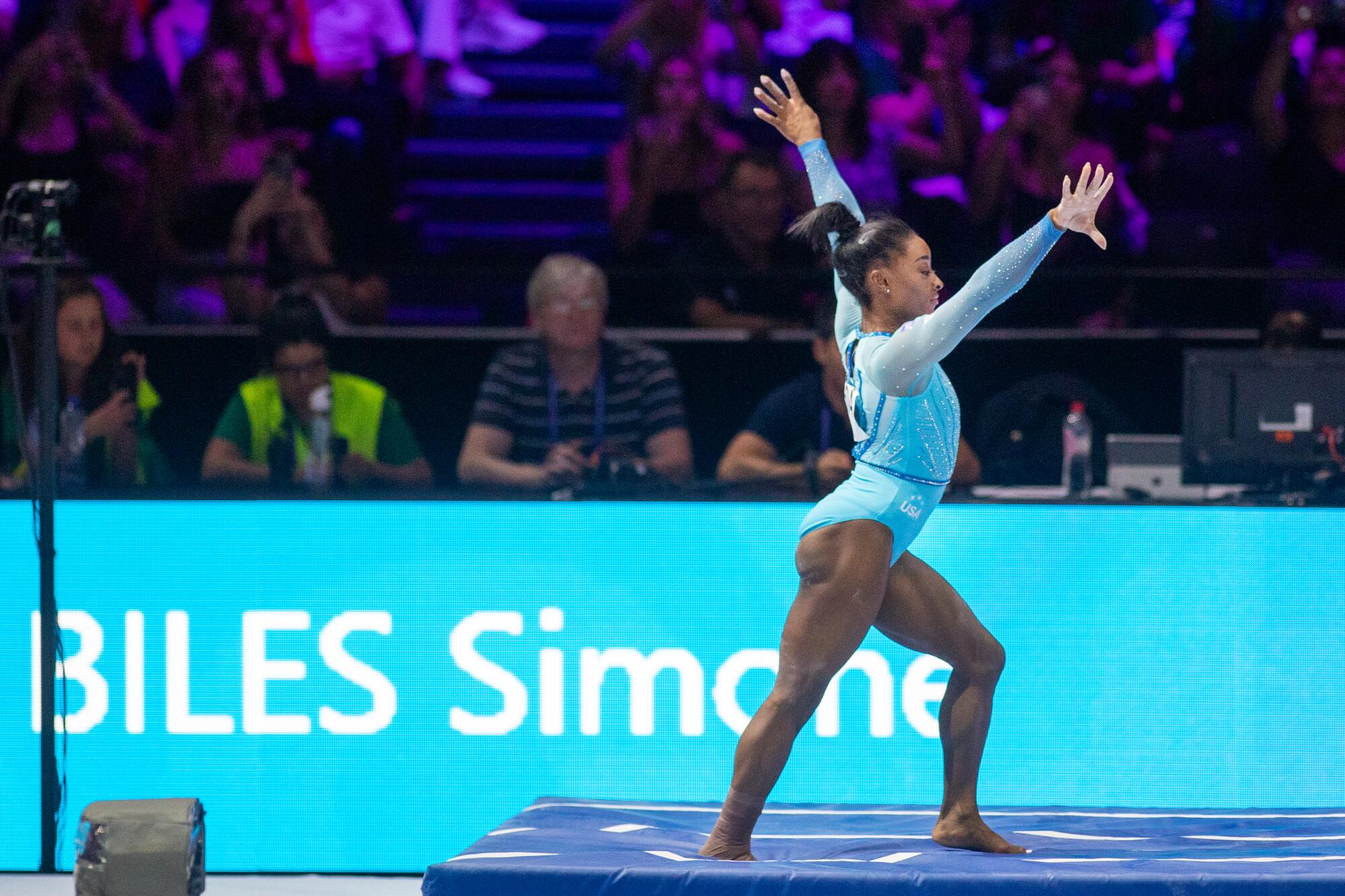
Simone Biles of the United States reacts after performing a vault during the 2023 gymnastics world championships in Antwerp, Belgium.
(Tim Clayton / Corbis via Getty Images)
With five skills named for her in the code of points, Biles is at the forefront of the sport’s progression. Peszek remembers when the double-twisting, double back tucks she and 2008 Olympic teammate Shawn Johnson competed were arguably the hardest tumbling passes in the world. Now Biles casually does that skill in combination with a full-twisting front layout.
“It’s really special to see the generations pass the torch and just how they’ve been able to take this sport by storm by creating all these new elements and really pushing the boundaries,” Peszek said. “Seeing her do it so effortlessly, it’s really a work of art to see.”
The Biles II was awarded the highest-difficulty score of any vault by the FIG at 6.4. Astronomical-difficulty scores, which are combined on each event with an execution score out of 10, allow Biles to win competitions by whole numbers as most of her peers fight for half-tenths.
On vault, most of the top medal contenders have difficulty values of 5.4 for the two-and-a-half twisting Yurchenko known as an Amanar or 5.6 for a Cheng, which begins with a roundoff onto the springboard, a half turn onto the vault table and a one-and-a-half twist off.
But Rebeca Andrade could challenge Biles for the crown. The Brazilian Olympic confederation published a YouTube video that featured the Olympic and world vault champion training a triple-twisting Yurchenko. If she lands it in international competition, it will bear her name.
Biles considered the skill as the next Yurchenko progression from an Amanar but has said going for the double flip was safer for her to land. The landing on a twisting flip presents additional challenges, Kuhn said, as gymnasts must absorb rotational forces to stop the twist while also controlling the landing vertically.
A 2013 study estimated that gymnasts absorb 11 times their body weight on landings during competition. The force increases to 18 times body weight if a landing is uneven, a common consequence of twisting elements. What Biles feels when her 4-foot-8 frame is falling from more than two and a half times her height to land the Yurchenko double pike might be even greater, Pongetti said.
“Her quads and her glutes and her hamstrings [and her calves], which otherwise would work to allow her to jump high, work in reverse to slow her down,” Pongetti said. “They are her brakes. … She is so good at not being stiff-legged when she lands.”
Fans seem to hold their breath as Biles floats and flips through the air. At the moment her feet punch into the mat, the crowd exhales with a roar of applause.
Thousands in Paris’ Bercy Arena will see the vault’s official Olympic debut. Millions more will watch internationally.
They’ll see Biles push the boundaries of sport and science in a gravity-defying six-second burst.


new video loaded: NASA Announces Artemis III Crew
transcript
transcript
NASA Announces Artemis III Crew
NASA announced the crew of Artemis III mission, which will fly to low-Earth orbit to test rendezvous and docking maneuvers with one or two lunar landers.
-
“I am excited to welcome you as the next crew in the Artemis journey to successfully return to the moon — this time to stay.” “I’m honored by the role that I’ve been given. I’m also very humbled by the task in front of us. But first and foremost, I’m grateful.” “So with that, the Artemis II crew, comrade, hands you the baton. You got the controls.” “As you know, we had a significant anomaly at our Launch Complex 36A on May 28. We’ve redoubled our efforts and are moving forward.”
By Alisa Shodiyev Kaff
June 9, 2026
Science
Santa Monica Mountains’ last steelhead trout survived the Palisades fire — and even had babies

Scientists feared the Santa Monica Mountains’ last remaining steelhead trout were dead, smothered by debris flows unleashed by the Palisades fire.
But the endangered fish surprised them: A team of biologists recently spotted 30 of the rare trout — and 21 babies — in Topanga Creek.
“There was a lot of happy dancing in the creek,” said Rosi Dagit, principal conservation biologist for the Resource Conservation District of the Santa Monica Mountains, which works with public and private landowners to conserve natural resources.
That’s because the steelhead here are endangered, at both the state and federal levels. Once, they swam in most streams of the Santa Monicas, but their numbers plummeted amid overfishing and coastal development. Increasingly frequent wildfire has further stressed their habitat. Topanga Creek, a biodiversity hot spot, is home to their last known population in the mountains that stretch from the Hollywood Hills to Point Mugu in Ventura County.
The trout that were spotted, including this one, are part of a distinct Southern California population that’s listed as endangered at the state and federal levels.
(RCDSMM Stream Team)
The California Department of Fish and Wildlife spearheaded a complex mission to rescue trout threatened by the Palisades fire that sparked in January 2025.
Time was of the essence. The fire hadn’t yet been fully contained. But rain was on the way, which would sweep massive amounts of sediment from the denuded hillsides into the water. Fish are often killed this way.
Crews stunned the fish with electricity, scooped them up in buckets, trucked them to a hatchery and ultimately moved them to Arroyo Hondo Creek in Santa Barbara County.
Within days, Topanga Creek was choked with mud. Some assumed the fish left behind were goners.
But in March, the conservation district’s team found four. The following month, when water conditions were clearer, they saw more.
“These fish continue to amaze me,” said Kyle Evans, environmental program manager for the state Department of Fish and Wildlife, who had seen the damage to the creek. “I had seen populations get wiped out in similar situations. So when I heard, I was thrilled.”
Evans surmises the fish that survived were in an area of the creek where less charred material and sediment were swept in.
“These fish likely hunkered down, were hiding under some rocks or places to try to get away from the main concentration of flow,” he said. “And luckily they weren’t buried.”
The ones that were spotted were fairly small, around 6 to 14 inches. Rainbow trout and steelhead trout are the same species, but with different lifestyles. If the fish remain in freshwater, they’ll be considered rainbows. However, they can migrate to the ocean and become steelhead, where they typically grow larger before returning to their natal waters to spawn.
Topanga Creek hasn’t fully recovered from the damage it sustained, but scientists say it’s looking better. Surveys last year were “so depressing,” Dagit said, with very few animals, and stretches that were essentially transformed into flat roads from all the sediment buildup. Some of the riparian canopy burned right down to the creek.
Then came 32 inches of rain over the last nine months, scouring out and moving sediment, creating deeper pools. Dagit said they recently found newt egg masses for the first time in years, as well as a few adult newts and many frogs. Plants that provide cover are starting to recover.
She provided photos comparing certain pools last year and this year, some dramatically transformed. In September 2025, the Shrine Pool could have been an overgrown hiking trail. This April, it was filled with shallow water.

The Shrine Pool in September 2025, left, and the same location in April 2026, right, with RCDSMM’s Isaac Yelchin donning a wetsuit.
(RCDSMM Stream Team)
Topanga Creek is home to another endangered fish, the small but hardy northern tidewater goby, often described as cute. Not long before the trout operation, Dagit led a rescue of hundreds of these fish too. Many were repatriated to the lagoon at the mouth of the creek in a moving ceremony last June.
There’s still the matter of what to do with the trout that were moved to Santa Barbara County last year. Evans would like to bring them home to the Santa Monicas at some point, but isn’t sure if it will happen. On one hand, they could bolster the small, genetically isolated surviving population. On the other, they might inadvertently bring in a disease or bacteria. There is some time to decide. Evans estimates the creek still needs to recover for two to three more years.
For now, the fish are functioning fine in their adopted creek. Experts worried the trauma wrought by the move would disrupt their spawning process, but they had babies that spring. This year, they spawned again.

The Pacifica Municipal Pier was shut down and taped off Thursday after city workers noticed cracks running through the landmark structure and concrete chunks falling into the ocean.
It’s just one of many coastal California structures that have recently crumbled under pressure from a rising and relentless ocean.
Officials from the small, beach city south of San Francisco said the pier was closed due to “cracking, separation, and displacement of the concrete walkway and structural elements.”
It will stay closed while structural engineers asses its safety.
Photos taken by city employees show a wide crack that runs from top to bottom and across the structure as well. Other photos show a large horizontal crack under the foundation of a small restaurant on the pier, the Chit Chat Cafe.
The cafe was also shut down.
This is not the first time the 53-year-old pier has shown signs of stress. In 2021, part of it was shut down after handrails along the edge collapsed. And in 2023, after a series of storms pummeled the Central California coast, damaging parts of the pier, the structure was partially closed for more than year.
Those same storms caused extensive damage in Aptos and Capitola, 70 miles south, where piers and waterfront infrastructure were swept away or damaged.
In 2024, a 150- to 180- foot section of the Santa Cruz wharf was ripped off by powerful waves.
At least 10 of the state’s dozens of coastal public piers were closed for part or all of 2024 due to structural damage sustained in winter storms since 2022. At least five others have longer-term upgrades planned to address structural issues.
“These things are costly to maintain,” said Zach Plopper, senior environmental director at Surfrider. “They are a part of our California coastal culture in many ways, but we’re going to need to reckon with, one, the state that they’re in, and two, the continuous and worsening threats they’re going to experience,”
He said most of the piers were constructed in the early 1900s, and they weren’t built to withstand decades of rough seas, storms and rising sea level.
“With this incoming El Niño, which is forecasted to be significant, and this marine heat wave we’re in the midst of, we’re kind of in uncharted waters as far as what this winter could bring in terms of storms and swells to the California coast, and we’re likely going to see a lot more damage,” he said. “Not just piers, but roads and other coastal infrastructure up and down the state.”
There was no storm in Pacifica earlier this week, so no single event could be blamed for the destruction.
However, a 2025 report from an outside engineering firm, GHD, found that several sections of the pier were in “poor” or “serious” condition, and they recommended closure before anticipated storms or events that could “subject the piles to high winds, swells and large waves.”
The firm found several areas of the pier where concrete was missing and rebar was exposed and corroding.
“The pier has continued to experience high winds and large waves in a harsh marine environment,” the engineers wrote in the report, noting that continuous exposure to seawater or marine spray was “detrimental” to the structure.
A 2023 city report estimated it would cost $19 million to repair.
That same year, a state law was enacted to require local governments along the California coast to plan for sea level rise in the coming decades.
Sea level has risen some 8 inches, on average, along the coast in the past 150 years, Plopper said, and researchers anticipate another foot in the next 25 years.
“We’re going to see profound shifts on our coastline, none that we have ever experienced before, and building static structures on the coast just doesn’t work all that well,” he said. “We’re going to have to make some really hard decisions.”
-

 New Jersey1 minute ago
New Jersey Food Council kicks off nationwide search for new CEO
-

 North Carolina4 minutes ago
4 charged after massive party in Alamance County ends with gunfire, stabbing, fights
-

 New Mexico4 minutes ago
The Battle of Socorro, New Mexico and the Uprising Against AI Data Centers
-

 North Dakota16 minutes ago
North Dakota election results: Latest on US House primary race
-

 Ohio19 minutes ago
$150,000 funding to be voted on for the Lisbon pool
-

 Oklahoma31 minutes ago
Oklahoma primary election guide for Bartians
-

 Oregon34 minutes ago
‘Changed my life’: Portland man warns of Facebook Marketplace dangers after robbery leaves him injured
-
 South-Carolina39 minutes ago
Evette and Wilson advance to runoff for South Carolina governor while Graham clinches nomination

