News
Will Harris sway PA voters? A Pittsburgh area Democrat and Republican each have a say

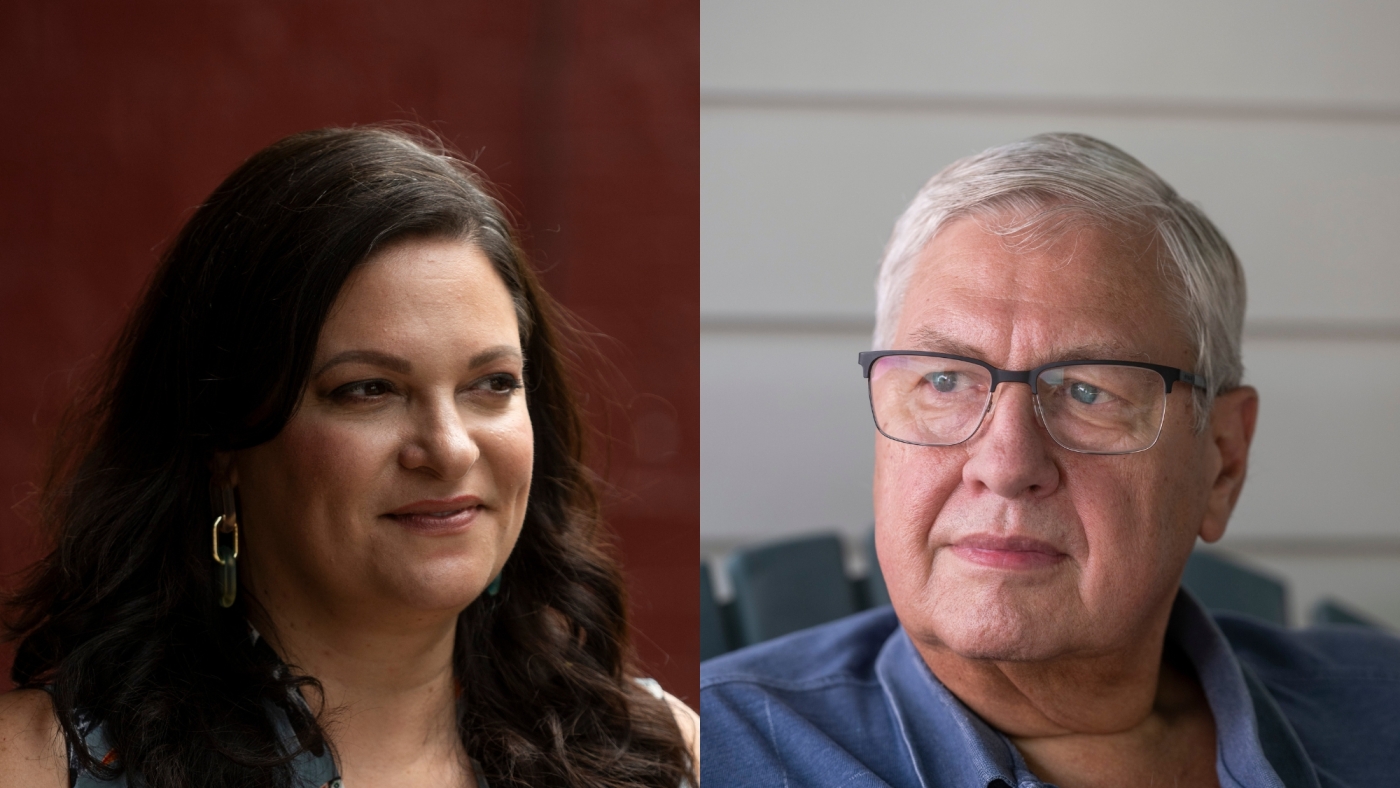
Left: Kathleen Madonna-Emmerling, Right: John Wink
Nate Smallwood for NPR
hide caption
toggle caption
Nate Smallwood for NPR
PITTSBURGH – Kathleen Madonna-Emmerling of Moon Township, a municipality that sits a few miles northwest of Pittsburgh, smiles as a server at local staple Primanti Brothers delivers a sandwich stacked higher than a double AA battery.
The story that locals like Madonna-Emmerling tell is that this Pittsburgh-style sandwich – layered with coleslaw, tomato slices, and French fries – was created so that local blue collar workers could drive large trucks and eat with one hand while on a shift.
The sandwich ties back to her family’s history – and that of many other residents in the area – of working in the steel industry and other blue collar jobs, many of which disappeared long ago. Her father was an auto worker involved in the local union. That led to her now working as a community organizer and “multi-hyphenate” political pot stirrer, she said.
When there were talks of closing a local school, she protested. She’s president of the library board and fought to keep a LGBTQ book on the shelves. She’s run for public office and trained activists to knock on doors at election time to shore up votes for Democrats.
But selling locals on President Biden at the top of the ticket has proven a struggle. His poor showing at the June debate with former President Donald Trump zapped a lot of energy. Then came the attempted assassination on Trump in nearby Butler, which caused a lot of “whiplash” in this area where many voters don’t adhere strictly to one party or the other.
“People are a little bit checked out. People are very tired. And we’re just trying to say, ‘OK , you’re going to be tired about the top of the ticket, but there’s still work to do,’” Madonna-Emmerling said, noting that some door-knocking efforts were slowed down after the shooting out of respect for Republican voters.
She couldn’t quite see a way forward.
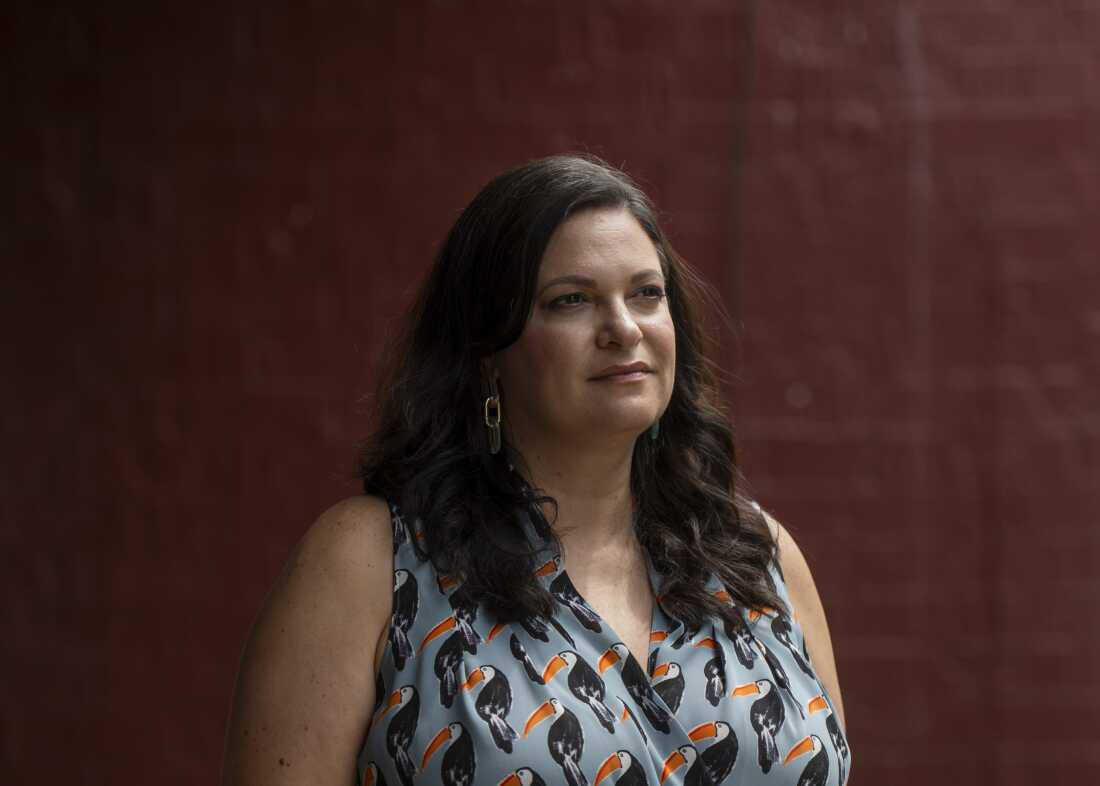
Kathleen Madonna-Emmerling poses for a portrait outside a restaurant in Moon Township, Pennsylvania on July 23, 2024.
Nate Smallwood for NPR
hide caption
toggle caption
Nate Smallwood for NPR
But then came the historic news that Biden was dropping out and making way for Vice President Harris to take his place. While she wasn’t necessarily calling for Biden to drop out, Madonna-Emmerling said she feels like his decision may prove a consequential one in Pennsylvania, which will again prove key to winning the White House.
“It was a literal exhalation, shoulders lowering,” Madonna-Emmerling said. “We’ve stopped the bleeding.”
More and more volunteers, she said, have called her in recent days about voter outreach efforts since Biden’s move.
“Plug in, let’s go,” she told them. “Get on the train. We’re all going together to the top.”
Their involvement in getting more voters to turn out could make all the difference in Moon Township, and other suburbs that surround Pittsburgh, which historically have voted for Republicans.
Trump won most of Moon Township’s 13 voting precincts in 2016 when he carried the state, according to Allegheny County Election Results data. And though most precincts again went his way in 2020, Democrats and Joe Biden picked up support in the town, when almost 2,000 more people voted. The same happened in small counties across the state, between here and Philadelphia and helped Democrats win the swing state back.
With the vice president now in the race, a new NPR poll found that the presidential race has hit a bit of a reset. Trump and Harris are now statistically tied, and some independent voters now say they are undecided,
Madonna-Emmerling feels that Harris’ campaign has injected new energy into Democrats, and she feels that the vice president’s background as a prosecutor is a winning combination and makes her an “ideal suburban candidate.”
Polling in the immediate aftermath of Biden’s endorsement for Harris shows she has more work to do with suburban voters, but also has more opportunity with folks in these areas who may now be undecided.
“Often in the suburbs, people want someone who is pro-public safety, pro-police,” Madonna-Emmerling said, adding that many in the area have family who are former military now working in law enforcement. “That can be a really hard barrier to overcome sometimes. And when you can say this is a clear case of a prosecutor against a felon, it’s a home run.”
But across town, a local Republican says, “We’ll see …”
Moon Township’s elected Republican tax collector John Wink, speaking to NPR from his backyard on a slightly muggy afternoon, said he believes the luster of Harris replacing Biden at the top of the ticket will wear off in the coming weeks.
“We’ll see if that lasts,” Wink said. “I think she’s a terrible candidate. When she actually ran for president, she couldn’t get votes.”

John Wink poses for a portrait outside his home in Moon Township, Pennsylvania on July 23, 2024.
Nate Smallwood for NPR
hide caption
toggle caption
Nate Smallwood for NPR
The core issues that Wink said he feels matter most to voters in this part of Pennsylvania – how they are currently experiencing inflation and securing the U.S.-Mexico border – still favor Trump.
Wink, who serves on the GOP’s state committee, has lived in the Pittsburgh area since he was two years old. His father was once mayor of Hampton Township, north of the city. Wink said he started working on campaigns, stuffing envelopes and putting mailers together for candidates, as early as 15 years old.
And his wife serves on the library board alongside Democrat Madonna-Emmerling.
Residents and voters here are by and large happy with how the town is run, regardless of the party affiliation of those running the local government, he feels. The roads are well maintained and the police force is good, he added.
It’s Pennsylvania’s status as a swing state, closely watched by national politics, that makes living here interesting from a political perspective, Wink said.
“I’m glad Pennsylvania is a swing state, much more interesting than if it was one way or the other,” Wink said. “It’s a whole lot more fun.”
One of his gauges for how elections might go is looking at campaign signs in front yards.
“I kind of thought Trump was in trouble in 2020 because I was seeing too many Biden signs, much more so than in 2016, where there were very little in the way of Hillary signs,” Wink remembered.
His verdict right now? It’s too early. There aren’t that many signs out yet, Wink said, but he’s still confident Trump will win.
So what are the keys for Trump and Harris here?
Wink said many local Republicans are excited to vote for Trump again, though he said he wished the party had nominated a younger candidate.
He would’ve liked to see Florida Gov. Ron DeSantis or former U.N. Ambassador Nikki Haley be the nominee. But Trump won the primaries, and Wink plans to vote for him.
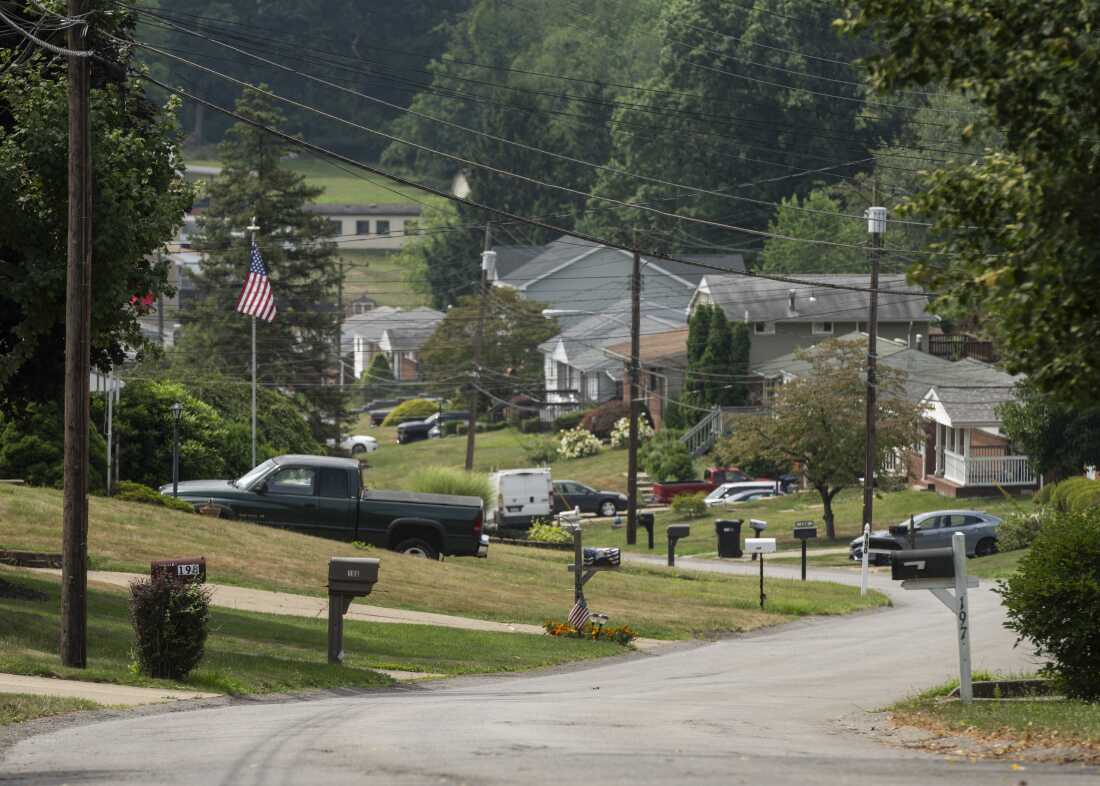
Moon Township a suburban town in Allegheny County on July 24, 2024.
Nate Smallwood for NPR
hide caption
toggle caption
Nate Smallwood for NPR
As for whether Moon Township and areas nearby will vote for Trump or Harris, if she becomes the nominee as expected, Wink and Madonna-Emmerling have a similar view.
Families and seniors on fixed incomes here are struggling with the cost of groceries and other costs of living. Under Trump, “things were humming along pretty well,” Wink said, and if Republicans can communicate that message and get their lower-propensity voters to turn out, the election will be theirs.
Madonna-Emmerling thinks voters here will want a candidate to be honest and relatable and Harris fits the bill.
She says people in this community work hard and care about their families and those around them. Speaking authentically to that could motivate those among them who are non-voters to head to the polls.
“Don’t be fake,” Madonna-Emmerling advised. “We have a strong bull**** detector.”
The audio version of this story was produced by Taylor Haney and edited by Gabriel Spitzer.


The exterior of the Robert F. Kennedy Department of Justice building is pictured on May 4, 2021, in Washington, D.C.
Patrick Semansky/AP
hide caption
toggle caption
Patrick Semansky/AP
The Justice Department released a memo this week that quietly calls into question decades of civil rights protections for Americans with disabilities and stirred fear and anger among advocates and families.
The memo, an opinion from the Office of Legal Counsel, argues that states do not have to provide in-home or community-based care to people with disabilities who need support. These services allow many disabled Americans to continue to live, learn and work at home or in their own communities, among family and friends.
“It is now the position of the United States government that people with disabilities don’t have a right to be part of their communities,” says Alison Barkoff, a health law and policy professor at George Washington University who led disability law and policy efforts during both the Obama and Biden administrations. “I can’t overstate how significant this change in position is.“
Without the federal government requiring that states provide these services – to help disabled people integrate into their communities – advocates and legal experts warn that cash-strapped states could cut them and return to what was once common practice: de facto segregation of Americans with disabilities in nursing homes and large institutions.
Pushback from the disability community was swift.
“As America prepares to celebrate 250 years of independence, [this memo] threatens to drag our nation back to a dark and shameful era of ignorance and cruelty,” said the American Association of People with Disabilities. “This interpretation will open the doors for states to revert to warehousing people with disabilities out of sight and out of mind in institutions.”
“This opinion is a direct threat to decades of progress toward community living for people with disabilities,” said Shira Wakschlag of The Arc of the United States, a nonprofit disability advocacy group. “People with disabilities shouldn’t be forced into institutions because a state refuses to provide services in the community.”
The Justice Department did not respond to an NPR request that it explain its position as well as why it is changing course after decades of legal and bipartisan support for community services.
What the law says
This new memo calls into question what legal experts say has been settled law for decades.
Both Section 504 of the Rehabilitation Act and Title II of the Americans with Disabilities Act have long been interpreted to require that states provide services to Americans with disabilities in the most integrated setting appropriate. In short: Institutionalization should be a last resort.
In 1999, a case testing these protections made it to the U.S. Supreme Court. In Olmstead v. L.C., two women with mental disabilities sued Georgia, arguing that the state had failed its obligation to provide services that would allow them to return to their communities and that it had continued to institutionalize the women instead, thus violating their civil rights.
The court agreed that states have a legal responsibility to provide support that integrates disabled Americans into their communities, and for nearly three decades, courts across the country have embraced that interpretation.
By 2023, 8.4 million Americans were receiving home- and community-based services through Medicaid.
The new memo, written by Lanora Pettit, principal deputy assistant attorney general in the Office of Legal Counsel, argues that, while federal law prohibits discrimination on the basis of disability, it does not impose an “integration mandate” on states to provide these community services.
What’s more, the memo argues, the Supreme Court’s Olmstead decision “held only that a state cannot institutionalize such patients without justification.”
But, the memo adds: “What counts as adequate justification remains an open question.”
At one point, Pettit acknowledges the novelty of this reading: “We recognize that this view of Olmstead‘s import is out of step with the common understanding of that decision within the federal courts.”
Why it matters
“The United States government since 1977 has taken the position that [federal law] includes an integration mandate that requires services to be provided in the most integrated setting appropriate,” says professor Barkoff, who worked in the Obama Justice Department leading its Olmstead enforcement efforts.
For decades, Barkoff adds, both Republican and Democratic administrations, including the first Trump administration, proactively enforced federal disability law and repeatedly brought actions against states that relied too heavily on care in large, segregated settings that the law says should be a last resort.
The courts and Congress decided institutionalization should be a last resort because people’s personal liberty is at stake, says Jennifer Mathis of the Bazelon Center for Mental Health Law: “Who you can see, when you can go out, when you eat, what you eat. Who your roommate is, who you talk to, what your environment is. And for so many people who are institutionalized, their life is literally a hallway. I have been on those hallways with people. It is deadening.“
This memo signifies a dramatic change in the U.S. government’s official position.
“We are incredibly concerned that the message coming from the federal government in this memo is, ‘It’s fine to go back to the days that people were placed in institutions,’ even though they can be served in the community, even though they want to be and even though it’s more cost-effective,” Barkoff says.
The timing matters too. The memo arrives as a new case, Texas v. Kennedy, is making its way through the courts. The case, brought by Texas and several other states, is essentially a fresh challenge to the integration mandate on states.
With this memo, the federal government is aligning itself with the plaintiffs in the case. Though Mathis cautions: “It’s important to understand that [this memo] is not the law, that the Justice Department can’t change the law. Congress makes laws, not agencies.“
For now, it’s not clear what the immediate impact of the memo will be, though it seems the Justice Department will stop its enforcement efforts around Olmstead.
Why now?
The Justice Department memo appears to be the latest salvo in a broader effort that began on July 24, 2025, when President Trump issued an executive order intended to make it easier for state and local governments to police homelessness.
“Endemic vagrancy, disorderly behavior, sudden confrontations, and violent attacks have made our cities unsafe,” the order argues, going on to claim that “the overwhelming majority of these individuals are addicted to drugs, have a mental health condition, or both.”
The administration’s solution: Involuntary institutionalization. “Shifting homeless individuals into long-term institutional settings for humane treatment through the appropriate use of civil commitment will restore public order,” the order reads.
In a 2023 campaign video, President Trump himself pledged: “For those who are severely mentally ill and deeply disturbed, we will bring them back to mental institutions, where they belong.”
A conservative Texas think tank, the Cicero Institute, has been a driving force behind recent efforts to forcefully combat homelessness, including through institutionalization.
One serious obstacle to large-scale institutionalization of the unhoused is federal disability law that has long required home- or community-based services instead, when appropriate. A footnote in the Justice Department’s new memo appears to suggest these laws have contributed to the rise in chronic homelessness.
To the contrary, Barkoff says, the Olmstead decision “has been one of the most effective tools in providing services and stable housing to people who are homeless.”
NPR has previously reported that the Trump administration’s push for institutionalization faces another big obstacle: An acute shortage of beds at these specialized facilities.
The memo arrives as Republicans have also passed deep cuts to Medicaid, which is the primary source of funding for community-based services many disabled Americans rely on.
Multiple legal experts tell NPR that, in response to last year’s One Big Beautiful Bill Act, states must now make deep cuts to a whole range of services previously funded by Medicaid. The Trump administration’s memo, they add, essentially gives states permission to cut these localized supports and, instead, rely on institutionalization – even though research shows the latter is considerably more expensive for states to provide.
This comes as disability advocates were already pushing back against the Trump administration’s announcement on Tuesday that it would move federal administration of special education programs out of the Department of Education and into the Department of Health and Human Services – a change that, as with the new Justice Department memo, raised fears of a rollback of the enforcement of longstanding civil rights protections.

new video loaded: The Sacred Catholic Site Where Trump Wants a Border Wall

By Reis Thebault, Christina Shaman, Jon Miller, June Kim and Melanie Bencosme
June 20, 2026

Kim was, in her words, “starving for that fatherly love.”
She became an intern for Baer and always looked forward to being held in his arms for extended periods of time. She eventually asked him if there was anything she could do to help ease the fear that she believed was still holding her back.
There was, Baer told her. At his direction, she took off her top and bra, Kim said, and he held her but didn’t touch her breasts or privates.
“It felt very parental, and it felt very special,” she said.
In hindsight, Kim said, she cherished the experience for another reason.
“I was getting this special attention from him,” she said. “I was pretty desperate for that in my life.”
She now sees it as classic grooming behavior.
It happened one other time, Kim said, and she eventually asked him if there was anything else she could do to experience a “bigger shift.”
Baer brought her to the pool house and instructed her to remove her clothes piece by piece, Kim said. He lay in bed with her, rubbed her back and held her breasts, according to Kim.
“There was no talking me into it — I just did it,” Kim said. “In hindsight, I realized I didn’t feel free to say no to any of it. I had the belief that if I did say no, he would write me off.”
When Kim got the call from her daughter Penelope, she said it jolted her out of what she now describes as a cult mindset.
She spoke to other women in the community and said she heard more stories involving naked holding.
One of those women was Inge Jechart. A mother of two with a doctorate in physics, Inge had been an active Real Love member since a friend recommended Baer around 2005.
“At that time, I was lost and lonely,” she said, describing struggling under the weight of a faltering marriage and a strained relationship with her sons. “I learned how to become a better person and more loving and understanding.”
The first time Baer held her in his lap, Inge was overcome with emotion.
“I just cried,” Inge recalled. “It was such a relief to feel safe and loved. What else do we want in life?”
Following that experience, Inge said, she booked every retreat at his house that she could. And it was there, in 2017, that she said she twice got naked with Baer at his direction.
“We hold our own children when they’re naked to make them feel safe,” Inge said. “For me, that’s what we were doing.”
“And here’s the thing,” she added. “It made a huge difference for me.”
But Inge said Baer fondled her breasts the second time, and that didn’t feel right at all.
“I said, ‘Hey, as a 4-year-old, I wouldn’t have breasts,’” she recalled. “And he stopped.”
Inge said Baer told her he had done it with only one other woman before, and he added in a stern voice: “I don’t talk about this with anyone else.”
“I got the message,” Inge said. “Our community was important to me, and I didn’t want it to blow up, so I kept silent.”
But she said she never considered that he might be engaging in naked holding with younger, more impressionable women like Veena and Penelope.
Kim, Penelope’s mother, said the same.
“It had never crossed my mind that he would ever do this with my daughter,” Kim said. “I was completely blind to that possibility.”
The backlash
In February 2019, Kim sat down at her computer and began to type an email to Baer.
“Greg what you have done with my daughter…is wrong, hurtful, traumatic and goes against so many gospel principles,” read the email, which was reviewed by NBC News.
“Holding people without clothes on needs to stop, what you are doing is wrong,” it added. “Touching my daughter between her legs when she was naked was wrong — there is no justification for it.”
“I know of 4 women personally who have undressed completely with you, and I don’t know hardly anyone that you spend time with so I conjecture that there are many more,” Kim wrote near the end. “I beg of you…put a stop to this horribly damaging behavior.”
Baer was defiant in his response.
Kim’s daughter was “claiming events that never happened,” he wrote. “And she is supplying lots of details that never happened. And now she is sharing these details with as many people as she can find.”
Kim’s email wasn’t the only scathing message Baer received during this period.
“I am writing to perhaps appeal to your consciences and any integrity you may still have left,” wrote a woman from the U.K. in an email viewed by NBC News. “Shut Real Love down now before it’s too late.”
“Greg you have had sexual dealings with way more women than we initially thought,” the woman added. “That’s not including the naked holding.”
Baer replied with another strong denial.
“Nothing, absolutely nothing, like this is occurring, and people are healing all over the place,” he wrote to the British woman.
After receiving an email from NBC News, the woman declined to be interviewed, citing the lasting emotional toll.
“It’s honestly an incredibly traumatic part of my life, and one I don’t want to revisit,” she wrote. “It’s been 8 years and I haven’t moved on.”
The aftermath
Veena, Penelope and her mother said they all reached out to the police in Baer’s hometown of Rome but were told there was not enough evidence to pursue a sexual abuse case.
The Rome Police Department confirmed to NBC News that it conducted an investigation but said no charges were brought due to “insufficient probable cause.”
The women said they had also reported Baer to their local Mormon churches.

A spokesman for the Church of Jesus Christ of Latter-day Saints, widely known as the Mormon church, said it “initiated ecclesiastical proceedings involving this individual beginning in February 2020.”
The process could lead to a member’s excommunication, but the spokesman said he was not authorized to comment on the outcome of the proceedings.
Veena and Penelope filed lawsuits against Baer in Georgia’s Floyd County Superior Court in April 2019. They were settled five months later for $12,000 each. (The attorney who represented Baer, Robert Smalley, declined to comment.)
By then, Veena was adapting to life outside of Real Love. She had already separated from her husband and left the church. While raising her three children, she went back to college. A career in physics no longer interested her. She earned a degree in psychology from Columbia University.
“To help me understand what on earth just happened,” Veena said.
A few years ago, she decided to write what became a very different book than the one originally conceived about her experience in Real Love. She used pseudonyms for the group and for Baer himself, but the account, she said, was drawn from her recollections, emails and journal entries.
“The True Happiness Company” was published last year with the subtitle, “How a Girl Like Me Falls for a Cult Like That.”
Veena hoped that it would help her process what happened and serve as a cautionary tale for others.
“The physical violation is not what unravels me,” she says in the book. “It’s the loss of life experience, the mental and emotional violation of having my young adulthood orchestrated by someone with undue influence over me. It’s the friendships that disintegrated. The career paths unexplored. The opinions he replaced with his own.”
“The changes feel almost imperceptible as they happen,” she added later in the book, “and then suddenly appear extreme in retrospect.”
If you or someone you know is in crisis, call or text 988 or go to 988lifeline.org to reach the 988 Suicide & Crisis Lifeline, or visit SpeakingOfSuicide.com/resources.
-

 Minnesota6 minutes ago
Aurora clinches division championship with 4-1 win over River Light
-

 Mississippi9 minutes ago
Mississippi Lottery Mississippi Match 5, Cash 3 results for June 20, 2026
-

 Missouri14 minutes ago
Silverfield Might Have Master Plan For Arkansas to Finally Take Down Missouri
-
Montana21 minutes ago
Montana Lottery Powerball, Lotto America results for June 20, 2026
-

 Nebraska24 minutes ago
Photos: Nebraska Athletics unveils new Adidas uniforms
-

 Nevada29 minutes ago
NEVADA VIEWS: Choosing a school for your child? Here’s what you need to know
-

 New Hampshire36 minutes ago
1 dead, 5 injured in head-on crash in NH – Boston News, Weather, Sports | WHDH 7News
-

 New Jersey39 minutes ago
Did anyone win Powerball? Winning numbers for June 20, 2026

