Politics
Top five moments from Secret Service director's hours-long grilling after Trump assassination attempt


U.S. Secret Service Director Kimberly Cheatle testified for hours on Capitol Hill Monday, facing a grilling from lawmakers on both sides of the aisle over the agency’s lapse in security that enabled the assassination attempt on former President Trump.
Cheatle testified before the House Oversight Committee, led by Chairman James Comer, R-Ky., after he subpoenaed her to appear.
REP. MACE CALLS ‘BULLS—‘ ON RESPONSE FROM SECRET SERVICE DIRECTOR CHEATLE
Cheatle testified before the House Oversight Committee Monday, just over a week after a would-be assassin Thomas Crooks attempted to take the life of Trump at his rally in Butler, Pa. on July 13.
Trump, during his rally, ever-so-slightly turned his head—narrowly missing the bullet shot by 20-year-old suspect Crooks’ AR-15-style rifle by just a quarter of an inch. The bullet hit him, instead, in his upper right ear.
United States Secret Service Director Kimberly Cheatle testifies before the House Oversight and Accountability Committee during a hearing at the Rayburn House Office Building on July 22, 2024 in Washington, DC. Cheatle has vowed cooperation with all investigations into the agency following the attempted assassination of former President Donald Trump. (Justin Sullivan/Getty Images)
The bullet killed firefighter, father and husband Corey Comperatore as he protected his family from the shots, and severely injured two others.
Cheatle admitted under oath that the Secret Service “on July 13th, we failed.”
Here are the top five moments from the highly-anticipated hearing:
Cheatle admits Secret Service ‘failed’ on July 13
Cheatle told the House Oversight Committee that “on July 13th, we failed” when it came to her agency’s handling of the assassination attempt on the former president and the shooting at his Butler, Pa. rally.
“As the director of the United States Secret Service, I take full responsibility for any security lapse of our agency,” she continued.
“We must learn what happened, and I will move heaven and earth to ensure that an incident like July 13th does not happen again,” Cheatle also said. “Our agents, officers and support personnel understand that every day we are expected to sacrifice our lives to execute a no fail mission.”
Democrats and Republicans call on Cheatle to resign
House Oversight Committee Chairman James Comer, R-Ky., called on Cheatle to resign, along with other Republican lawmakers.
But Democrats called for her resignation as well, including Rep. Ro Khanna, D-Calif., who said, “If you have an assassination attempt on a president or a former president or a candidate, you need to resign.”
Cheatle has maintained that she will not resign, and said she is committed to getting answers on the massive security failure for the American people.
TIMELINE: TRUMP ASSASSINATION ATTEMPT
Rep. Greg Steube, R-Fla., says he plans to introduce articles of impeachment against her.
“In light of Kimberly Cheatle’s unacceptable handling of the Trump assassination attempt, her disastrous appearance before the House Oversight committee today, and her refusal to resign, we have no choice but to impeach,” Steube said in a post on X. “I will be filing articles of impeachment against Kimberly Cheatle this afternoon.”
Kimberly Cheatle, Director, U.S. Secret Service, departs after testifying during a House Committee on Oversight and Accountability hearing on Oversight of the U.S. Secret Service and the Attempted Assassination of President Donald J. Trump, on Capitol Hill, Monday, July 22, 2024, in Washington. (AP Photo/Rod Lamkey, Jr.)
And Rep. Anna Paulina Luna, R-Fla., accused Cheatle of perjuring herself and stonewalling members of the House Oversight Committee, telling her protectees are “sitting ducks” with her in charge.
GOP Rep. Nancy Mace calls ‘bulls—’ on Cheatle response
Rep. Nancy Mace, R-S.C., told Secret Service Director Kimberly Cheatle on Monday that her response that she had “no idea” how her opening statement for today’s House Oversight Committee hearing on the Trump rally shooting got leaked to media agencies is “bulls—.”
The fiery remark from the South Carolina lawmaker came after Cheatle was directed by Mace to answer a series of yes or no questions on the Secret Service’s response to the attempted assassination of former President Trump in Pennsylvania, in which Cheatle said “yes” to it being a “colossal failure,” and a tragedy that could have been prevented.
“Would you say leaking your opening statement to Punchbowl News, Politico’s Playbook and Washington Post several hours before you sent it to this committee as being political? Yes or no?” Mace asked Cheatle.
“I have no idea how my statement got out,” Cheatle responded.
Rep. Nancy Mace said Secret Service Director Kimberly Cheatle was “full of s—” at a Monday, July 22, 2024, House hearing. (Associated Press)
Mace fired back: “Well that’s bulls—.”
Mace started mentioning news articles published between 5 and 7 a.m. ET, about three to four hours before she said the House Oversight Committee received Cheatle’s statement.
Mace then asked Cheatle, “Have you provided all audio and video recordings in your possession to this committee, as we asked on July 15? Yes or no?”
SECRET SERVICE DIRECTOR OPENS TESTIMONY WITH FRANK ADMISSION: ‘WE FAILED’ — BUT WON’T RESIGN
“I would have to get back to you,” Cheatle said.
“That is a no. You’re full of s– today. You’re just being completely dishonest,” Mace told Cheatle, before being interrupted with a call for decorum inside the hearing room at the Rayburn House Office Building on Capitol Hill.
Cheatle unable to answer how many times Trump team made extra security requests
Secret Service Director Kimberly Cheatle on Monday said that “for the event in Butler, there were no requests that were denied” from former President Trump’s team.
“They asked for additional help in some form or another. You told them no. How many times did you tell them no? And what’d you tell them no to?” Rep. Jim Jordan, R-Ohio, asked Cheatle, referencing comments made by Secret Service spokesperson Anthony Guglielmi.
Republican presidential candidate former President Donald Trump is moved from the stage at a campaign rally, Saturday, July 13, 2024, in Butler, Pa. (AP Photo/Evan Vucci)
“What I can tell you is that in generic terms, when people when details make a request, there are times that there are alternate ways to cover off on that threat or that report,” Cheatle responded.
Cheatle tells House Oversight Committee she called Trump after shooting to apologize
Cheatle testified Monday that she called former President Trump after the shooting to apologize.
She also attempted to explain to the committee that her agency was unaware of a suspicious threat during the rally, despite the public pointing to a man on a roof minutes before former President Trump was shot.
She stressed, though, that the Secret Service and “the people that are in charge of protecting the president on that day would never bring the former president out if there was a threat that had been identified.”
Trump told “Jesse Watters Primetime” in an interview that aired Monday night that Cheatle came to see him in the days following the assassination attempt.
“It went very nicely. She was very nice, I thought. But, you know, somebody should have made sure there was nobody on that roof,” he said.
Fox News’ Ashley Carnahan contributed to this report.



WASHINGTON — California’s two Democratic senators on Thursday criticized the Trump administration after it requested $87.6 billion from Congress to address some of the nation’s most “urgent needs” but omitted funding for victims of last year’s Los Angeles wildfires.
“Donald Trump’s desire to punish Los Angeles and the state of California for not voting for him, means once again that thousands of Angelinos are left watching this administration fight for anything but them, their businesses, and their communities,” Sens. Alex Padilla and Adam Schiff said in a joint statement.
“These fires did not discriminate based on party or political preference. Neither should this administration,” they added.
The omission is the latest strain in a yearlong standoff between California leaders and the Trump administration over federal disaster aid, and it comes after Los Angeles Mayor Karen Bass and Los Angeles County Supervisor Kathryn Barger met with President Trump at the Oval Office in April to request the funding.
At the meeting, Trump signaled his commitment to working with local officials to help with disaster recovery efforts. The officials asked for $16 billion that would be split between the city and county. The money would consist primarily of disbursements from the Federal Emergency Management Agency flagged for communities hit by the fires, part of a $33.9-billion wildfire relief funding request made by Gov. Gavin Newsom.
Two months later, those talks have yet to yield results sought by local leaders.
The budget request, submitted by the Office of Management and Budget on Wednesday, mostly seeks funding for the Pentagon to address costs related to the Iran war. It also includes $11.1 billion in economic assistance for American farmers, $1.4 billion to address the Ebola virus outbreak in Central Africa, $500 million to support “ongoing efforts to complete restorations and construction projects” across the nation’s capital and $1 billion to boost the pensions of workers at General Motors that were cut as a result of the automaker’s bankruptcy.
“I urge the Congress to take action on these important and urgent requests as soon as possible,” White House budget director Russell Vought wrote in a letter addressed to House Speaker Mike Johnson (R-La.).
Vought said the administration was open to discussing “additional relief for other urgent matters.” The White House did not immediately respond when asked why the budget request did not mention the Eaton and Palisades disaster relief funds.
State leaders, including Newsom, have repeatedly accused the Trump administration of stonewalling billions in wildfire aid. The governor visited Washington in December to meet with lawmakers, including three who serve on the Senate and House appropriations committees, to push for the funding.
The governor also attempted to meet with FEMA about the matter, but said his request was denied. Newsom, a political foe of Trump’s, would not say whether he had attempted to meet with Trump to talk about the recovery efforts.
Politics
Trump administration pledges $150M in aid, deploys Navy warships after deadly Venezuela earthquakes

Secretary Rubio details US aid to Venezuela after earthquakes
Secretary Rubio, in Manama, Bahrain, outlines the comprehensive U.S. government response to the devastating back-to-back earthquakes in Venezuela. He confirms immediate deployment of search and rescue teams, medical resources and humanitarian assistance, emphasizing the urgency to save lives. Rubio reiterates President Donald Trump’s commitment to supporting Venezuela and collaborating with international partners on recovery efforts and long-term stability.
NEWYou can now listen to Fox News articles!
Following a catastrophic set of earthquakes that left at least 235 people dead in Venezuela, the Trump administration has activated a government-wide humanitarian response, pledging $150 million in aid and deploying U.S. Navy warships to assist in life-saving rescue operations.
The rapid mobilization Thursday comes after back-to-back magnitude 7.2 and 7.5 earthquakes rocked northern Venezuela roughly 120 miles west of Caracas Wednesday night.
The rare earthquake “doublet” injured more than 940 people and turned the state of La Guaira into a disaster zone, while forcing the closure of the damaged Simón Bolívar International Airport, according to Venezuela’s Health Ministry.
US RESCUE TEAMS TO DESCEND ON HARD-HIT CARIBBEAN AFTER CATASTROPHIC HURRICANE MELISSA’S IMPACT
Rescuers search for victims in a collapsed building following an earthquake in Caracas on June 24, 2026. (Manaure Quintero / AFP via Getty Images)
The U.S. Department of State announced on Thursday it is mobilizing $150 million in aid, which includes $50 million in new bilateral awards for relief partners on the ground — such as Samaritan’s Purse, Catholic Relief Services and World Vision — along with a $100 million contribution to a United Nations humanitarian pooled fund.
To spearhead efforts on the ground, the State Department has deployed a regional Disaster Assistance Response Team alongside two highly specialized urban search-and-rescue teams from fire departments in Fairfax County, Virginia, and Los Angeles County, California.
U.S. WARSHIPS TO PATROL INTERNATIONAL WATERS AROUND VENEZUELA AS TRUMP VOWS TO STOP CARTELS
Members of the County of Los Angeles Fire Department’s international urban search and rescue team (USA-2) prepare to leave for Venezuela, in Pacoima, Calif., Thursday. (Blake Fagan/AFP via Getty Images)
U.S. Southern Command (SOUTHCOM) said it is surging assigned U.S. military forces to the region, directing the USS Fort Lauderdale and the USS Billings to Venezuela to back the State Department-led operations.
The USS Fort Lauderdale will serve as a “floating command center” with a flight deck to support heavy-lift helicopters and a well deck to launch landing craft, according to SOUTHCOM.
Meanwhile, the agile USS Billings will provide critical support close to the shorelines to accelerate the disaster response missions.
U.S. SOUTHCOM said it has directed USS Fort Lauderdale (LPD 28) and USS Billings (LCS 15) to Venezuela to support State Department-led U.S. government relief operations in Venezuela. (@Southcom/X)
SOUTHCOM said it is also sending rotary-wing aircraft, which will provide critical life-saving airlift support, transporting U.S. government response personnel, search and rescue teams and partners during relief operations.
Amid the crisis, the State Department emphasized that the safety of U.S. citizens remains the administration’s highest priority.
“The Trump Administration has no higher priority than the safety and security of Americans. The Department of State is working tirelessly to provide consular assistance to U.S. citizens and their families in the affected areas,” officials wrote in a statement. “The United States remains steadfast in its commitment to helping Venezuela recover from this devastating disaster and will continue to explore additional ways to provide meaningful assistance during this critical time.”
CLICK HERE TO DOWNLOAD THE FOX NEWS APP
U.S. citizens in Venezuela are urged to enroll in the Smart Traveler Enrollment Program (STEP) and can contact the State Department 24/7 at 202-501-4444 for emergency assistance.
Family members in the U.S. seeking information on loved ones can call toll-free at 888-407-4747.
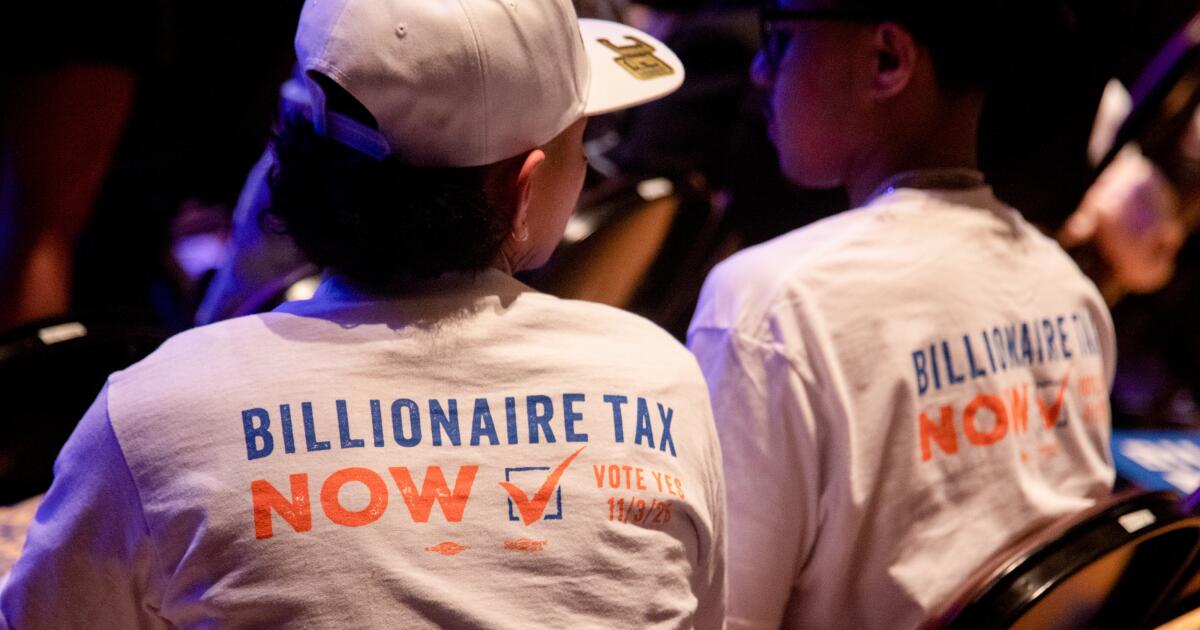
Proponents of a tax on California billionaires vowed on Thursday to move forward with their November ballot measure despite mounting opposition from many of the state’s most powerful political forces.
A labor union spent $31 million gathering signatures to qualify the measure for the ballot in an effort to offset federal healthcare funding cuts that will affect millions of California’s most vulnerable residents. A representative for the campaign supporting the ballot measure pushed back at opposition to the effort as self-entitled wealthy Californians and entrenched Sacramento interests.
“While a few morally bankrupt billionaires and their buddies in Sacramento want to see California’s hospitals close, and tax breaks for billionaires protected — I assure you, the vast majority of voters do not,” said Debru Carthan, a spokesperson for the Billionaire Tax Now Coalition, which is funded by the Service Employees International Union-United Healthcare Workers West, the sponsor of the proposal.
California Secretary of State Shirley Weber is expected to officially certify the measure to appear on the Nov. 3 ballot on Thursday evening.
Carthan said their effort has support in public opinion polls, and from lawmakers, unions, community organizations and volunteers across the state, “something the billionaires and their buddies will never have.” And she criticized Gov. Gavin Newsom for opposing the measure, saying that he is in “lock-step” with President Trump and billionaires.
“Gov. Newsom has no plan,” Carthan said during a Thursday evening news conference. “He has no plan to stop emergency rooms from closing. He has no plan for your healthcare costs. He has no plan to make sure that your family doesn’t have to drive further and wait longer to get medical care. Gov. Newsom has no plan to fix one of Trump’s deadliest domestic policy blunders.”
Rep. Ro Khanna (D-Fremont) also attacked the governor, though not by name.
“If you’re opposed to this tax, you’re on the side of trickle-down economics,” Khanna said. “You’re protecting the very, very rich, as opposed to standing up for the working class.”
Both Khanna and Newsom are considering running for president in 2028.
The Newsom administration did not respond to a request for comment Thursday evening.
A coalition of healthcare, education, public safety, housing, business and labor leaders opposed to the proposal warned that it would make the state’s notoriously unstable budget even more unpredictable.
“The dangerous wealth tax directly threatens vital funding for education and schools, healthcare and clinics, public safety, and infrastructure projects by making California’s revenue even more volatile,” the leaders of the California Medical Assn., the California Primary Care Assn. and the California School Boards Assn. said in a statement. “That’s why so many leaders – both Democrats and Republicans – are joining us and saying NO. We look forward to ensuring voters have the facts, know the stakes, and resoundingly reject this reckless experiment in November.”
Supporters of the one-time proposed 5% tax on the assets of the state’s wealthiest residents pitched the effort as a stop-gap measure to offset devastating federal healthcare funding cuts passed by the GOP-led Congress and signed by President Trump nearly one year ago. The federal legislation is expected to result in $100 billion in cuts that would affect California’s most vulnerable residents.
The proposed tax, which would be retroactive to billionaires who lived in the state as of Jan. 1, drew predictable opposition from the wealthy, notably Silicon Valley tech leaders.
But it notably divided liberals. While Sen. Bernie Sanders (I-Vt.) and Khanna supported the proposal, Newsom was among the Democrats who opposed it because of fears about the potential impact on the state’s volatile budget.
Despite being the fourth largest economy in the world — the home of Hollywood and Silicon Valley — California’s budget is extremely dependent on the state’s most prosperous residents.
Newsom and others who generally support increasing taxes on the wealthiest Americans also argued that the proposed billionaire tax in California was poorly crafted and that any such levies ought to be enacted nationally, because varying state policies would be ineffective.
Opponents also argued that the political priority in the 2026 midterm election should be squarely focused on efforts to make sure Democrats regain control of Congress to serve as a counter balance during the final two years of Trump’s presidency.
“It’s disappointing. This is a critical election where we need to concentrate on flipping the house and undoing the damage that was done” by Trump’s legislation that led to the healthcare funding cuts, said Jodi Hicks, chief executive and president of Planned Parenthood Affiliates of California. The wealth tax “is short term and doesn’t address what is the long-term problem. And I’m not even sure the policy is a viable solution. It’s so critical to be sending the right message — holding Congress accountable and how we need to find long-term solutions to make sure Californians have access to healthcare.”
Dave Regan, the president of SEIU-United Healthcare Workers West, lashed out at the leadership of Planned Parenthood as “out of touch” with their workers and their patients.
Rob Lapsley, co-chair of Californians Against Tax Increases and president of the California Business Roundtable, argued that the proposed wealth tax would ultimately affect every Californian.
“Strip away the spin, and this measure forces every California taxpayer, not just billionaires, to file a sworn declaration of their net worth with the Franchise Tax Board under penalty of perjury,” Lapsley said in a statement. “And it hands the Legislature the power to extend the wealth tax to all Californians and every kind of property, including home equity, retirement savings without ever returning to the voters – effectively gutting” voter-approved caps on property tax increases.
Supporters of the tax submitted nearly 1.6 million signatures in April to qualify the proposal for the ballot, roughly double the number required. However, support for the effort has grown increasingly shaky. Newsom’s team created a broad coalition of opponents, including healthcare and education activists, that undercut the foundational argument for the tax.
The union that crafted the proposal responded last week by proposing a legislative alternative that would create a 2% tax on billionaire’s assets. It was flatly refused by the Newsom administration. No deal was reached by the Thursday evening deadline for the union to withdraw the proposal from the November ballot.
Two efforts that were crafted to sink the proposed billionaire tax — dubbed poison pills — also qualified for the Nov. 3 ballot, according to the California Secretary of State’s office. One would bar new state taxes on personal property, while the other prohibits any new taxes being exempted from existing state spending rules and to be regularly audited. If the billionaire tax proposal is approved by voters but either of the other proposals receives more votes, the tax measure would be voided.
“We will not allow California’s most vulnerable patients to be used as political pawns,” said Francisco Silva, president and CEO of the California Primary Care Assn. “Our broad coalition will mount an aggressive campaign to educate voters, defeat this reckless initiative, and protect care for millions of patients.”
The proposed billionaire tax would apply to more than 200 Californians, some of whom proactively left the state or moved their companies out of California because of the proposal.
The prospect of the wealthy fleeing the state is among the reasons that prominent Democrats such as Newsom opposed it, given California’s budget being so reliant on the state’s most prosperous residents.
Sergey Brin, a co-founder of Google, is among the billionaires who have reportedly moved out of California because of the tax proposal. He donated at least $82 million to an organization that is funding efforts to invalidate the proposed billionaire tax.
Ballot measure proponents had a Thursday evening deadline to withdraw their proposals.
Other policy proposals that will appear on the Nov. 3 ballot include:
- Requiring government-issued voter identification to cast ballots in elections.
- Reforming the California Environmental Quality Act, once a third-rail in Democratic politics that has become increasingly scrutinized in the rebuilding in the aftermath of the Palisades and Eaton wildfires.
- Creating a $11.3-billion affordable housing bond.
Two notable proposals were pulled off the ballot after negotiations between the California Hospital Assn. and labor unions:
- An effort to limit healthcare executives’ compensation.
- A union proposal by the same union backing the billionaire tax that would have required many healthcare clinics to spend 90% of their revenue to serve low-income and underserved residents.
-

 Technology6 minutes ago
World Cup ticket scams target desperate fans
-
Business8 minutes ago
Snap sued by parents of girl who was raped by man she met on Snapchat
-
 Entertainment14 minutes ago
‘The Bear’ at closing time: Ayo Edebiri and Jeremy Allen White reflect on five seasons
-
 Lifestyle21 minutes ago
L.A. Affairs: After decades of near-misses, I finally told him: ‘I’m not leaving here without you’
-
Politics24 minutes ago
Trump budget request omits funds for L.A. fire relief, prompting criticism from senators
-
 Science29 minutes ago
EPA touts crackdown on smuggled pesticides in L.A. visit
-
 Sports36 minutes ago
Commentary: Did Padres curse themselves by messing with that anti-Dodgers FTD burger?
-

 World44 minutes ago
Copernicus lead warns extreme heat measures needed or deaths to ensue

