Entertainment
The Anthony Ramos 'Twisters' chase and blockbuster Hollywood hustle


Since breaking out in the hit musical “Hamilton” in 2015, Anthony Ramos has moved from Broadway to the big screen, starring alongside Lady Gaga in “A Star Is Born” and earning a Golden Globe nomination for his leading “In the Heights” turn as Usnavi.
He has faced down titans in “Godzilla: King of the Monsters” and teamed up with the Autobots in “Transformers: Rise of the Beasts,” but last summer, while shooting “Twisters,” Ramos says, “S— got real.”
A standalone sequel to the 1996 disaster film “Twisters” follows Kate (Daisy Edgar-Jones) and Javi (Ramos), two former storm chasers who reunite after drifting apart following the aftermath of a devastating tornado. Back in Oklahoma, they set out to put new methods of storm tracking to the test, while occasionally clashing with brash but charming “tornado wrangler” and internet personality, Tyler Owens (Glen Powell). Helmed by “Minari” director Lee Isaac Chung, it’s a crowd-pleasing whirlwind with heart and plenty of epic action sequences.
Shot on location in the middle of tornado season, Ramos says it was an experience unlike any other — one that quickly taught him and his co-stars just how unpredictable and powerful a twister can be.
(Christina House/Los Angeles Times)
What drew you to “Twisters”? Were you a fan of the original?
It’s an awesome franchise, and the first film was really iconic. But I think the main reason I signed on was for [director] Lee Isaac Chung. I just wanted to work with him, because he’s one of the best in the game right now. I wanted an opportunity to spend a few months with him, learn from him, and make a great movie.
What was it about his approach to a “disaster movie” that you were drawn to?
I felt like he could just focus on the characters and the story. He made a big movie feel small and personal. For the most part, it felt like we were shooting an indie, except for when we were being blown away with fans and rain. [Laughs] But aside from that, it was pretty intimate.
I’m sure you experienced a lot of firsts on this set, especially when it came to filming the storm sequences.
Yeah, “Transformers” was pretty special effects heavy, but this was something else. I mean, they had a jet engine from a plane that they were using for the wind. It was so powerful that we’d roll up to film in our truck, I’d open the door, and it was like, “Yo, this is gonna fly off.” Even filming the final scene, where Glen [Powell] gets pinned down, and I’m trying to help him, we were getting pelted with gallons of water. I’m talking like two dumpsters full of water coming at us like a cannon. It was like a ride at Universal Studios. It was a wild experience.

(Christina House/Los Angeles Times)
What was it like shooting in the middle of tornado season in Oklahoma?
We had a whole special effects team, but a lot of the [weather] was real. I’m talking like, it would be blue skies, and we’d be like, ‘Wow, it’s such a gorgeous day out.’ Then all of a sudden, within minutes, it was overcast, and the wind started blowing. It was like, ‘Wait, where did this come from?’ Every now and then a tornado touched down near us, especially when we started to shoot further outside of Oklahoma City. It got pretty hectic out there.
Were there any close calls?
We had to wrap up early a couple of times. There was one scene where me and David Corenswet were shooting in the car, and behind us was this awesome storm cloud. They told us we had to stop because it was gonna turn into something, and sure enough it did. It turned into a real tornado, and our director went and chased it with one of our storm chaser consultants, Sean.
What did you learn from the storm chasers on set with you?
Oh, we’d ask them everything from what music they play while they’re out there chasing, or what they do when they’re out in the field. I realized a lot of chasing is actually just waiting for something to happen. We also got to see all the cool stuff they do with their cars. They rig them with all this technology to detect wind speed, and moisture, but also they have so much stuff prepared for any situation. Sean had an ax in his car, and when I asked him about it, he said he kept it in there because when he’s out chasing, a tree could just fall on his car. He’s got to be prepared for anything.
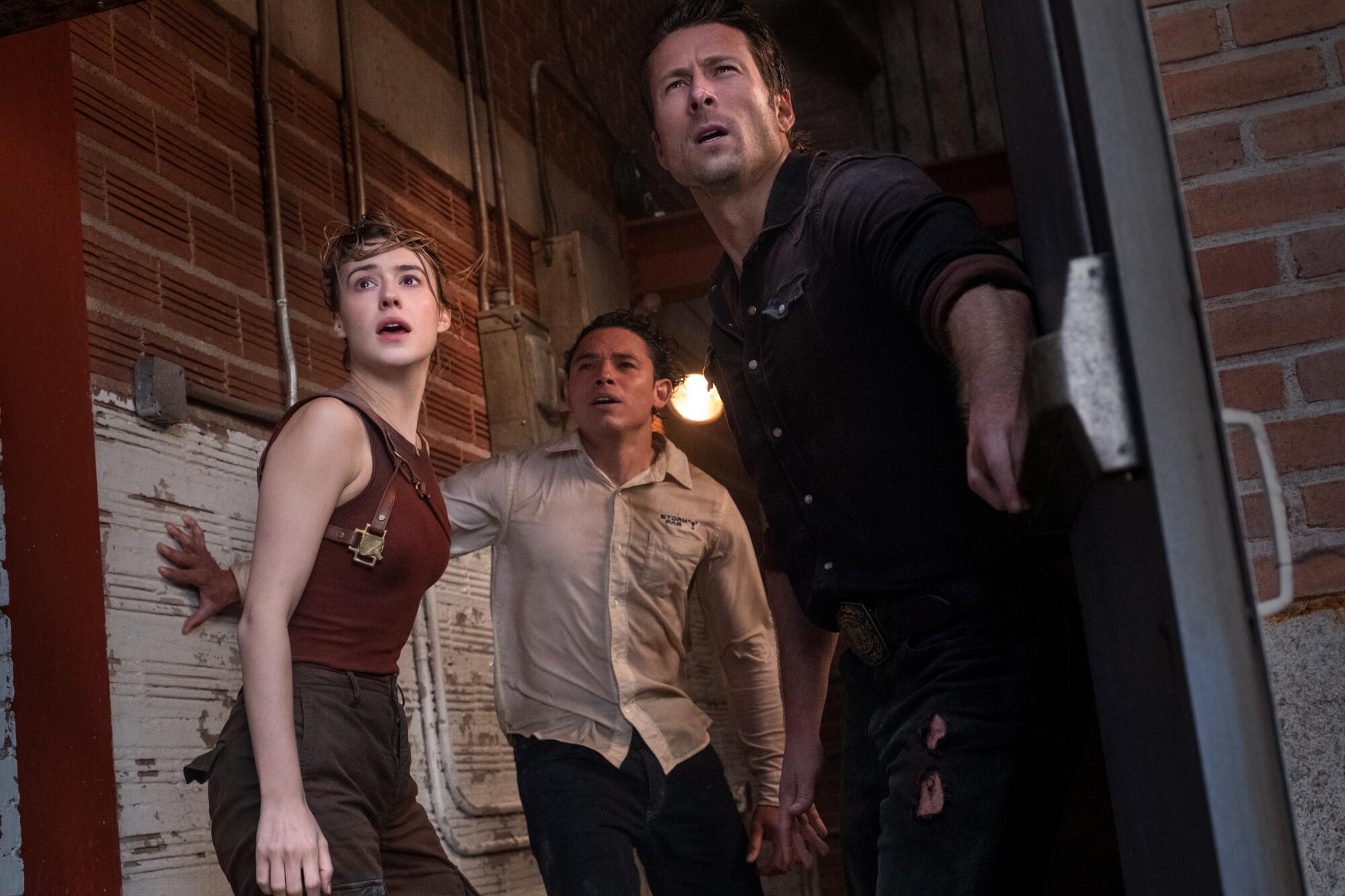
Daisy Edgar-Jones, Anthony Ramos, center, and Glen Powell in “Twisters.”
(Melinda Sue Gordon / Universal Pictures, Warner Bros. Pictures and Amblin Entertainment)
You mentioned that executive producer Steven Spielberg wanted you to use your real accent for the movie. Did that shape the kind of backstory you developed for Javi?
Yeah, I thought of him as someone who grew up in Miami, who went to [Oklahoma University] to study storms, and became a storm chaser. It made sense to me that he’d want to study storms, because he probably grew up around hurricanes, and I learned from Sean that they chase hurricanes, too. He’s literally gone into the eye of a hurricane.
What does it mean to you to be playing a character in a major blockbuster with your real accent?
It’s a big deal for me to be able to speak the way I speak in a movie like this. I never heard a scientist sound like me. Ever. When you grow up in a neighborhood that’s low income, or in the projects, being a meteorologist isn’t exactly the first thing on your list. When I was growing up, not just me, but my friends, we never thought about being a news anchor, a scientist, or a storm chaser. We didn’t know that was even an option. But now that I’ve watched it on the big screen, it’s like, ‘Oh, yeah, a guy from Brooklyn could do this if he wanted. Why not?’ Javi sounds like he knows what he’s talking about. I don’t know what I was saying, but I sounded smart. [Laughs]
Javi brings up this kind of moral question in the movie about people who try to profit off of disaster-prone areas. Is that something you’ve gained insight on after going back to Puerto Rico in the aftermath of Hurricane Maria?
After Maria, there were a lot of people who saw an opportunity on the island. Unfortunately, that hurricane devastated the island in a way where a lot of people moved and left for New York or Florida or wherever they could go. So people who had money capitalized on that. They bought up land, and you see now that they’ve developed it into a tourist attraction. But what I took from that experience was the resilience of the people. It was so inspiring.
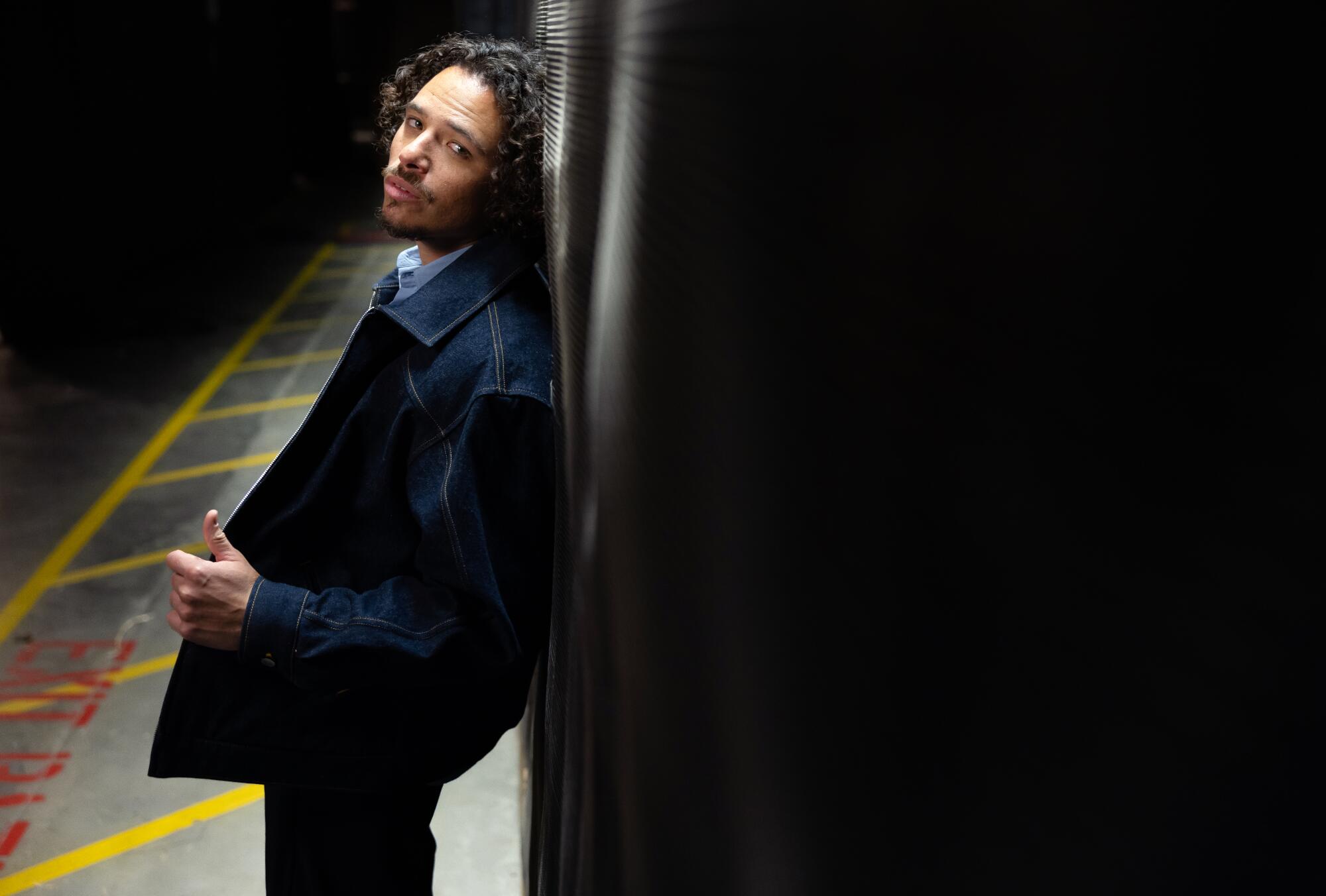
(Christina House/Los Angeles Times)
What sticks with you the most from that time?
I was there working with Defend Puerto Rico, this organization my boy Eli Jacobs-Fantauzzi started. We were there clearing out this guy’s house that had been absolutely decimated, and they were going to knock it down and try to rebuild. He was devastated, but there was this woman there that kept saying, “¿Quién dice que no se puede?” (Who says that we can’t do it?) We don’t need to wait for anybody, we can do this ourselves, we’ll figure it out. To experience complete devastation, and just have the sheer courage and heart and faith in other people, it’s special.
That’s a dynamic you also see a bit in both films. In rural or remote communities where these storms are a reality, people might feel a little bit left behind, so they learn to count on each other and take things into their own hands.
Exactly. It’s powerful to see people coming together for themselves. It was this whole attitude of ‘We’re gonna figure this out.’ People were protesting and fighting for what was theirs, because that’s their land, and they love it like no one else.
Now that you’ve had a chance to decompress from tornado warnings and sudden storms, what’s next on the horizon?
I can’t wait for my new music to start coming out. I’ve been working on that for a minute now. I’m also producing, so I’m excited about the “Bob the Builder” movie, working with Mattel. I like being able to see an idea from start to finish. It takes a long time, but it’s exciting to build something. I’m also writing a musical. I’ve been working on that with my boy Will Wells, who I met in “Hamilton” on Broadway. We have 14 songs already. It’s been an amazing experience.
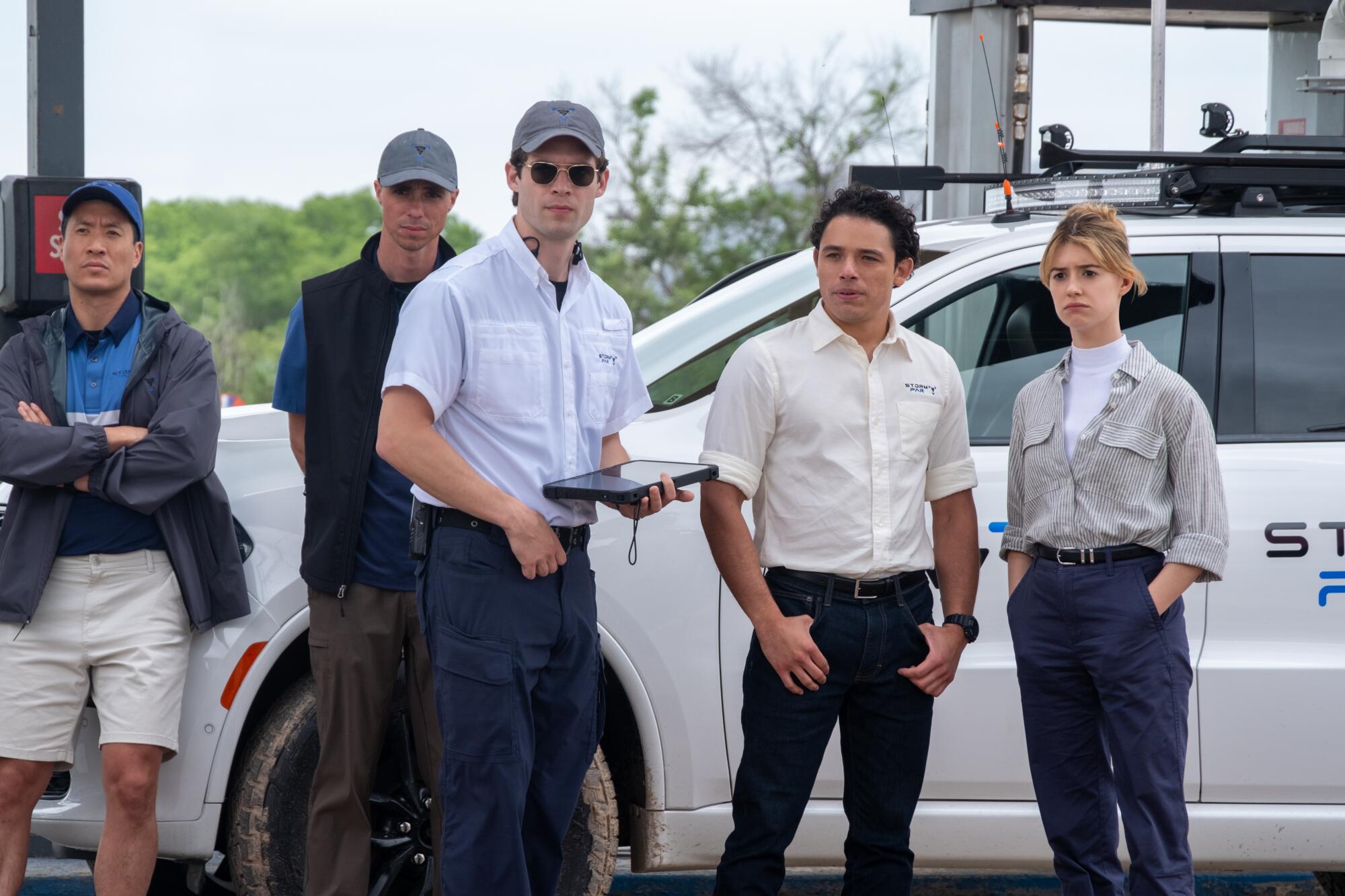
On the set of “Twisters” are Stephen Oyoung, from left, Alex Kingi, David Corenswet, Anthony Ramos and Daisy Edgar-Jones.
(Melinda Sue Gordon / Universal P Warner Bros. Pictures & Amblin Entertainment)


RICHMOND, Va. (WRIC) — In this episode of 8News Reel Talk, Julia Broberg sits down with Hekla Petursson and Catori Ryan to talk about “Toy Story 5.”
The hosts gave their reviews and provided the following star ratings:
Catori: ★★★★
Hekla: ★★★★★
Julia: ★★★★.2
To watch more livestreams and digital video content, head to the WRIC+ Originals page. You can also watch full on-demand videos on your smart TV using the WRIC+ app.

Passing “Go” has become especially lucrative for mobile game publisher Scopely.
The Culver City-based Scopely launched “Monopoly Go!” in 2023, betting fans of the classic board game would flock to a mobile version aimed at casual gamers.
By 2025, “Monopoly Go!” had accrued $6 billion in lifetime in-app purchase revenue, becoming the fastest free mobile game to do so, according to app analytics firm Sensor Tower.
This summer, the app is expected to reach $8 billion in lifetime revenue, the company says, solidifying “Monopoly Go!” as Scopely’s biggest game and far surpassing the company’s popular “Pokémon Go.” The company declined to disclose its total profits.
Scopely Co-Chief Executive Javier Ferreira.
As overall downloads in the mobile game market have stagnated and in-app purchases and retention become the main drivers of growth, Scopely has hit on an age-old Hollywood strategy — using known franchises and intellectual property to bring out fans.
“These are incredibly durable and long-lasting games that have really passionate communities and fandom around them,” said Javier Ferreira, co-chief executive of Scopely. “We’re in the business of building people’s favorite thing, and that’s a difficult thing to do. The power of [intellectual property] is that, in some cases, that is already their favorite thing.”
The company’s journey toward “Monopoly Go!” began in 2014, when Scopely formed a partnership with Rhode Island-based toymaker Hasbro. Its first collaboration was a Yahtzee mobile dice game that ultimately drew millions of players worldwide (though it was especially popular in the U.S.) and generated more than $1 billion in lifetime revenue.
After that, Scopely approached Hasbro about taking on the “crown jewel” of its board game empire — Monopoly.
Monopoly’s massive global popularity was an obvious draw. But adapting an hours-long real estate transaction game for a casual, mobile audience proved challenging.
Development of what would become “Monopoly Go!” ultimately took seven years, two of which were spent trying to make movement around the board more fun. In that time, the company scrapped two versions of the game; one deemed too competitive, and one that was too complex, Ferreira said.
Developers wanted to capture the “roller coaster feel” of the board game’s highs and lows, while also having simple rules and ensuring a strong social element, he said.
“We couldn’t just copy,” Ferreira said. “We had to reinvent it and re-imagine it, and that’s a complicated, creative endeavor.”
Today, “Monopoly Go!” brings in more than $2 billion in annual revenue and has been downloaded across the globe more than 300 million times.
Now with “Pokémon Go,” which the company owns after acquiring maker Niantic’s game business last year, “Scopely has gone from a successful publisher to one of the defining companies in mobile gaming,” Randy Nelson, head of insights at Appfigures, a mobile app analytics firm.
“The company cracked the code on licensed games years ago,” he wrote in an email. “Its biggest hits work because they’re great games first and recognizable brands second.”
Though the company’s overall game downloads have slowed, its gross revenue has largely increased every year since 2020, according to Appfigures data.
Shortly after Scopely released “Monopoly Go!,” the company was acquired by Savvy Games Group, which is owned by the Saudi Public Investment Fund, for $4.9 billion.
In a statement about the deal, Savvy Games Group Chief Executive Brian Ward touted the success of “Monopoly Go!” as “indicative of Scopely’s ongoing position at the forefront of the global games sector.”
Representatives of the Saudi investment fund are part of Savvy Game Group’s board and do sometimes give some feedback on company initiatives, though Ferreira said the company has remained “very independent.”
The proposed acquisition of gaming giant Electronic Arts by the Saudi Public Investment Fund is not expected to affect Scopely since EA largely focuses on high-budget console and computer games, he said.
As Scopely, now 3,000 employees strong, looks to the future, it has embarked on a number of entertainment partnerships with studios to add franchises such as “The Simpsons,” “Hello Kitty” and Marvel to its mobile game ecosystem.
“They give us access to these universes that millions of people love and are really invested in,” Ferreira said. “We see this as a very strategic part of our business.”

Rose of Nevada is a genuinely poetic movie that pushes the boundaries of the Groundhog Day-style time-travel narrative while carving out an identity completely its own. Rather than relying on the familiar mechanics that audiences have come to expect from the genre, the film approaches the concept through a more reflective and emotional lens. The result is a movie that feels thoughtful, ambitious, and surprisingly moving.
It makes a huge on-screen presence felt through its cast, particularly George MacKay and Callum Turner, who both deliver performances that elevate the material beyond a simple science-fiction premise. Combined with breathtaking visuals and a strong directorial vision, Rose of Nevada becomes something far more memorable than many of its genre contemporaries.
George MacKay continues to prove why he is one of the most compelling actors working today. Following his acclaimed work in 1917, he once again demonstrates an ability to carry a film through sheer presence and emotional authenticity.
Every scene feels grounded because of his performance, even when the story ventures into more abstract territory. Alongside him, Callum Turner delivers what could easily be viewed as a breakout performance. The chemistry between the two leads helps anchor the film, allowing audiences to connect with the characters even as the narrative challenges conventional storytelling expectations.
One of the film’s greatest strengths is its visual presentation. The cinematography is nothing short of earth-shattering. Nearly every frame looks like a carefully crafted painting, capturing both the beauty and mystery of the world these characters inhabit. There is a dreamlike quality to the imagery that perfectly complements the film’s themes of time, memory, and destiny.
The camera lingers on landscapes just long enough to allow viewers to soak in their beauty without ever slowing the pace. It’s the kind of cinematography that demands to be appreciated on the largest screen possible.
Director Mark Jenkin continues to establish himself as one of the most distinctive voices in modern British cinema. Following the atmospheric and haunting Enys Men, Jenkin once again crafts a story that feels deeply connected to folklore and place.
The British backdrop becomes a character in itself, with rugged coastlines, open landscapes, and isolated locations contributing to the film’s unique atmosphere. His direction never feels showy or excessive; instead, he trusts the audience to absorb the experience and interpret its deeper meanings.
What makes Rose of Nevada especially fascinating is how it recalls classic time-travel films without simply copying them. There are moments that evoke the spirit of The Final Countdown, particularly in the sense of wonder and uncertainty surrounding the temporal elements.
Yet the film remains firmly rooted in its own identity, focusing more on emotion and introspection than spectacle. It invites viewers to engage with its ideas rather than simply consume them.
This is also one of those rare films that benefits from reflection after the credits roll. It is not a movie designed to provide easy answers. Instead, it lingers in the mind, encouraging discussion and interpretation. The more time you spend thinking about it, the more rewarding it becomes. Much like a fine wine, Rose of Nevada continues to improve with age, revealing new layers and details upon reflection.
Overall, Rose of Nevada is a beautiful, ambitious, and visually stunning piece of filmmaking that deserves to be experienced on the big screen. Powered by exceptional performances, remarkable cinematography, and confident direction, it stands as one of the more unique takes on time travel in recent memory.
Overall Grade: 4/5 Stars
-

 Connecticut2 minutes ago
Workers say violent disturbances followed staffing shortages at CT youth psychiatric facility
-

 Delaware5 minutes ago
Thousands moving to Delaware County fuels need for more housing
-

 Florida10 minutes ago
Aerial photos show sprawling algal blooms. What causes them in Florida?
-

 Georgia17 minutes ago
Georgia election bill deadlines: New law delays ballot QR code removal
-

 Hawaii20 minutes ago
Hawaii overpays SNAP benefits by nearly 10% in 2025
-

 Idaho25 minutes ago
Idaho woman finds love on reality TV’s ‘Farmer Wants a Wife’
-

 Illinois32 minutes ago
Illinois man charged after Rochester sting catches phone scammer with $50K in cash
-

 Indiana35 minutes ago
New law allows alcohol at participating county fairs in Indiana

