Entertainment
Review: 'Crossing' is a journey into empathy for those in transition, in several senses

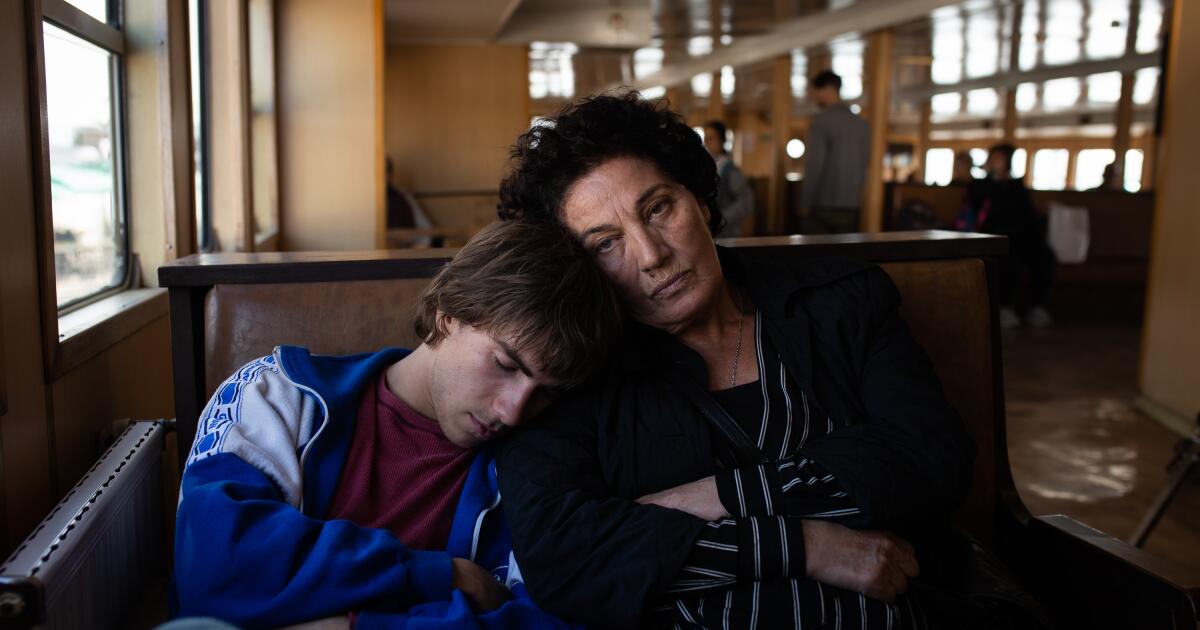
We know what typically happens in movies when characters go looking for missing loved ones. Surprise — they find themselves. End of quest. But something more nuanced emerges regarding our internal compasses in filmmaker Levan Akin’s “Crossing,” about a retired Georgian schoolteacher trying to track down her transgender niece in Istanbul. It’s what gives this compassionate, cautiously hopeful movie’s open-eyed naturalism a wonderful, pulsating humanity.
Grim-faced, dignified Lia (Mzia Arabuli) doesn’t have much information to go on, only the hearsay of a young, restless operator named Achi (Lucas Kankava), who tells her that her niece Tekla, whom he knew as a local prostitute in their Black Sea port city of Batumi, has likely decamped to one country over. Reluctantly adopting the cocksure Achi as translator and companion — his border excursions with tourists have given him a smattering of Turkish and English (plus Achi wants out of Georgia) — Lia sets off with stoic determination. The question curling the edges of this search, however, is whether Tekla even wants to be found.
Because what’s also clear, and bracingly so in Akin’s thick-of-it depiction, is that massively populated Istanbul makes disappearing easy. One person’s acute sense of absence is for another, perhaps, an opportunity to blend in, as evidenced by the trans neighborhood Lia and Achi encounter, with sex workers popping their heads out of apartment windows to assess these visitors, like some colorful urban advent calendar. The atmosphere simultaneously projects wariness, vivacity and community.
Akin, a Swedish filmmaker whose family originally hails from Georgia, knows this is a story tinged with sadness for lives that have been ostracized and marginalized. But his wider view starts from a place of optimism about what curiosity engenders. The first long, calmly fluid shot in “Crossing,” after the edgily comic vibe of the early minutes, comes when Lia and Achi board one of Istanbul’s intercity ferries, and cinematographer Lisabi Fridell’s camera leaves our mismatched duo to roam the decks so we can feel the peaceful spirit of lives in transit: tea being served, passengers talking, a boy plucking a stringed bağlama as the water rushes by.
It’s a graceful segue for a movie about going somewhere, letting a trip open you up. The sequence alights on the movie’s other significant figure on that ferry, Evrim (Deniz Dumanli), a trans woman lawyer working for an NGO. The movie’s most aspirational character, she meets struggle (like the bureaucracy of getting hospital administrators to sign off on her identity) with friendly poise, finding romance with a kind-eyed cab driver. In crossing paths with Lia and Achi, Evrim knows how to help.
“Crossing” begins with a hard-edged woman trying to bridge a terrible distance, yet it’s measured in incremental expressions of closeness everywhere, across generations, among strangers and between everyone we meet and their possible futures. (Even a street cat plays its connective part.) Whether we’re in daytime or night, there always seems to be a light bathing someone’s face or beckoning them, a visual touch I came to appreciate in a movie that could so easily have taken a more despairing route considering its gritty backdrop.
Akin’s prior film, the queer-themed Tbilisi-set character study “And Then We Danced,” showed how tender his approach to LGBTQI+ stories is, keeping sentimentality at bay while foraging for well-earned smiles. And if you’ve seen that film, which criticized the homophobic strictures of traditional Georgian dance as it celebrated the form’s manifestation of joy, you won’t be surprised that “Crossing” also finds time to bring its pair of weary Georgians to their feet. Lia may not technically be looking for her niece on a restaurant’s dance floor, but as Arabuli’s exquisitely turned, gently cracking performance shows, the life she exhibits is its own discovery.
‘Crossing’
Not rated
In Georgian, Turkish and English, with subtitles
Running time: 1 hour, 46 minutes
Playing: Opens Friday, July 19 at Laemmle Royal, West Angeles



Rose of Nevada is a genuinely poetic movie that pushes the boundaries of the Groundhog Day-style time-travel narrative while carving out an identity completely its own. Rather than relying on the familiar mechanics that audiences have come to expect from the genre, the film approaches the concept through a more reflective and emotional lens. The result is a movie that feels thoughtful, ambitious, and surprisingly moving.
It makes a huge on-screen presence felt through its cast, particularly George MacKay and Callum Turner, who both deliver performances that elevate the material beyond a simple science-fiction premise. Combined with breathtaking visuals and a strong directorial vision, Rose of Nevada becomes something far more memorable than many of its genre contemporaries.
George MacKay continues to prove why he is one of the most compelling actors working today. Following his acclaimed work in 1917, he once again demonstrates an ability to carry a film through sheer presence and emotional authenticity.
Every scene feels grounded because of his performance, even when the story ventures into more abstract territory. Alongside him, Callum Turner delivers what could easily be viewed as a breakout performance. The chemistry between the two leads helps anchor the film, allowing audiences to connect with the characters even as the narrative challenges conventional storytelling expectations.
One of the film’s greatest strengths is its visual presentation. The cinematography is nothing short of earth-shattering. Nearly every frame looks like a carefully crafted painting, capturing both the beauty and mystery of the world these characters inhabit. There is a dreamlike quality to the imagery that perfectly complements the film’s themes of time, memory, and destiny.
The camera lingers on landscapes just long enough to allow viewers to soak in their beauty without ever slowing the pace. It’s the kind of cinematography that demands to be appreciated on the largest screen possible.
Director Mark Jenkin continues to establish himself as one of the most distinctive voices in modern British cinema. Following the atmospheric and haunting Enys Men, Jenkin once again crafts a story that feels deeply connected to folklore and place.
The British backdrop becomes a character in itself, with rugged coastlines, open landscapes, and isolated locations contributing to the film’s unique atmosphere. His direction never feels showy or excessive; instead, he trusts the audience to absorb the experience and interpret its deeper meanings.
What makes Rose of Nevada especially fascinating is how it recalls classic time-travel films without simply copying them. There are moments that evoke the spirit of The Final Countdown, particularly in the sense of wonder and uncertainty surrounding the temporal elements.
Yet the film remains firmly rooted in its own identity, focusing more on emotion and introspection than spectacle. It invites viewers to engage with its ideas rather than simply consume them.
This is also one of those rare films that benefits from reflection after the credits roll. It is not a movie designed to provide easy answers. Instead, it lingers in the mind, encouraging discussion and interpretation. The more time you spend thinking about it, the more rewarding it becomes. Much like a fine wine, Rose of Nevada continues to improve with age, revealing new layers and details upon reflection.
Overall, Rose of Nevada is a beautiful, ambitious, and visually stunning piece of filmmaking that deserves to be experienced on the big screen. Powered by exceptional performances, remarkable cinematography, and confident direction, it stands as one of the more unique takes on time travel in recent memory.
Overall Grade: 4/5 Stars
Entertainment
Kylie Jenner hit with third lawsuit as former chef claims Palm Springs party led to miscarriage

Less than two months after being sued by two former housekeepers, Kylie Jenner has been hit with a third workplace lawsuit. The beauty mogul’s former private chef alleges a grueling workload led to her miscarriage.
Filed Monday in Los Angeles Superior Court, the complaint alleges the woman routinely worked 11- to 12-hour shifts, five days a week, and was assigned physically demanding tasks despite alerting supervisors to her high-risk pregnancy.
A representative for Jenner did not immediately respond to The Times’ request for comment.
According to the filing, reviewed by The Times, the woman was told she was selected to work as Jenner’s private chef around Thanksgiving 2024. In early December 2024, the woman claims she informed her supervisors, also named as defendants, that she was three months pregnant and “required reasonable accommodations to protect her health and pregnancy.”
On New Year’s Eve in 2024, supervisors who had allegedly been hostile with the former chef directed her to “lift and transport heavy food items across the street and uphill without assistance,” the documents say.
As a result of the physical exertion, the former chef claims that she “became dizzy, began choking and gasping for air, and required assistance from security personnel, who intervened by providing water and aid.”
Around Feb. 1, 2025, the then-chef, five months’ pregnant at the time, was assigned to work Jenner’s child’s birthday event in Palm Springs, where she wasn’t provided “adequate support” despite the scale and demands of the party, according to the lawsuit. The former chef claims that when she asked for help and expressed concern over the workload, she was ignored by supervisors.
“Due to exhaustion and overwhelming physical strain, [she] broke down emotionally in the bathroom during the event,” reads the suit. “That evening, [she] experienced extreme physical exhaustion and heaviness throughout her body as a result of the prolonged and intense workload.”
The next morning, while the former chef was still in Palm Springs, the filing states that she awoke experiencing severe hemorrhaging and drove herself to the emergency room. “At the hospital, [she] was informed that there was no detectable heartbeat and that she had lost her unborn child.”
According to the former chef, she informed her supervisors of the miscarriage and medical emergency and, in the following days, was “falsely accused of leaving the kitchen and refrigerator in disarray following the Palm Springs event,” the lawsuit states.
The court documents claim that the former chef suffered severe hemorrhaging again on Feb. 8 and collapsed in her bathroom. The filing states that after the miscarriage she suffered severe depression and emotional distress, and claims that a supervisor reprimanded her, saying, “Stop it, just stop it. You are upsetting Kylie. You are making her depressed.”
“Celebrity status does not exempt anyone from California’s employment laws. We look forward to presenting the evidence in court and allowing the facts to speak for themselves,” attorney Della Shaker told The Times.
The former chef is seeking an unspecified amount of damages and claims that in addition to suffering accommodation failures, pregnancy discrimination and harassment, she was misclassified as an independent contractor, did not get paid on time or for the appropriate hours she worked, and was wrongfully terminated.
After being let go, the former chef claims that she sent a formal written complaint to co-defendant Tri Star detailing the alleged discrimination, harassment and wage theft. The lawsuit states that on May 22, 2025, the management team sent her an email offering a settlement and release agreement (essentially offering her money to sign away her right to sue).
The legal filing follows two lawsuits brought by former housekeepers of the embattled reality star. Less than two weeks after one woman on Jenner’s cleaning staff sued her, claiming her co-workers harassed and discriminated against her, another housekeeper came forward with allegations claiming the “Keeping Up With the Kardashians” star didn’t intervene while she suffered abuse from fellow staff, despite the housekeeper slipping the reality star a letter pleading for help.
Shaker also represents Angelica Hernandez Vasquez, who filed the suit against Jenner on April 17, and Juana Delgado Soto, who filed her lawsuit on April 29.

James Gunn isn’t exactly crushing it.
Named co-chairman and chief executive officer of the newly formed DC Studios in 2022, the “Guardians of the Galaxy” filmmaker wrote and directed the division of Warner Bros. Discovery’s largely disappointing “Superman,” released last year.
This week, DC Studios’ second big-screen affair, “Supergirl,” lands in theaters with similarly underwhelming results.
‘Superman’ review: James Gunn gets DCU off to rocky, overstuffed start
Starring Milly Alcock as the movie’s namesake Kryptonian heroine — who also goes by Kara Zor-El and is the cousin of David Corenswet’s Superman/Clark Kent/Kal-El — “Supergirl” isn’t distractingly zany the way its 2025 sister film was. Instead, it’s tonally boring, a chore of a movie chock full of thinly drawn characters and increasingly bombastic and violent.
To be clear, Gunn isn’t at the helm for “Supergirl.” Instead, it’s the typically dependable Craig Gillespie (“I, Tonya,” “Cruella”), working from a script by Ana Nogueira, making her less-than-impressive feature-writing debut.
This planet-hopping adventure in the new DC Universe isn’t a complete space wreck, however, thanks largely to the spunky performance by Aussie Alcock, best known for portraying the younger Rhaenyra Targaryen in the early episodes of HBO’s “House of the Dragon.”
When we catch up with Kara, she’s basically as we left her late in “Superman”: a super-sized mess. She’s out with her beloved, rambunctious dog, Krypto — the peppy and powerful pup having already been a major player in “Superman” — and enjoying a 23rd-birthday pub crawl among planets under a red sun. (Quick reminder: Supergirl, like Superman, draws her incredible powers from a yellow sun, like Earth’s, so she’s at least vaguely normal under a red sun and, importantly, can become intoxicated. The color of suns is a major factor throughout “Supergirl,” and it’s the movie’s most inventive narrative element.)
It is on such a world where a drunken Kara encounters 13-year-old Ruthye Marye Knoll of the Danastia Clan (Eve Ridley), whose family has just been brutally slain by the ruthless Krem of the Yellow Hills (Matthias Schoenaerts). Understandably, Ruthye wants revenge against Krem — leader of the Brigants, a band of male pirates and traffickers — and can think of little else.
She’s offering anyone who will help a sword made by her family of skilled weapons makers. The beyond-buzzed Kara isn’t interested, but she gets involved when a scumbag type tries to take the sword. She continues to do her best to fend off Ruthye’s subsequent pleas for assistance in her quest to kill Krem, but when the baddie — in the process of stealing her floating RV of a spaceship — shoots a charging Krypto with a poison dart, Kara has designs on punishing him, too. In fact, she needs to retrieve the specific antidote Krem carries with him to save her four-legged bud.
And so the gals are off to other worlds, initially traveling via the space equivalent of a beat-up Greyhound bus, on which they run into a trio of pillaging Sklarian Raiders. The sequence in which Kara retrieves stolen possessions and extracts information from them is as zany as “Supergirl” gets.
As their trek through the stars warps on, Kara and Ruthye encounter Lobo (Jason Momoa, seemingly leaving his Aquaman character back in the defunct DC Extended Universe), a rough-and-tumble, motorcycle-riding bounty hunter. They team up — sort of, eventually — but their alliance of convenience is one of the flick’s myriad plot threads that fail to tie into a sturdy knot.
The screenplay by Nogueira — an actor who’s penned a pair of plays — attempts to explore why Kara is so jaded by taking us back to her childhood in the Kryptonian city Argo, protected by her father’s tech after the planet’s demise. Of course, that protection proved to be temporary, or she wouldn’t have eventually been sent to Earth like her cousin before her. It’s lukewarm fare, with Kara eventually learning the familiar Spider-Man lesson — with great power comes great responsibility.
Gillespie adds a few nice touches from the director’s chair throughout the movie, but they’re too little to elevate the proceedings.
Again, Alcock — whose credits also include the recent Netflix limited series “Sirens” — does what she can with the material. It’s a demanding role, as she is on screen for most of the movie, and is spirited in it.
Unfortunately, the lesser-known Ridley — making her feature debut following a few television appearances — is given even less to work with. We never learn much about the one-note Ruthye beyond that her family was killed in her presence and that she is really upset about it.
If you’re expecting the always-lively Momoa to save the day, he brings his larger-than-life presence to Lobo, but the demon-like figure isn’t very interesting. A mix between Aquaman and his Khal Drogo from “Game of Thrones,” the longtime DC Comics character isn’t anything you wouldn’t expect here.

If there’s another bright spot in the cast, it’s Schoenaerts (“Rust and Bone,” “The Old Guard”), who brings a touch of nuance to the villainous Krem. You may have expected a bigger name to play the big bad in this second DC Universe big-screen effort, but some of the acting choices the Belgian makes keep things vaguely engaging when he’s within the frame.

Sadly, vaguely engaging is the best “Supergirl” can manage.
We’ll see if Gunn can turn things around, starting with the HBO series “Lanterns” in August and the horror-tinged film “Clayface” in October, before he returns to direct Corenswet, Alcock and the rest of the “Superman” gang in “Man of Tomorrow,” arriving a little more than a year from now.
We’re hoping for super results, but, at this point, it’s tough to say we’re expecting them.
‘Supergirl’
Where: Theaters.
When: June 26.
Rated: PG-13 for sequences of strong violence, action, language, and smoking.
Runtime: 1 hour, 48 minutes.
Stars (of four): 2.
-
 Politics10 minutes ago
Supreme Court rules Trump may end legal protection for Haitians and Syrians
-
 Science13 minutes ago
Drug overdoses in L.A County drop for third straight year. Here’s why
-
 Sports18 minutes ago
Drug charges against U.S. skiing great Bode Miller to be dropped, his attorney says
-

 World28 minutes ago
Prioritise workers’ health during heatwaves, says ETUI
-
News55 minutes ago
Federal judge halts Trump’s election executive order seeking to create a federal voter list
-

 Los Angeles, Ca2 hours ago
Boyle Heights warehouse cleanup begins as crews face 85 million pounds of spoiled food
-

 Detroit, MI3 hours ago
Would Detroit Lions Salary Cap Be Wrecked If Terrion Arnold Gets Cut?
-

 San Francisco, CA3 hours ago
Two more Presidio Heights homes reach $10M range as luxury supply dwindles

