Wyoming
Angling in hot water: how higher temperatures are impacting river ecosystems and fishing outfitters

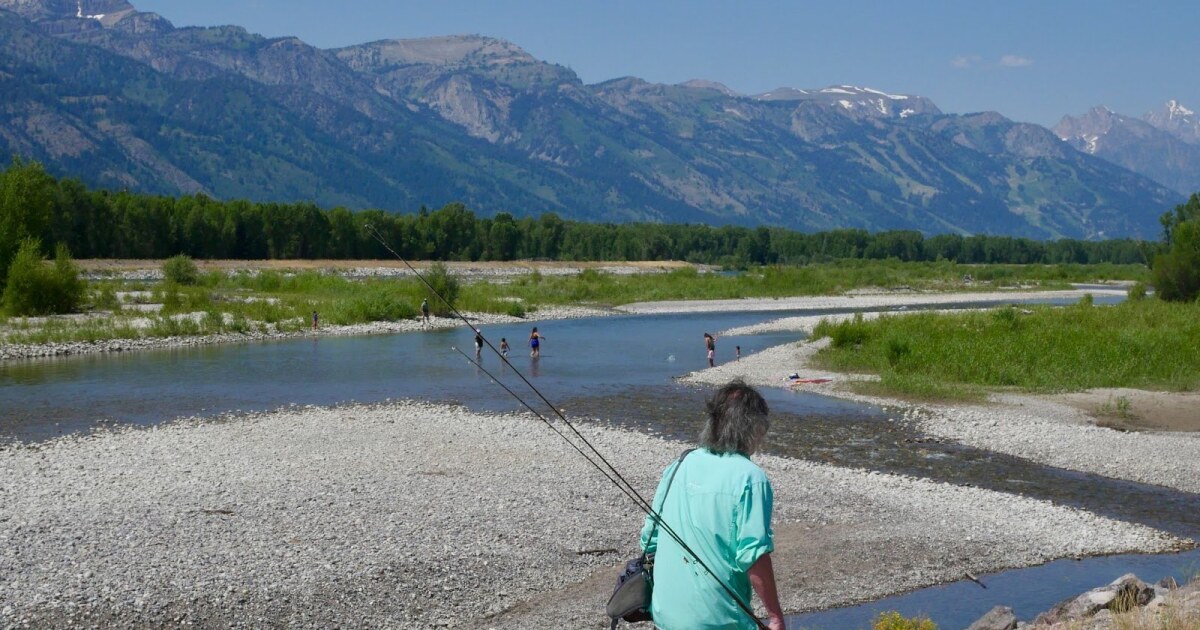
Earlier this month, a heat wave broke records across the country and also hit Wyoming hard. Most counties in the eastern part of the state were under heat advisories for multiple days. But the heat didn’t just impact air temperatures, it also took a toll on water ecosystems. The increased heat is impacting rivers, fish and the guides that rely on them.
Inside the Westbank Anglers fly-fishing shop in Wilson, long sleek rods line the walls. There’s boxes on boxes of brightly-colored flies, some with hair, fur and feathers.
In the office at the back of the shop, owner Mike Dawes said company guides are seeing water temperatures on the nearby Snake River already creep close to 68° in the middle of July. That’s a number that basically means it’s time to stop fishing for cold water species like trout.
“The water temperature is getting 66°, 67° on the Snake. And that’s just…I’ve never heard that before at this time of year,” he said.
Hannah Habermann
/
Wyoming Public Media
Dawes said that’s more normal for the middle of August. Westbank Anglers has been trying to get clients out on the water earlier, and Dawes himself was doing the same during the unseasonably warm heat spell a couple days ago.
“We were putting the boat on, floating at six in the morning, which is pretty magical, but also kind of a necessity,” he said.
The state of Wyoming doesn’t implement mandatory fishing closures, like Montana does. But Dawes thinks it should, and thinks the collective community of fishing outfitters could do more.
“In general, in terms of the outfitting business, we’re just behind a little bit. We need to catch up,” he said.
Catching up, in Dawes’ opinion, could look like having fishing representation on the state’s outfitting board, which he said is very hunting-focused. It could also mean getting all the management agencies across the state to collaborate on when it’s time to shut down fishing.
As far as how those kinds of closures might impact his business?
“I think I’ve been doing it long enough that if I was worried about it, I’m worrying about the wrong things,” he said.
Dawes said if it’s this hot on the high-elevation, glacier-fed Snake, there’s no doubt the rest of Wyoming’s waters are also feeling the heat.
“We typically have colder water temperatures than the rest of the state. So if we’re hot, then we know they’re hot,” he said.
Wyoming Game & Fish Casper Regional Fisheries Supervisor Matt Hahn said there’s two main things going on for fish when water heats up.
“One is just the physics of oxygen and water, so the warmer water is, the less dissolved oxygen that it can carry,” he said.
The second, Hahn explained, is physiological.
“They end up putting a lot more energy into respiration, just trying to pull as much oxygen from the water as possible. If the water temperature continues to go up, the physiological response becomes more and more dire,” he said.

Getting caught on a fishing line and being out of the water only adds to the stress for the cold-blooded critters.
“The fish obviously is trying to escape and so that increases energy demand on the fish at a time when it doesn’t have a lot of excess energy to expend on such things,” he said.
Hahn said different types of fish are adapted for different temperature ranges. There’s cold water fish like trout and salmon, cooler water fish like walleye and perch, and warm water fish like bass and catfish.
When it comes to trout fishing, getting above 68° means you’re starting to get into what Hahn called “the lower end of the stressful range,” with 75° being the mark where long-term exposure can result in mortality and 80° being lethal in minutes for most trout.
Warm water also means the quality of fishing goes downhill quickly.
“The fish are stressed. They’re putting all their energy into respiration. They don’t really have energy to spend on feeding because there’s an energetic cost to feeding,” he said.
Hahn said that Wyoming Game and Fish has really stepped up their education around best-practices for fishing, advising people to use barbless hooks or shift their fishing to earlier in the day.
“68° degrees is just a good benchmark to remind people, ‘Maybe I should start thinking a little closer about what I’m doing at a point, maybe just a little bit ahead of when it becomes critical’,” he said.
Three rivers in the northwest corner of Yellowstone National Park got to that point. On July 15, the agency announced that it was closing fishing on the Madison, Firehole, and Gibbon Rivers, and most of their tributaries. The agency pointed to warm water temperatures and low river flows.
John Schilling is the manager of Madison River Outfitters in West Yellowstone. He said local outfitters stopped fishing those rivers weeks before the closure and thinks the park could be way more proactive.
“We usually, on our own, stop fishing them by July 1st every year because they’re just too hot. And actually, the federal government, in our opinion, should automatically close them no matter what,” he said.

Madison River Outfitters Facebook
Schilling said that’s also the norm for most guiding companies in West Yellowstone.
“The Firehole [River] has been over 80° since the third week in June, so we refuse to take clients there,” he said, pointing to the fact that it’s a geothermal river.
He said Madison River Outfitters normally start fishing again on the Firehole in September. He thinks Yellowstone should follow suit.
“There’s still fish in there that you can catch, but it’s just not good for them. Too stressful. We’ve still got lots of water,” he said.
Schilling’s been in the area for forty years and said this is only the second time he can remember Yellowstone having fishing closures. The first was in 2021 and applied to the same rivers on the west side of the park.
Madison River Outfitters is still guiding on the Upper Madison River in Montana and on rivers in the northeast part of the park. Schilling said if those rivers in Yellowstone close, it might be a different story.
“If they close the northeast corner, then we’d see some impact,” he said. “Then we’d have nowhere else to go in the park.”
Boots Allen is the advocacy and outreach coordinator for the Snake River Fund, a Jackson-based nonprofit that promotes stewardship and access. He said dealing with hot water temperatures is a relatively new topic in the industry.
“It wasn’t until like the late 90s, early 2000s that this became an issue in the fishing world,” he said.

Allen is also a senior fishing guide at Snake River Angler. He started gathering his own data on the river in 2003. At first, he was only using a personal stream thermometer, then started consulting the first water temperature gauge at Moose just outside of Jackson when it was installed in 2007.
He said in the last few years, water temperatures have been breaking the 68° threshold. In 2022, the max temp was 71°.
“It was pretty shocking to see that we’re starting to break that 70° mark,” he said.
Although Wyoming Game and Fish and Grand Teton National Park haven’t issued closures like Yellowstone National Park has, Allen said the agencies do sometimes issue recommendations.
“Once you cross the 68° mark, the general recommendation is to finish your fishing at about 3 p.m.,” he said.
Allen said water temperatures, just like air temperatures, tend to peak between 4 and 7 p.m. each day. He added that there are other precautions anglers should take, regardless of water temperature.
“When you hook your fish, try and get that fish in as quickly as possible. Expose it to air above the surface of the water as little as possible and really try not to do it at all,” he said.
He said people should also wet their hands to keep the fish’ protective “slime” layer intact and to help keep the fish cool.
Allen said some guides he knows are taking all of August off because of the high temps. He’s cutting down his own days for that month too and is seeing the shoulder seasons get a lot busier.

Hannah Habermann
/
Wyoming Public Media
But, the downstream waters of the fishing industry look a bit murky. Allen said guides will have to keep adapting, even if that means hanging up the rod.
“If it gets to a point where they have to shut down fishing in the future – might not be in my lifetime, might be in my kid’s lifetime – that’s something we’ll just deal with,” he said.


This news report mentions suicide. If you or someone you know is in immediate danger of harming themselves, please call 911. If you or someone you know is experiencing suicidal thoughts, call the U.S. National Suicide Prevention Lifeline at 988 or text “WYO” to 741-741 for the Crisis Text Line.
CASPER, Wyo. — Three Republican gubernatorial candidates shared their views on a myriad of topics spanning taxation, energy production, resource rights and more Wednesday at the third Politics in the Park forum.
The event at Casper’s Washington Park featured state Sen. Eric Barlow, retired Marine Corps Col. Brent Bien and State Superintendent of Public Instruction Megan Degenfelder. The candidates seek to replace Gov. Mark Gordon, who cannot run again due to term limits.
Fellow Republican candidate Curt Blake did not attend the forum, which was hosted by the Natrona County Republican Party and the Natrona County Republican Women. Other candidates in the race include Democrat Kenneth Castner and Constitution Party nominee Rebecca Bextel.
Taxes, budget and education
When asked about economic growth and budget strategies, the candidates offered different plans. Bien called for deep tax cuts and deregulation. He expressed support for a November ballot initiative that would exempt 50% of a primary residence’s assessed value from property taxes.
Barlow warned that broad tax cuts could hurt local public services.
“All your property taxes support local governments, your schools, your cities, towns, and counties and your special districts,” he said.
Degenfelder said the key to low taxes and maintaining services is increasing state energy production. She said the state must deliver public services efficiently without overspending, adding that the private sector is solely responsible for creating jobs and economic growth.
Elaborating on job creation and how to stimulate the economy, all three pointed to the state’s public education system as a primary workforce development driver. They stressed a need to shift focus toward trade schools and career-based learning to prepare students for current opportunities.
“We skipped an entire generation of teaching these kids [trades] when they were in school,” Bien said, emphasizing that electricians and welders can currently name their price.
Degenfelder said pushing too many students toward college caused a workforce disconnect and led young people to leave the state. She said Wyoming must prepare students for local job openings to keep them from moving away.
Barlow said educational institutions must partner directly with local industries to align training and secure the economy.
Energy and climate
Questions about uranium mining, rare earth minerals and oil and gas leasing on state lands drew unified support for ramping up extraction and streamlining the permitting process while avoiding federal overreach. Degenfelder spoke about the national security implications of domestic rare earth processing.
“Do you know who processes 90% of rare earths? It’s not another state. It’s China,” Degenfelder said. “I spent time in China. Trust me, we do not want China to be in control of who’s processing rare earth minerals.”
Bien urged the state to speed up leases and permits to generate employment. Barlow supported subsidizing and promoting rare earth processing.
Regarding climate change, Bien rejected the narrative of man-made climate shifts and favored legacy industries.
“I do believe that God controls the climate,” Bien said.

Degenfelder said climate policies have been weaponized against Wyoming’s legacy energy industries, and argued that Wyoming’s cleaner-burning coal should be used globally. Barlow advocated for an all-of-the-above approach where all energy sources compete without subsidies.
When asked about specific infrastructure projects, including an influx of data centers and a proposed pumped hydroelectric project at Seminoe Reservoir, the candidates saw things differently. Bien firmly opposed both. He said a 2010 state law unfairly granted tax waivers to multibillion-dollar corporations, creating a system of corporate favoritism that leaves local ranchers and small business owners empty-handed.
Degenfelder said she supports data centers only if they don’t deplete water resources or raise utility rates for residents. Barlow countered the negative premise of the question entirely, saying the state already has over two dozen data centers without widespread neighbor complaints or resource abuse.
All three candidates agreed the State Board of Land Commissioners has a fiduciary duty to balance energy development with long-term benefits for schools and communities, and that the state must push back against federal regulations that threaten Wyoming’s core industries.
Infrastructure, water and land access
The candidates answered questions about infrastructure, water rights and corner crossing. Degenfelder said keeping water is vital to Wyoming’s survival and pledged to work with the federal government to stop what she considered downstream theft.
“Without water, we don’t have life. Nothing else matters,” Degenfelder said. “And right now, for many, many years, we’ve allowed these downstream states to steal Wyoming’s water and now we’re in the fight for our life … for our water rights.”
2026 Politics in the Park coverage
Bien said he wouldn’t give up any more water rights beyond original compacts. He suggested investing state savings into local water storage and irrigation. Barlow acknowledged that the current multi-year drought has created natural and legal challenges, adding the Legislature is increasing its technical and legal expertise to defend water rights.
On the topic of corner crossing, the candidates noted recent court rulings that favor public access but offered different solutions. Bien said the Legislature should define a corner, Degenfelder favored case-by-case reviews, and Barlow proposed land exchanges to resolve disputes.
“If we want to have less conflict, less corner crossing, let’s work toward fewer corners,” Barlow said. “Let’s work toward consolidations within the current law. Let’s work toward things that make meaningful access available to those public land users and still protect all the private property rights.”
Healthcare and community services
The candidates expressed support for telehealth expansion, rural healthcare access and annual cancer scans for firefighters.
Degenfelder said emergency medical services should be an essential service. Bien said funding models need standardization before making a statewide EMS designation.
Barlow promised to create a healthcare strike team on Aug. 19 if he wins the primary election. He said the team would bring providers, payers and patients together to improve care.
The candidates supported protecting Medicaid for vulnerable people. Bien called for tort reform to lower insurance costs, while Degenfelder spoke about expanding the healthcare workforce pipeline.
On the state’s high veteran suicide rate, candidates supported wrap-around services, with Barlow citing local nonprofit partnerships and Bien pushing for robust VA hotline access. Degenfelder said Wyoming must make sure returning veterans are provided with strong community support and are made fully aware of the services available to them.
2026 Election Tracker
Regarding food insecurity, the candidates advocated for localized solutions, with Bien calling for ranchers to feed local schools and Barlow suggesting potential state support for school boards using their funds for nutrition programs. Degenfelder said her strategy focuses on creating more physical sites for food access and actual meals, rather than expanding government programs.
All three candidates opposed the decriminalization of marijuana.
They agreed the state’s pardon and expungement system needs reform to help nonviolent offenders restore their rights.
When asked what they would stop, Bien named corporate favoritism and regulation.
“Number one is to stop the exodus of young people from the state of Wyoming,” Degenfelder said. “You should not, if you’re a grandparent, have to get on an airplane just to see your kids and your grandchildren.”

Barlow pledged to protect public lands and reduce “the divisiveness, the ugliness that’s going on in our political climate.”
“I don’t believe it serves this nation,” he said.
Federal overreach and transparency
When asked how they would assert state authority, Bien cited the 10th Amendment and a Montana court case involving federal funds.
“So, it is one of those things to where, if it’s not in the best interest of Wyoming and it falls within the 10th Amendment and outside of those enumerated powers, I will definitely push back,” Bien said.
Degenfelder favored working with a sympathetic federal administration to return power to the states. Barlow said he would order the state attorney general to challenge unconstitutional federal mandates.
On transparency, Bien called for a state audit and an end to nondisclosure agreements in public–private partnerships. Barlow pointed to the need to update the Wyoming Public Records Act for the digital age, while Degenfelder focused on giving grassroots citizens direct access to the governor’s office rather than catering to special interests.

Closing thoughts and up next
In a lighter moment regarding daylight saving time, the candidates joked about the inconvenience, with Barlow suggesting moving the clock a half-hour permanently. He and Bien mentioned the possibility of working with governors from neighboring states to press the federal government to do away with the time change. Degenfelder said it’s an issue the Legislature is grappling with.
The evening wrapped up with a lightning round about the candidates’ favorite things about Wyoming. Barlow and Degenfelder praised the honest, hardworking people, while Bien celebrated the state’s wide, wild landscape.
Related

Warsaw, N.Y. — Speedy cow, a new community owned internet service is now online in Wyoming County.
The service will bring faster, more reliable internet to Wyoming County residents.
The county received $15 million in grant funding to build the broadband network.
Anyone living in Wyoming County can sign up on the Speedy Cow website.
With the network being community run, that means all customer service experiences will be locally based.
“At the end of the day we own the system, so if there’s an issue with the system, the service or anything like that, you call the county and we’ll take care of it,” a county official said. “We’ll reach out to community broadband networks necessary and resolve any issues that the residents might have and at the end of the day, the residents of the county, the taxpayers of the county, own this system.”
Net profits from the service will be returned to expand and improve the system.
$3.8 Million in funding awarded for Affordable Broadband in Genesee County
___

One of the biggest auto and truck collections in Wyoming is about to go up for auction. You are not going to believe the size of this event. Chunks of old classics to working old cars and trucks will be on the block.
Watch the video below as they preview the Rick Knigge Collection up for auction in Evansville, Wyoming. This auction will feature many hot rod project bodies, muscle cars, old trucks, Jeeps, rock crawlers, and more. This will all be sold by VanDerBrink Auctions with online and live bidding.
The auction will be held Saturday, July 8th. Some of the auctions will be online, but some will be in person only.
According to the website, Rick passed away unexpectedly, and his family decided to offer this wild collection at auction. The auction will be live onsite with online bidding for vehicles, motors, bodies, and a few other items. There is a large assortment of 1932-35 Ford, MOPAR, Chevrolet parts, performance parts, Tri-Five, and more. These parts will be offered only to onsite bidders, so plan now to attend this wild auction.
Rick Knigge Liked to “Go Fast”! The louder, faster, the better! There are many 1932-40 Ford, Dodge, Plymouth, Chevrolet Cars and Bodies for Rods along with parts!
Here is a second video with more about Rick and the collection he loved.
The collection has muscle cars from a Plymouth GTX to Chevelles and Camaros, and more. 1970- 80s speed boats, Monster Trucks, just to name a few. There will be motors, high-performance, and vintage speed parts.
You are not going to believe the size of this event. Chunks of old classics to working old cars and trucks will be on the block.
SEE: 39 Hot Cars On Display In Wyoming
The goal of this gallery is not to provide every detail of every car, their modifications and their owners.
This was just a cool car show in Casper Wyoming.
Not matter if the people attending were into cars or not.
There was a lot of OHHH and AHHH’s heard up and down every street.
Gallery Credit: Glenn Woods
-

 Detroit, MI17 minutes ago
Would Detroit Lions Salary Cap Be Wrecked If Terrion Arnold Gets Cut?
-

 San Francisco, CA26 minutes ago
Two more Presidio Heights homes reach $10M range as luxury supply dwindles
-

 Dallas, TX32 minutes ago
One Dallas Cowboys Contract That Will Age Poorly in 2026
-

 Miami, FL39 minutes ago
Live updates: Today’s South Florida News
-
 Boston, MA41 minutes ago
A federal judge in Boston has blocked parts of Trump’s order to limit voting by mail
-
 Denver, CO47 minutes ago
Denver Transplant Games sets Guinness World Record for most living donors, recipients in one place at one time
-

 Seattle, WA54 minutes ago
17-year-old boy shot in High Point, multiple suspects seen running from crashed car
-

 San Diego, CA57 minutes ago
Foodie forecast: A new cafe opens in La Jolla’s Arcade building

