Politics
In this historic Black neighborhood in Milwaukee, the Biden question is met with indifference

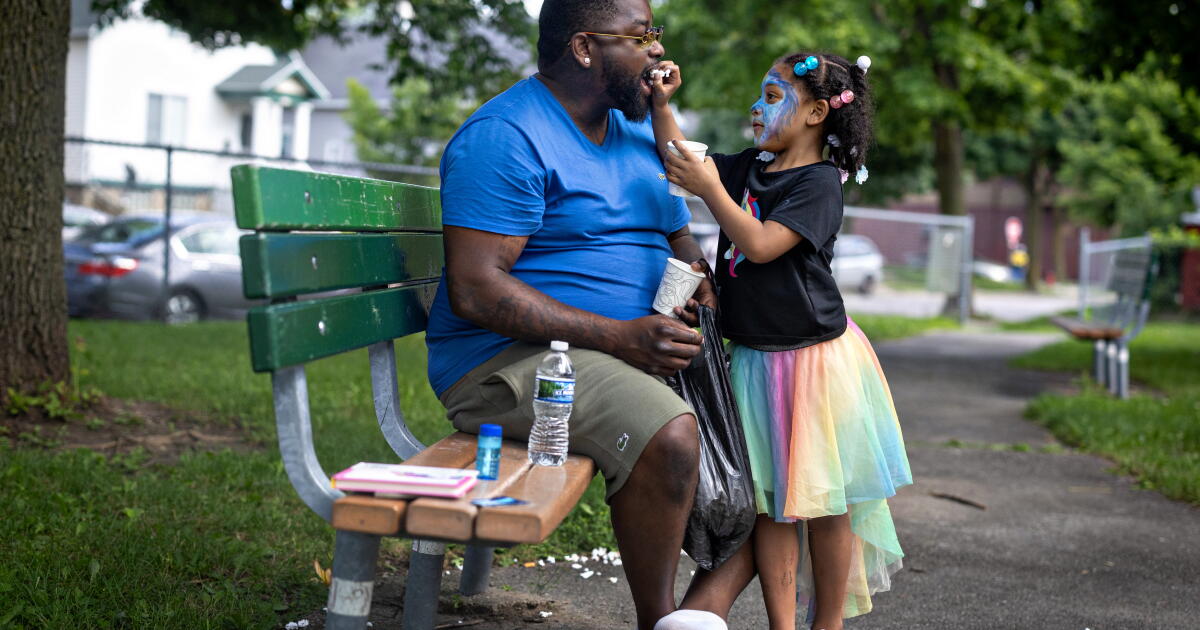
Lisa Collins sat in the shade of a green ash tree Wednesday in the Milwaukee neighborhood of Lindsay Heights handing out free hot dogs and hamburgers as part of a “joyful rebellion” against the nearby Republican National Convention.
Though she plans on voting for President Biden in the upcoming election, it is not without trepidation.
“That made me so mad at that debate, I said I’m not voting, I’m just not,” she said of Biden’s awful performance. “But you know I am.”
Hers is a kind of ambivalence common in this part of town, where the dreams of Black Americans have flourished, withered and risen again, in a city and state that will play a critical role in deciding which candidate wins the Oval Office.
Lisa Collins works the food station at the Milwaukee Childcare Collective event during the Republican convention.
(Jason Armond / Los Angeles Times)
Much of the world is obsessing over big questions: Would a second term for Donald Trump be a step toward authoritarianism? Is Biden mentally competent? Should Biden step aside, and if he did, could Kamala Harris successfully carry a campaign? Should it be left to an open field of Democratic contenders?
But in Lindsay Heights, like many places, a lot of folks have yet to think about the election. Those who have are often uninterested in those soul-searching questions that dominate headlines.
At this event arranged by the Milwaukee Childcare Collective, most people didn’t know they were gathered in response to the convention. They came for the face painting and food, and their concerns are more mundane: teaching kids to read, paying the bills, finding a napkin to clean Popsicle juice off chubby toddler legs.
Deshay Majors, sitting with his son and young daughter, she of the sticky knees, said he has not yet decided whom he will vote for.
“It all depends what they are talking about,” he said of how he will make his decision, though he isn’t sure which issues will sway him, or what he wants to hear.

Community members get free clothes at the Milwaukee Childcare Collective event.
(Jason Armond / Los Angeles Times)
It’s a reminder that it ain’t over until it’s over, but time is running out.
On the national front, there is an air of despondency. Many are convinced that as long as Biden remains atop the ticket, the party is destined to lose the White House. Possibly in a Trump landslide. Very likely in addition to losing control of the Senate.
Even before his debate debacle, Biden was struggling to match his performance four years ago with Black voters, a vital Democratic constituency, especially in swing states.
Paul Maslin, who has been polling and strategizing in political contests since the days of Jimmy Carter, put Biden’s chances of reelection “somewhere between slim and none.”
“And slim,” he said, “is making reservations to leave town.”

Kids play basketball at the Milwaukee Childcare Collective event.
(Jason Armond / Los Angeles Times)
A recent poll by the Associated Press and University of Chicago found nearly two-thirds of Democrats surveyed said Biden should withdraw from the presidential race and let his party nominate someone else.
Biden’s standing with independent and undecided voters is even worse, said Maslin, who has decades of experience in Wisconsin politics.
“His campaign has to have told him, or should be telling him, ‘Mr. President, one thing the voters you need to win this election have in common is they don’t like you,’ ” Maslin said. “They owe it to themselves, to him, to the party, to the country.”
The upper echelon of Democrats (those “elites” Biden has taken to railing against) are voting with their wallets.
“I can tell you, having talked to a lot of donors, their depression and despair has curdled into anger,” said Paul Begala, a strategist who twice helped put Bill Clinton in the White House. “They’re very angry. And angry people don’t donate.”
But that outrage hasn’t reached this parklet, where the basketball hoops lack nets and the closest bathroom is in a nearby church.
The area is named for Bernice Lindsay, the first Black woman to obtain a journalism degree from Ohio State University. She moved to these narrow streets north of downtown in the 1920s, intent on helping to create a place where Black professionals could own homes and raise families. For awhile, the community thrived — until freeways, violence and neglect tumbled it into decline, like so many other minority enclaves in America.

Kids gather for free ice cream at the Milwaukee Childcare Collective event.
(Jason Armond / Los Angeles Times)
Now, it’s a community working to raise itself back up. Vacant-lot gardens grow strawberries, and residents organize to help themselves and win what they need from a government that has too often passed them by — Democrat or Republican.
Some of the Victorian and Queen Anne homes are fixed up, some are boarded up, and most have front porches where people gather.
Sheyenne Wilson, 25, has been visiting those porches to talk about Biden, though the organizer says she likes to mostly listen.
What she hears isn’t pro-Biden or pro-Trump, but more pro-Lindsay Heights.

Sheyenne Wilson, with her son, Khalif El, is an organizer for the Biden campaign.
(Jason Armond / Los Angeles Times)
“Basically people want someone who will support the community,” she said, her 10-month-old son, Khalif, on her lap.
That, said her fellow organizer Trasus Wright, is the opening he uses. He sees abortion as the kind of personal issue that can move voters — even his wife, Dea Wright, is undecided.
Dea Wright likes Trump’s stance on school choice — their six children benefited from such a program, she said.
“Where Trump gets me is where they start saying Christianity in schools,” she said.
Trasus Wright said he isn’t bothered by his wife’s uncertainty because he believes that “Joe is going to bring her around. His policies around advocating for women are going to be what matters.”
And what of Biden being too old?
“They’re both old,” said Eric Donelson, unbothered by reports of Biden’s mental decline as he ate a hamburger.
And what about Vice President Kamala Harris? Would she be a better candidate?
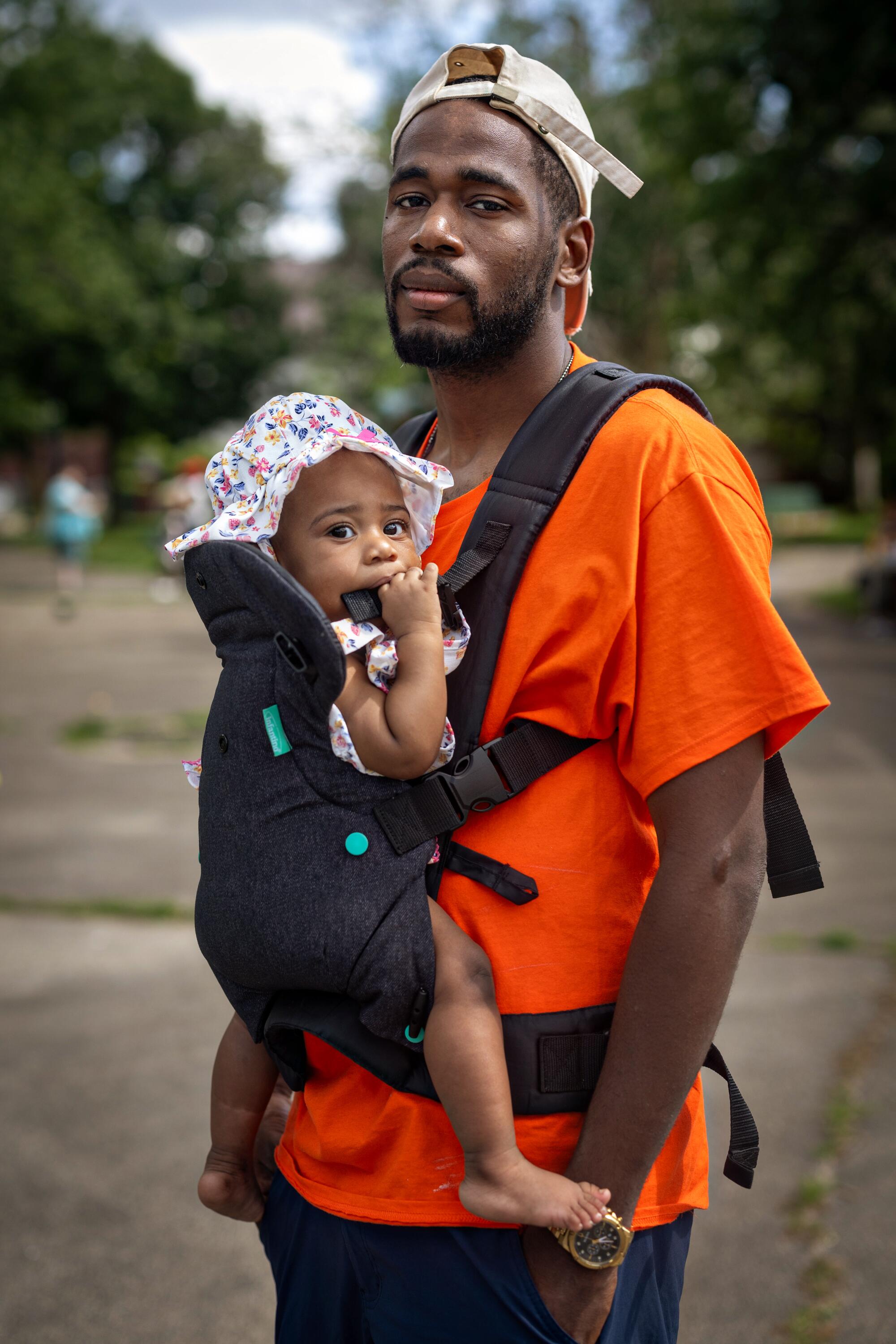
Robert Jackson and his daughter, Blessing, at the Milwaukee Childcare Collective event.
(Jason Armond / Los Angeles Times)
“Do we vote for somebody just because they look like us, or for what they represent?” said Wilson, who has concerns about Harris’ prosecutor past.
“I still don’t think there will ever be a lady president,” said Collins, the woman handing out food.
“We forget she’s vice president. She don’t talk,” Donelson said. “Speak up, woman.”
And as for anyone else? There aren’t any names familiar enough to warrant an opinion.
But Trump is no shoo-in here, either — despite his push for Black voters in recent weeks, including a convention airing of an Amber Rose/Forgiato Blow rap video meant to show the party’s inclusiveness.
“I am not voting for Trump, I’m letting you know. I don’t like nothing about Trump, I am going to keep it real,” Donelson said.
“Trump’s got a little more energy in his body than Biden,” Collins argued.
“Biden is getting old, but I’d rather work with old, senile than a crazy man,” Donelson shot back.
“I’m going to tell you something. I said, this is all a mess to me,” Collins said.
What Linsday Heights shows is the disconnect between the political elite and the voters, for either party.
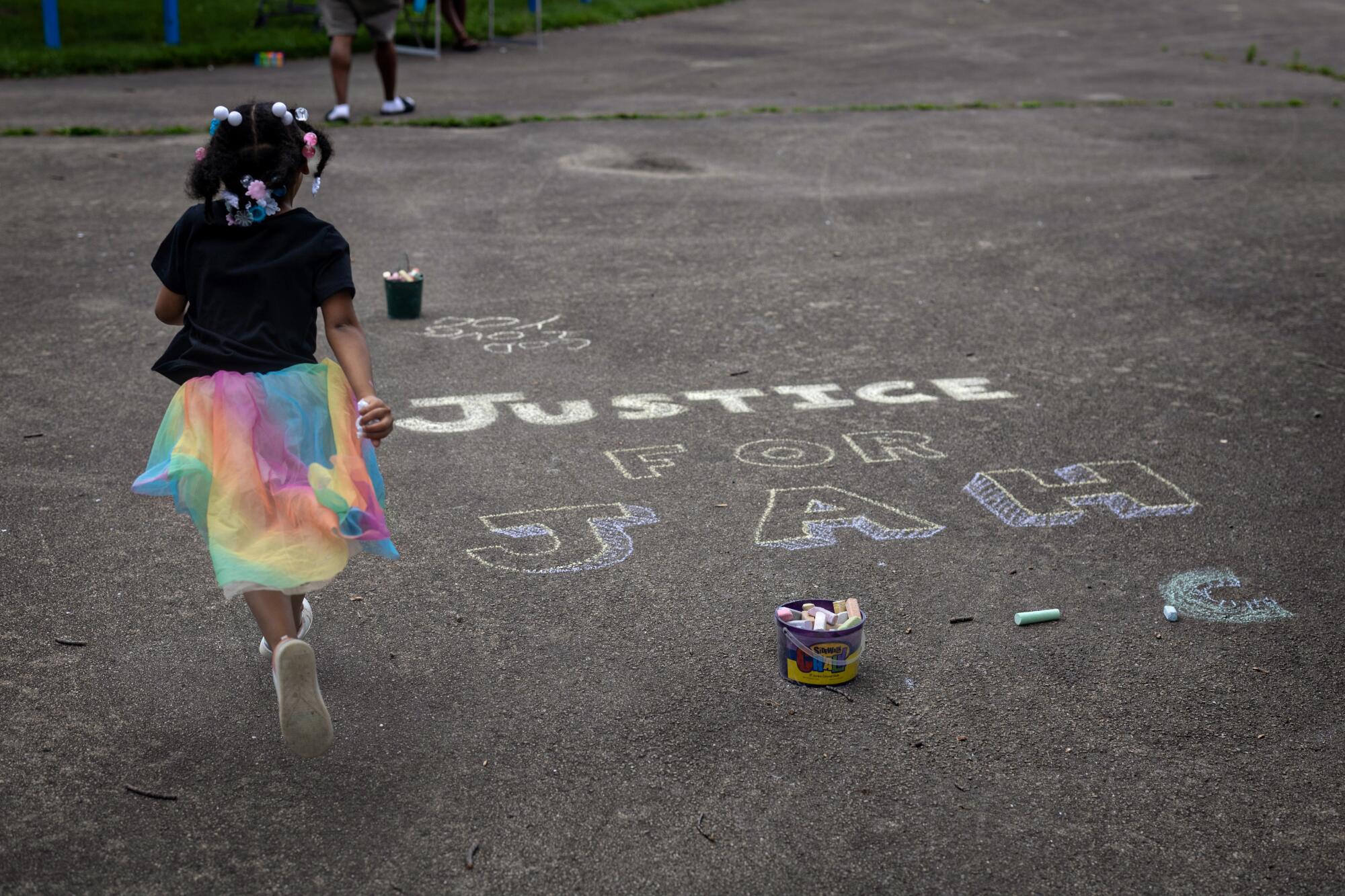
“Justice For Jah” is a reference to Samuel Sharpe Jr., who was killed by members of the Columbus, Ohio, Police Department who were in Milwaukee for the Republican National Convention.
(Jason Armond / Los Angeles Times)
Biden will have to decide in a matter of days if he is staying or leaving — and the pressure has grown intense.
Democrats are set to have a virtual roll call for delegates in early August to formally pledge their allegiance. Once that is done, it becomes increasingly hard for another candidate to step in.
But for the voters in Lindsay Heights, mistrustful of politics and concerned about daily life, time is running out for either party to reach them with a message that carries enough meaning to carry them to the polls.
If that neglect continues, it probably won’t make much of a difference what Biden decides.

Construction workers unfurled a large printed tarp to cover scaffolding installed at the White House’s front entrance. Doug Burgum, the interior secretary, said President Trump had ordered the repairs after noticing damage to columns.
Politics
WATCH: Trump’s Energy chief reveals what escalating Iran tensions could mean for gas prices

NEWYou can now listen to Fox News articles!
Energy Secretary Chris Wright is telling Americans not to be concerned about the possibility of another surge of sharp increases in gasoline prices as tensions with Iran have started to escalate once again.
Asked whether Americans should worry about higher prices at the pump and how the Trump administration is preparing to keep the economy stable if the conflict continues to worsen, Wright told Fox News Digital: “It has not been any good behavior from Iran that’s allowed oil to flow. It’s been the United States military.”
“That’s not changing,” he assured, speaking from the Great American State Fair on the National Mall this week.
US CLAWS BACK KEY CONCESSION TO IRAN AFTER FRESH ATTACKS ON COMMERCIAL SHIPS IN STRAIT OF HORMUZ
(Mario Tama/Getty Images) (Mario Tama/Getty Images)
With Iran striking three commercial vessels transiting the Strait of Hormuz on Monday and Tuesday, Wright doubled down in urging citizens to not credit Iran for the U.S. military’s work to ensure oil shipments continue flowing through the strait.
“Look, the U.S. Military has been the key asset here,” he said. “They have assured the flow of oil and gas through the Strait of Hormuz throughout. Not at the beginning of this conflict, but through the last six weeks.”
Wright said the administration is closely monitoring global oil supplies as the tentative ceasefire with Iran seemingly came to come to a halt, with President Donald Trump telling Secretary-General Mark Rutte the call for peace with Iran is “over” at the NATO Summit in Turkey on Wednesday.
But, he pointed to the continued shipping through the Strait as evidence that markets should remain stable.
TRUMP SAYS IRAN CEASEFIRE IS ‘OVER’ AFTER IRANIAN ATTACKS TRIGGER MASSIVE US RESPONSE
President Donald Trump speaks at the White House on Tuesday, April 22. (AP/Alex Brandon)
“We’re of course constantly watching the supply of oil, the supply of refined products and what’s going on there,” Wright said. “And I think still all positive trends.”
Beyond geopolitical concerns, Wright also praised the new chain of discounted gas stations across Pennsylvania and New Jersey, Freedom Fuel, which promises customers prices below the national average.
The Trump administration, though not involved with the network, has heavily endorsed the new chain and its 25 locations.
“We love it,” Wright said when asked about Freedom Fuel. “I mean, look, any mechanism we can to lower energy costs for Americans of all kinds, we’re all in on.”
“With Freedom Fuels, they’re just lowering it down to their wholesale price of gasoline,” Wright said. “So they’re not making any money selling gasoline, but they’ve got convenience stores. That’s how most gas stations make money.”
NEWSOM UNDER FIRE AS CALIFORNIA GAS TAX HIKE SENDS PUMP PRICES EVEN HIGHER
Gasoline costs are a known concern for many Americans, and amid surging prices there has been a considerable increase in those opting to purchase electric vehicles to save money long-term at the pump — with Tesla dominating the market for these types of models.
Wright argued one of the benefits to living in America is having the option to choose what type of vehicle you drive.
CLICK HERE TO DOWNLOAD THE FOX NEWS APP
“We just want people to buy what they would prefer,” he told Fox News Digital when asked his thoughts on increasing calls for support of the electrification of cars. “Consumer choice — you wanna buy an electric car, you wanna buy a gas powered car, diesel powered car, buy a big truck. That’s the choice.”
“That’s why you live in America. You get the choice of all those.”

In 2023, California regulators levied more than $100,000 in fines against the private operator of a federal immigration facility, kicking off a three-year battle over whether detainees who do work at the facilities should be considered employees.
The question went beyond semantics: If considered employees, the detainees would be subject to state worker protection laws.
A legal settlement announced this week now affirms that private immigrant detention facilities are subject to California’s workplace safety and health requirements.
“Every worker deserves a safe and healthy workplace and should be able to report workplace hazards without fear of retaliation,” said Denisse Gómez, spokesperson for the California Division of Occupational Safety and Health or Cal/OSHA.
“Individuals who perform work in these facilities are entitled to workplace safety protections, and this settlement reinforces Cal/OSHA’s commitment to enforcing those protections and safeguarding vulnerable workers,” she added.
Under the settlement between California and the GEO Group, a Florida-based private prison company, the company recently withdrew its legal challenges and agreed to pay more than $100,000 in the fines.
The GEO Group did not respond to requests for comment.
Back in 2023, Cal/OSHA issued $104,510 in fines against the GEO Group. The agency had found six violations of state code by the company after detainees complained about a lack of protective equipment and proper training while cleaning the facility for $1 per day.
Detainees alleged they routinely wiped black mold off shower walls at the facility, saw black dust spew from air vents and used cleaning solutions that lacked instructions during the COVID-19 pandemic.
The biggest fine levied against the GEO Group was for failure to establish and maintain “effective written procedures to reduce employee risk of exposure to aerosol transmissible disease.”
Advocates viewed Cal/OSHA’S recognition of the detainees as workers as a victory that could pave the way for future labor rights fights at other detention centers in the state.
But the GEO Group appealed, arguing that detainees participating in ICE’s voluntary work program make their own schedules and aren’t employees, so hazard exposure couldn’t be “as a result of assigned duties,” as California law states. Plus, the company argued, there wasn’t enough evidence that detainees were exposed to any hazard.
Early last year, the state’s Occupational Safety and Health Appeals Board rejected the GEO Group’s argument and found that detainees should be considered “affected employees.”
The GEO Group sued, but three days before a California Superior Court hearing in May, the company and Cal/OSHA reached the settlement.
Along with paying the fines, the GEO Group agreed to draft plans for avoiding aerosol transmissions at 12 secure and reentry facilities in California, including five detention centers that hold immigrants.
“GEO ensures detainees are afforded the necessary tools, equipment, and personal protective equipment … to safely and effectively perform any necessary tasks,” the settlement states.
Gómez said the settlement also leaves intact the appeals board’s ruling that civil immigration detainees who participate in work programs can participate in proceedings anonymously, “acknowledging the potential for retaliation when individuals raise workplace safety concerns.”
But the question of whether detainees are employees and deserve certain protections isn’t entirely resolved — at least not for the federal government.
Last month, U.S. Immigration and Customs Enforcement released new standards for detention facilities across the country. The revised guidelines “emphasize that detainee volunteers participating in the voluntary work program are not considered facility and/or government employees” and thus not entitled to labor regulations.
Attorney Mariel Villarreal said the timing of the new detention standards made her question whether the GEO Group had asked ICE to specify in its standards that detainees are not workers in response to its battle with Cal/OSHA.
“To me, it’s a reaction to this very settlement,” she said. Villarreal works for the California Collaborative for Immigrant Justice, which filed the original complaint on behalf of detainees who said they worked in unsafe conditions.
Villarreal pointed to a Washington Post report that GEO Group executives privately asked ICE to specify that detainees are not employees of the facilities where they work. Two top Trump administration officials, border czar Tom Homan and acting ICE director David Venturella, previously worked for the GEO Group.
New versions of ICE detention standards take effect as contracts are established or modified, so this year’s rules won’t immediately apply to every facility.
An ICE spokesperson did not comment about the settlement. The spokesperson, who did not provide their name in an emailed statement Wednesday, said the agency has begun transitioning detention facilities to meet the 2026 standards, “building on its longstanding commitment to safe, secure, and professional detention operations.”
“ICE has consistently implemented many of these best practices independently, reinforcing its role as the leader in detention operations,” the spokesperson added.
The GEO Group and other immigrant detention center operators have faced other legal battles over workers’ rights, including lawsuits in Washington, Colorado and California over the $1-per-day payment.
Villarreal said she’s confident that the Cal/OSHA settlement would continue to hold even if California facilities incorporated the new standards. But she said she believes the statements are an attempt by the GEO Group to “sidestep responsibility” and avoid the possibility of being fined under similar circumstances in other states.
“These statements in the new standards are a way for them to try and preserve profits as much as possible,” she said. “GEO and ICE are so intertwined at this point that they have the same motives.”
-

 Kansas19 seconds ago
Kansas parents charged after child fatally shoots 5-year-old, 8-year-old
-

 Kentucky3 minutes ago
Affordable Care Act rates rate hikes could strain Kentucky families, WKAS warns
-

 Louisiana8 minutes ago
Moncus Park gets helping hand from 260 youth volunteers across Louisiana
-

 Maine15 minutes ago
Maine’s high court keeps transgender athlete referendum off 2026 ballot
-

 Maryland18 minutes ago
MD woman sentenced to 2 years, $6.8M restitution in multi-million-dollar laundering scheme
-

 Michigan30 minutes ago
Harmful algal blooms reported on 2 large West Michigan lakes
-

 Massachusetts33 minutes ago
Insider tips for navigating the Brimfield Antique Flea Market
-

 Minnesota38 minutes ago
Northwest Minnesota Foundation awarded $200,000 for child care economic development

