Politics
Multiple security failures allowed would-be assassin to get clear shot at Trump

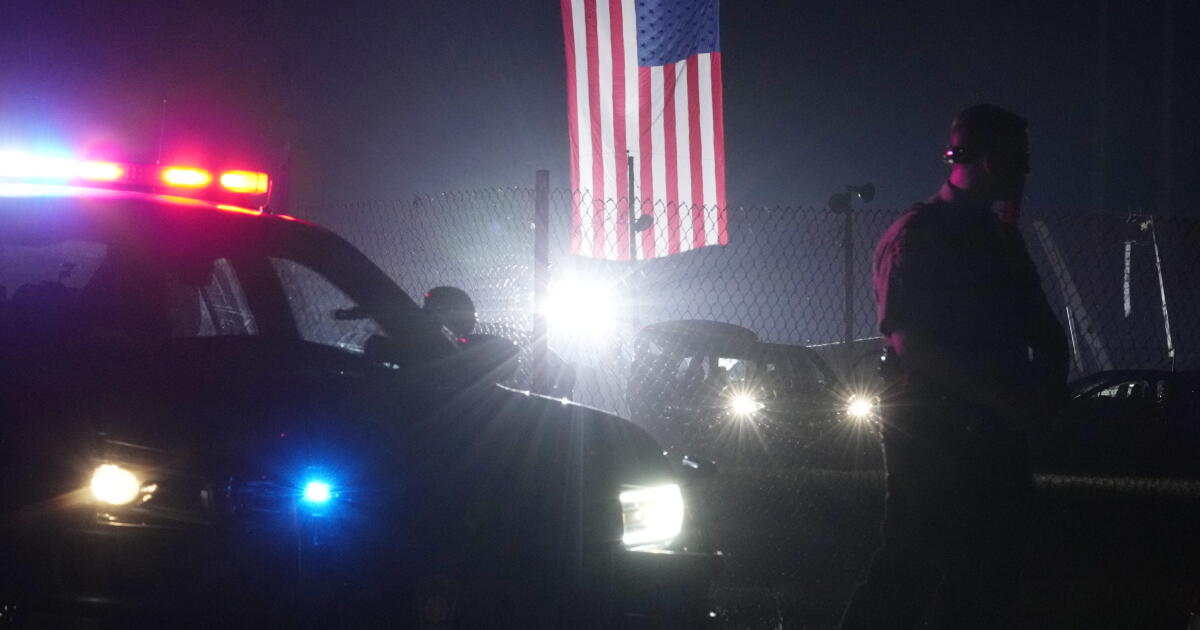
A string of security failures led to a gunman being able to fire multiple shots at former President Trump, killing a retired fire chief and wounding two others at a campaign rally in Butler, Pa., according to law enforcement sources.
Although armed security personnel responded swiftly, rushing a bloodied Trump off the stage after Saturday’s assassination attempt, questions about security flaws are mounting.
Among the issues that have been exposed in recent days:
- How the gunman was able to gain access to the roof of a nearby building and why authorities were not able to stop him before he opened fire: The building was meant to be covered by local law enforcement because it was not in the immediate vicinity of the venue, according to law enforcement sources not authorized to speak publicly about the investigation. The details of how the U.S. Secret Service and local authorities divided tasks for the rally remain unclear.
- When authorities learned of the threat: Videos show that some in the crowd noticed the gunman and tried to get the attention of law enforcement at least a minute before he fired at Trump. Local police say an officer got onto the roof just before the shooting but had to retreat because the gunman moved to shoot at him.
- Whether Secret Service sharpshooters could have fired on the gunman before he launched his attack: Videos from the rally show Trump standing at a lectern with two Secret Service snipers positioned on a rooftop in the background. In the seconds leading up to Trump’s being struck by gunfire, the snipers can be seen looking through a scope and adjusting their rifles before firing. Investigators also are examining those tactics, according to law enforcement sources not authorized to discuss the inquiry.
Twenty-year-old Thomas Matthew Crooks shot at the former president with an AR-style rifle from more than 450 feet away. A bullet grazed Trump’s ear before Secret Service snipers returned fire and killed Crooks a few seconds after.
Federal officials have defended the Secret Service while acknowledging security failures at the rally.
An FBI investigation is underway, and an independent review will be conducted on the Secret Service’s actions at the campaign event, Homeland Security Secretary Alejandro N. Mayorkas said during a news briefing Monday.
A person not authorized to discuss the investigation said that Crooks’ father purchased the rifle in 2013 and that Crooks purchased about 50 rounds from Allegheny Arms & Gun Works in Bethel Park, Pa., on the morning of the shooting.
Steve Gordon, a retired Los Angeles Police Department SWAT team sniper who reviewed social media video of the shooting, said he saw a slight delay before Secret Service snipers fired on Crooks. Gordon said the delay was caused by the agent trying to find his target.
The investigation also is examining communications between local police and the Secret Service.
Despite public criticism of security at the rally, Mayorkas offered his support to the Secret Service and its leadership.
“What you saw onstage on Saturday, with respect to individuals putting their own lives at risk for the protection of another, is exactly what the American public should see every single day,” Mayorkas said, referring to the agents who surrounded Trump after he was shot.
In an interview with ABC News on Monday, Secret Service Director Kimberly Cheatle said the shooting “was unacceptable” and “something that shouldn’t happen again.”
“It was obviously a situation that as a Secret Service agent, no one ever wants to occur in their career,” she said. “The buck stops with me.”
Cheatle said local police were inside the American Glass Research building where Crooks was positioned.
“There was local police in that building. There was local police in the area that were responsible for the outer perimeter of the building,” she said.
Cheatle said the Secret Service shared support for the building where Crooks was as well as the inner perimeter at the rally site.
“And then we sought assistance from our local counterparts for the outer perimeter,” she added.
People take cover after former President Trump is shot during a campaign rally in Butler, Pa., on July 13, 2024.
(Evan Vucci / Associated Press)
Mayorkas said it’s not unusual for the Secret Service to rely on other law enforcement agencies during a presidential campaign to fill out tasks, noting that is especially true for the Trump campaign.
“We draw upon resources not only across the federal government, but with state and local law enforcement,” he said.
Mayorkas declined to comment on specifics of the security detail or communications between the Secret Service and local law enforcement.
The Pennsylvania State Police said in a statement that the Secret Service requested 30 to 40 of their officers to assist in securing the rally’s inner perimeter Saturday.
The agency said securing the property and building where Crooks was perched on the roof was not part of the officers’ duties. It remains unclear which agency was responsible for securing that building.
Law enforcement became aware of Crooks after people alerted security that a man was acting strangely outside the rally venue. Attendees saw Crooks pacing near magnetometers at the event entrance, according to reporting from the Associated Press.
The tip sparked a search for Crooks, who was able to elude security and climbed onto the roof.
In multiple videos from the rally and shared on social media, attendees can be heard shouting, “He’s got a gun!” as they point to the nondescript rooftop where Crooks was positioned.
When local police were alerted to the armed man lying on the roof, officers tried to climb up but were deterred when the gunman pointed his weapon at them, sending them ducking for cover, Butler County Sheriff Michael Slupe told local news stations.
Although While the gunman was visible to those at the back of the building, the angle of the roof meant it was far harder for Secret Service snipers to see him until he aimed over the peak with his gun.
Rally attendee and Butler resident David Bocci was seated about 50 to 60 yards away from Trump’s stage on Saturday.
He said he watched as armed Secret Service snipers atop the building behind Trump looked around with binoculars. About three minutes later, he heard what he thought were fireworks. When the noises kept going, he realized they were gunshots. He said he heard the Secret Service yell, “President down!” and panic broke out.
Bocci dropped to the ground with the rest of the crowd before seeing Trump get back up and raise a fist in the air a few moments later.
“It was mind-blowing to me that [Secret Service] were looking and aiming that way for so long and somehow the shooter still got shots off first,” he said.
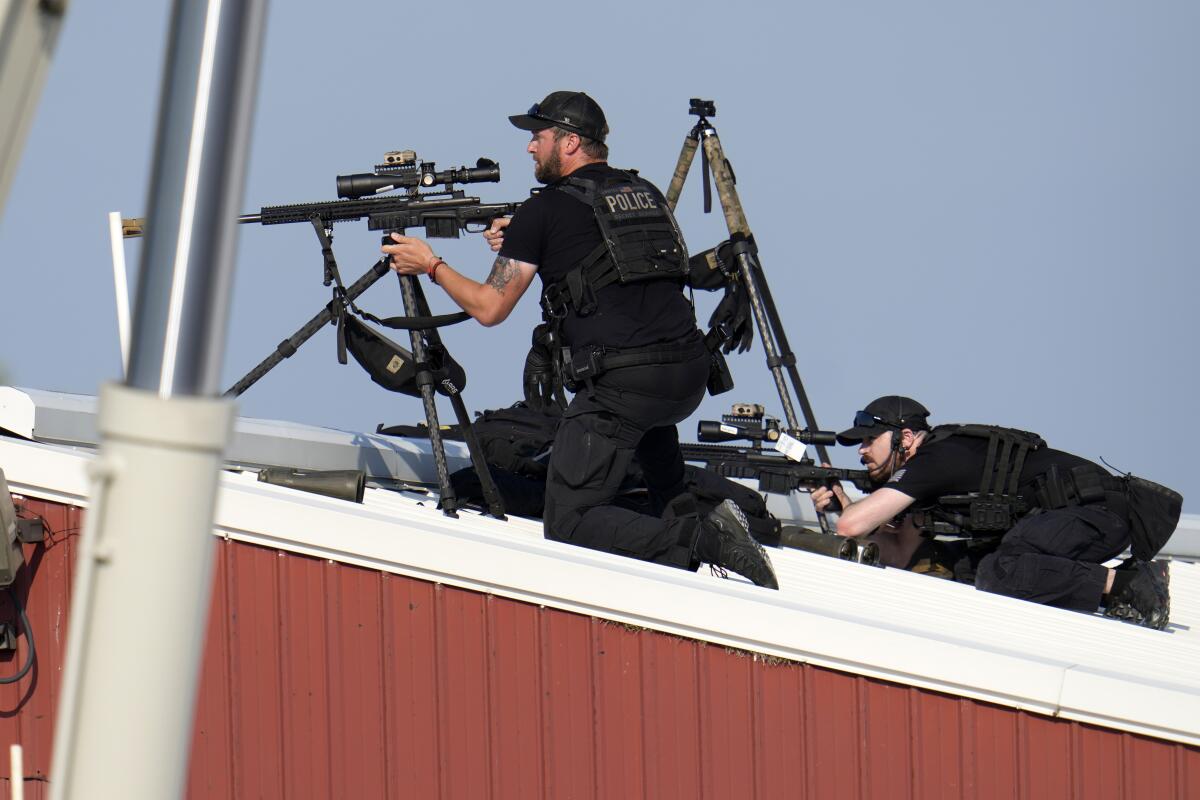
Police snipers return fire after shots rang out during former President Trump’s campaign rally in Butler, Pa., on July 13, 2024.
(Gene J. Puskar / Associated Press)
Mayorkas did not speak about any specific flaws in Saturday’s security detail.
He declined to say how security has changed for the Trump campaign and for President Biden’s administration. But the direction of the Biden administration, the Secret Service will now also provide a security detail to independent presidential candidate Robert F. Kennedy Jr.
“The Secret Service enhanced former President Trump’s protection based on the evolving nature of threats to the former president and his imminent shift from presumptive nominee to nominee. This includes enhancements related to securing the former president during the Republican National Convention,” Mayorkas said during Monday’s news briefing.
Details of those enhancements would not be made public because they involve sensitive tactics and procedures, he said.
Troy Douthett with the Butler City Council dismissed as “hogwash” the Secret Service’s claim that the shooter was outside its security perimeter.
“Anything in sight should be under their watch,” said Douthett, an independent who voted for Trump in 2016 but did not vote in 2020.
“Local law enforcement is not equipped for protecting a president. That’s just insanity to me. We would have full expectation that the professionals would be professional,” he added.
On Monday, the FBI gained access to Crook’s cellphone, searched his car and home and conducted nearly 100 interviews of “law enforcement personnel, event attendees and other witnesses,” according to a news release from the agency.
The bureau has also received “hundreds of digital media tips” from the public, including images and videos from the scene. Anyone with information can contact the FBI at tips.fbi.gov or (800) 225-5324.
Times staff writers Goldberg and Lin reported from Pennsylvania, Solis and Winton from Los Angeles.



Construction workers unfurled a large printed tarp to cover scaffolding installed at the White House’s front entrance. Doug Burgum, the interior secretary, said President Trump had ordered the repairs after noticing damage to columns.
Politics
WATCH: Trump’s Energy chief reveals what escalating Iran tensions could mean for gas prices

NEWYou can now listen to Fox News articles!
Energy Secretary Chris Wright is telling Americans not to be concerned about the possibility of another surge of sharp increases in gasoline prices as tensions with Iran have started to escalate once again.
Asked whether Americans should worry about higher prices at the pump and how the Trump administration is preparing to keep the economy stable if the conflict continues to worsen, Wright told Fox News Digital: “It has not been any good behavior from Iran that’s allowed oil to flow. It’s been the United States military.”
“That’s not changing,” he assured, speaking from the Great American State Fair on the National Mall this week.
US CLAWS BACK KEY CONCESSION TO IRAN AFTER FRESH ATTACKS ON COMMERCIAL SHIPS IN STRAIT OF HORMUZ
(Mario Tama/Getty Images) (Mario Tama/Getty Images)
With Iran striking three commercial vessels transiting the Strait of Hormuz on Monday and Tuesday, Wright doubled down in urging citizens to not credit Iran for the U.S. military’s work to ensure oil shipments continue flowing through the strait.
“Look, the U.S. Military has been the key asset here,” he said. “They have assured the flow of oil and gas through the Strait of Hormuz throughout. Not at the beginning of this conflict, but through the last six weeks.”
Wright said the administration is closely monitoring global oil supplies as the tentative ceasefire with Iran seemingly came to come to a halt, with President Donald Trump telling Secretary-General Mark Rutte the call for peace with Iran is “over” at the NATO Summit in Turkey on Wednesday.
But, he pointed to the continued shipping through the Strait as evidence that markets should remain stable.
TRUMP SAYS IRAN CEASEFIRE IS ‘OVER’ AFTER IRANIAN ATTACKS TRIGGER MASSIVE US RESPONSE
President Donald Trump speaks at the White House on Tuesday, April 22. (AP/Alex Brandon)
“We’re of course constantly watching the supply of oil, the supply of refined products and what’s going on there,” Wright said. “And I think still all positive trends.”
Beyond geopolitical concerns, Wright also praised the new chain of discounted gas stations across Pennsylvania and New Jersey, Freedom Fuel, which promises customers prices below the national average.
The Trump administration, though not involved with the network, has heavily endorsed the new chain and its 25 locations.
“We love it,” Wright said when asked about Freedom Fuel. “I mean, look, any mechanism we can to lower energy costs for Americans of all kinds, we’re all in on.”
“With Freedom Fuels, they’re just lowering it down to their wholesale price of gasoline,” Wright said. “So they’re not making any money selling gasoline, but they’ve got convenience stores. That’s how most gas stations make money.”
NEWSOM UNDER FIRE AS CALIFORNIA GAS TAX HIKE SENDS PUMP PRICES EVEN HIGHER
Gasoline costs are a known concern for many Americans, and amid surging prices there has been a considerable increase in those opting to purchase electric vehicles to save money long-term at the pump — with Tesla dominating the market for these types of models.
Wright argued one of the benefits to living in America is having the option to choose what type of vehicle you drive.
CLICK HERE TO DOWNLOAD THE FOX NEWS APP
“We just want people to buy what they would prefer,” he told Fox News Digital when asked his thoughts on increasing calls for support of the electrification of cars. “Consumer choice — you wanna buy an electric car, you wanna buy a gas powered car, diesel powered car, buy a big truck. That’s the choice.”
“That’s why you live in America. You get the choice of all those.”

In 2023, California regulators levied more than $100,000 in fines against the private operator of a federal immigration facility, kicking off a three-year battle over whether detainees who do work at the facilities should be considered employees.
The question went beyond semantics: If considered employees, the detainees would be subject to state worker protection laws.
A legal settlement announced this week now affirms that private immigrant detention facilities are subject to California’s workplace safety and health requirements.
“Every worker deserves a safe and healthy workplace and should be able to report workplace hazards without fear of retaliation,” said Denisse Gómez, spokesperson for the California Division of Occupational Safety and Health or Cal/OSHA.
“Individuals who perform work in these facilities are entitled to workplace safety protections, and this settlement reinforces Cal/OSHA’s commitment to enforcing those protections and safeguarding vulnerable workers,” she added.
Under the settlement between California and the GEO Group, a Florida-based private prison company, the company recently withdrew its legal challenges and agreed to pay more than $100,000 in the fines.
The GEO Group did not respond to requests for comment.
Back in 2023, Cal/OSHA issued $104,510 in fines against the GEO Group. The agency had found six violations of state code by the company after detainees complained about a lack of protective equipment and proper training while cleaning the facility for $1 per day.
Detainees alleged they routinely wiped black mold off shower walls at the facility, saw black dust spew from air vents and used cleaning solutions that lacked instructions during the COVID-19 pandemic.
The biggest fine levied against the GEO Group was for failure to establish and maintain “effective written procedures to reduce employee risk of exposure to aerosol transmissible disease.”
Advocates viewed Cal/OSHA’S recognition of the detainees as workers as a victory that could pave the way for future labor rights fights at other detention centers in the state.
But the GEO Group appealed, arguing that detainees participating in ICE’s voluntary work program make their own schedules and aren’t employees, so hazard exposure couldn’t be “as a result of assigned duties,” as California law states. Plus, the company argued, there wasn’t enough evidence that detainees were exposed to any hazard.
Early last year, the state’s Occupational Safety and Health Appeals Board rejected the GEO Group’s argument and found that detainees should be considered “affected employees.”
The GEO Group sued, but three days before a California Superior Court hearing in May, the company and Cal/OSHA reached the settlement.
Along with paying the fines, the GEO Group agreed to draft plans for avoiding aerosol transmissions at 12 secure and reentry facilities in California, including five detention centers that hold immigrants.
“GEO ensures detainees are afforded the necessary tools, equipment, and personal protective equipment … to safely and effectively perform any necessary tasks,” the settlement states.
Gómez said the settlement also leaves intact the appeals board’s ruling that civil immigration detainees who participate in work programs can participate in proceedings anonymously, “acknowledging the potential for retaliation when individuals raise workplace safety concerns.”
But the question of whether detainees are employees and deserve certain protections isn’t entirely resolved — at least not for the federal government.
Last month, U.S. Immigration and Customs Enforcement released new standards for detention facilities across the country. The revised guidelines “emphasize that detainee volunteers participating in the voluntary work program are not considered facility and/or government employees” and thus not entitled to labor regulations.
Attorney Mariel Villarreal said the timing of the new detention standards made her question whether the GEO Group had asked ICE to specify in its standards that detainees are not workers in response to its battle with Cal/OSHA.
“To me, it’s a reaction to this very settlement,” she said. Villarreal works for the California Collaborative for Immigrant Justice, which filed the original complaint on behalf of detainees who said they worked in unsafe conditions.
Villarreal pointed to a Washington Post report that GEO Group executives privately asked ICE to specify that detainees are not employees of the facilities where they work. Two top Trump administration officials, border czar Tom Homan and acting ICE director David Venturella, previously worked for the GEO Group.
New versions of ICE detention standards take effect as contracts are established or modified, so this year’s rules won’t immediately apply to every facility.
An ICE spokesperson did not comment about the settlement. The spokesperson, who did not provide their name in an emailed statement Wednesday, said the agency has begun transitioning detention facilities to meet the 2026 standards, “building on its longstanding commitment to safe, secure, and professional detention operations.”
“ICE has consistently implemented many of these best practices independently, reinforcing its role as the leader in detention operations,” the spokesperson added.
The GEO Group and other immigrant detention center operators have faced other legal battles over workers’ rights, including lawsuits in Washington, Colorado and California over the $1-per-day payment.
Villarreal said she’s confident that the Cal/OSHA settlement would continue to hold even if California facilities incorporated the new standards. But she said she believes the statements are an attempt by the GEO Group to “sidestep responsibility” and avoid the possibility of being fined under similar circumstances in other states.
“These statements in the new standards are a way for them to try and preserve profits as much as possible,” she said. “GEO and ICE are so intertwined at this point that they have the same motives.”
-

 Texas4 minutes ago
Fetus found deceased along Lewisville Lake shoreline was discarded intentionally, police say
-

 Utah7 minutes ago
Tyler Robinson preliminary hearing expected to wrap up Friday – KSLNewsRadio
-
Washington12 minutes ago
Bengals 2026 Opponent Preview: Washington Commanders
-

 Vermont12 minutes ago
Beau Welling’s Stowe Country Club Revamp Signals New Vermont Golf Era
-

 Virginia19 minutes ago
Rabid cat, bat, raccoons and skunks reported in these 4 Virginia counties
-

 Wisconsin28 minutes ago
Shipwreck Coast sanctuary council to meet July 16 in Sheboygan
-

 West Virginia34 minutes ago
Helicopter crashes in Pocahontas County
-

 Wyoming37 minutes ago
Wyoming officials say Meta’s 715,000-square-foot data center is responsible for contaminating its water system with a rare bacterium | Fortune

