Northeast
'Predator's playground': Former addict says Philadelphia drug market 'worse' despite city clearing efforts

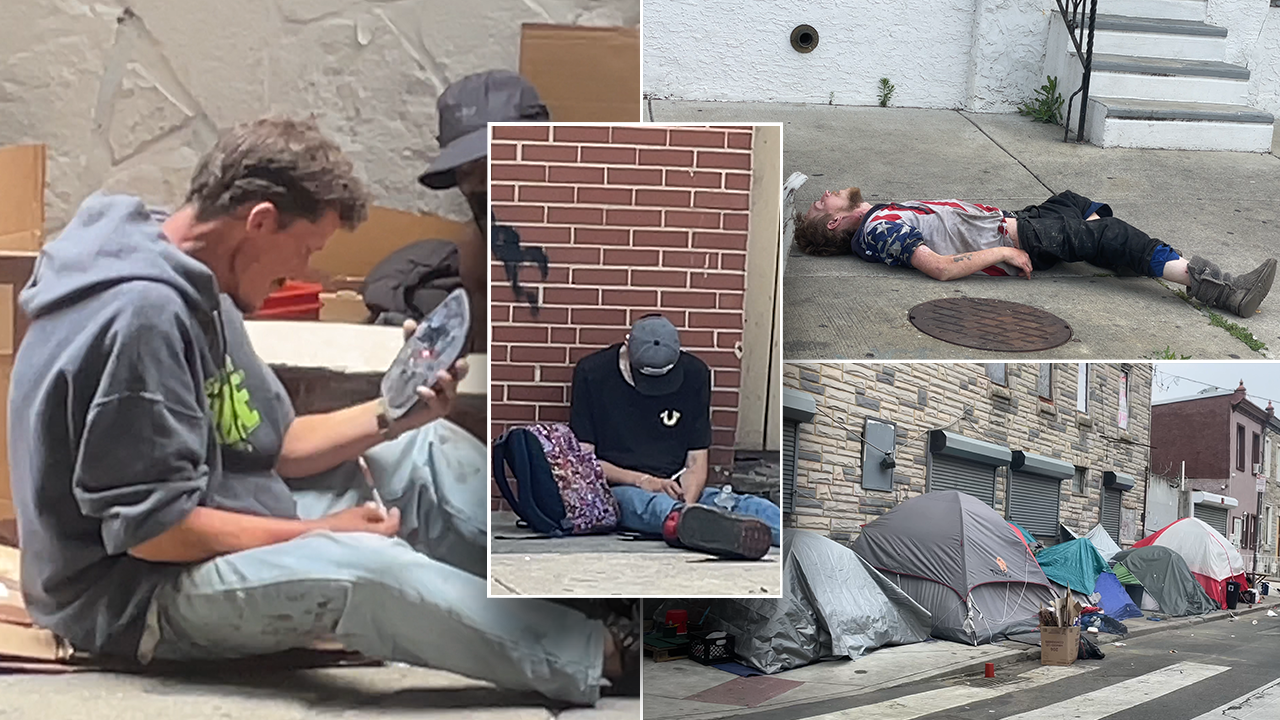
Dozens of new police officers are hitting the streets of Philadelphia’s most notorious neighborhood, promising to crack down on drug dealing, prostitution and other crimes.
But one man who used to deal and use drugs in the area worries the effort won’t last.
“They’re just taking the trash from the front of the house and moving it to the side,” Frank Rodriguez said. “It’s more for show and grandstanding than addressing the core issues.”
Frank Rodriguez started selling marijuana to help his mom pay the bills, but eventually graduated to dealing heroin. Later, he became an addict himself. (Fox News Digital)
CRISIS IN KENSINGTON: RESIDENT SAYS NEIGHBORHOOD ‘GIVEN TO THE WOLVES,’ BEGS PEOPLE TO STOP FEEDING ADDICTS
A record 1,413 people died from drug overdoses in 2022 in Philadelphia, according to the city health department, an 11% increase from the year prior. The Kensington neighborhood is ground zero for the city’s opioid crisis and was among the first areas of the country overtaken by fentanyl.
Rodriguez moved to Kensington as a child and started selling marijuana by the time he was a teenager. He became addicted to drugs after his mother died in a car accident in 2004, and continued using them until 2016.
Now, he owns a barbershop in Milton, Pennsylvania, but he returns to Kensington to provide free haircuts and film testimonials from suffering drug addicts in an effort to humanize them.
He described Kensington as “a predator’s playground,” plagued with addiction, mental health issues and “a level of suffering and dehumanization” unrivaled by other cities.
WATCH MORE FOX NEWS DIGITAL ORIGINALS HERE
“You can’t walk or look anywhere around there and not be emotionally bothered by what you see,” Rodriguez told Fox News Digital. “You smell rotting flesh. You see people with holes in their limbs.”
Years of failed efforts to crack down on lawlessness and tent encampments have frustrated many locals, and cleaning up the neighborhood was a pillar of the most recent mayoral race. Last fall, newly elected Democrat Cherelle Parker suggested the National Guard could be brought in to help.
CRISIS IN THE NORTHWEST: INSIDE ONE OF OREGON’S LARGEST HOMELESS CAMPS WITH A FORMER DRUG DEALER
Troops haven’t materialized yet, but Parker’s administration has taken numerous other steps, such as appointing the first-ever Kensington drug czar, signing a curfew into effect for businesses without liquor licenses in a portion of the neighborhood and sending police to sweep one major homeless encampment, according to local media reports.
And 75 new police recruits sworn in last month were specifically assigned to patrol Kensington.
“I will make no excuses for the fact that we will go down there in a much more forward posture, that we will be making arrests,” Philadelphia Police Commissioner Kevin Bethel said at a press conference ahead of the graduation.
A child looks on as people use drugs in Philadelphia’s Kensington neighborhood. (Jon Michael Raasch/Fox News Digital)
PENNSYLVANIA MAN PAYS RANSOM TO RECLAIM HOUSE FROM SQUATTERS: ‘THE CITY IS REWARDING CRIMINALS’
Rodriguez said he’s definitely seen a “ramp-up in police presence” since Parker took office in January, yet “the problem’s gotten worse.”
“We’re not dealing with 20 people. We’re not dealing with 100 people. We’re dealing with thousands of people,” he said.
Rodriguez added that he worries Kensington will be a rough beat for rookies.
“I don’t think it’s the place for new officers,” he said. “I don’t even think the majority of the seasoned, veteran cops are equipped with the knowledge and the know-how to deal with what’s going on there.”
Parker replaced two-term Mayor Jim Kenney and took a stronger tough-on-crime tone than her predecessor. She supported stop-and-frisk, a tactic that Kenney had vowed to end in Philadelphia. As a city councilor, Parker opposed Kenney’s push to open supervised injection sites.
“Instead of needles on the floor, I would love to see flowers and kids playing,” Rodriguez said. “So I hope and pray, keep my fingers crossed. But if I’m being realistic … what I see in Kensington — it’s going to be a very, very bad summer.”
Click here to hear more from Rodriguez.
Read the full article from Here


Before Jesse Tyler Ferguson starred on “Modern Family,” he was a bartender at the Winter Garden Theater in Midtown Manhattan, when “Cats” was in performances there. It was 1995, and he had come to New York from Albuquerque. He was cast in the Off Broadway production of “On the Town,” which later moved to Broadway.
“These professional dancers and singers in ‘Cats’ were auditioning for the same role as me, and I got it,” he said. “It’s like my Shirley MacLaine story.”
After starring in the original Broadway production of “The 25th Annual Putnam County Spelling Bee,” Mr. Ferguson was cast as the uptight lawyer Mitchell Pritchett on the ABC sitcom. After the show ended in 2020, he won a Tony Award for “Take Me Out.”
Now he is starring as Truman Capote in the play “Tru.” He recently spent his day off with The New York Times.

Almost 15 years have passed since Milan Lucic blew up goalie Ryan Miller on Garden ice, an infamous hit that would help send the Buffalo Sabres into their Dark Ages. On Sunday in Game 4 at the Garden, the Sabres finally got a little payback.
With a chance to tie the best-of-seven series on Causeway Street, the Bruins were embarrassed by the Sabres thanks to a comically bad first period that put them in a hole from which they had no chance to extricate themselves. The B’s took a well-deserved 6-1 loss and are now down in the series 3-1. They will be down to their last out of the season when they face the Sabres in Game 5 on Tuesday at Keybank Center.
“Man to man in here, if we’re not f—- embarrassed with what just happened, I don’t know what to say,” said Charlie McAvoy, who along with his partner Jonathan Aspirot was minus-4. “It’s not over after three games. We have everything to play for here and we know we’re such a better team than what we did today.”
“Embarrassed” was the operative word after the game.
The B’s had won 29 games on Causeway Street this season, tied with the Carolina Hurricanes for most home Ws in the NHL. But they couldn’t win either of their home games in the series and, if they don’t get their game in order before Game 5, they will have played their last game at the Garden for the season.
Meanwhile, the Sabres, after 14 years out of the playoffs, are on the verge of their first playoff series win since 2007.
The Bruins’ have suffered more dramatically painful losses on home ice in recent memory. The Game 7 Stanley Cup Final loss in 2019 comes to mind. But it’s hard to think of one that was less competitive. The Sabres’ forecheck made mincemeat of the Bruins’ defense in the first period.
How do you explain a team not being ready to compete and/or execute in such a big game?
“I can’t,” said coach Marco Sturm. “I don’t know. I really don’t know. I could feel a little bit of it in Game 3, for no reason, and definitely today. If you’re a Boston Bruin and playing at home, you should be very excited going into a playoff game. We didn’t, so I can’t really answer that question right now.”
The first period was a theater of the macabre for Bruins fans, at least those fans who hadn’t sold their tickets to Sabres fans.
They fell down 4-0 and it could have been much worse than that. The B’s were outshot 19-5 and they were charged with 10 giveaways, which felt like some charitable counting from the stat crew.
The first goal against at 4:17 was a harbinger of things to come. McAvoy’s simple D-to-D pass didn’t connect with Aspirot and the puck drifted dangerously toward the blue line. One of their best defensive forwards, Fraser Minten, jumped in to help. But after he collected the loose puck, Minten’s reverse bank pass went right to Alex Tuch, who fed Peyton Krebs for the one-timer goal. The Sabres’ fans in the building popped loudly and it was the beginning of a long afternoon for the home team.
The Sabres made it 2-0 seconds after a Buffalo power play ended at 7:10. Hampus Lindholm’s soft clear attempt was knocked down and then Ryan McLeod fed Josh Doan at the top of the crease for a redirect.
On the third goal, Jordan Harris, inserted into the lineup for Mason Lohrei, coughed up the puck upon Doan’s stick check and it went right to Zach Benson, who moved in and tossed an in-tight backhander at Jeremy Swayman, who made the initial stop but the rebound bounced off Benson and trickled in.
Sturm was in no mood to discuss what wrong from an X-and-O standpoint.
“I can’t even going into the rush game, the O-zone, D-zone, I really can’t,” said Sturm. “In all areas, we were just behind. Emotionally, if you’re not ready for it…it didn’t matter. So I don’t talk about little details because they were not there today.”
Sturm called his timeout at that point at 9:15 after the Benson goal.
“We were just hurting and I had to stop this, first of all,” said Sturm. “Message-wise, there’s a few things I had to address and the other thing, you had to wake them up. For some reason, two games in a row, we were just totally flat. In a playoff game. That just can’t happen.”
But happen it did, and the timeout couldn’t stop the hemorrhaging.
Buffalo made it 4-0 at 14:24 when Aspirot knocked a Sabre into Swayman, leaving the goaltender flailing. Bowen Byram used the opportunity to score his third of the series into the shortside.
Predictably, the Bruins fans that were in the house booed their team off the ice at the of the first.
To make matters worse, the B’s were without Viktor Arvidsson to start the second after he had taken a high hit from Mattias Samuelsson late in the first.
Pride kicked in a little bit in the second period and the B’s finally spent a little time in the Sabres zone, especially late in the period. But Alex Lyon (22 mostly easy saves) made the stops he needed to, when the Sabres didn’t block the shots in front of him. The B’s earned one power play late in the second but they did nothing with it and they still faced the daunting four-goal deficit to start the third.
For the most optimistic of Bruins fans, even their hopes were doused when Beck Malenstyn scored on a deflection early in the third, followed up quickly by a Tuch goal, both goals coming off turnovers.
Sturm then gave Swayman the mercy pull, which frankly could have happened after the disastrous first. The netminder appeared to let his teammates have it before he went down the tunnel.
Only a Sean Kuraly goal with 39.9 seconds left, with the B’s killing a Nikita Zadorov major after he cross-checked and punched Rasmus Dahlin, kept the B’s from suffering their first shutout of the season.
That didn’t change the overriding feeling utter failure one iota.
“A waste of opportunity,” said David Pastrnak, who took nine shots, only one of which got through to the net. “Unacceptable. We expect more from ourselves. We are better than that. You can’t show up like that, in an afternoon game. The first period is so f— important…to show up like that as a team is unacceptable.”
We will see on Tuesday what, if anything, they can do about it.

A woman has died, and three others were injured following a shooting at a bar in Vandergrift, Armstrong County, according to Pennsylvania State Police.
Troopers said they were called shortly after 1:15 a.m. Sunday to Niki’s Quick Six on First Street in Vandergrift for reports of shots fired.
A local police officer who arrived first found one woman dead and multiple people suffering from gunshot wounds, according to a public information report provided by state police.
The woman who died was identified as Jessica Hilliard, 34, of Apollo. Hilliard was pronounced dead at the scene. Another victim, Rebecca Boston, 24, of McIntyre, was found at the scene and was last listed in critical condition.
Two other victims, Hector Saballos, 34, of Vandergrift, and Dominik Dellach, 25, of Vandergrift, left before troopers arrived. Police said both were later listed in stable condition.
The suspect has been identified as David Dunmire, 36, of Vandergrift. Police said he remained at the scene and was taken into custody without incident.
An investigation determined that a physical altercation broke out in the parking lot outside the bar before Dunmire allegedly pulled out a firearm and fired multiple rounds, striking several people.
State police said they consulted with Armstrong County District Attorney Katie Charlton, who approved a criminal homicide charge.
The investigation remains ongoing.
-

 News1 minute ago
What We Know About the Gunman at the White House Press Dinner
-

 Politics7 minutes ago
‘Shots Fired!’: Inside the Pandemonium at the Washington Hilton
-

 Business13 minutes ago
Confusion and Fright at the White House Correspondents’ Dinner After Shots Were Fired
-

 Lifestyle43 minutes ago
Sunday Puzzle: Blank to blank
-

 Technology55 minutes ago
Google’s new gradient icon design is coming to more apps
-

 World1 hour ago
Hormuz crisis spurs $24B Iraq trade corridor as Gulf routes shift
-

 Politics1 hour ago
Obama says motive unclear despite manifesto outlining alleged targets in WHCD shooting
-

 Health1 hour ago
Highly contagious stomach bug surges in US as some groups face severe effects