Michigan
West Michigan has a dangerously low blood supply, Donation are needed

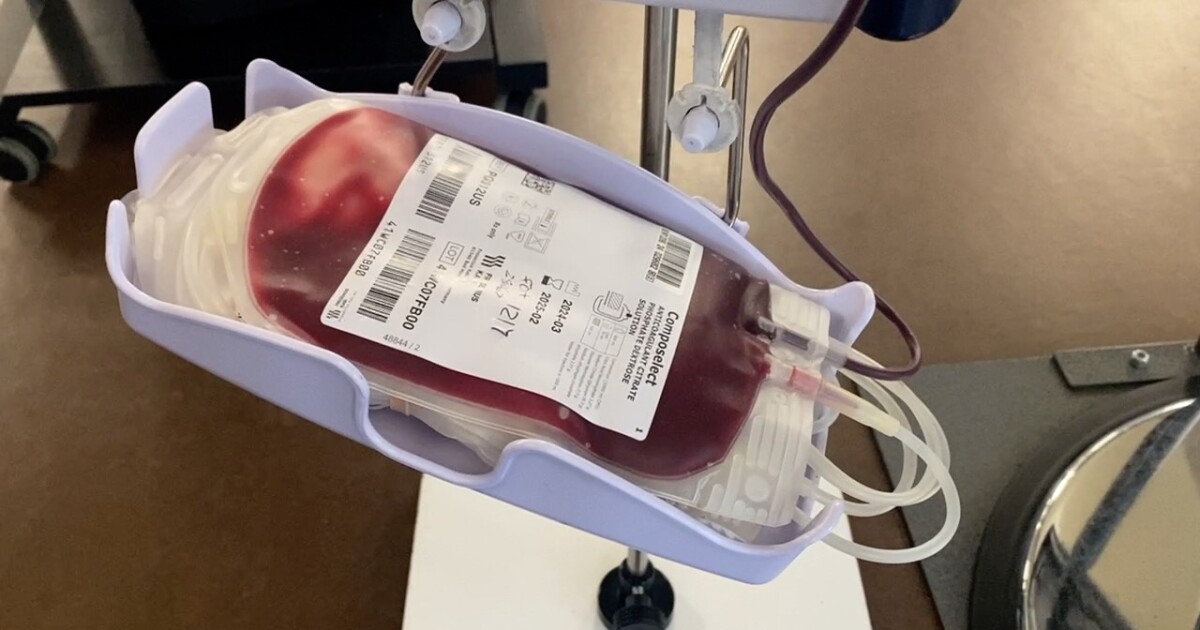
GRAND RAPIDS, MICH. — West Michigan is facing a critical blood supply shortage. Versiti Blood Center tells me certain blood types have less than a day’s supply.
“ I am a regular donator; I’ve been giving blood for years.” Said Nancy Coelho.
She visits Versiti blood center on Fuller Avenue regularly. This time she noticed many empty chairs around here when during lunch hour.
Nancy Coelho says, “I definitely noticed it was less busy. I was the only person giving whole blood at the time of my donation.”
“It’s an emergency blood shortage right now.” Said Dawn Kaiser, Versiti Blood Center of Michigan Director of donor Services.
She says the shortage is happening because regular donors are not coming in and area hospitals have been needing a larger supply of blood saying, “We actually are encouraging our staff to get on the beds and donate blood. Because we’re that critical.”
To meet the needs of area hospitals, 600 units of blood are needed daily.
“If we if we don’t get enough donations, hospitals will have to tell there are patients who are having elective surgeries that they have to postpone, and that could cause a backup in the hospitals.” Said Kaiser.
Versiti says last week they had their lowest donation count of the year and need 4,000 donors in the next 7 days to meet the demand.
Kaiser says “It’s a community problem when we don’t have enough blood. It’s not a Versiti problem, because people help people and people need people, we only rely on volunteer blood donors to supply our blood supply.
“There are so many people who are desperate for blood products now, in hospitals, children, cancer patients, people who are really ill and it’s one way we can all help.” Said Nancy.
Versiti says donating blood takes about an hour and who can complain when you get snacks as a reward afterwards.
To find a local place to donate got to Versiti.org
Follow FOX 17: Facebook – X (formerly Twitter) – Instagram – YouTube



Enter your email and we’ll send a secure one-click link to sign in.
WLNS 6 News is provided by Nexstar Media Group, Inc., and uses the My Nexstar sign-in, which works across our media network.
Learn more at nexstar.tv/privacy-policy.
WLNS 6 News is provided by Nexstar Media Group, Inc., and uses the My Nexstar sign-in, which works across our media network.
Nexstar Media Group, Inc. is a leading, diversified media company that produces and distributes engaging local and national news, sports, and entertainment content across its television and digital platforms. The My Nexstar sign-in works across the Nexstar network—including The CW, NewsNation, The Hill, and more. Learn more at nexstar.tv/privacy-policy.

As temperatures rise in Michigan each summer, so to do the chances of harmful algal blooms (HABs) developing in our lakes, causing a risk to both ecosystems and public health.
HABs are formed wherever there is rapid growth of cyanobacteria, or blue-green algae, which are naturally found in lakes, rivers and ponds. Some cyanobacteria found in blooms contain toxins that can be harmful to people and animals, and often present as blue-green, yellow or brown streaks, foam, or thick paint-like scums on the water surface, according to the Michigan Departments of Environment, Great Lakes, and Energy (EGLE)
To help keep track of these harmful algal blooms across the state, EGLE has teamed up with the Michigan Department of Health and Human Services (MDHHS) to update its online reporting form to include harmful algal blooms. Now the public can easily report suspected HABs to the state by filling out the form at Michigan.gov/HABs. Individuals can also make a report by calling EGLE’s Environmental Assistance Center at 800-662-9278.
“This new online form is an easy and efficient way for Michiganders to help monitor and safeguard our water resources,” said Jerrod Sanders, director of Water Resources Division at EGLE, in a news release. “This tool improves efficiency and helps us respond to potential risks more effectively.”
It will also allow EGLE and MDHHS staff to better understand how HABs develop, and creates the potential to send out public notifications about what areas to avoid as a way of keeping people and pets safe when they’re detected.
Breathing in or swallowing water with HAB toxins can cause asthma-like symptoms, difficulty breathing, stomach pain, vomiting, diarrhea, runny eyes and nose, weakness, headaches or dizziness. Skin contact can also cause rashes, blisters or hives.
“If you had contact with or swallowed water with a suspected HAB and feel sick, call your health care provider or seek medical attention as soon as possible,” said Dr. Natasha Bagdasarian, chief medical executive.
Locations of HAB reports verified by EGLE and results of cyanotoxin testing will be displayed on the Michigan Harmful Algal Bloom Reports Map for the public to review.
For more information on health effects, causes and reports on the occurrence of HABs in Michigan lakes, visit Michigan.gov/HABs.
Copyright 2026 by WDIV ClickOnDetroit – All rights reserved.

KALAMAZOO, Mich. — Beach season is here, and Lake Michigan is the most popular of the Great Lakes for swimming. However, it can also be the most dangerous.
According to the Great Lakes Surf Rescue Project, 81 people drowned in the Great Lakes in 2025. 36 of those drownings, or almost half, happened in Lake Michigan.
“Even an Olympic swimmer is not going to swim against the rip current,” Pat Whelan, Plainwell district supervisor for the Michigan DNR Parks and Recreation Division, said.
What makes a rip current so dangerous is the natural instinct to try and swim back to shore. However, it is not the way to escape.
“It’s a term called ‘flip, float, and follow,’ where you flip on your back so you can breathe,” Whelan said. “Follow that, float on the top of that current and follow it out into the lake until you can feel it release you. Then you’re going to swim parallel to the shore, and then the waves themselves will help push you back into the shore.”
It’s been more than 20 years since Andy Fox, 17, drowned in a rip current at Grand Haven State Park, but the pain is still fresh for his mother, Vicki Cech, who rarely goes to the beach.
“When I have company in, sometimes I’ll walk out on the pier, but as a rule I just don’t go there anymore,” Cech said. “Not that beach, because that one does have a lot of sad memories for me.”
Pictured is Andy Fox, 17, in this undated photo. Fox drowned in a rip current at Grand Haven State Park in 2006. (Cech/WWMT)
Compared to other Lake Michigan beaches, Grand Haven State Park has added safety features as conditions are known to change rapidly.
Grand Haven uses the color warning system, but at other beaches, they have flags.
At Grand Haven State Park, however, there is an electronic lighting system on an orange tower. When the life ring on that tower is pulled, Ottawa County dispatch is alerted right away.
Blue towers on the beach are equipped with cameras, providing a video feed of what is happening where the life ring was pulled.

Electric lights instead of flags are used to alert people of swimming conditions at Grand Haven State Park.
“They can push the bottom and actually talk back and forth with central dispatch,” Whelan said.
Alongside these additions, Cech would like to see lifeguards on Grand Haven’s beaches.
“I know there’s all kinds of different things we have down there. Life rings closer to the water and everything like that,” Cech said. “But I’d say the only thing which I see South Haven has finally gotten lifeguards, the ultimate would be lifeguards.”
Michigan got rid of lifeguards at state parks in the 1990’s. The DNR said it was a combination of cost and liability concerns.
South Haven, however, welcomed lifeguards back to the city’s beaches for the first time in 25 years on Monday.
Those lifeguards do not yet have chairs and towers yet, but they will be posted between each flag section, with green, yellow and red colors marking that day’s swimming conditions.
More information about the Great Lakes Surf Rescue Project can be found online.
-

 Los Angeles, Ca1 hour ago
Man arrested for multiple Los Angeles freeway shootings: CHP
-

 Detroit, MI1 hour ago
Archdiocese of Detroit’s list of parishes chosen for halted Masses grows
-

 San Francisco, CA2 hours ago
Giants reassign 3B coach Borg; Wotus named interim replacement
-

 Dallas, TX2 hours ago
Vigil honors victims of Dallas apartment explosion that killed three and injured five
-
Miami, FL2 hours ago
Miami kosher, Mutra, restaurant earns Michelin star | The Jerusalem Post
-

 Boston, MA2 hours ago
Red Sox outfielder Roman Anthony suffers another injury setback
-

 Denver, CO2 hours ago
Denver weather: Warm weather to end May
-

 Seattle, WA2 hours ago
Seattle City Council proposal would use street closures to curb gun violence


