Northeast
Missouri AG sues New York over 'reprehensible lawfare' against Trump: 'Poisonous to American democracy'


EXCLUSIVE – Missouri Attorney General Andrew Bailey filed a lawsuit against the state of New York, alleging it violated Missourians’ First Amendment right to hear from former President Trump during the 2024 presidential election.
Bailey’s lawsuit alleges New York’s “illicit prosecution, gag order, and sentencing” of Trump has undermined his ability to campaign for president, sabotaging Missourians’ ability to hear from him and cast a fully informed vote for a presidential candidate mere months before the election.
His lawsuit petitions the Supreme Court to declare that New York’s restrictions on President Trump’s ability to campaign unlawfully interfere with the presidential election, to remove any gag orders against the former president and to halt his pending sentencing until after the presidential election.
“Right now, Missouri has a huge problem with New York. Instead of letting presidential candidates campaign on their own merit, radical progressives in New York are trying to rig the 2024 election by waging a direct attack on our democratic process,” said Bailey.
MISSOURI AG TO SUE NEW YORK OVER ‘UNCONSTITUTIONAL LAWFARE’ AGAINST TRUMP: ‘TIME TO RESTORE THE RULE OF LAW’
Missouri Attorney General Andrew Bailey filed a lawsuit against New York alleging election interference in the 2024 presidential race. (Getty Images)
“I will not sit idly by while Soros-backed prosecutors hold Missouri voters hostage in this presidential election. I am filing suit to ensure every Missourian can exercise their right to hear from and vote for their preferred presidential candidate.”
The lawsuit alleges three specific violations, including interference with the presidential election in other states, violation of the First Amendment and the unlawful change of election rules in the months leading up to an election. It comes just one month after New York’s Manhattan DA, Alvin Bragg, won a guilty verdict against Trump.
GOP AG LAUNCHES NEW PROBE INTO COMMUNICATIONS FROM DOJ AND TRUMP PROSECUTORS
Trump was found guilty of 34 counts of falsifying business records in the first degree. Trump pleaded not guilty to all counts. Each count carries a maximum prison sentence of four years. Trump faces a maximum sentence of 136 years.
“This lawfare is poisonous to American democracy. The American people ought to be able to participate in a presidential election free from New York’s interference. Any gag order and sentence should be stayed until after the election,” Bailey said.
Missouri Attorney General Andrew Bailey is suing the state of New York over what he calls its “illicit prosecution, gag order, and sentencing” of former President Trump. (Bill Clark/CQ-Roll Call, Inc via Getty Images)
In the lawsuit, Bailey lays out the timeline of how Bragg brought charges against Trump, alleging he did it to boost President Biden’s campaign and keep Trump out of the White House.
Bailey noted Bragg was previously involved in a lawsuit against Trump while working for the New York Attorney General’s Office and then campaigned for his current position by promising to use that experience to prosecute Trump.
BRAGG DOES ‘NOT OPPOSE’ TRUMP REQUEST TO DELAY SENTENCING; AWAITS JUDGE MERCHAN’S APPROVAL
Bailey alleges the state of New York’s prosecution of former President Trump violates Missourians’ First Amendment rights. (AP Photo/David A. Lieb, File)
Additionally, Bailey pointed out that Bragg hired the third highest-ranking member from Biden’s Department of Justice, Matthew Colangelo, to lead the prosecution against Biden’s political opponent.
His lawsuit also alleges Judge Juan Merchan, the judge overseeing Trump’s New York criminal trial, violated state judicial ethics rules by donating to the Biden campaign.
Bailey called it “reprehensible lawfare” against the former president.
“Trump’s conviction is very likely to be overturned on appeal. But, by then, the constraints New York has sought to impose on Trump to limit his ability to campaign will already have had their full effect. Missouri has a strong, judicially enforceable interest in its citizens and electors being able to hear Trump’s campaigning free from any gag order or other interference imposed by the State of New York.”
– Missouri Attorney General Andrew Bailey
Bailey filed a motion of preliminary injunction, asking the court to immediately halt any further action in the New York case until after the American people have had their say at the ballot box.
“Radical progressives in New York are trying to rig the 2024 election. We have to stand up and fight back,” Bailey previously told Fox News Digital in an exclusive interview.
Trump on Monday moved to overturn his criminal conviction in the Manhattan case after the U.S. Supreme Court ruled a former president has substantial immunity for official acts committed while in office. He also requested to delay his sentencing, which was scheduled for July 11, just days before the Republican National Convention, where he will be formally named as the 2024 GOP presidential nominee.
Bragg said Trump’s request to toss the verdict was without merit, but he did not oppose the request to delay sentencing.
Merchan on Tuesday afternoon delayed Trump’s sentencing date to September 18 at 10 a.m.
Fox News Digital’s Brooke Singman contributed to this report.
Read the full article from Here


ATTLEBORO, Mass. (WJAR) — U.S. Immigration and Customs Enforcement Boston said Friday that it arrested a Barbados national during targeted operations in Attleboro.
ICE Boston said Irijah Jabarri Stowe Marshall is “a criminal illegal alien.”
According to officials, his criminal history includes a pending charge for failing to register as a sex offender in Massachusetts.
He was also previously convicted of attempted rape and aggravated sexual contact, ICE Boston said.
Pittsburg, PA
Pittsburgh’s air quality considered “unhealthy for everyone” on Friday due to wildfire smoke

The air quality will remain poor today. Officially, the air quality will be in the “very unhealthy” to “hazardous” range.
Friday’s forecast and air quality warnings
How hazardous are things? Wildfire smoke, like what we are dealing with today, really gives you a double whammy when it comes to impacting your health. The first is that you may notice when talking about air quality that we label it with a number, and then we put behind it PM2.5 or maybe 10.
The 2.5 is important because it is talking about the size of the particles that we are describing as parts per million. The unit for 2.5 is microns. 1 micron is the same as 0.00003937 inches or 0.001 mm. So 2.5 microns is around a fourth the width of a single wool fiber or around 1/7th the width of a human hair. It’s tiny and grating.
It’s small enough to get deep into your lungs but hard enough to irritate, like very fine sandpaper. For those with respiratory issues already in place, this increased irritation causes shortness of breath and frequent coughing spells. Not good.
The good news is that our air quality will rapidly improve overnight, with us returning to more normal air quality on Saturday morning. The bad news is that another plume of smoke is expected to roll in on Sunday, but that plume is not expected to be as bad as this current one.
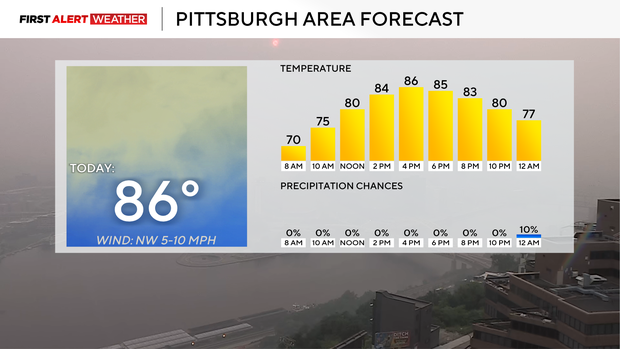
Getting to today’s forecast, it is going to be hot with highs in the mid-80s today. There will be a haze sitting over the city all day long. I have noon temperatures near 80 degrees with light winds of around 5 mph.
Kennywood and Sandcastle close due to air quality
Both Kennywood and Sandcastle announced on Friday morning that the parks will be closed due to the air quality alert issued by the Pa. Department of Environmental Protection.
According to both parks, patrons who purchased tickets for July 17 will be valid on one operating day throughout the rest of the season.

According to Love Food, the best bowl of ramen in Connecticut isn’t tucked away in one of the state’s larger cities. Instead, you’ll have to make your way to Granby, where Tiger Belly Noodle Bar has earned national recognition for serving what the publication says is Connecticut’s top ramen.
If you’re expecting a massive menu with dozens of choices, that’s not what you’ll find here. Tiger Belly keeps things relatively simple, focusing on a handful of carefully crafted noodle dishes that have developed a loyal following. The standout, according to Love Food, is the restaurant’s aptly named Darkness Ramen.
This isn’t your average bowl of noodles. The star of the dish is a rich tonkotsu broth that’s simmered for more than 25 hours to develop its deep, savory flavor. It’s then topped with tender pork belly, enoki mushrooms, plenty of garlic, and finished with black garlic oil for an extra layer of richness. The result is a bowl that’s hearty, comforting, and packed with bold flavors.
Ramen has exploded in popularity across the United States over the past decade, with restaurants putting their own spin on the classic Japanese comfort food. Whether you prefer a traditional pork-based broth, spicy variations, seafood, or vegetarian options, there’s no shortage of great places to grab a bowl these days. But when it came to picking just one restaurant in Connecticut, Love Food says Tiger Belly Noodle Bar stands above the rest.
So, if you’re the type of person who’s willing to take a road trip for great food, Granby might deserve a spot on your list. A slow-simmered broth, fresh ingredients, and a little black garlic magic were apparently enough to earn this Connecticut restaurant some well-deserved national bragging rights.
Classic Rock Songs That Describe Each Greater Danbury Town…
10 of the Best Waterfalls in Connecticut
Did a White Plains Researcher Get Too Close to the Truth About UFOs?
Leon Davidson of White Plains, NY, had a résumé packed with top-level science work — from IBM and Union Carbide to atomic research and sci-fi writing. But when he turned his focus to UFOs, what followed was a strange paper trail that linked him to the CIA, classified communications, and government efforts to shut him down. The story you’re about to see reveals what those efforts looked like — and why they may have gone to such great lengths.
Gallery Credit: Lou Milano
-

 News19 minutes ago
Where Wildfire Smoke Is The Worst Right Now—And What To Do About It
-

 Los Angeles, Ca2 hours ago
LADWP begins long-term repairs after West Hollywood water main rupture
-

 Detroit, MI2 hours ago
Livestream: Mayor Sheffield, Detroit health chief to address wildfire smoke threat
-
 San Francisco, CA3 hours ago
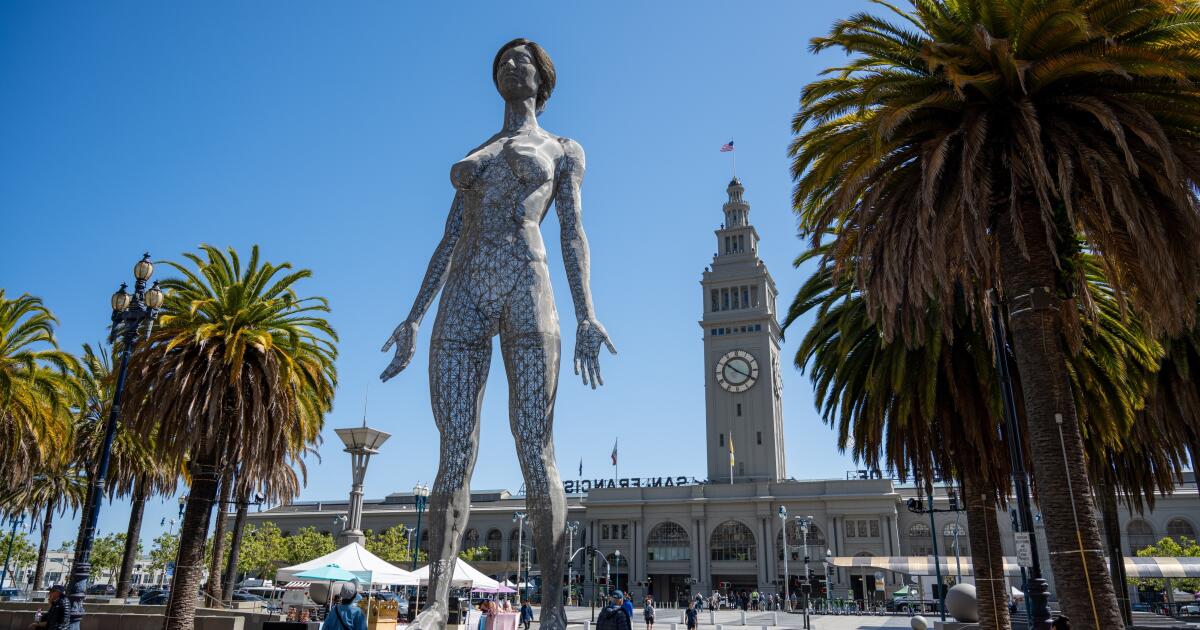
A sculpture of a giant naked woman goes on sale in San Francisco. Bring a crane
-

 Dallas, TX3 hours ago
No ‘straight answer’: Why Pioneer Cemetery is the latest battleground at City Hall
-

 Miami, FL3 hours ago
TSA hosts news conference ahead of World Cup third place match at Miami Stadium
-

 Boston, MA3 hours ago
ICE Boston arrests Barbados national during targeted operations in Attleboro
-

 Denver, CO3 hours ago
Denver Broncos training camp is 2 weeks away

