Politics
California races roiled by border, immigration. It could tip control of the House

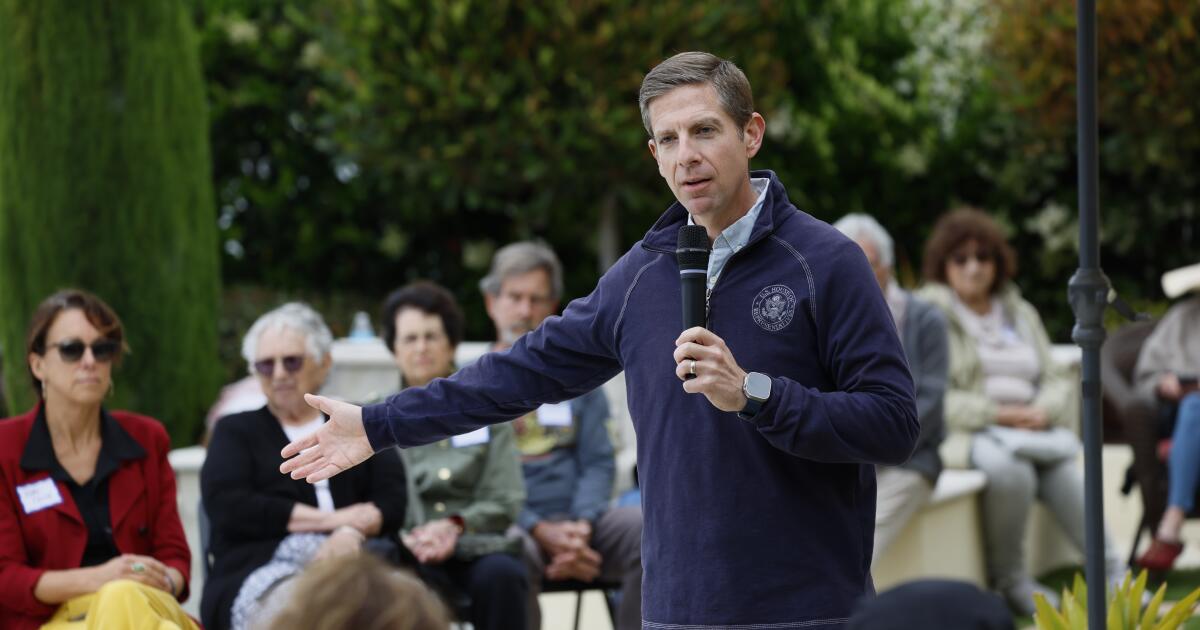
On a recent overcast Saturday in the manicured backyard of a constituent’s home, Rep. Mike Levin (D-San Juan Capistrano) told several dozen supporters about his efforts to bring more sand to local beaches, reduce veteran homelessness and prevent gun violence.
From the crowd, Peggy Aveni whispered to her friend: “What about immigration?” When Levin began taking questions, she immediately raised her hand.
“I am concerned about the immigration thing,” Aveni told him. “I know that the Republicans have tried to squash anything from happening. So, will anything happen before the election?”
With immigration at the forefront of the presidential election, the U.S.-Mexico border has become an increasingly significant political issue in downballot races. In California, where the San Diego region is now a top destination for arriving migrants, a handful of competitive House races could help determine control of Congress.
A handful of California Republicans appear vulnerable in the November election, including Reps. David Valadao of Hanford and Ken Calvert of Corona, and their defeat could help Democrats reclaim the majority in the House of Representatives.
But there are also Democrats — including Levin — who are clinging to their seats.
“Right now, the border is the No. 1 issue impacting this district,” said Levin’s Republican opponent, retired businessman Matt Gunderson. “The San Diego County line has become the epicenter of border crossings. Until we secure the border, all our other issues, in terms of public safety and public health and inflation, kind of fall to the wayside.”
Immigration is becoming a higher priority for Levin, whose maternal grandparents immigrated to the U.S. from Mexico with parents who had work permits.
(Allen J. Schaben / Los Angeles Times)
Levin, an environmental lawyer who has served the 49th District in Congress since 2019, represents most of northern coastal San Diego County and parts of southern Orange County. His top priorities are fighting climate change, supporting veterans and protecting democracy, though immigration has increasingly crept up his list.
At the Encinitas campaign event, he told the crowd that the asylum system is broken. It has become easier for people to pay thousands to a cartel or get step-by-step instructions on social media than to enter through a legal pathway, he said.
He reminded them that Republicans, heeding the demands of former President Trump, killed a bipartisan border security bill after months of negotiations. Trump, the presumptive Republican presidential nominee, and conservative news outlets have used politically divisive issue of immigration as a cudgel to attack President Biden.
“We do have a genuine crisis,” Levin said. “It is not necessarily what Fox News makes it out to be. But it’s unacceptable. It’s untenable.”
Aveni, 70, who is an independent voter, said she supports Levin but found his answer to her question evasive. She said she supports legal immigration.
“My friends in general, even the more liberal ones, understand that this is a big issue for Southern California,” she said. “I want something done, and it’s just too bad that it took three years in the Biden administration to even get there.”
In an interview after the event, Levin said that his grandparents on his mother’s side immigrated from Mexico with their parents, who had work permits. He said their experience might not have been possible today.
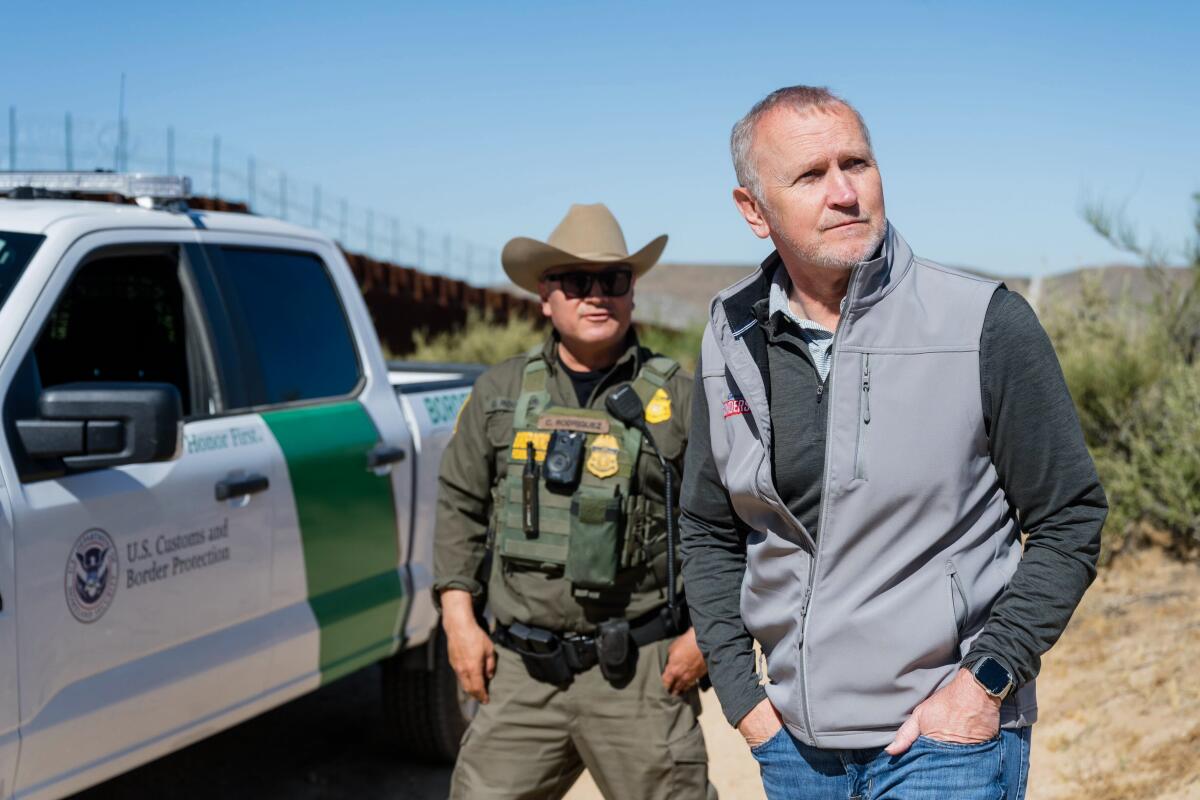
Republican Matt Gunderson, who’s challenging Levin, says that until the border is secured, “all our other issues, in terms of public safety and public health and inflation, kind of fall to the wayside.”
(Gunderson Campaign)
Levin said he wants to expand legal pathways to citizenship, particularly for so-called Dreamers and others who have lived in the U.S. for decades.
The failed border security deal marked the first time most Democrats supported immigration legislation that did not include a legalization component. Still, he said, it was a good-faith negotiation that included necessary funding for more border agents, asylum officers and immigration judges.
“It’s true that it’s a political issue,” he said, but “it is genuinely a national security concern that should be treated as such. For me, that prioritizes where it ranks on the continuum of all the variety of other things that voters may care about.”
At the White House three days after his meet-and-greet, Levin stood near Biden, just behind Homeland Security Secretary Alejandro N. Mayorkas, as the president announced his executive order limiting asylum at the border. The order raises the legal standard for asylum claims and blocks access for those crossing outside legal points of entry when their numbers average more than 2,500 a day.
Asked how he felt about Biden leaning on the same legal provision that Trump used to ban people from several Muslim-majority countries, Levin said he hopes Biden is using it “for far different purposes.” The historic numbers of arrivals in the last few years, he said, show change is necessary.
But Gunderson, Levin’s Republican challenger, said the president’s order had come too late. The former car dealership owner, who ran unsuccessfully for state Senate in 2022, has focused his campaign largely on affordability for the middle class.
The Biden administration dismantled Trump’s border policies just to “inch their way back” as the election nears, Gunderson said.
“No recent ‘come to Jesus’ perspective is going to change what they’ve done over the last three and a half years,” he said.
Immigration is factoring into other California races, too. In the 45th District, Republican Rep. Michelle Steel of Seal Beach faces Democratic challenger Derek Tran, an Army veteran and Orange County business owner whose parents were Vietnamese political refugees.
Tran recently faced heat from Asian American community leaders for telling Punchbowl News that Steel “tries to run on that she’s a refugee” though “she came to this country for economic gain.” Her family fled communist North Korea for Seoul before she later moved to the U.S. for college.
For her part, Steel has criticized Democrats for their handling of the U.S.-Mexico border, saying her constituents had arrived legally.
And in the 41st District, Calvert, the longest-serving Republican member of California’s congressional delegation, faces Democrat Will Rollins, a former federal prosecutor who helped prosecute Jan. 6 insurrectionists.
A redrawing of congressional maps divided the once solidly GOP district in Riverside County. Though both candidates have advocated for securing the southern border, Rollins also supports a path to citizenship for certain immigrants and says those arriving at the border should be treated humanely.
Dave Wasserman, senior editor and elections analyst for the nonpartisan Cook Political Report, said that while immigration has been one of Biden’s weakest issues in approval polls, “Democrats down ballot have been somewhat successful in establishing independence from the White House on this issue.”
The issue has become a lightning rod in districts and states not just along the border, but also across suburbs farther north due to the strain that recent arrivals have placed on municipal budgets, Wasserman said. He pointed to Rep. Tom Suozzi (D-N.Y.), who jabbed at the administration as being slow to respond to the issue, while also blasting Trump and Republicans for sabotaging the bipartisan compromise.
“Generally swing voters are supportive of tightening the border or going further than Biden and Democrats have gone in the last three years,” Wasserman said. “Whereas the focus in 2016 was on Trump’s rhetoric on immigrants and immigration in a way that polarized Hispanic voters against him, the focus now has been on the humanitarian crisis stemming from record numbers of illegal crossings.”

Politics
Trump says Iran missiles ‘aren’t the problem’ after White House made them central to war rationale

NEWYou can now listen to Fox News articles!
For months, senior Trump administration officials argued that Iran’s ballistic missile arsenal helped shield Tehran’s nuclear ambitions and was a key reason the U.S. launched Operation Epic Fury attacks on the country.
Now, President Donald Trump is suggesting Iran having missiles may not be a problem at all.
“If other countries have them, it’s a little bit unfair for them not to have some. If Saudi Arabia and Qatar, and they all have some, I would say that in relative proportion, I think it’s okay,” Trump said at the G7 international forum Wednesday. “Am I going to let Saudi Arabia have missiles, but (Iran) can’t have them? It doesn’t work that way.”
“Missiles aren’t the problem. They hurt a little location, but they don’t blow up the planet.”
“The Gulf nations will address the nonnuclear issues, as we’ll be talking about the ballistic missiles,” the president added. “And we’ll talk, also, about the terrorist proxies that they have that — we don’t want that to happen.”
A map displays the range of ballistic missiles fired from Iran, highlighting areas within reach. (Fox News)
ISRAELI OFFICIALS REPORTEDLY WARN IRAN’S BALLISTIC MISSILES COULD TRIGGER SOLO MILITARY ACTION AGAINST TEHRAN
Trump made the remarks while discussing whether Iran should be permitted to retain missile capabilities in a news conference at the G7 in Évian-les-Bains, France, just as details of the memorandum of understanding between the U.S. and Iran were being released.
The comments strike a much different tone than arguments repeatedly made by senior administration officials in recent months, who described Iran’s ballistic missile force as both a major threat to regional security and a protective shield for Iran’s nuclear program.
“Iran can never have a nuclear weapon, and we will not allow Iran to hide behind the immunity of a massive short-term ballistic missile inventory, or the ability to make them or launch them,” Secretary of State Marco Rubio told reporters in a press conference March 3. “What they are trying to do, and have been trying to do for a very long time, is build a conventional weapons capability as a shield to hide behind.”
TRUMP VOWS TO HIT IRAN ‘VERY HARD’ AFTER OBLITERATING NEARLY ’90 PERCENT’ OF REGIME MISSILES
Other senior officials repeatedly described degrading Iran’s missile capabilities as a central objective of Operation Epic Fury.
In remarks at the White House on March 2, days after the start of the operation, Trump said, “Our objectives are clear. First, we’re destroying Iran’s missile capabilities … and their capacity to produce brand new ones.”
War Secretary Pete Hegseth later said March 4 the mission was “laser-focused” on obliterating Iran’s missiles and the facilities that produce them, while White House Press Secretary Karoline Leavitt said the same day one of the administration’s primary goals was to “destroy the regime’s deadly ballistic missiles and completely raze their missile industry to the ground.”
Heavy weapons, including ballistic missiles, air defense systems and unmanned aerial vehicles, are displayed during the 44th anniversary of the eight-year war with Iraq, known as Holy Defense Week, at Baharestan Square in Tehran, Iran, on Sept. 25, 2024. (Photo by Fatemeh Bahrami/Anadolu via Getty Images)
Rubio repeatedly returned to the theme throughout the operation, arguing that degrading Iran’s missile force was necessary to prevent Iran from using conventional military power as cover for a future nuclear weapons program.
TRUMP SAYS US, ISRAEL SHATTERED IRANIAN MILITARY CAPABILITIES, PRESSES LEADERS TO SURRENDER: ‘CRY UNCLE’
“This is about very specific objectives,” Rubio told reporters on March 30. “The President laid them out on the first night of the operation… Here they are — you should write them down. Number one, the destruction of their air force. Number two, the destruction of their navy. Number three, the severe diminishing of their missile launching capability. And number four, the destruction of their factories so they can’t make more missiles and more drones to threaten us in the future. All of this so that they can never hide behind it to acquire a nuclear weapon. That was our objective from the beginning; that remains our objective now.”
Leavitt made similar comments the same day, saying the objectives of Operation Epic Fury included “destroying their ballistic missiles” and dismantling the infrastructure used to produce them while ensuring Iran never obtains a nuclear weapon.
Trump’s remarks at the G7 also raised questions about the administration’s approach to Iran’s nuclear program, another issue that administration officials had previously described in far less flexible terms.
Trump’s comments also come as the administration pursues a memorandum of understanding with Iran that leaves unresolved one of the central disputes in the nuclear negotiations: the future of Tehran’s enrichment program.
Under the framework agreement unveiled this week, the United States and Iran agreed to spend 60 days negotiating the fate of Iran’s nearly 900-pound stockpile of near-weapons-grade 60% enriched uranium and any future enrichment activities. Administration officials said the minimum outcome under discussion would involve down-blending the material under International Atomic Energy Agency supervision, while acknowledging that key details of a final agreement remain unsettled.
Officials described Iran’s willingness to dilute its stockpile as a significant concession, but also acknowledged that the memorandum does not resolve whether Iran will ultimately be permitted to retain any enrichment capability.
TRUMP REAFFIRMS HARD LINE ON IRAN NUCLEAR DEAL: ‘WILL NOT ALLOW ANY ENRICHMENT OF URANIUM’
President Donald Trump arrives for a gala dinner at the Versailles Palace in Versailles, France. (Nathan Laine/Bloomberg via Getty Images)
Trump appeared to strike a more accommodating tone when discussing Iran’s access to nuclear power at the G7.
“It is a little hard, though, when you say that somebody wants it, other people have it, other, adjoining states have it. And you’re not letting them have it for purposes of electricity and things like that,” Trump said. “It’s always a little tough. You have to use a little common sense.”
CLICK HERE TO DOWNLOAD THE FOX NEWS APP
The administration had previously drawn a much harder line on Iran’s nuclear program. Special envoy Steve Witkoff said the United States could not allow Iran to retain “even 1 percent” enrichment capability, while White House officials repeatedly described the end of Iranian enrichment as a red line.
The White House referred back to Trump’s recent remarks on missiles when asked for additional comment. “
“We are going to let the President’s comments stand,” a State Department spokesperson said when asked for comment.
The Pentagon could not immediately be reached for comment.
Politics
Commentary: Behested payments aren’t illegal, but they are a problem. Especially for Newsom

After Gov. Gavin Newsom announced this week that the U.S. Department of Justice may be investigating his wife, Jennifer Siebel Newsom, media and pundits pounced on millions in charity payments he has solicited for nonprofits, including ones she is involved in.
Those donations, known as “behested payments,” aren’t illegal in California, but, long before Newsom started asking for them, many have found them unsavory — with good cause. A behest, after all, is by definition a command or at least a strong suggestion.
Anytime a politician is commanding money, regardless of the purpose, there is at least the appearance that the giver — Meta, Google, Blue Shield for example — may expect something in return.
It may seem absurd that the Trump administration could be investigating Newsom for questionable ethics, when Trump has hawked everything from crypto-coins to sneakers from the Oval Office. But the problem Newsom now faces is that behested payments are actually skeevy, and legal or not, they make an excellent target for pummeling the presidential contender. Especially because some of the charities are tied to his wife.
“The Newsom case has blown it wide open, but this has been an issue for years,” Sean McMorris told me. He’s the transparency, ethics and accountability program manager at Common Cause, a nonpartisan organization that has been raising alarms over behested payments for more than a decade.
McMorris said that while these payments don’t violate any laws, they are “ripe for abuse” because companies and people likely aren’t ponying up cash just to be good citizens. If you or I called up PG&E and asked them to give a few million to our favorite cause, I doubt we’d have much luck, even if it involved kittens, puppies or small children in need.
The entire system, McMorris points out, “doesn’t really work unless you’re shaking down people who you know need things from you as a politician.”
Jerry Brown used behested payments to get millions for charter schools he supported. Lesser luminaries such as mayors (including Antonio Villaraigosa, Eric Garcetti and Karen Bass, just to name the last three in L.A.) have used them for all kinds of stuff from jobs programs to fixing up official residences.
And it’s far from a Democratic thing. Arnold Schwarzenegger, a Republican, used them to pay for travel and after-school programs. Republican James Gallagher, who recently won a congressional seat, used them to fund computers for schools while he was in the state Legislature. Senate Minority Leader Brian Jones has raised millions, including helping to get $800,000 in donations to fund a replica of a historic ship for the maritime museum in his San Diego district.
Trump himself could be considered king of behested payments, with his corporate-paid ballroom and birthday bash.
Literally, folks, find me a politician with an itty-bitty bit of clout, and I’ll show you a trail of behested payments stretching through their pet projects. For that reason alone, it’s unlikely that California legislators will take any action to curb them, especially now when doing so would appear as a criticism to Newsom and Democrats in general.
And, to be fair, behested payments can do a lot of good. Newsom supercharged behested payments during the pandemic, raising hundreds of millions for programs to get Californians through that social disaster.
For that reason and others, not all experts find them terribly troubling. Jessica Levinson, a Loyola Law School professor with an expertise in election and governance issues, points out that money in politics is nothing new and at least behested payments are (mostly) required to be acknowledged. Anything over $5,000 and the politician has to report it to the California Fair Political Practices Commission, which keeps a public database.
That makes behested payments far more transparent than, say, dark money donations to a mysterious political action committee. And at least the money is going to a good cause, be it historical ships or computers for kids.
“I actually don’t think that they’re the evil mechanism that other people do,” Levinson said. “I mean, my feeling is like, let’s live in reality, right? People are going to want to give as much money to or close to powerful people as possible, and I think that we have a choice between money going to independent expenditure groups or political committees or going to nonprofits.”
So behested payments in and of themselves might not be much of a headache for Newsom. But some of the payments Newsom solicited went to nonprofits Siebel Newsom is involved with, and which have paid her a salary. That proximity is uncomfortable for many of us. There is no distinction for a behest given to a charity with direct ties to the politician, but maybe there should be.
Still, salaries being paid by behested payments also aren’t illegal, and it’s been done before, even by Newsom. Villaraigosa was paid through behested funds for his work as the state “infrastructure czar” back in 2022. Bass considered paying former L.A. Police Commissioner Steve Soboroff through behested-funded nonprofits for his work after the recent fires before public scrutiny pushed him to forgo the funds.
None of that is to say the Newsoms are off the hook in a federal investigation. Newsom’s office said that along with the FBI, agents from the IRS have been knocking on doors and asking questions. All of us — probably the Newsoms included — will just have to wait to see if the fine-tooth combs of the feds pick up any dirt.
If there is any lesson to be learned at this point, it’s about ambition and hubris. Behested payments are easy money for California politicians and business as usual — everyone does it. But maybe they shouldn’t. It’s not black or white.
Newsom is learning quickly what it means to have a powerful enemy like Trump, one who has shown he will use the full power of the American government for his own purposes. One who can tip the scales and slide white to gray and gray to felony.
Federal investigators do not like to come up empty-handed, and the wink-wink nature of behested payments creates just that kind of ambiguity that provides reasonable cause for investigation — a self-inflicted vulnerability that surely has every California politician nervous.
Politics
Double endorsement drama: Trump backs second candidate in red state’s GOP gubernatorial runoff

NEWYou can now listen to Fox News articles!
President Donald Trump is making an 11th-hour endorsement in the final stretch ahead of Tuesday’s high-profile Republican gubernatorial runoff in solidly red South Carolina, saying he “can’t hurt one of them by only Endorsing the other.”
Trump on Friday took to Truth Social to say that he was supporting longtime South Carolina Attorney General Alan Wilson and Lt. Gov. Pamela Evette in the battle for the GOP nomination in the race to succeed term-limited Republican Gov. Henry McMaster.
“I can’t hurt one of them by only Endorsing the other, so, therefore, I am going to Endorse, for Governor of South Carolina, both Pam Evette and Alan Wilson!” Trump wrote, adding: “With either one you can’t go wrong.”
The endorsement of Wilson appears to be a move by Trump to hedge his bets, because Trump is already backing Evette, who is also supported by McMaster, a longtime top ally of the president.
The South Carolina runoff had been viewed as the latest test of Trump’s immense grip over the GOP and the power of his endorsements in Republican nominating contests.
DEMOCRACY ’26: STAY UP TO DATE WITH THE FOX NEWS ELECTION HUB
South Carolina Attorney General Alan Wilson announced his candidacy for governor on Monday, June 23, 2025, accompanied by his family. (Tracy Glantz/The State/Tribune News Service via Getty Images)
And his decision to back both Evette and Wilson isn’t the first time he’s made dual endorsements in the same Republican race. He was backing both Gina Swoboda and Jay Feely in next month’s Republican primary in Arizona’s 1st Congressional District before Swoboda dropped out of the congressional race to run for secretary of state.
Most famously, Trump endorsed “ERIC” in the 2022 GOP Senate primary in Missouri, where the two major candidates were Eric Schmitt and Eric Greitens. Both candidates claimed the endorsement, with Schmitt ultimately winning the nomination.
In South Carolina, Trump endorsed Evette late last month, a week and a half before the gubernatorial primary.
Evette finished on top of a crowded field of contenders in the primary election, with Wilson second. The field also included Reps. Nancy Mace and Ralph Norman, and multimillionaire businessman Rom Reddy. Since no candidate won a majority of the vote, as the top two finishers, Evette and Wilson advanced to the June 23 runoff.
Mace and Norman endorsed Wilson after failing to advance to the runoff. And Wilson was also backed a week ago by Sen. Ted Cruz, the conservative firebrand from Texas.
The runoff between Evette and Wilson has become combustible, and in Tuesday’s final debate both candidates launched personal attacks and accused each other of lying and misrepresenting their records.
Wilson has worked to contrast his tenure as attorney general with what he’s argued is Evette’s largely ceremonial role as lieutenant governor. And he has spotlighted his experience as a combat veteran, prosecutor, and the state’s top law enforcement official.
Evette has showcased herself as an outsider and a Trump-endorsed businesswoman, while casting Wilson as a career politician.
Sen. Tim Scott of South Carolina, who is supporting Wilson and has helped with fundraising, made calls on behalf of Wilson and encouraged the president’s endorsement of the state attorney general, a source familiar told Fox News Digital.
It’s been 28 years since a Democrat won a gubernatorial election in South Carolina, and the winner of the GOP runoff will be considered the clear favorite in the general election against Democratic nominee Jermaine Johnson, a state representative.
South Carolina Lt. Gov. Pamela Evette announces her bid for the Republican nomination for governor at The Smokestack at Judson Mill in South Carolina on July 14, 2025. (Joshua Boucher/The State/Tribune News Service/Getty Images)
The brute force of the president’s endorsement power has been on display in GOP primaries over the past two months, with his candidates ousting incumbents he targeted in showdowns in Indiana, Louisiana, Kentucky and Texas that grabbed plenty of national attention.
But Trump’s endorsement streak in statewide and congressional Republican primaries was snapped three weeks ago when his last minute endorsement of Republican Rep. Randy Feenstra of Iowa in the race to succeed retiring GOP Gov. Kim Reynolds wasn’t enough to propel the three-term congressman to victory.
Feenstra was narrowly edged by Zach Lahn, a businessman, farmer and former political strategist who was backed by the political wings of MAHA — the acronym for the Make America Healthy Again movement aligned with Trump Health Secretary Robert F. Kennedy Jr. — and Turning Point USA, the powerful conservative organization co-founded by the late Charlie Kirk.
Zach Lahn raises his fist in celebration after defeating his primary opponent in Iowa’s GOP gubernatorial race on Tuesday, June 2, 2026. (Zach Lahn for Governor via Facebook)
Trump rebounded a week later, as Evette finished first in the GOP gubernatorial primary and longtime Trump ally Sen. Lindsey Graham of South Carolina won a majority of the vote in the Republican Senate primary, and avoided a runoff.
Graham, who was endorsed by Trump, was facing primary challenges from five candidates, including conservative businessman Mark Lynch, who took aim at the senator over his support for the war in Iran. Lynch was backed by some MAGA leaders who have been critical of the president.
And a couple of days ago, Trump-backed candidates won two of the three top races in Georgia and Alabama, with the one setback coming against a billionaire businessman who shelled out over $100 million of his own money to boost his campaign.
Rep. Barry Moore, a House Freedom Caucus member and longtime Trump supporter who was endorsed by the president, comfortably defeated rival Jared Hudson, a former Navy SEAL sniper who was supported by some top names on the right, in solidly red Alabama’s GOP Senate runoff.
In battleground Georgia’s Republican Senate runoff, an 11th hour endorsement by Trump this past weekend helped boost Rep. Mike Collins, a MAGA champion, to victory over former college football coach Derek Dooley, who was backed by popular conservative Gov. Brian Kemp.
Collins will face Democratic Sen. Jon Ossoff in the general election in a race that’s among a handful that will likely decide if the GOP holds its slim majority in the chamber in the midterms.
Republican gubernatorial candidate Rick Jackson speaks to supporters at a campaign stop in Alpharetta, Ga., on June 14, 2026. (Paul Steinhauser/Fox News)
Jones regularly showcased his Trump endorsement, but Jackson, who launched his bid in February long after the president had endorsed Jones, repeatedly said that Trump had inspired him to run.
But in Georgia’s GOP gubernatorial runoff, the candidate Trump backed, Lt. Gov. Burt Jones, who was also endorsed by Kemp this past weekend, was defeated by Rick Jackson, who ran as an outsider.
CLICK HERE TO DOWNLOAD THE FOX NEWS APP
A Trump political operative, pointing to Tuesday’s loss by Trump-backed Jones, noted that “Rick Jackson set a record for spending in a statewide Republican primary. He spent Tom Steyer level money in a state a fraction of the size of California. That’s going to have an impact.”
And the operative, who asked to remain anonymous to speak more freely, also emphasized that “Rick bearhugged Trump. All of his ads and material was about how he’s going to be Trump’s favorite governor. So the race was not really a referendum on Trump.”
Fox News’ Luke Trevisan contributed to this report
-

 Maryland5 minutes ago
Two Injured In Waldorf Shooting, One Flown To Trauma Center – The BayNet
-

 Michigan8 minutes ago
Michigan QB Bryce Underwood on Year 1’s challenges and what’s next
-

 Massachusetts14 minutes ago
Mass. man charged with posing as teen, exposing himself to 12-, 13-year-old girls
-

 Minnesota20 minutes ago
Minnesota man arrested in WI for ‘numerous’ criminal sexual conduct charges against a child
-

 Mississippi24 minutes ago
Eight tornadoes confirmed in Louisiana and Mississippi from Post-Tropical Cyclone Arthur storms
-

 Missouri29 minutes ago
1 dead and 5 wounded in Kansas City shooting
-

 Montana36 minutes ago
Planning For Life After Coal Cost a Montana County Commissioner His Seat – Inside Climate News
-

 Nebraska39 minutes ago
Today in History – June 20: ‘Carhenge’ opens to public in Alliance, Nebraska

