Business
Column: How anti-union southern governors may be violating federal law

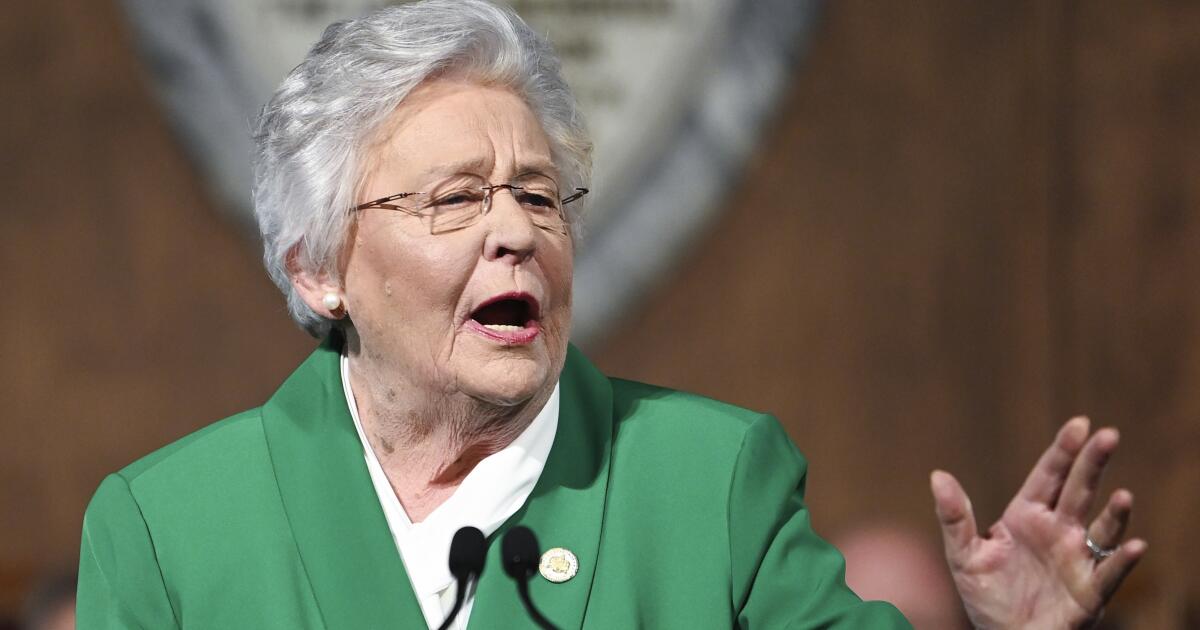
Six Republican governors in the Deep South want their constituents to know that they’re looking out for them.
That’s why they issued a joint statement earlier this year condemning the organizing campaign launched by the United Auto Workers at auto plants across the region.
“As governors, we have a responsibility to our constituents to speak up when we see special interests looking to come into our state and threaten our jobs and the values we live by,” the governors said.
We have one federal labor policy, not 50 different state policies, when it comes to union organizing and collective bargaining.
— Benjamin Sachs, Harvard Law School
Three of the governors have gone further — signing laws denying state economic development subsidies to any employer that voluntarily recognizes a union (that is, without insisting on a formal vote by workers). They’re Kay Ivey of Alabama, Brian Kemp of Georgia and Bill Lee of Tennessee.
These steps raise the question of whether those governors and other political leaders are breaching federal labor law by their actions, which could prompt the government to invalidate unsuccessful union votes and order new elections.
“We have one federal labor policy, not 50 different state policies, when it comes to union organizing and collective bargaining,” says Benjamin Sachs, a professor of labor and industry at Harvard Law School and the author of a recent article examining how the actions of anti-union politicians may have illegally interfered with employees’ right to “a free and untrammeled choice for or against” a union.
Sachs acknowledges that the rules governing federal preemption of state labor laws are murky about the conditions in which federal labor law would prevail, and also the point at which politicians’ actions render union representation elections unfree and unfair — threshold findings that would prompt the National Labor Relations Board to invalidate an election and order a new vote.
That said, “Alabama probably can’t condition its economic incentives on the relinquishment of the federal right” to voluntary recognition of a union, Sachs told me. But he adds that how any such case unfolds would depend on the federal court that heard it.
Political interference in union organizing campaigns in the South isn’t new. In 2014, Sen. Bob Corker of Tennessee and the state’s then-governor, Bill Haslam — both Republicans — threatened Volkswagen with retribution for taking a tolerant view of a UAW organizing campaign at its factory in Chattanooga.
One visiting VW executive referred positively to the labor-management “works councils” common in the company’s home, Germany: “Volkswagen considers its corporate culture of works councils a competitive advantage,” he said.
Corker, a former Chattanooga mayor, voiced an almost certainly specious claim that VW executives had “assured” him that the company would open a new SUV manufacturing line at the plant — if the workers turned the UAW down. A local VW executive denied that.
After losing the election, the UAW filed an unfair labor practices complaint with the NLRB, but ultimately withdrew it. The union lost another election at the plant in 2019, but two months ago it won a third election there, its first victory at an auto plant in the Deep South.
As the UAW stepped up its campaign to unionize other plants in the South, the region’s Republican political leaders pushed back hard. In their joint statement, the governors of Alabama, South Carolina, Georgia, Mississippi, Texas and Tennessee accused the union of unspecified “misinformation and scare tactics.”
Parroting an argument straight out of the corporate anti-union playbook, they said, “The experience in our states is when employees have a direct relationship with their employers, that makes for a more positive working environment. They can advocate for themselves and what is important to them without outside influence.” All six states have automobile plants that could be targeted by the UAW.
One question relevant to whether the governors have crossed over to engaging in unfair labor practices that could invalidate a union election, Sachs says, is whether the NLRB could judge them to be “agents” of the employers. In that case, the board might consider their actions to be tantamount to actions by an employer interfering with the workers’ right to vote in a free and fair election.
“It doesn’t seem too crazy that the board might find the elected officials to be agents of the employers,” Sachs says. In several cases in which an employer didn’t disavow statements by elected officials warning a plant would close or there would be a loss of jobs if its workers voted to unionize, the board found the election to be unfair. In similar cases, the board does not have to find that there was direct contact between the politicians and the employer.
The chief target of the anti-union laws signed by Ivey, Kemp and Lee is the “card check” procedure, one of the two paths to union recognition under federal labor law — the other being a secret ballot. In the card check process, after more than 50% of employees at a workplace sign authorization cards seeking representation by a union, the employers can voluntarily recognize the union, waive any demand for a secret ballot among the workers, and participate in negotiations.
The Alabama, Georgia and Tennessee laws deny state economic incentives to companies that accept card check authorizations without demanding a secret ballot. They also forbid employers to voluntarily provide unions with contact information for employees without the workers’ prior consent. These both are requirements that obviously make unionization drives harder.
Like other Republican state initiatives, the anti-unionization laws were incubated on the far right — specifically the Koch-backed American Legislative Exchange Council, or ALEC — the source of model laws aimed at cutting taxes, hamstringing healthcare reforms, privatizing public education, blocking environmental regulations and other such conservative hobby horses.
The anti-union laws in the three states are reproduced almost verbatim from a model law ALEC dubbed the “Taxpayer Dollars Protect Workers Act.” To put it another way, neither the state legislators nor the governors had to break a sweat to draft and enact these measures — they were spoon-fed the texts.
Southern states are generally quite candid about their efforts to attract manufacturers by guaranteeing them a low-wage rank-and-file workforce and union-free factory floors. On its economic development web page, for example, Oklahoma even brags about how much lower than national averages are the median hourly wages in 12 occupational categories — $17.01 for machinists vs. $19 nationally, $26.17 vs. $30.75 for construction managers, and so on.
Oklahoma doesn’t have any auto plants, but hope springs eternal. Oklahoma and the six states whose governors signed the anti-union letter are all “right-to-work” states, which ban contracts requiring all workers in a unionized workplace to be union members.
In signing Alabama’s measure denying economic incentives to employers that voluntarily negotiate with unions, Ivey declared, “Alabama is not Michigan. … We want to ensure that Alabama values, not Detroit values, continue to define the future of this great state.”
She said a mouthful. The median annual wage in Alabama was $41,350 last year. In Michigan, where unions are popular, it was $46,940. That’s higher than in any of the other states whose governors signed the anti-union letter. (The median wage in Mississippi, whose governor, Tate Reeves, signed the joint statement, was $37,500, the lowest in the nation.)
Whether states can use their economic incentives to ban card check recognition may have to be weighed by the courts. As John Fry of Harvard Law observed in a report earlier this year, states clearly can’t outlaw card check agreements directly — such agreements are legal under federal law, which protects voluntary recognition of a union and the voluntary sharing of employee contact information.
As for wielding economic incentives as a weapon, the Supreme Court has ruled that states can impose labor-related rules mostly when they’re applied to projects in which the states have a direct interest, such as on public works projects.
But the issue is almost certain to come before the courts again; following its negotiating successes with the Big Three automakers last year, the UAW announced a two-year, $40-million campaign to organize nonunion plants “across the country, and particularly in the South.”
The union lost a unionization election last month at Mercedes plants in Alabama, but has now turned its attention to a Hyundai plant in the same state. Politicians across the South are sure to react with ever more draconian laws and policies aimed at forestalling unionization. Will they be smart enough to keep on the right side of the legal line? Possibly, but that’s not the way to bet.



In 2016, Walt Disney Co.’s “Moana” became a box office hit, captivating audiences with catchy earworms from Lin-Manuel Miranda and a spunky young heroine who rejected the label of princess.
Now, just 10 years later, it’s the latest Disney animated film to be given the live-action treatment.
Burbank-based Disney has long reached into its vault in search of animated classics to redo in a live-action format. But a decade is the shortest time between one of the company’s original animated movies and the reimagined film. (2025’s “Lilo & Stitch,” which originally debuted in 2002, is the next closest with a gap of 23 years.)
Why go back to “Moana” so soon? The Polynesian wayfarer is extremely popular.
The 2016 animated film grossed more than $643 million at the global box office, then spawned a 2024 sequel that made more than $1 billion worldwide. The original is the most-watched movie in Disney+ history with more than 1.5 billion hours of viewing.
“Every once in a while in Hollywood, we make a film that is more than a film,” actor Dwayne Johnson, who reprises his role as the demigod Maui, said onstage during the movie’s premiere Tuesday at the Hollywood Bowl after a Polynesian dance performance. “I think you could feel it already tonight, with our culture and with what we have represented. But also not only our Polynesian culture … it’s also a shared culture around the world.”
The latest “Moana,” out this weekend, will join a cadre of family films at the multiplex.
That includes Disney and Pixar’s “Toy Story 5,” which has now racked up more than $774 million worldwide, and Universal Pictures and Illumination’s “Minions & Monsters,” which debuted domestically last week to a softer-than-expected opening of $62 million for the five-day Fourth of July holiday weekend.
The weaker haul for “Minions & Monsters” has led to questions about whether there are too many family films in theaters, which could affect the reception for the latest iteration of “Moana.” But as the last of this summer’s trio of major animated films, the runway could be clear for the film to build steam.
“I don’t think two movies make saturation,” said Andrew Cripps, head of theatrical distribution for Walt Disney Studios. “There’s a huge fanbase for the ‘Moana’ franchise.”
But with two “Moana” movies in the last decade, will audiences flock to another film? Analysts are expecting an opening weekend haul of $75 million, though studio estimates are closer to $60 million to $65 million. The film’s production budget is about $250 million.
“When you look at these massive movies that were just incredible — ‘The Lion King,’ ‘Aladdin,’ ‘Beauty and the Beast’ — they were brought back after years and years,” said David A. Gross, who writes the industry newsletter FranchiseRe. “I think there’s an argument that says absence makes the heart grow fonder with some of these. We’ll see.”
Early reviews of the film have been mixed, and “Moana” has so far notched a 37% rating on aggregator Rotten Tomatoes. The movie is a nearly frame-by-frame re-creation of the original.
Disney’s live-action remakes have largely been box-office boons for the company, with a few exceptions.
In the last 16 years, five films have grossed more than $1 billion globally, including 2017’s “Beauty and the Beast” and 2019’s “The Lion King” and “Aladdin.” (Other live-action spin-offs based on classic animated movies, such as 2024’s “Mufasa: The Lion King” and 2014’s “Maleficent,” also had solid performances.)
“It goes back to the original [intellectual property] of these movies,” Cripps said of the importance of live-action films for Disney’s slate. “People grow up with it, they become fans of it, they live with it. When you’ve got IP that resonates so well literally around the world with fans, I just think it’s a clever extension.”
There have been some notable misfires, including last year’s “Snow White,” which cratered at the box office amid a myriad of controversies, including racist backlash to the casting of Rachel Zegler, who is of Colombian descent, as the titular princess, its depiction of little people and its lead actors’ views on the Israel-Hamas war.
In general, live-action retellings have also typically performed well overseas — a marketplace that isn’t always reliable these days.
Across 13 recent live-action films from Disney and other studios, all made more than 60% of their global box office revenue in international markets, Gross said.
By comparison, films across all genres typically bring in about half of their revenue overseas, he said.
“When these movies connect,” Gross said, “they work everywhere.”
Business
Meta discontinues Instagram feature on new AI image generation tool after Hollywood backlash

A new tool that let people take publicly posted Instagram photos and use AI to generate new images from them drew such a big backlash in Hollywood that Meta has discontinued one of the features.
Instagram’s parent company, Meta, on Tuesday rolled out the new AI tool, called Muse Image, which makes it easy to “turn your ideas into high-quality visuals you can download and share anywhere.”
In a promotional video, Meta showed examples like adding a friend into a band photo.
But the tool came under fire from talent agencies, managers and union officials. They noted that many Instagram accounts were opted in by default, allowing users to manipulate the image and likeness of celebrities without their consent.
“I just think it’s wrong again to expect people to opt themselves out of something that literally has been proven to be able to create harm,” said Kyle Hjelmeseth, chief executive of Los Angeles-based influencer talent management firm G&B.
By Friday, Meta said a feature on Muse Image that helps pull photos from public Instagram accounts was no longer available.
“Earlier this week, we announced that one way for people to generate images in Meta AI is by @-mentioning public Instagram accounts that they want to reference,” Meta said in a blog post. “Our intent was to provide a useful creative tool and to give people control over whether their public content could be referenced in this way. We’ve heard the feedback that this feature missed the mark, so it’s no longer available.”
Creative Artists Agency, which raised concerns to Meta on behalf of its clients, commended the tech company for its swift decision.
“Putting individual rights and consent at the forefront is essential to building responsible technology,” the Century City-based talent agency said in a statement. “We look forward to ongoing conversations to ensure creators stay protected as technology evolves.”
Hollywood has long been wary of AI, after a string of deepfakes — videos or images depicting celebrities doing or saying things they never authorized. Jamie Lee Curtis and others have appeared in ads for products they never endorsed. Last year, OpenAI’s Sora 2 video tool drew outrage in Hollywood after users conjured up dead celebrities without their estates’ consent. OpenAI later said it would give rights holders more granular controls.
After Meta rolled out its new tool, there was immediate backlash from Hollywood.
“Anything other than a clear and conspicuous OPT-IN for these types of uses of Instagram users’ images is unacceptable, and an utter miscalculation of public sentiment regarding the obvious dangers and harms inherent in such use,” performers union SAG-AFTRA said in a statement.
United Talent Agency was also critical of Meta, saying it demands opt-in for the use of likeness, image and intellectual property of its clients on any platform.
“The use of such property without OPT-IN consent, credit and compensation is exploitation, not innovation,” the Beverly Hills-based talent agency said.
Meta’s initial response on Wednesday was that users can choose to opt out of having their photos used by Muse Image by changing their settings.
“We built Muse Image with strong controls and safety guardrails from day one,” Meta said in a statement. “Private accounts and those belonging to users under 18 are automatically excluded and adult users with public accounts can opt out with just a couple clicks. We will take action against any content that violates our Community Standards.”
Two days later, Meta removed a key feature from Muse Image, saying it received feedback that it “missed the mark.”
The launch fits a familiar Silicon Valley pattern — ship products first, ask for forgiveness later.
“They leverage their scale to make it easy to use the tools as well as to scale out the content that is available,” said Mickey Maher, chief business officer at Vermillio, which tracks people’s digital likenesses and intellectual property. “It’s not unique to this Meta product.”
Others said opt-out should be the default.
“This dark pattern of AI overreach, where essentially it’s a free-for-all when it comes to your content, information, is something that nobody actually wants,” said Lori Fena, former chair and executive director of the Electronic Frontier Foundation and co-founder of New York-based Personal Digital Spaces. “What we need in this new AI ecosystem is the ability to create trust and to have some sort of understanding and authenticity, and this does exactly the opposite.”

Television City, one of the most famous studios in the entertainment industry where generations of TV shows have been created, is expected to hit the market again as its owner grapples with debt.
It’s the latest sign of distress in Hollywood as the film and TV industry struggles from a sharp falloff in production activity across Southern California.
Television City’s owner, Hackman Capital Partners, is already in the process of selling the historic Radford Studio Center, which gave L.A.’s Studio City neighborhood its name. Hackman defaulted on a $1.1-billion mortgage in January and investment bank Goldman Sachs took over the property, which is now escrow for a sale to Netflix.
The sprawling Television City property is one of the most desirable locations in Los Angeles, sharing fences with the Original Farmers Market and the luxury Grove outdoor shopping center, each of which attracts millions of visitors every year.
If the studio at Beverly Boulevard and Fairfax Avenue where “American Idol,” “All in the Family” and scores of other shows were filmed becomes available as expected, the owners of the Grove and the Farmers Market would be among the likely contenders for the property for potential expansion of their businesses, said sources familiar with the matter who were not authorized to comment.
Grove owner Rick Caruso was among the bidders for Television City, formerly known as CBS Television City, last time it was on the market and could emerge as a possible bidder.
The highest bid when broadcaster CBS sold the studio in 2019 came from Hackman Capital Partners, an international movie studio operator and commercial property landlord that paid $750 million for the 25-acre site that is near Hollywood, Beverly Hills and and the Sunset Strip.
Hackman Capital’s plan to recoup its investment included continuing to operate Television City as a studio for rent while adding new revenue-generating features.
Last year the city approved Hackman Capital’s $1-billion plan to add 980,000 square feet of offices, sound stages, production facilities and retail space.
The original studio designed by famed Los Angeles architect William Pereira erected in 1952 has city landmark protections, but newer structures on the property do not and there are acres of surface parking that could be converted to other uses.
Both Caruso and Farmers Market owners A.F. Gilmore have sued to limit the planned expansion of the studio, calling it a “massively scaled” development that “would overwhelm, disrupt, and forever transform the community.”
The debate over the development has played out amid a serious downturn in the region’s entertainment industry, with studios shifting film and television production to Georgia, New Mexico and other out-of-state locations.
L.A.’s entertainment industry also suffered a series of blows including the COVID-19 shutdown, strikes by writers and directors in 2023 and cutbacks at studios that reduced demand for sound stages.
A group of Hackman Capital’s lenders led by Deutsche Bank filed a notice of default last month, saying they’re owed more than $357 million. Hackman Capital is still trying to renegotiate its debt.
“The studio market is evolving, and the financing environment for studio assets remains complex,” Chief Executive Michael Hackman said in a statement. “We are engaged in active discussions with our lending partners and are carefully evaluating all of the alternatives.”
A person familiar with the process but not authorized to speak about it publicly said Hackman Capital will be hard-pressed to pay its debt in light of challenges facing the industry. The notice of default is “the baby step to put Television City in play” for new buyers, the source said, “and it is in play.”
Already in play is Manhattan Beach Studios, another Hackman Capital property encumbered by a $240-million loan from Deutsche Bank that the lender is in the process of selling. A buyer could foreclose on the property and potentially change its use to advanced manufacturing such as aerospace or defense, which is in high demand in Southern California.
Brokerage Cushman & Wakefield, which is managing the sale, emphasized in marketing materials that the 22-acre site has “significant available power capacity” and “offers flexible uses” on “some of the most irreplaceable underlying land in the South Bay.”
-

 News18 minutes ago
Mexico-US relations are already strained, but experts say they’re about to get worse | CNN
-

 Los Angeles, Ca2 hours ago
Rosemead High School student identified as teen stabbed to death in El Monte
-

 Detroit, MI2 hours ago
Three dead in Metro Detroit mall shootings in eight days: What we know
-
San Francisco, CA2 hours ago
I’m a writer who left LA for an AI startup in San Francisco. It was like stepping into a whole new world.
-

 Dallas, TX2 hours ago
Dallas weather: Widespread thunderstorms bring flash flood risks and brief heat relief
-

 Miami, FL2 hours ago
Why I’m Not Worried About Giannis in Miami
-

 Boston, MA2 hours ago
Gallery: Tall ships display their splendor at Sail Boston
-

 Seattle, WA2 hours ago
Seattle Weather: Cooler Sunday to close out weekend

