Entertainment
'Inside Out 2' calms box office anxiety with blockbuster opening

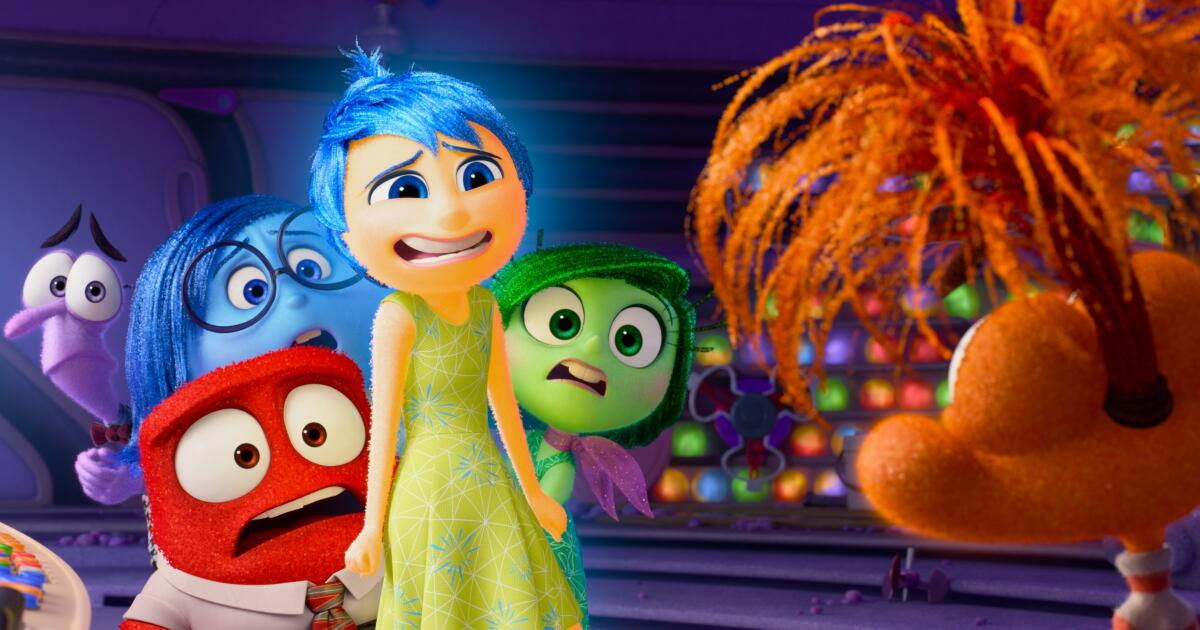
Hollywood’s summer movie anxieties gave way to joy this weekend with the massive debut of Disney and Pixar’s “Inside Out 2.” The animated sequel earned $155 million in ticket sales from 4,440 theaters in the U.S. and Canada, according to studio estimates Sunday.
It’s the second-highest opening weekend in Pixar’s nearly 29 years of making films and the second-biggest animated opening ever (behind only the $182.7 million launch of “Incredibles 2” in 2018). It’s also the biggest of 2024, which had not had any films debut over $100 million. With an estimated $140 million from international showings, “Inside Out 2” had a staggering, and record-breaking, $295 million global debut.
The success is significant for Pixar, marking a much-needed return to form for a studio that has had a string of underwhelming launches including “Elemental,” which did eventually become a success, and “ Lightyear,” which didn’t. It’s also important for the greater Hollywood ecosystem and the health of theatrical exhibition, which had been running at a 26% deficit before this weekend. “Inside Out 2” marks the biggest opening since “Barbie” launched to $162 million last July.
“This is a monumental weekend for movie theaters,” said Paul Dergarabedian, the senior media analyst for Comscore.
Kelsey Mann directed “Inside Out 2,” which picks up with Riley as she turns 13. That means the arrival of new emotions like Anxiety (Maya Hawke), Ennui (Adèle Exarchopoulos), Envy ( Ayo Edebiri ) and Embarrassment (Paul Walter Hauser) to the mix. Amy Poehler once again lent her voice to Joy in a cast that includes Tony Hale, Lewis Black and Phyllis Smith as Fear, Anger and Sadness, respectively. It got glowing reviews from both critics (92% on Rotten Tomatoes) and audiences who gave it an A CinemaScore, suggesting that this won’t be a first-weekend wonder either. With kids out of school and an open market until “Despicable Me 4” enters the ring over the Fourth of July holiday weekend, “Inside Out 2” is just getting started.
The film is estimated to have cost $200 million to produce, which does not account for the millions spent on marketing. Going into the weekend, it was tracking for a debut in the $90 million range, which would have been in line with “Inside Out’s” first weekend in June 2019. Even that would have been considered a terrific achievement, and enough to claim the biggest opening of the year — finally unseating March releases like “ Dune: Part Two ” and “ Godzilla x Kong.”
It got off to a huge start with $13 million from Thursday preview showings, which started at 3 p.m. As the only major release of the weekend, its theatrical footprint was equally impressive — playing on 400 IMAX screens, more than 900 “premium large format” screens and over 2,500 3D screens.
“The family audience still loves going to the movies,” Dergarabedian said. “As an outside of the home experience, it’s still a relative bargain.”
This re-commitment to theatrical comes after Disney sent several Pixar films straight to its streaming service, Disney+, during the pandemic including “Soul,” “Luca” and “Turning Red.” Last month, the New York Times reported that Pixar had decided to return its focus to feature films (and not producing shows for Disney+) and that it had laid off 14% of its workforce (about 175 employees).
“As important as this weekend is for the industry at large, for Pixar this is huge. They’ve been trying to get their groove back since the pandemic,” Dergarabedian said. “Pixar had for decades one of the most impressive box office track records ever. They’ve really come back big.”
Second place went to Sony’s “Bad Boys: Ride or Die,” now in its second weekend with $33 million, down only 42% from its opening. In just 12 days, it’s already earned more than $112 million domestically and $214 million globally. As of Friday, the four-film franchise had crossed the $1 billion mark.
“Bad Boys’” success last weekend was the start of a higher-earning turnaround for the lagging summer movie season. For Hollywood, the summer season, which runs from the first weekend in May through Labor Day, usually represents about 40% of the yearly box office. The deficit is still significant, with ticket sales down 28% for the summer and 24% for the year (and this is still before “Barbenheimer”), but it’s progress in a more promising direction nonetheless.
“We’re not going to get there overnight,” Dergarabedian said. “But it’s good news for theaters. And we have some big movies on the way.”
Bahr writes for the Associated Press.


Hello, dear reader! Do you like what you read here at Omnivorous? Do you like reading fun but insightful takes on all things pop culture? Do you like supporting indie writers? If so, then please consider becoming a subscriber and get the newsletter delivered straight to your inbox. There are a number of paid options, but you can also sign up for free! Every little bit helps. Thanks for reading and now, on with the show!
Warning: Full spoilers for the film follow.
I think it’s safe to say that horror is having a bit of a moment. Of course, horror is one of those genres that can always be counted on to be financially profitable, both because it often requires less money and because it’s so effective at tapping into the anxieties, fears, and desires of a particular cultural moment. I’ve loved almost every horror movie I’ve seen this year but, even in a year known for its strong offerings, Adrian Chiarella’s Leviticus is something special. I knew going in that it was going to be one of those films that got into my mind and under my skin. I’ve been on a long and winding journey back to Christianity over the past year or so, and so the issue of faith and queerness has been much on my mind. This film crawled into my mind and my soul, latched its hooks in me, and hasn’t let me go since.
The film begins with an amorous encounter between teens Naim (Joe Bird) and Ryan (Stacy Clausen), and at first it seems the two of them have found a connection they both clearly need. However, when Naim discovers Ryan kissing their pastor’s son, Hunter (Jeremy Blewitt) and tells the pastor what’s happened, things take a sinister turn. Ryan and Hunter undergo a terrifying encounter with a healer, who curses them to be haunted, tormented and, in Hunter’s case, killed by the thing they desire most. Unfortunately for Naim, his mother Arlena (Mia Wasikowska), soon hands him over to the healer, and it’s not long before he’s set on a terrifying course with his beloved Ryan.
Both Joe Bird and Stacy Clausen are phenomenal in this film, with each bringing something unique to the table. Bird perfectly captures Naim’s adolescent angst, as well as his sense of alienation and yearning for something more, some human connection that neither his mother nor their devout religious community can provide. He finds it unexpectedly in Clausen’s Ryan, and the two actors have palpable chemistry. And yet, all the while, Naim is also haunted by his resentment of Ryan and the fact that his own actions were what brought about their harrowing.
For his part, Clausen captures the nuances of a very complicated figure. Ryan is a rougher type than Naim, or at least it seems at first, but as the film goes on he shows a deep well of sensitivity and kindness. Like Naim, he yearns for queer connection. Clausen also superbly captures the menace and danger of Ryan’s doppelganger, even his silent movements conveying a sense of murderous menace. It’s not every actor who could play both characters with equal depth, but Clausen is more than up to the task, his wounded angelic beauty lending even his more terrifying moments an erotic charge.
Though there are moments of gore–including a disturbing moment in which we see Hunter’s head in a field–for the most part Leviticus relies on slowly spreading dread and suspense as the spectral Ryan torments and pursues Naim relentlessly any time he’s alone. Jed Kurzel’s score is also haunting and potent, with an ever-present thrumming that settles into your bones. Combined with the frequent shots of the heavily industrialized area in which these boys live–as well as the eerily intense church scenes–this score keeps us on the edge of our seats, waiting to see what new horror is going to unfold.
Indeed, there’s something particularly deeply unsettling about the premise of being tormented and, in Hunter’s case, literally killed by a demon that takes the form of your innermost desire. From a certain perverse Christian point of view this is exactly what queer desire itself is, so it makes sense that a “healer” like the one we see in this film–or, for that matter, Hunter’s family–would resort to such a desperate attempt to “save” these boys from themselves. The whole ordeal is made all the more upsetting because the being isn’t content to just torment you: as both Hunter’s death and that of the young woman who dies at the beginning of the film reveal, it wants you to suffer. Naim’s own encounter with the demon late in the film is especially disturbing, particularly once the creature tries to literally tear his throat out from the inside.
While the portions with the demon are obviously harrowing and heartbreaking, for me the most traumatic and insidious moment is the one in which Arlene admits she knew from the get-go that the “exorcism” would have terrible and lasting consequences, that Naim would have to live the rest of his life in fear. It’s a moment that’s stunning–devastating, really–for both Naim and those of us in the audience–because it reveals the extent to which Arlene’s own terror of the unknown has poisoned her relationship with her son. It’s also one of those moments that cuts to the bone precisely because it matches so neatly with so many lived experience; there are a distressing number of “Christian” parents who would rather see their children destroyed, both emotionally and physically, rather than have them be their true, God-given selves.
And yet, despite the terror and the horror and the betrayals, there are moments of genuine beauty and affection and erotic connection. The scene in which Ryan admits he wouldn’t want to be haunted by anyone other than Naim is genuinely affecting, and their shared erotic encounter on a bus is also beautifully staged. Somehow, these two young men manage to find an island of calm and love amid all the fear and dread and violence. To be sure, though, these moments are always tinged with terror. While I was watching the scene on the bus I still felt nervous, terrified lest they be discovered and unsettled by the fact that it was precisely this desire that was poised to seal both of their dooms. The film thus powerfully evokes the sinister effects of internalized homophobia, the way that a noxious religious ideology can crawl into your brain and make you fear yourself, your desires, your love, and the person who you feel the greatest connection to. In some terrible ways, the film suggests that the most damaging aspect of this haunting isn’t the violence itself; it’s the sundering of the self.
It would’ve been easy–and, for some no doubt, very satisfying–for the film to conclude with Naim and Ryan defeating their demonic tormentor and riding off into the sunset to have a happy gay life in the big city. However, Leviticus is a far cannier and subtler film than that, and it is smart enough to realize that such an ending would feel cheap and unearned and, more to the point, that it would rob the film of its essential power. By leaving the ending tinged with melancholy and ambiguity, the film suggests that our heroes will be haunted by their ordeal and that there is no easy happy ending in a world in which such homophobia is still very real and very present. (As a brief side note, it’s very satisfying to see Arlene frantically searching for Naim after he abandons her. One can but hope that the rest of her life is spent in misery as she reckons with her loneliness and her complicity in her son’s torment).
However, there is still hope in the conclusion, and it’s fitting that the last we see of Naim and Ryan is the two of them with their heads together, sharing a set of headphones. Queer life is difficult, sometimes, and there is always another hill to climb, another battle to be won. We’re led to hope, though, that these two troubled young men will manage to find their own form of peace and love and happiness, both with one another and with the queer community they’ll one day find.
Netflix on Monday announced more content for kids is coming to the streamer, with a new baking and crafting competition series inspired by popular animated show “Gabby’s Dollhouse.”
Kids programming is a key part of the Netflix‘s ecosystem, accounting for nearly 22% of all viewing on the platform last year, the company said. “Gabby’s Dollhouse,” an animated series about a young girl who goes on adventures in her dollhouse, is among Netflix’s most popular shows, ranking fourth in the second half of last year with about 108 million views.
The new competition show might benefit from its existing fan base, as its challenges are inspired by “Gabby’s Dollhouse” and features young baker duos.
“Since Gabby’s Dollhouse first premiered on Netflix in 2021, a world of creativity and imagination has exploded for our young audience and it only continues to grow,” said co-creators Jennifer Twomey and Traci Paige Johnson in a statement.
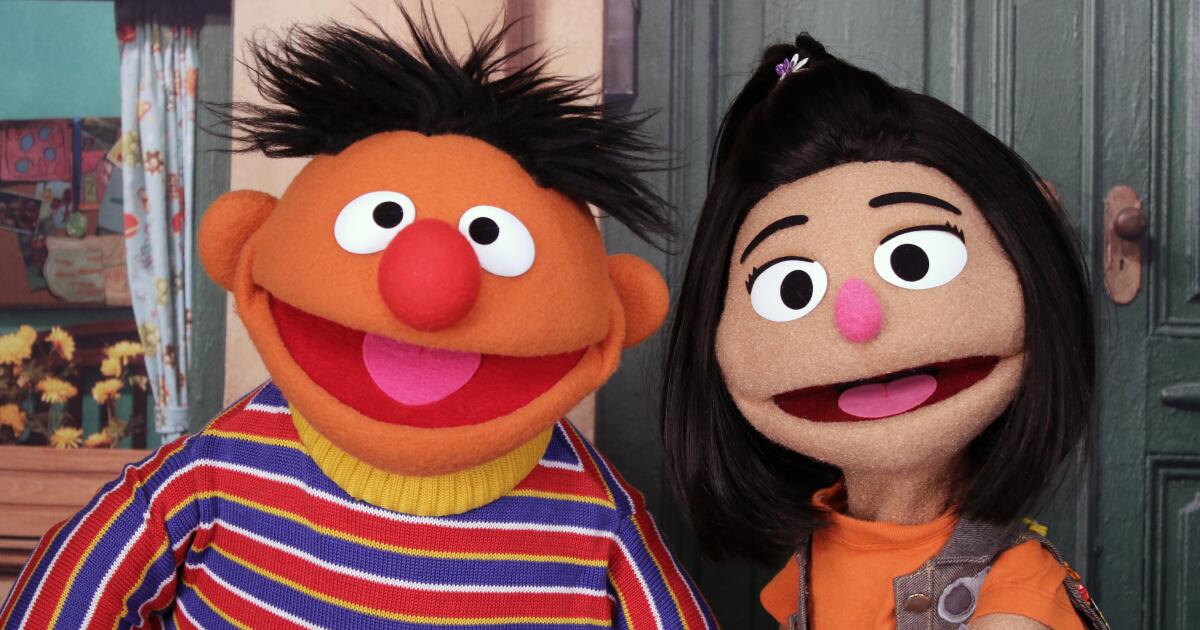
The program is part of a larger wave of kids programming coming to Netflix. Last year, Netflix struck a deal for the worldwide premiere rights to Sesame Street, after Warner Bros. Discovery said it would no longer fund production on new episodes. On Monday, Netflix said the Sesame Street collection with more than 100 episodes will be on the streaming service and next month other library programs including “Sesame Street Classics” and “My Sesame Street Friends: My Abby Season 2” will be on Netflix.
Some analysts say kids programming can be attractive to streaming services because if shows become popular, it can help retain customers. It may be more difficult for parents to say no to young children when canceling a subscription.
Other upcoming kids shows on Netflix include the third season of preschool comedy “Dr. Seuss’s Red Fish, Blue Fish” and the second season of “Sheriff Labrador,” which helps children learn safety tips, which both come out in August.
Netflix also said its podcast “Bedtime Stories with Netflix Jr.” which tells stories from worlds including “Gabby’s Dollhouse” and “Dr. Seuss” will be available for streaming on Netflix for the first time on Monday. Netflix Playground, the company’s game app, will also add more games including “My Very Hungry Caterpillar” later this year.
Visitors to Netflix House locations such as Dallas will also get to meet some of their favorite characters from kids shows, including JJ from CoComelon Lane and Elmo from Sesame Street.

The King of Horror has given his stamp of approval to Obsession, this year’s breakout hit horror movie.
Stephen King, the prolific author of best-selling horror novels including It, Carrie and The Shining, applauded the May release Tuesday in a two-line review on Threads.
“I gave OBSESSION a B+ in my movie book, but I keep thinking about it,” King, 78, wrote of YouTuber Curry Barker’s directorial feature film debut. “That weird mixture of humor and horror.”
Obsession — which follows the dangerous consequences of a hopeless romantic’s (Michael Johnston) naive wish for his crush (Inde Navarrette) to love him back — has been a massive box-office success, grossing over $297 milion worldwide off a micro-budget of approximately $750,000 to $1 million.
It has earned major plaudits from critics and a 94 percent score on the popular review aggregator Rotten Tomatoes.

In her four-star review, The Independent’s Clarrisse Loughrey labeled Obsession “one of the creepiest horror movies of 2026.”
The new sensation marks 26-year-old Barker’s first feature film. He previously directed the 2024 found-footage, prank-themed horror Milk & Serial, which he shot for $800 and uploaded directly to YouTube.
Obsession’s theatrical release coincided with that of fellow YouTuber Cane Parson’s directorial debut, Backrooms, a horror film adapted from his popular YouTube series about liminal spaces. The movie has similarly taken the box office by storm.
The success of both projects signals a fresh direction for the genre, leading Loughrey to declare that “the future of horror is on YouTube.”

“Gone is any feeling of Gothic tenderness, of the misunderstood going bump in the night. Here, the generation exposed to what feels like only the very worst of the world has responded in kind, with horror in which punishment is swift, nasty, and arguably well deserved,” she added. “Obsession is delicately handled work, unafraid to find pockets of humor.”
Meanwhile, King, who often shares his opinion about TV and film online, recently directed his followers’ attention to Apple TV+’s new dark comedy, Maximum Pleasure Guaranteed.
Starring Tatiana Maslany as Paula, a newly divorced mom who becomes convinced she witnessed a crime, the show centers on her spiral into a rabbit hole of blackmail, murder and youth soccer.
Comparing it to the streamer’s Matthew Rhys-led comedy horror series Widow’s Bay, King argued that it was “even better.”
“It’s like Hitchcock came back to do it one more time,” The Long Walk author said on X. “And Tatiana Maslany is so good. The play of emotions on her face is pretty incredible. She goes from comic to terror in an instant.”
Last September, he also revealed his list of 10 favorite films of all time, which consisted of Sorcerer (1977), Godfather 2 (1974), The Getaway (1972), Groundhog Day (1993), Casablanca (1942), The Treasure of the Sierra Madre (1948), Jaws (1975), Mean Streets (1973), Close Encounters of the Third Kind (1977) and Double Indemnity (1944).
-
 Politics2 minutes ago
Facing FCC pressure, ABC launches campaign to support ‘The View’ and its TV stations
-
 Sports10 minutes ago
Dodgers defeat Twins, but lose Kyle Tucker and catcher Dalton Rushing
-

 World20 minutes ago
Belgium issues visas to Taliban delegation for EU migration talks
-

 News50 minutes ago
Trump says proof of his allegations that vandals cut Reflecting Pool paint will be provided in court
-

 New York2 hours ago
Video: Historic Brooklyn Church Destroyed in Fire
-

 Los Angeles, Ca2 hours ago
2 killed in high-speed crash on Mulholland Highway
-

 Detroit, MI3 hours ago
Man armed with gun shot by police in downtown Detroit ahead of fireworks show, police say
-

 San Francisco, CA3 hours ago
San Francisco home with a history of squatters hits the market for $1.3 million

