Entertainment
Appreciation: For 'Alienist' author Caleb Carr, rescuing a cat meant rescuing himself

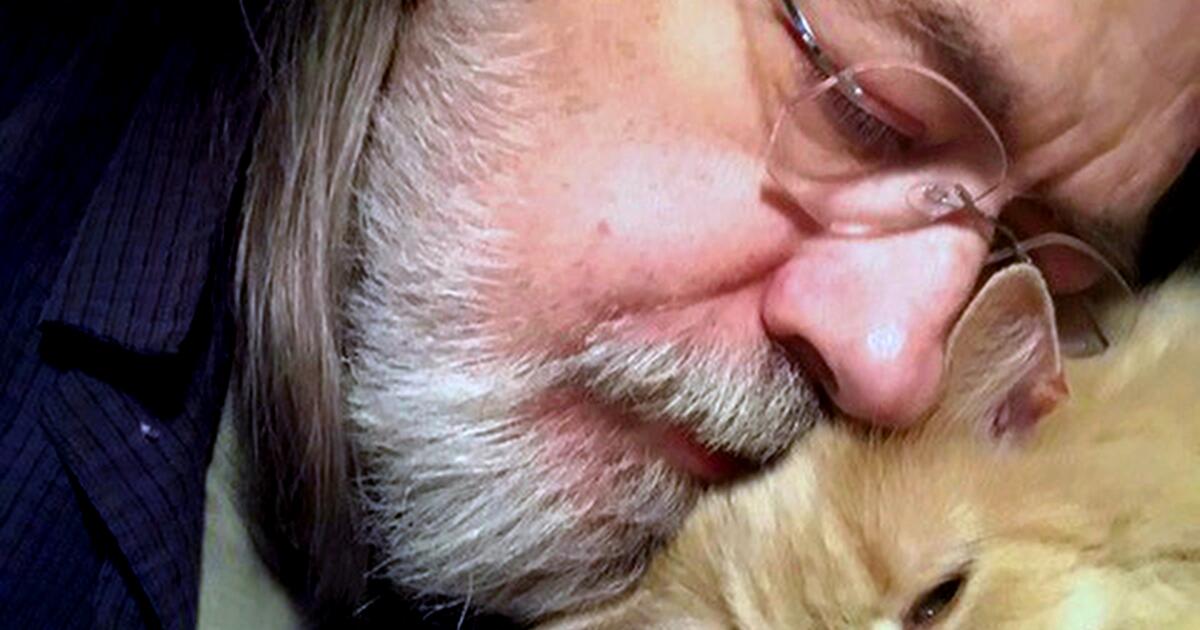
Caleb Carr, the novelist and military historian who died of cancer Thursday at age 68, was best known for exploring the darker angels of human nature. His breakout novel, “The Alienist” (1994), helped pioneer the historical thriller as we know it, telling the grisly tale of a child psychiatrist tracking a killer of young male prostitutes in 1890s New York. His other books include a sequel, “The Angel of Darkness” (1997), and a historical study of terrorism and warfare, “Lessons of Terror” (2002).
But when I had a late-night, hourlong conversation with Carr in late January, we mostly talked about our mutual love of cats.
Carr, his illness already far along, was eagerly awaiting the publication of what he correctly figured would be his final book, “My Beloved Monster.” It’s the story of his bond with Masha, the Siberian forest cat with whom he shared his fortress of a home in upstate New York, near a ridge called Misery Mountain. Contracted to do a third “Alienist” book, Carr instead called an audible, choosing to write his first memoir. Dipping briefly into his tortured childhood — he was regularly beaten by his father, the journalist and Beat poet muse Lucien Carr, and grew up in hardscrabble bohemian conditions on Manhattan’s Lower East Side — the book’s primary subject is how Carr found solace in the unconditional love of animals, and with his grief for Masha, who died in April 2022.
Staring down death, talking about grief, he was casually, effortlessly, macabrely funny that night. He spoke of how he argued with his publisher, Little, Brown, to forgo the standard “Author of ‘The Alienist’” tag on the front cover, which features a photo of his blond, fluffy rescue cat: “I thought, ’Guys, they’re going to think I wrote a book about murdering cats or some horrible thing.’” He discussed the challenges of getting cat lovers to read a Caleb Carr book: “We may have to convince them. These may not be people who spend their time reading grim stories about serial killers 130 years ago.”
And we talked a lot about what animals can teach us, and how they can even provide a kind of love that many of us didn’t know growing up. Even in childhood, when his father was knocking him down flights of stairs, Carr had pets to comfort him. “It’s amazing to think about it now, but there were cats, and other animals, that were trying to make me feel better,” he said. “The idea of that was so at odds with everything I was experiencing.”
I didn’t realize how much I had in common with the guy who wrote “The Alienist,” a book I admire for its vivid, doggedly researched detail but whose author I hadn’t studied. We were both basketball freaks; when we spoke, Carr’s beloved Knicks were on a roll (“They’re doing scarily well,” he said). We both survived childhoods fraught with danger, though mine wasn’t as dramatic or brutal as Carr’s. And we have both found comfort in the companionship of cats, known for self-sufficiency but also, quiet as it’s kept, quite loving and dependable when the chips are down. If you have a cat, and you’re not feeling well, that cat won’t stray far.
As we talked, my attention-hogging, gray-and-white tuxedo cat, Mr. Kitty, strolled in front of my laptop camera. “He’s cool-looking!” Carr enthused, the energy in his voice rising. I explained that he was a good cat but could also get pretty aggressive with his teeth and claws. He likes human flesh. “Well, they’re hunters,” Carr replied. “They’re wildlings. Sitting inside, being all the things that they’re pictured as being in Victorian literature, is not their nature.” Over the years I have always tried not to get mad at my cats for being cats — knocking things over, going on the attack when I least expect it. Carr’s words have actually helped me succeed in this endeavor.
“My Beloved Monster” by Caleb Carr
(Little, Brown)
Carr, too, could have been a wildling. “I could have been one of those dead-eyed drone troublemakers that comes out of an abusive household very easily, if it hadn’t been for cats,” he told me. His childhood home life was chaos, but he and his siblings always had pets. “All the animals we had really did teach us enough about love that we understood it outside of any human definition, although this was never something I talked about with anybody,” he said.
Carr’s longtime agent, Suzanne Gluck, was also a friend since they were both in high school at Friends Seminary in Manhattan. The irony of a future military historian attending a Quaker school is not lost on Gluck. “He was such a square peg in a round hole,” Gluck said in an interview the day after Carr’s death. “The administration really didn’t know what to make of him.”
He didn’t talk much about his home life then. And he was no misanthrope. “He was this pied piper,” Gluck said. “He was this very vibrant, interesting, thoughtful, charismatic guy with a lot of friends. He wasn’t someone sitting in the corner, troubled and wanting to be alone.”
Gluck recalls her response when Carr told her he was writing about Masha instead of serial killers: “This might be where the music stops.” The assignment, after all, called for more “Alienist.” But Bruce Nichols, then the publisher at Little, Brown and Carr’s editor, loved the story of Masha. (As the husband of a veterinary behaviorist , his might have been the perfect pair of eyes for the project.)
“When I read it, I just stopped thinking about ‘The Alienist,’” Nichols said. “I stopped thinking about fiction and just thought about all the great books that had been written as memoirs by dog and cat owners”— books like “Merle’s Door,” Ted Kerasote’s account of lessons learned from his Labrador mix. Carr, and Masha, got the go-ahead.
Readers should be thankful for that. Carr wasn’t in need of redeeming in his final years, but “My Beloved Monster” is nonetheless an act of redemption. It gives specific life, and teeth and claws, to that old cliché about how we don’t rescue animals; they rescue us.


In Sender, writer-director Russell Goldman’s high-anxiety debut, the filmmaker expands on his 2022 short Return to Sender, in which Allison Tolman starred as a woman who receives packages she didn’t order. That may not sound like a premise that would result in a paranoid, darkly comedic thriller, much less a feature. But in extending his story from 18 minutes to just over 90, Goldman follows a maddening scenario involving an online retailer called Smirk, a fictionalized Amazon counterpart. More significantly, he captures the frenzied mindset of his protagonist, who grapples with staying sober and several other major life changes—all compounded by a layer of justifiable paranoia brought on by the endless packages. Goldman’s tweaky style and elusive scripting create a peculiar, out-of-whack presentation that destabilizes the viewer, firmly placing us in his main character’s perspective. However, by the end, the journey through this cine-manic headspace doesn’t add up to much, and the potential character study at the center feels somewhat lost in the mechanics of the conspiracy.
Britt Lower (AppleTV’s Severance) stars as Julia, who has just lost her job and moved into a rental home to get her life on track. She is backed financially by her overbearing sister Tatiana (Anna Baryshnikov), who occasionally comes nosing around to verify that Julia doesn’t backslide. And she doesn’t. Julia attends regular Alcoholics Anonymous meetings, where she meets the steely Whitney (Rhea Seehorn), who isn’t interested in being her sponsor. But at home, Julia receives a Smirk package with her brand of lipstick. The problem? She didn’t order it. She calls customer service, and the representative doesn’t help much before telling her, “Be sure to stay alert and aware.” Wait, what? Sender is loaded with nagging, unplaceable details like this. They’re often amusing, intriguing, and exasperating in the same moment. But these pieces don’t complete a whole picture, at least not a narratively satisfying one.
The Smirk packages, delivered by the outwardly helpful, nice-guy driver Charlie (David Dastmalchian), contain a random assortment of objects, from drum kits to protein powder. The squirrelly Julia, already coming apart at the seams from her recent drama, doesn’t know what to make of it. She’s convinced there’s some plot against her, perhaps by someone at Smirk. To what end, she doesn’t know. But Goldman gives us a glimpse of the long-term consequences of her ordeal in the prologue, which features Jamie Lee Curtis (also a producer) as Lisa, a woman in circumstances similar to Julia’s. Lisa’s response to receiving a box of soil with a broken shin pad (with “Can’t Can’t Can” scrawled on it) entails an attempt to suffocate herself with the bubble wrap, only to do far worse with a sharp edge of the shin pad. To show Lisa’s fate, Goldman’s imagery becomes twisted and surreal but also cryptic.
Sender’s disorienting mood is matched by a skewed formal presentation. Cinematographer Gemma Doll-Grossman’s wide-angle lenses and arch angles might feel at home in a Ken Russell or Terry Gilliam feature such as The Devils (1971) or 12 Monkeys (1996). Julia’s half-remembered drinking binges, accented by blurry close-ups, suggest she may have slept with any number of coworkers. She can’t remember, and it embarrasses her. Her rental is dressed in simple if shabby décor, which gives way to Julia’s erratic collage-like overhaul. Melisa Myers’ stuffed production design makes the most of heightened colors and banal, cluttered rooms that lend a normality to the bizarre, ever more disturbing predicament. Nathan Ruyle’s erratic music delivers what must be described as a soundscape rather than a traditional score, with collusive sound effects and tones driving our certainty that Julia is onto something. Along with Marco Rosas’ discordant editing, Goldman’s technical approach effectively reflects Julia’s fragmented, sleep-deprived mind. But his work as a writer hasn’t done enough to justify this level of technique.
After Julia makes a revelatory discovery that small cameras have been embedded in the products from those mysterious packages, the eventual explanation about what has been happening and why strains logic and underwhelms. It also raises even more unanswered questions. Although well-made and acted—Lower and Seehorn should be on track to movie stardom—Goldman’s script could have used another draft to better work through what unfolds. Sender doesn’t give us enough of its characters’ inner lives beyond the situation at hand, so Julia, Charlie, Tatiana, and Whitney feel like devices in a scenario rather than well-drawn human beings. Even so, Goldman fills his film with deeply broken people who try to gain control of their lives by controlling others, exposing and preying on their weaknesses. Despite the material’s potential resonance, Goldman’s style is overpowering. Still, his kernel of an idea and the way he explores it demonstrate his clear skill, and for much of Sender, its sheer oddball energy earns admiration.

“Lethal Weapon” star Danny Glover has revealed he has been living with Alzheimer’s disease for years.
In an interview with NBC’s Lester Holt that aired on the “Today” show on Wednesday, the 79-year-old actor and activist opened up about living with the disease. According to People, he received his diagnosis in 2023, which was not long after he was awarded an honorary Oscar in 2022.
“I could live with it, in a sense,” Glover says of his condition, which has been affecting his movement, speech and memory. “I’m sure as it advances, things are going to be different and changing.”
A neurodegenerative disease, Alzheimer’s is a type of dementia that affects memory, thinking and behavior and worsens over time, according to the Alzheimer’s Assn. Holt reports that more than 7 million Americans over 65 are living with Alzheimer’s, with Black men suffering at a rate double the national average.
Glover and his family say the Hollywood icon is sharing his story now to “have ownership of his life” and to help remove the stigma around the disease.
“They’ve got my back,” Glover says of his family’s support.
Besides his portrayal of L.A. police Det. Roger Murtaugh in the “Lethal Weapon” film series, Glover is known for roles in movies including “Places in the Heart” (1984), “The Color Purple” (1985), “To Sleep With Anger” (1990), “Angels in the Outfield” (1994), “Dreamgirls” (2006) and “The Last Black Man in San Francisco” (2019). He’s also been a vocal advocate for social justice and humanitarian causes both in the U.S. and abroad.
He was the recipient of the Academy of Motion Picture Arts and Sciences’ Jean Hersholt Humanitarian Award in 2022.
“I don’t feel like it’s the end of my life,” he said in his interview with People about living with Alzheimer’s. “There’s work to do.”

Enter your email and we’ll send a secure one-click link to sign in.
WKRN is provided by Nexstar Media Inc., and uses the My Nexstar sign-in, which works across our media network.
Nexstar Media Inc. is a leading, diversified media company that produces and distributes engaging local and national news, sports, and entertainment content across its television and digital platforms. The My Nexstar sign-in works across the Nexstar network—including The CW, NewsNation, The Hill, and more. Learn more at nexstar.tv/privacy-policy.
-

 News13 minutes ago
Newsom’s office responds to SCOTUS ruling on women’s sports as California faces ongoing trans athlete wave
-

 Los Angeles, Ca2 hours ago
Family of boy, 8, killed by falling tree branch at Calabasas park to get $14.6M
-

 Detroit, MI2 hours ago
The worst Detroit sports uniform from every pro team
-

 San Francisco, CA2 hours ago
Discovery Bay driver arrested for San Francisco fatal vehicle collision | Contra Costa Herald
-

 Dallas, TX2 hours ago
Erling Haaland’s Dallas Western wear purchase goes viral
-

 Miami, FL2 hours ago
Miami’s FIFA Fan Fest draws thousands to Bayfront Park to watch Team USA win World Cup match against Bosnia
-

 Boston, MA2 hours ago
2026 Yukon Denali Ultimate gets pricey, but tops the charts
-

 Denver, CO2 hours ago
Nuggets Sign Marvin Bagley to 1-Year Deal: What It Means

