World
Senate races are roiled by campus protests over the war in Gaza as campaign rhetoric sharpens


HARRISBURG, Pa. (AP) — The student protest movement disrupting university campuses, classes and graduation ceremonies over the war in Gaza is also roiling Senate contests across the nation as Democrats tread cautiously over an internal divide and Republicans play up their rivals’ disagreements.
The political impact of the protests on the White House campaign has drawn considerable attention, with opposition to President Joe Biden’s handling of the Israel-Hamas war reverberating from Columbia to UCLA. The fast-evolving landscape of the demonstrations is shaping pivotal Senate races, too.
Tent encampments have popped up at universities in many states where Democrats this election year are defending seats essential to maintaining the party’s razor-thin Senate majority. At some schools, police crackdowns and arrests have followed.
The protests have sharpened the campaign rhetoric in Pennsylvania, Nevada, Ohio and Michigan, among other places. Republican candidates in California and Florida have stepped up their criticism of the Democratic president for the U.S. response to the war or for chaotic scenes on American campuses.
Some Republicans have shown up at encampments, including one at George Washington University, not far from the White House. Sen. Rick Scott, R-Fla., who is facing reelection, said on social media that he went there to show solidarity with Jewish students. “We need to do all we can to protect them,” he said.
Republican candidate David McCormick, during a visit to the University of Pennsylvania, said protesters at the Ivy League school did not know the “difference between right and wrong, good and evil,” and were creating a hostile atmosphere for Jewish students.
McCormick has decried what he frames as a lack of leadership and moral clarity on the part of his Democratic opponent, Sen. Bob Casey, as well as by Biden and administrators at the school buffeted by accusations of harboring antisemitism.
“What’s happening on campuses is clearly a test of leadership and moral courage, both for the college presidents and for our leaders and for Sen. Casey and President Biden,” McCormick said in an interview.
Israel and its supporters say the protests are antisemitic, a charge that Israel’s critics say is sometimes used to silence legitimate opposition. Although some protesters have been caught on camera making antisemitic remarks or violent threats, protest organizers, some of whom are Jewish, say it is a peaceful movement aimed at trying to save the lives of Palestinians civilians.
Many Democrats, from Biden on down, avoided saying much about the situation until recently as universities began to crack down and comparisons were made to anti-war protests of the 1960s.
Even then, Democrats balanced their criticism of antisemitism and rule-breakers with the need to protect the right to free expression and peaceful protest. Some have tried to avoid taking sides in protests that have pitted pro-Israeli versus pro-Palestinian Democrats and divided important parts of the party’s base, including Jewish, Arab American and younger voters.
Republicans, meanwhile, have railed at what they characterized as equivocating or silence by Democrats. Republicans professed solidarity with Jews against antisemitism while condemning the protests as lawless.
Mike Rogers, a Republican seeking an open Senate seat in Michigan, said student protesters at Columbia were “Hamas sympathizers.” In California, GOP Senate candidate Steve Garvey called them “terrorists” practicing “terrorism disguised as free speech.”
In five states, the National Republican Senatorial Committee, the Senate Republicans’ campaign arm, is using the protests in digital ads about student loan forgiveness, saying Democrats want to pay off the loans of students “radicalized by the far left” who are “threatening Jews,” “attacking police” and “acting like terrorists.”
McCormick and others say universities that, in their view, tolerate antisemitism should lose federal subsidies and that visas should be revoked for any foreign student inciting violence or expressing pro-Hamas sentiments at the encampments.
Casey, long a staunch supporter of Israel, has criticized acts of antisemitism on campuses and pointed to legislation he sponsored as a way to make sure the Education Department takes action.
“Students of course have the right to peacefully protest, but when it crosses the line either into violence or discrimination, then we have an obligation to step in and stop that conduct,” Casey said Thursday as he urged colleagues to pass his bill.
Democratic Sen. Jacky Rosen of Nevada, who is Jewish and facing reelection, said she was “horrified” by displays of antisemitism on campuses and, like Casey, called for the department to hold schools accountable.
In California, U.S. Rep Adam Schiff, the Democratic nominee for an open Senate seat, took aim at the Columbia demonstration and said “antisemitic and hateful rhetoric is being loudly and proudly displayed.” Accused by Garvey of being “incredibly silent” on the protests, Schiff, who is Jewish, voted for a House bill similar to Casey’s and released a statement that condemned violence and the “explicit, repeated targeting and intimidation of Jewish students.”
Republicans elsewhere contended statements by Democrats were equivocating and inadequate.
Republicans called out Sen. Sherrod Brown, D-Ohio, after he told an Axios reporter last week that he was “not going to talk about the politics of that. People always have the right to speak out and should.”
His Republican opponent, Bernie Moreno, charged that Brown had “wholeheartedly endorsed these vile and violent antisemitic demonstrations.”
Later, at a news conference, Brown gave more expansive comments. “Students want to make their voices heard, they need to do it in a way that’s nonviolent, they need to do it in a way that doesn’t spew hatred, and laws need to be enforced,” he said.
In Michigan, which has a relatively significant Muslim population, Biden’s handling of the war is expected to factor heavily into the presidential and Senate races.
Rogers, a favorite for the GOP nomination, thanked New York City police for confronting protesters and “standing up to protect Jewish students at Columbia from the visceral hatred we’ve witnessed from Hamas sympathizers on their campus.”
Republicans argued that U.S. Rep. Elissa Slotkin, the front-runner for the Democratic nominationfor Senate, had not spoken out strongly against protests at Columbia, her alma mater, and that she took five days after they began to say anything at all.
Slotkin, who is Jewish, said in an April 22 statement — the most recent wave of demonstrations began at Columbia on April 17 — that “the use of intimidation, antisemitic signs or slogans, or harassment, is unacceptable.”
It was, she suggested, a complicated topic.
“I would rather be thoughtful and take more time than have a knee-jerk answer for any issue,” Slotkin said in an interview. “But especially this one.”
__
Associated Press reporters Adam Beam in Sacramento, California; Joey Cappalletti in Lansing, Michigan; Mike Catalini in Trenton, New Jersey; Tassanee Vejpongsa in Philadelphia; and Stephany Matat in West Palm Beach, Florida, contributed to this report.



As Israel’s war on Lebanon rages, hundreds gather in Rmeileh by Sidon Gate to watch the 2026 World Cup. Organised by influencer Bilal Haddad, the fan zone offers food trucks, shisha and family activities, giving people a rare chance to relax. Al Jazeera’s Justin Salhani went to check it out.
Published On 20 Jun 2026

WASHINGTON (AP) — Mark Schiefelbein has been based in Washington, D.C., with AP for about three years, and before that spent a decade in Beijing at AP’s China bureau.
Here’s what he had to say about this extraordinary photo.
Why this photo?
This was an event that had never happened before in the 250-year history of the United States and may never happen again: a night of mixed martial-arts cage match brawls on the South Lawn of the White House, with bloodied competitors battling it out in front of the president, vice president, and other leaders of the country. AP had other photographers ringside at the event focusing more on the fights themselves. So I felt my role was to capture the context of the evening — the location, the people in attendance, the environment.
How I made this photo
A small group of other photographers and I, the White House press pool, had been allowed to photograph part of the evening from a position in the stands directly opposite the White House. I was carrying four cameras with a variety of lenses from 12 mm to 300 mm. This let me capture everything from ultra-wide views of the “claw” structure built for the fights, to close-ups of leaders and celebrities in attendance. I had been following Diego Lopes with my longest lens as he moved around the ring celebrating his win over Steve Garcia. When I saw him start to climb onto the cage, I immediately realized there might be a possibility of a picture like this and zoomed out to capture more of the scene.
An octagon on the White House lawn for Trump’s 80th birthday and the nation’s 250th, in photos
Why this photo works
The White House is surely one of the most recognizable buildings in the world. The columns of the South Portico, the fighter standing with arms and legs spread wide in celebration, and the octagon padding of the UFC ring tell an entire story as your eyes move from top to bottom of the frame. With Lopes standing with his back to the camera, facing the White House, it becomes less a photo of him and more about the evening, the event, and the spectacle. It was fortunate that it was after nightfall, so things that might have been distracting, like the Marine Band and spectators seated behind the ring, are mostly in the dark. Only the key elements – the White House, Lopes, and the ring are lit up.
—
For more extraordinary AP photography, click here.
World
British Prime Minister Keir Starmer faces potential leadership challenge from newly-elected Andy Burnham

NEWYou can now listen to Fox News articles!
Andy Burnham has officially won his special election and regained a seat in Parliament, setting him up to challenge the deeply unpopular Keir Starmer as the leader of the Labour party and as prime minister.
Burnham, currently the mayor of Greater Manchester in northwest England, won a seat in Makerfield and came away with 55% of the vote in a field of more than a dozen candidates, according to The Associated Press. The runner-up was Rob Kenyon of Reform UK, a right-wing populist party, who received more than 9,000 fewer votes than Burnham.
Burnham last served as a member of Parliament in 2017 but strongly implied in his victory speech that he is returning with the intention to lead the United Kingdom.
“Everyone knows that politics isn’t working. Everyone can feel that the country isn’t where it should be. Tonight could, just could, be the turning point,” he said, according to the AP. “This result will bring about a country that works fairly for everywhere and for everybody.”
TRUMP ALLY NIGEL FARAGE DEALS MAJOR BLOW TO STARMER IN LOCAL UK ELECTIONS AS RESIGNATION CALLS MOUNT
Britain’s Labour party candidate Andy Burnham speaks to supporters after the Makerfield by-election in Ashton in Makerfield, England, on Friday, June 19, 2026. (Jon Super/AP)
This special election, called by-elections in Britain, was unusually significant because the area’s Labour MP, Josh Simons, intentionally resigned to allow Burnham to win the seat and pursue leadership.
The potentially outsized impact of this election was juxtaposed with the strange scene that unfolded when all the candidates gathered on Friday morning to hear the results. Burnham stood in between an independent candidate dressed in a fox costume and another candidate known as “Count Binface”.
As his name suggests, “Count Binface,” whose real name is Jonathan David Harvey, was wearing a trash can on his head and regularly runs in U.K. elections to advocate for increased voter turnout.
Starmer congratulated Burnham in a social media post on X, saying voters “chose Labour’s campaign of hope and optimism over division and hate.”
When asked about Burnham’s intentions to oust him as leader, Starmer said he will fight to remain prime minister, a position he has held for nearly two years.
“I’ve said repeatedly I’m not going to walk away from that,” Starmer told reporters.
Labour party candidate Andy Burnham, center, stands with other candidates on the podium at the Edge Wigan, awaiting the Makerfield by-election result announcement in Wigan, England, on Friday, June 19, 2026. (Jon Super/AP)
AS EPSTEIN-LINKED APPOINTMENT SPARKS BACKLASH, UK PM STARMER FACES PARTY REVOLT AMID RESIGNATION CALLS
Starmer led the Labour party to a landslide victory in July 2024 and ever since, his popularity has been eroding thanks to a persistently high cost of living, an anemic economy and a scandal over his willingness to accept gifts from wealthy donors.
Last September, Starmer was slammed for appointing Peter Mandelson as the British ambassador to the United States, when it was known as early as 2019 that Mandelson had a friendship with convicted child sex offender Jeffrey Epstein. Following an enormous public backlash, Mandelson was quickly dismissed from his post.
With Starmer as leader, Labour is increasingly losing liberal-minded voters to the Green Party, while also facing stronger challenges by Reform UK, a Nigel Farage-led party that advocates against mass migration and in favor of tighter border controls. Farage, an ally of U.S. President Donald Trump, said he was disappointed by Burnham’s victory.
Burnham is expected to head to London to be sworn in as soon as Monday. Under the British parliamentary system, the governing party can hold leadership elections in the middle of the term. The winner of such a contest can become prime minister without there having to be a national election.
British Prime Minister Keir Starmer awaits Switzerland’s Federal President Guy Parmelin on the sidelines of the G7 summit, in Evian-les-Bains, France, on Tuesday, June 16, 2026 (Isabel Infantes/Pool Reuters via AP)
CLICK HERE TO DOWNLOAD THE FOX NEWS APP
Under Labour rules, a lawmaker can challenge the leader if they win the backing of a fifth of their party’s members in the House of Commons. Burnham has enough lawmakers on board to trigger a leadership contest, according to a report from The New Statesman.
According to the AP, Culture Secretary Lisa Nandy said Burnham and Starmer will “have a conversation about what comes next” in the next few days.
The Associated Press contributed to this report.
-
 Entertainment5 minutes ago
At the Fonda, Jane Remover’s violent yearning heralds a new kind of stardom
-
 Lifestyle7 minutes ago
Beer, with a twist? SoCal dads find solidarity through an unexpected activity
-
 Politics13 minutes ago
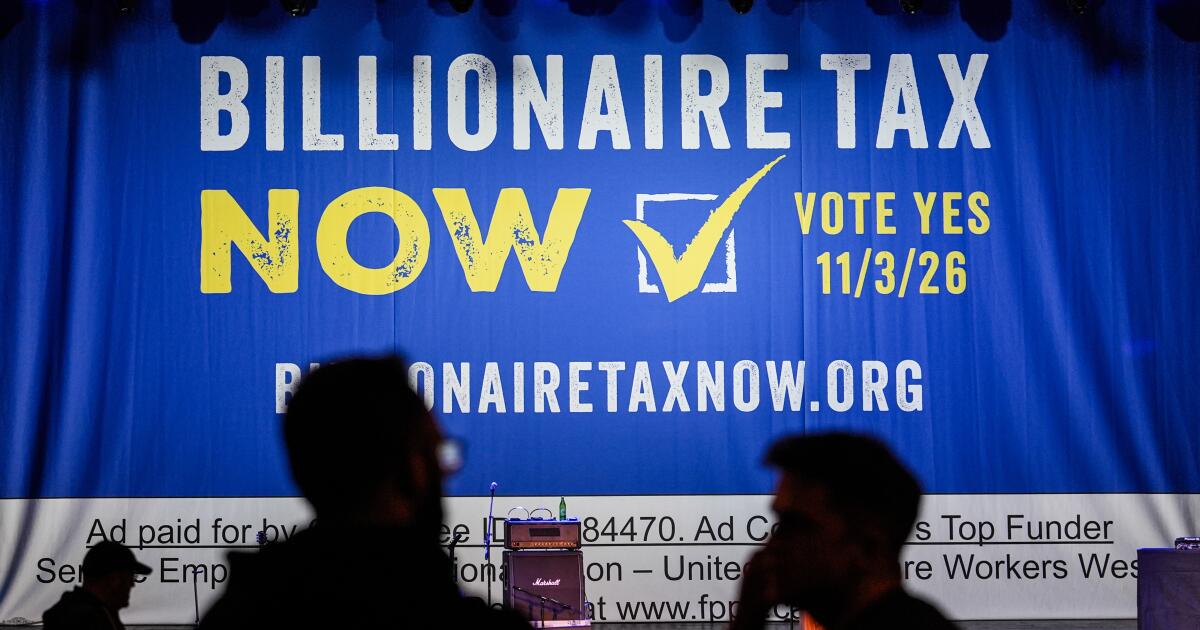
Billionaire tax proposal faces hurdles as it moves closer to November ballot
-
 Science20 minutes ago
Here’s why the Lincoln Memorial Reflecting Pool went green so fast
-
 Sports23 minutes ago
Shohei Ohtani out of Dodgers’ lineup vs. Orioles for birth of his second child
-

 World35 minutes ago
Lebanese influencer organises World Cup event amid Israel’s attack on Leban
-
 News58 minutes ago
Air Force One, gifted to Trump from Qatar, arrives at Joint Base Andrews
-

 New York2 hours ago
Video: Fans Show Up to the Parade in Their Best Knicks-Themed Attire

