Lifestyle
L.A. Affairs: I'm a divorced woman. Was I ready to be naked with a new guy?
As a newly single woman in my 50s in Los Angeles, I was terrified. I’d been married so long that the last time I’d heard the words “sexy” and “hot” was when I’d ordered sea bass in a spicy shiitake broth. I hadn’t been nipped, tucked, suctioned, filled or augmented. I figured I stood a better chance of being hit by lightning than hit on by a good-looking guy.
Understandably my girlfriends were getting weary of my “I’m going to die alone” attitude so they dragged me out to have some fun, which I assumed meant a glass of wine and a nice cheese plate, not shots of tequila in a trendy nightclub in Westlake. The last time I was in a club I was doing the Hammer Dance in parachute pants! I was in over my head. What if no one checked me out or asked me to dance. My self-esteem was already so low that I considered spending the rest of the year in bed. Maybe I just needed 11 months to reevaluate my Sleep Number and catch up on “The Bachelor.”
As it turned out, guys don’t ask you to dance anymore. They just move in on you. One guy moved in so close, it was less about dancing and more about grinding. I joked that in some countries, we were now officially married.
He didn’t get the joke, and I was not about to stay with a man with no sense of humor. I was starting to enjoy myself when fate reminded me that I was newly separated and supposed to be miserable and made me trip on an unseen step. I fell. Hard. On a concrete floor.
I was mortified. I was sure people were laughing at me, but instead, they just stepped over me on the way to the bar. Alcohol trumps everything. I got up, dusted off my pride and went back on the dance floor. I was in the middle of “raising the roof” when a pocket-sized man approached me and asked if I liked his friend. At first, I thought he was referring to his penis in the most unimaginative way, but then he gestured behind me to his actual friend — a thirtysomething tall, dark and gorgeous man. And me definitely likey!
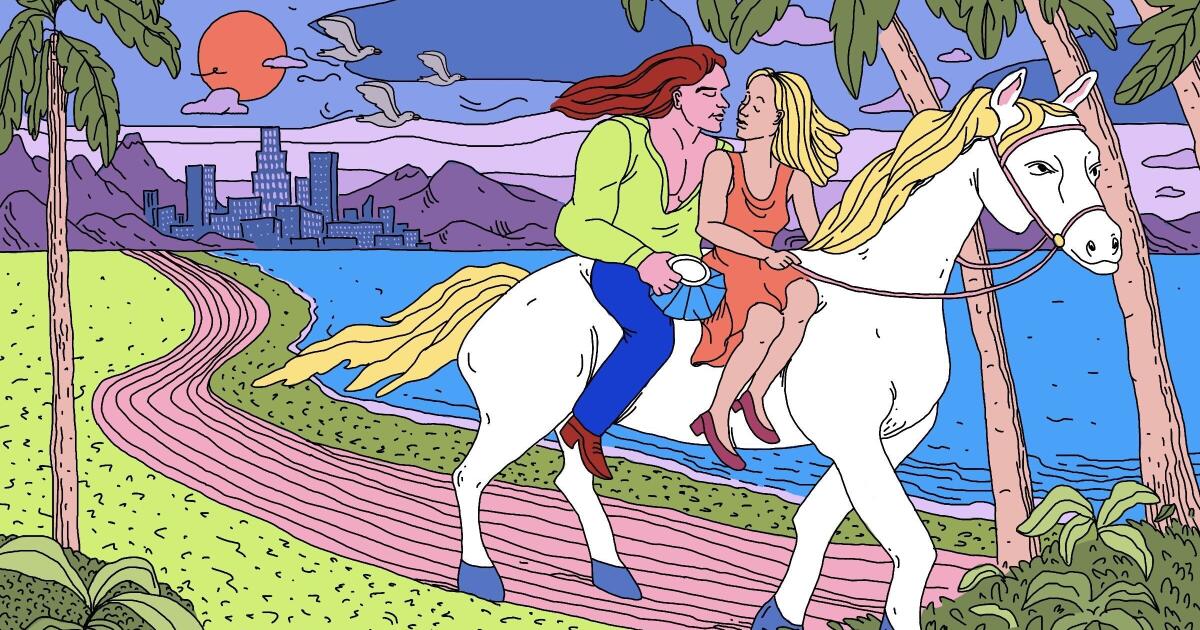
He introduced himself in broken English as Daniel. He had just moved to Southern California from Italy to be a chef at a local hot spot. I felt like I was stepping into the pages of a Harlequin romance. Pretty soon he’d be shirtless on a horse, and I’d be behind him, holding his abs so I didn’t fall. Like I really needed a reason.
He suggested we go back to his apartment for Prosecco and more dancing, and I did what any mid-50s woman would in my situation: I threw all reason, good sense and safety concerns to the wind and blurted “Yes, God, yes!”
Daniel asked if I had a friend who could join us because the pocket-sized man had ironically big pockets and would pick up our tab and drive us in his fancy SUV. I knew convincing a girlfriend wouldn’t be easy, so I went for the jugular. I used guilt. I’d been miserable for months going on years. Did my friends really want to deny me one night of a superficial, meaningless lust connection?
After a speedy ride where I sat on my one good butt cheek, the four of us arrived at Daniel’s apartment in Agoura Hills. He popped open some bubbly and made a toast that was seductive and unintelligible, but I was suddenly in my head.
What was I doing? I wasn’t ready for sex. I wouldn’t even get naked in front of a mirror! And what about the bump on my butt from the fall that was swelling by the minute? Would it be too conspicuous if I sat on a bag of ice or frozen peas? Before I could get to the freezer, Daniel pulled me and my spiraling in for a slow dance and he started singing to me in Italian. It was corny, off-key and incredibly romantic. My girlfriend, Shauna, seeing where this might go, asked Daniel’s friend to drive her home. (That is a comedy of errors for a whole other essay.)
I didn’t say goodbye. I was too focused on Daniel’s roaming hands that were headed south for warmer regions. I yelped as he touched the bruised cheek then quickly recovered with a flirty laugh. Encouraged by my fake flirty laugh, he started undoing the buttons on my jeans. I stopped him and moved his hands up. He moved them down. I moved them up. I wondered if you could have sex with your clothes on. It had been a minute since I’d had sex with someone new. Maybe things had changed.
He took my hand and led me to the bedroom. I looked at the bed and briefly wondered if the sheets were clean. As a mom, I could get stains out of anything. My domestic reverie was cut short as he took off his shirt. I looked at his ridiculous body and I knew it was my turn. I also knew I wasn’t ready. I got into bed fully clothed, and he crawled in next to me. He pulled me in and kissed me, and I forgot all about the divorce, the heartache and the fear of being alone. I was making out with a hot Italian guy with a hematoma on my butt that was now the size of a ping-pong ball, and it was exactly what I needed. I felt hotter and sexier than any sea bass, but most important, I felt hopeful. Maybe I was going to be OK after all.
The author is a Golden Globe-winning TV comedy writer from England. She lives in Woodland Hills, but her adventures happen everywhere. She’s on Instagram: @mariaannebrown
L.A. Affairs chronicles the search for romantic love in all its glorious expressions in the L.A. area, and we want to hear your true story. We pay $400 for a published essay. Email LAAffairs@latimes.com. You can find submission guidelines here. You can find past columns here.

Lifestyle
Best Christmas gift I ever received : Pop Culture Happy Hour
Lifestyle
L.A.’s latest viral party spot is … Seafood City. Yes, you read that right
Under the glow of fluorescent lights at Seafood City market in North Hills, packages of pre-made adobo, salted shrimp fry and and dried anchovies glisten in meat coolers.
A DJ, dressed in a traditional barong, blasts a dance remix of Whitney Houston’s “I Wanna Dance with Somebody” as a crowd gathers to take a shot of fish sauce together.
“That was disgusting!” a man shouts into the mic, flashing a grimacing expression.
At Seafood City, DJs 1OAK, left, EVER ED-E and AYMO spin in barongs, the Philippines’ national formal shirt.
The smells of lechon and lumpia float through the air. Smiling children munch on halo-halo (a Philippine dessert made with ube ice cream, leche flan and shaved ice). Flags of the Philippines wave in the air as a man in UCLA Health scrubs hops into the center of an energetic dance circle. Employees shoot store coupons out of a money gun and toss bags of Leslie’s Clover Chips into the crowd. Fathers hold their children on their shoulders as a group of college students perform a Tinikling routine, a traditional Philippine dance in which performers step and hop over and between bamboo poles.
“This is so Filipino,” a woman says, in awe of the scene.
Sabria Joaquin, 26, of Los Angeles, left, and Kayla Covington, 19, of Rancho Cucamonga hit the dance floor at “Late Night Madness” in North Hills.
“I came here for groceries,” explains an elderly man, adding that he decided to stay for the party.
Seafood City, the largest Philippine grocery store chain in North America, typically closes at 9 p.m. But on certain Friday and Saturday nights, its produce or seafood aisle turns into a lively dance floor for “Late Night Madness.” On social media, where the gathering has exploded, it looks like a multigenerational nightclub that could use dimmer lighting. But for attendees who frequent the store, it’s more than that. It’s a space for them to celebrate their Filipino heritage through food, music and dance in a familiar setting.
“This is something that you would never expect to happen — it’s a grocery store,” says Renson Blanco, one of five DJs spinning that night. He grew up going to the store with his family. “My mom would [put] us all in the minivan and come here, and she’d let us run free,” he adds. “It’s comfortable here. It’s safe here.”
1. Rhianne Alimboyoguen, 23, of Los Angeles follows an employee through the produce section. 2. Allison Dove, 29, left, and Andrea Edoria, 33, both of Pasadena, enjoy Philippine street food. 3. Katie Nacino, 20, left, Daniel Adrayan, 21, and Sean Espiritu, 21, of the Filipino American Student Assn. at Cal State Northridge, practice tinikling, a traditional Philippine folk dance, in an aisle.
The first Seafood City location opened in 1989 in National City, a suburb of San Diego, which has a nearly 20% Asian population including a rich Filipino community. For its founders, the Go family, the mission was simple: to provide a market where Filipinos and people within the diaspora could comfortably speak their native language and buy familiar products. It’s since become a community anchor. Of the nearly 40 locations in Northern America, at least half of them are based in California, which has the highest population of Asian Americans in the United States.
-
Share via
The first “Late Night Madness” event happened in September in Daly City, Seafood City’s newest location. The company wanted to launch a street food program at the store’s food hall in a fun and creative way.
The DJ played a selection of hip-hop, pop, soul and classic Pinoy records like VST & Company’s “Awitin Mo, Isasayaw Ko.” Hundreds of people showed up, and videos of people of all ages turning up in the popular supermarket spread like wildfire. So the company decided to continue hosting the event in October during Filipino American History Month and for the rest of the year. It’s since expanded to more locations around the country and in L.A., including Eagle Rock.
By 10 p.m. at the Seafood City in North Hills, at least 500 people are dancing in the produce section, next to rows of saba bananas, fresh taro leaves and bok choy. The lively crowd forms dance circles throughout the night, taking turns jumping in the center to show off their moves to songs like Earth, Wind & Fire’s “Let’s Groove,” “Nokia” by Drake and Justin Bieber’s “I Just Need Somebody to Love.” At one point, TikToker and artist Adamn Killa hops on the mic and says “If you a Filipino baddie, this is for you,” before doing his viral dance.
Among the Philippine street food offerings were pandesal sliders, lumpia-style nachos, lobster balls and various skewers.
A group of employees dance behind the counter as they serve hungry patrons who fill their trays with various Filipino street food including pandesal sliders (soft Philippine bread filled with adobo, lechon or longganisa) and Lumpia Overload (think nachos, but a bed of lumpia instead of tortilla chips), lobster balls and barbecue chicken skewers. (No alcohol is served.) Meanwhile, a few lone shoppers sprinkle into the store to get their weekly groceries as music blasts through the speakers.
First-generation Filipino American Andrea Edoria of Pasadena says “Late Night Madness” reminded her of the family parties she attended as a child in L.A. and in Manila, where her parents are from.
“Growing up as a child of immigrants, I was kind of self conscious about displaying too much of my culture,” she says between bites of spiral fried potato. She went to the Eagle Rock event with her mother last month as well. “So it kind of fed my inner child to see so many people celebrating this shared culture and experience that we each grew up [with].”
A multi-generational crowd is drawn to the dance floor. At center is Jade Cavan, 44, of Chatsworth.
Members of the Filipino American Student Assn. at Cal State Northridge perform a tinikling performance.
She adds, “I think it’s so important especially now at a time where our country is so divisive and culture is kind of being weaponized, I think it’s a beautiful reminder that we can come together and find something that unites us.”
About 10 minutes before midnight, the grocery store is still bustling with activity. A dance battle breaks out and people begin hyping up the young women. The DJ transitions into slower tracks like Beyoncé’s “Love on Top” and Mariah Carey’s “All I Want for Christmas is You.” The remaining folks sing along loudly as they walk toward the exit, smiles imprinted on their faces. Staff rush to clean up, then huddle together for group photos to memorialize the evening.
After the final song is played, employees rush to clean up the supermarket.
Patrick Bernardo, 34, of Van Nuys looks at the counter, where a man had been chopping lechon, before stepping outside.
“There’s barely anything left on that pig,” he says, pointing to it as proof that the night was a success.
Lifestyle
10 books to help you understand America as its 250th birthday approaches
With the nation’s big 2-5-0 coming up next year, NPR staff and critics recommended a lot of U.S.-focused titles for Books We Love, our annual year-end reading guide. Below you’ll find 10 favorites — perfect for the history buff on your gift list, or anyone looking to learn more about how the U.S got to where it is today. Read on, or check out our full 2025 list here.
American Grammar: Race, Education, and the Building of a Nation, by Jarvis R. Givens
In this deeply researched book, Harvard University professor of education and African American studies Jarvis R. Givens locates 1819 as a “crossroads” in the history of education in the United States. That year, Congress passed the Civilization Fund Act, providing funding for assimilative boarding schools for Native American children, and the governor of Virginia signed an anti-literacy law that made it a crime to teach enslaved people to read and write in schools. Amid the Trump administration’s effort to dismantle the Department of Education, Givens’ clear-eyed assessment of American education offers an opportunity to reflect on the long-standing relationships among race, power and schooling in the U.S. — Kristen Martin, book critic and author of The Sun Won’t Come Out Tomorrow: The Dark History of American Orphanhood
The Fate of the Day: The War for America, Fort Ticonderoga to Charleston, 1777-1780, by Rick Atkinson
I’ve been eagerly waiting years for this book! This is the second volume of Rick Atkinson’s trilogy on the American Revolution. Atkinson makes good use of letters and diaries. You feel like you’re in the middle of a battle, with all the sights, sounds and tragedy. Harrowing tales of hand-to-hand fighting, scalping and desperate evacuations. Fine detail: the waxed mustaches of the Hessian forces, the number of rum barrels distributed to weary and ill-clad troops, the dull thud of cannonballs smacking into ships. The stench of makeshift hospitals, with piles of limbs stacked outside. He carefully lays out how the battles began, and the successes, mistakes and missed opportunities – on both sides. — Tom Bowman, Pentagon reporter
History Matters, by David McCullough, Dorie McCullough Lawson (contributor), and Michael Hill (contributor)
If history can be a comfort read, this is it. David McCullough’s daughter Dorie McCullough Lawson and his longtime researcher, Michael Hill, assembled this posthumous collection over two years. Some of the historian’s old manuscripts and files were kept in a New England barn, so the occasional acorn and nest turned up along with the historian’s glorious observations about Americans and their history. The essay subjects are diverse – painter Thomas Eakins, Harriet Beecher Stowe in Paris, “A Book on Every Bed” (it will melt your heart). One theme emerges that you might find reassuring in its own way: There was no “simpler time.” — Shannon Rhoades, supervising senior editor, Weekend Edition
Last Seen: The Enduring Search by Formerly Enslaved People to Find Their Lost Families, by Judith Giesberg
In 2017, historian Judith Giesberg and her team of graduate student researchers launched a website called the “Last Seen” project. It now contains over 5,000 ads placed in newspapers by formerly enslaved people hoping to find family members separated by slavery. The ads span the 1830s to the 1920s and serve as portals “into the lived experience of slavery.” In Last Seen, her book drawn from that monumental website, Giesberg closely reads 10 of those ads placed in search of lost children, mothers, wives, siblings and comrades who served in the United States Colored Troops during the Civil War. — Maureen Corrigan, book critic, Fresh Air
Medicine River: A Story of Survival and the Legacy of Indian Boarding Schools, by Mary Annette Pember
Mary Annette Pember, a citizen of the Red Cliff Band of Wisconsin Ojibwe and a national correspondent at ICT News, grew up in the 1950s and 1960s as her mother’s “secret confessor,” listening to fairy-tale-like stories of the horrors she endured at an assimilative boarding school. In Medicine River, Pember traces the repercussions of her mother’s maltreatment, situating her family’s story within the United States’ systemic use of education to eradicate Native cultures. Through an approach that is “part journalistic research, part spiritual pilgrimage,” Pember provides a cuttingly personal account of the history of federally funded Indian boarding schools and a moving look at how Indigenous traditions and rituals can light the path for healing. — Kristen Martin, book critic and author of The Sun Won’t Come Out Tomorrow: The Dark History of American Orphanhood
Mother Emanuel: Two Centuries of Race, Resistance, and Forgiveness in One Charleston Church, by Kevin Sack
There was great symbolism when a white supremacist targeted Charleston’s Mother Emanuel African Methodist Episcopal Church, killing nine Black worshippers as a means to ignite a race war. As we learn in this deeply researched history, the congregation has been involved in the struggle for racial justice ever since it was founded in an “act of bold subversion” by enslaved and free African Americans in the 1800s. I am struck by the stories of clergy and members who fought against seemingly insurmountable odds at nearly every turn of history, truly living out their faith and believing in a better America. — Debbie Elliott, correspondent, National Desk
There Is No Place for Us: Working and Homeless in America, by Brian Goldstone
In this paradigm-shifting, immersive book, journalist and anthropologist Brian Goldstone follows five families in Atlanta who, despite working full time, struggle to stay housed amid gentrification, a lack of tenants’ rights and low wages. These families, all Black, fall into a “shadow realm” – they are not considered officially homeless by the federal government, but lack a fixed living place as they double up with friends and family, sleep in their cars, or pay exorbitant rates at extended-stay hotels. Woven throughout their stories is a trenchant exploration of how America’s disinvestment in public housing and relentless pursuit of free-market growth have fueled housing insecurity for poor working families. — Kristen Martin, book critic and author of The Sun Won’t Come Out Tomorrow: The Dark History of American Orphanhood
The War of Art: A History of Artists’ Protest In America, by Lauren O’Neill-Butler
This book is about the creative – if often short-lived and not always successful – ways in which artists have fought for social change in the U.S. since the 1960s. Personal favorite: a chapter on how the scrappy video collective, Top Value Television (TVTV), changed the public’s view of political conventions. With artist-led protests once again becoming a thing – from the thousands of actors and filmmakers who recently pledged to boycott the Israeli movie industry in response to the humanitarian crisis in Gaza, to the presence of a 12-foot statue depicting President Trump and the late sex offender Jeffrey Epstein frolicking on the National Mall, this book about the past provides a powerful frame for thinking about artist-led actions today. — Chloe Veltman, correspondent, Culture Desk
We the People: A History of the U.S. Constitution, by Jill Lepore
As the U.S. approaches the 250th anniversary of its founding, it feels like an appropriate time to reflect on where we’re at as a country and how we got here. We the People, by Jill Lepore, a history and law professor at Harvard University, helps satisfy that impulse. It tells the story of the U.S. Constitution, which is among the world’s oldest constitutions. Lepore focuses on battles over amendments, which were fought not just by politicians but by ordinary Americans. The founders designed the Constitution to be amended, but it has become much more difficult to do so over the years. As the Constitution becomes harder to amend, Lepore writes, the risk of political violence becomes greater. — Milton Guevara, producer, Morning Edition and Up First
Who Is Government?: The Untold Story of Public Service, by Michael Lewis (editor)
Thousands of unsung heroes in the government are making life better for Americans. But because of bureaucracies being made up of bureaucrats, we rarely hear those stories. This book showcases them. Like a coal-mining safety official who helped the U.S. reach zero mine-collapse deaths. Or the man who has led the National Cemetery Administration to the top of the American Customer Satisfaction Index. As the federal government is in its biggest shake-up in a generation, it’s worth learning about where the bright spots are. — Darian Woods, host, The Indicator from Planet Money
This is just a fraction of the 380+ titles we included in Books We Love this year. Click here to check out this year’s titles, or browse nearly 4,000 books from the last 13 years.
-
Iowa1 week agoAddy Brown motivated to step up in Audi Crooks’ absence vs. UNI
-
Maine1 week agoElementary-aged student killed in school bus crash in southern Maine
-
Maryland1 week agoFrigid temperatures to start the week in Maryland
-
New Mexico7 days agoFamily clarifies why they believe missing New Mexico man is dead
-
South Dakota1 week agoNature: Snow in South Dakota
-
Detroit, MI1 week ago‘Love being a pedo’: Metro Detroit doctor, attorney, therapist accused in web of child porn chats
-
Health1 week ago‘Aggressive’ new flu variant sweeps globe as doctors warn of severe symptoms
-
Maine7 days agoFamily in Maine host food pantry for deer | Hand Off