Sports
Why drafting a successful NFL quarterback remains 'an inexact science'


The NFL franchise quarterback — the highly coveted symbol of hope, cornerstone of championship aspirations, difference between irrelevance and immortality — is also the rarest of breeds.
Don’t call it tanking, but desperate organizations abandon win-at-all-cost principles with the goal of landing an elite passing prospect with one of the top picks in the NFL Draft. Other quarterback-needy teams routinely mortgage future resources to improve draft positioning. But despite NFL decision-makers’ robust resumes as talent evaluators and extensive research — countless hours of game film, interviews and a gamut of measurables and grading tools — drafting a franchise quarterback remains one of the most challenging exercises they will ever execute.
“We all evaluated Tom Brady wrong when New England drafted him in the sixth round, and he’s turned out to be one of the best players — not just the best quarterback — the National Football League has ever seen,” Atlanta Falcons coach Raheem Morris said. “So it is continuously an issue for everybody. … We know those things that you go out and try to find, but it’s just a hard position to evaluate.”
On Thursday, teams will draft the next crop of projected franchise saviors. But these pivotal selections essentially amount to educated guesses about a position often described as the hardest to play in all of professional sports.
In the modern era of the NFL Draft (since 1967), 130 quarterbacks have been selected in the first round. Only 61 of those (46.9 percent) have won a playoff game as a starter, according to NFL Research, and just 58 of those quarterbacks (44.6 percent) have garnered Pro Bowl honors. Just 13 (8.1 percent) won a Super Bowl as a starter, and two of those didn’t even win their Super Bowls for their original teams.
Projecting quarterback talent poses such a challenge, in part, because of the differences between the college and pro games. Yes, college prospects play the same position. But transitions rarely prove seamless because college offenses and the defenses they face differ so greatly from those on a professional level.
“Just because you’re good at algebra, does that mean you’re good at calculus?” Miami Dolphins coach Mike McDaniel asked. “College football is a different game that has overlapping variables, but it’d be far-fetched to say at any position collegiate success dictates professional success.
“It’s a different orchestration of an 11-person game, and there’s different nuances to it. … And that’s why it’s an inexact science, because the success of the quarterback in the collegiate platform is based upon compounding variables that you have to sift through.”
College and professional football are played with different spacing thanks to different hash mark alignments. In college, the chalk markings that indicate where the ball will be snapped are 40 feet apart. In the NFL, that distance is just 18 feet, 6 inches, meaning the ball is nearer the center of the gridiron. It’s easier to scheme receivers open in college while NFL passing windows are much tighter thanks to narrower hash marks and faster defenders. All of that requires faster decision-making and greater accuracy.
“We’ve got draft picks at every position,” said Jacksonville Jaguars head coach Doug Pederson, a former NFL quarterback himself. “So space and time — the speed element — plays a big factor.”
It takes time for rookies at any position to adjust to that faster-paced game. Then throw in the responsibilities heaped on a quarterback: running a huddle, maybe for the first time (most colleges utilize no-huddle offenses), reading more complex defensive coverages and making protection and play-call changes at the line of scrimmage.
“The amount of information he has to process in such a limited amount of time, all the leadership stuff and intangible stuff … there’s a certain amount of athletic gifts and talent you have to have, and then there’s so much more beyond that,” said Green Bay Packers GM Brian Gutekunst. “And I think the thing that is lost at times is how much of it has to be developed over time.”
NFL coaches and scouts must use their imaginations while studying a prospect to grasp his ability to make that leap.
“You turn on the (college) tape and you’re seeing certain successful, explosive offensive teams that are putting up a ton of points,” Minnesota Vikings coach Kevin O’Connell said. “But you’re trying to figure out if This play right here; this third-down play — does this translate to what we’re going to ask him to do in our offense? … You try to find the traits first, and then go back and apply those traits to (prospects) doing certain things that maybe they don’t even know they’re doing at the time.”
Of course, there are quarterbacks who excel at executing elements of the pro game despite never having displayed such an ability in college. C.J. Stroud, 2023 Offensive Rookie of the Year, played at a top-five level his first year while executing a Houston Texans offense whose concepts and responsibilities differed vastly from the system he ran at Ohio State.
The speed, elusiveness and athleticism Lamar Jackson displayed at Louisville made him a lock to terrorize NFL defenses as a runner, but Jackson faced doubts about his passing ability because many NFL scouts didn’t see many NFL-type throws during evaluations. In six pro seasons with the Baltimore Ravens, Jackson has twice won MVP — including after last season — while being among the league leaders in passer rating.
“We’re only getting to see who a player is right now in college at 21, 22 years old. … It’s a complete projection on who can be better,” Hall of Fame quarterback Kurt Warner said. “We’ve all seen guys who were average college quarterbacks — and you could probably include myself — that become better and great at the next level. … And we’ve all seen other quarterbacks who were great college quarterbacks that never got any better and disappeared in the NFL.
“We throw out, ‘Well, man, their ceiling is so high when they put it all together.’ But we don’t really know what somebody’s ceiling is until they get there or they get close to it. … I also believe that the ceiling for guys is more mental than it is physical, and that’s really hard to truly test.”
Not that NFL teams don’t try, investing in evaluation tools like the Wonderlic and S2 cognition tests in hopes of grasping a quarterback’s intelligence or processing speed. Stroud called into question the S2 test’s credibility last season after his low score leaked and caused some NFL analysts to question his ability to succeed as a pro. The unfazed Texans took Stroud second overall, and he led Houston to the AFC South title after throwing 23 touchdown passes and just five interceptions.
GO DEEPER
What did NFL learn about S2 after CJ Stroud? ‘People in our league can’t help themselves’
And that’s why some coaches insist cognitive tests can’t reflect competency the same way that on-field execution and face-to-face X’s and O’s discussions do.
“I know those are all good metrics to go off of — and how players learn and when they process and all that,” Pederson said. “But to me, the bottom line is you’ve got to go spend time with these guys.”
That’s no guarantee, either.
Heading into the 2007 draft, JaMarcus Russell had IT. The 6-foot-6, 256-pound LSU star dwarfed most quarterbacks, even some linemen. And he had a winning pedigree, leading the Tigers to top-10 finishes in his sophomore and junior seasons.
He dazzled during his pro day in front of the 100-plus NFL talent evaluators in Baton Rouge, with the football exploding out of his hand. His 40-yard dash time (4.84 seconds) topped some players a fraction of his size. Some NFL analysts described Russell’s pro day as the best they had ever seen. The Oakland Raiders fell in love and took him first overall three months later.
Three years later, Russell was out of the NFL, never to return.
Blinded by Russell’s marvelous physical gifts, the Raiders had missed red flags. A lengthy contract holdout retarded his development process, and a poor work ethic and problems with substance abuse ensured him a label as one of biggest busts in NFL draft history — and a cautionary tale about the dangers of falling in love with a player based on his pro day performance.
But Russell wasn’t the first player to inflate his draft status with a wondrous workout. Nor was he the last.
Illinois’ Jeff George shined at his 1990 pro day, convincing the Indianapolis Colts to draft him first overall and award him a $15 million contract, an astounding figure for that day. Strong-armed but erratic and undisciplined, George ultimately developed into a journeyman with a 37.1 winning percentage as a starter and 1-2 playoff record.
Zach Wilson’s performance at his pro day in 2021 sparked comparisons to Aaron Rodgers, and the New York Jets took the former BYU star second overall. But Wilson proved unable to adjust to the massive leap in the level of competition, and a poor developmental plan around him ultimately doomed his prospects. The Jets this week essentially gave him to the Denver Broncos for a swap of late-round picks.

Ryan Leaf washed out after parts of three NFL seasons in San Diego and Dallas (Getty Images)
Pro day workouts can certainly inspire NFL decision-makers, but they emphasize physical gifts and not poise, focus, grit and determination — the traits that define great quarterbacks. Mike Tyson once famously said, “Everyone has a plan until they get punched in the mouth.” The same applies to NFL quarterbacks, just replace the punch with a 6-foot-7, 280-pound pass-rusher with track-star speed. Or an All-Pro safety with better ball skills than most college wide receivers. Or a coach or teammate berating them on the sideline for making a mistake.
Great quarterbacks elevate in times of apparent crisis.
“The franchise quarterback is someone you can win because of, rather than just with,” said longtime NFL agent Leigh Steinberg, whose client list includes Patrick Mahomes, Troy Aikman, Steve Young and Warren Moon. “The critical distinction is the quarterback who can have thrown a couple interceptions — the crowd is booing, the game’s getting out of hand, what does he do now?
“A franchise quarterback is someone who can compartmentalize, adopt a quiet mind, filter out past mistakes and elevate his level of play in critical circumstances to take a team to and through victory.”
Gauging a quarterback’s ability to handle adversity is hard, NFL coaches say, because few prospects — most of them the brightest and best athletes on their teams since grade school — have encountered anything in life like the pressure and defeats they will experience in the NFL.
“Some cases, you never really know until you have that time to try to develop a guy,” Gutekunst said.
Steinberg points to the differences in mental makeup that wound up defining the careers of Peyton Manning and Ryan Leaf. In 1998, Steinberg recruited and signed Leaf because the Washington State star possessed greater physical gifts and more impressive measurables than Tennessee’s Manning, who went No. 1 to the Indianapolis Colts.
“Ryan Leaf, physically, was the better quarterback than Peyton Manning,” Steinberg said. “But Peyton Manning had the killer mentality and attention to detail, so Ryan missed that.”
After being selected second by the San Diego Chargers, Leaf played portions of only three NFL seasons, went 4-17 as a starter and threw just 14 touchdown passes against 36 interceptions while getting sacked 65 times.
“In adversity, Ryan Leaf receded and became more isolated and felt embarrassed,” Steinberg said. “He started out very fast in training camp and first couple preseason games, but when he hit a (regular-season) game, then he went into a shell, and the best in terms of therapists and everything else couldn’t get him back out.”
NFL coaches and general managers struggle to explain how to identify the intangibles that forge a quarterback for greatness. But a tireless work ethic, an approach to film study that borders on maniacal and obsessed, displays of strong leadership and respect for the game tend to shine through.
“You’ve got to spend time with him and get to know him a bit and try to give them different things and put them in different situations as much as you can,” Kansas City Chiefs coach Andy Reid said at the NFL Scouting Combine. “You do it while in environments like this. You visit him at college campuses or have them come with us. It’s you talking to their coaches and then talking to the players around them.”
Said Washington Commanders general manager Adam Peters, “I’ve always found in scouting that you make the biggest mistakes more so on the person than the actual talent.”
Plenty of disappointing quarterback prospects have received more blame for their failure to blossom than they should have. Some failed because they landed in environments that gave them little chance for success.
Stanford’s Andrew Luck and Baylor’s Robert Griffin III, the first two picks of the 2012 draft, were supposed to transform Indianapolis and Washington into perennial contenders, respectively. But Luck’s poor supporting cast — especially along the Colts’ offensive line — led to his stunning retirement six years later. And dysfunction largely ruined Griffin’s promising career in Washington.
The Colts essentially committed malpractice through negligence. Frugal free agency spending, poor drafts and the repeated refusal to upgrade a weak line placed Luck in ever-present risk of serious injury. By the time his career abruptly concluded, the quarterback’s gauntlet of serious injuries included a high-ankle sprain, calf strain, abdominal muscle tear, lacerated kidney, concussion and torn labrum in his shoulder.
Meanwhile, Griffin landed with a franchise mired in turmoil. Then-owner Daniel Snyder undermined then-coach Mike Shanahan and poisoned the relationship between quarterback and coach. Griffin managed to put up a historic rookie season before suffering a knee injury that required reconstructive surgery. Then, desperate to save his job, Shanahan allowed Griffin to rush back in 2013. Griffin regressed while backup Kirk Cousins ascended, causing a quarterback controversy. Shanahan was fired at the end of the season. Griffin never recaptured his magic.

GO DEEPER
How does the greatest QB prospect since Elway walk away before he’s 30? Inside ‘Luck’
Organizational alignment, a clear development plan and quality teammates are among the must-haves for quarterback success. New England discovered Brady and developed him into a future Hall of Famer who delivered six Lombardi Trophies and 20 years of stability. Kansas City is the league’s latest dynasty with Mahomes as the centerpiece thanks to similar top-to-bottom alignment and a carefully planned quarterback development plan.
“There’s a lot of things that go into that,” Reid said. “Where’s the staff at? Are they in their last year, are they in their first year? What offense are you asking this guy to be in? Will it work with his strengths and will you try to better the things that he’s not as strong at, weaknesses? Are you willing to stand before (reporters) and kind of protect that guy so he can grow a little bit?”
In each case when he groomed a top young quarterback, Reid exercised patience. In Philadelphia, Donovan McNabb backed up Pederson after being selected second overall in 1999, playing only sparingly until Week 10, when Reid felt comfortable enough to turn the reins over. Perhaps it’s no coincidence that of the four quarterbacks picked in the first round that year, only McNabb and Minnesota’s Daunte Culpepper, who also sat initially, became effective starters. Draft mates Tim Couch and Akili Smith, who played before they were ready, were deemed busts.
In Kansas City, Mahomes sat behind Alex Smith on a playoff team for a year before becoming the starter. Three Super Bowls and two MVP honors later …
Steinberg believes public displays of patience and sincere acts of support are crucial to a quarterback’s development. He pointed to the friction and public arguments between Leaf and then-Chargers general manager Bobby Beathard during the quarterback’s bad stretches of play and noted the contrast between then-Colts GM Bill Polian’s repeated proclamations of support for Manning despite his leading the NFL in interceptions as a rookie.
“It is a combination of scouting and development skills,” Steinberg said. “All the quarterbacks that haven’t made it, they can’t all have been bad draft picks. They just can’t. Drafting and the evaluation process is way too thorough.”
Understanding the need for time and development at the position, the Packers have repeatedly drafted quarterbacks before their starter’s play drops off, so coaches don’t feel the pressure to rush a young prospect on the field prematurely. As a result, Green Bay has had relatively clear succession plans from Brett Favre to Rodgers to Jordan Love, leading to stability for three decades.
But the Packers are the outliers. Troubled organizations are most often the ones in need of franchise savior. The desperation for transformational talent — both to contend and to save jobs — clouds judgment and leads to mind-blowing blunders, sometimes when warning signs are right there.
In 2021, Zach Wilson went to the Jets second overall with no clear development plan despite the leap in competition level. North Dakota State’s Trey Lance was a project player who San Francisco punted on just two seasons after giving up three first-round picks to move up to No. 3 to select him. Ohio State’s Justin Fields, Chicago’s pick at No. 11, played behind horrendous lines and for coaches and coordinators who never displayed a firm grasp of his strengths and weaknesses. And Mac Jones went 15th to quarterback-needy New England when most rival scouts had a third-round grade on him.
After Wilson’s trade to Denver this week, none of the four is on the roster of the team that drafted him.
The Bears have used 36 different starting quarterbacks since Favre first suited up for Green Bay. In 2017, they traded up to draft Mitch Trubisky (now a journeyman backup) over Mahomes. Five years later, they drafted Fields. Now, after moving on from Fields this offseason, Chicago is expected to take Caleb Williams first overall with hopes that this time things will be different.
(Illustration: Eamonn Dalton / The Athletic; photos: Jordon Kelly, Kevin Sabitus / Getty Images)



NEWYou can now listen to Fox News articles!
With the largest World Cup field in the history of the tournament, 32 of the 48 teams will be fighting for a spot in the knockout stage.
66.6% of nations will advance out of the group stage this summer, which is a massive upgrade from 50% in past World Cups. Because of this, sportsbooks have adjusted with less favorable odds.
Prior to the start of the tournament, Spain, Argentina, Brazil, England, and Germany entered with the strongest odds to advance from the group stage, supported by recent major-tournament success and talent-rich rosters.
All five nations are heavily favored at -10000 to advance to the knockout round.
The Spaniards are the defending European Champions while the Argentinians are looking to win back-to-back titles. Germany has not made it out of the group stage in the last two World Cups, but has always been a perennial contender— having won four titles in its history. And then of course there’s Brazil, which has more titles than any country with five.
Now, after the conclusion of the first day of the World Cup, Mexico has joined the group at the top. El Tri has surged to -10000 to advance to the knockout stage after initially being just -1400. Mexico’s huge leap up the oddsboard is a direct result of its dominating 2-0 win over South Africa.
With that in mind, let’s dive into the odds for each team to advance to the knockout stage of the 2026 FIFA World Cup as of June 12.
This page may contain affiliate links to legal sports betting partners. If you sign up or place a wager, FOX Sports may be compensated. Read more about Sports Betting on FOX Sports.
Odds to Advance to Knockout Stage
Spain: -10000 (bet $10 to win $10.10 total)
Argentina: -10000 (bet $10 to win $10.10 total)
Brazil: -10000 (bet $10 to win $10.10 total)
England: -10000 (bet $10 to win $10.10 total)
Mexico: -10000 (bet $10 to win $10.10 total)
Germany: -10000 (bet $10 to win $10.10 total)
Portugal: -5000 (bet $10 to win $10.20 total)
France: -5000 (bet $10 to win $10.20 total)
Belgium:-3500 (bet $10 to win $10.29 total)
South Korea: -2500 (bet $10 to win $10.40 total)
Switzerland: -1800 (bet $10 to win $10.56 total)
Netherlands: -1400 (bet $10 to win $10.71 total)
Morocco: -1000 (bet $10 to win $11 total)
Colombia: -1000 (bet $10 to win $11 total)
Uruguay: -1000 (bet $10 to win $11 total)
Canada: -1000 (bet $10 to win $11 total)
Ecuador: -900 (bet $10 to win $11.11 total)
Norway: -900 (bet $10 to win $11.11 total)
United States: -750 (bet $10 to win $11.33 total)
The U.S. men’s national team is currently -750 to advance from Group D (Photo by Omar Vega/USSF/Getty Images).
Croatia: -500 (bet $10 to win $12 total)
Austria: -500 (bet $10 to win $12 total)
Türkiye: -500 (bet $10 to win $12 total)
Ivory Coast: -500 (bet $10 to win $12 total)
Japan: -500 (bet $10 to win $12 total)
Egypt: -340 (bet $10 to win $12.94 total)
Algeria: -310 (bet $10 to win $13.23 total)
Scotland: -310 (bet $10 to win $13.23 total)
Senegal: -230 (bet $10 to win $14.35 total)
Sweden: -230 (bet $10 to win $1435 total)
Bosnia and Herzegovina: -220 (bet $10 to win $14.55 total)
Paraguay: -205 (bet $10 to win $14.88 total)
Iran: -200 (bet $10 to win $15 total)
Czechia: -165 (bet $10 to win $16.06 total)
Ghana: -140 (bet $10 to win $17.14 total)
Australia: -110 (bet $10 to win $19.09 total)
DR Congo: +100 (bet $10 to win $20 total)
Raúl Jiménez helped propel Mexico to a 2-0 win over South Africa in the opening match of the 2026 FIFA World Cup (Photo by Yair Gonzalez/Jam Media/Getty Images).
Saudi Arabia: +105 (bet $10 to win $20.50 total)
Tunisia: +140 (bet $10 to win $24 total)
New Zealand: +150 (bet $10 to win $25 total)
Uzbekistan: +180 (bet $10 to win $28 total)
Cape Verde: +200 (bet $10 to win $30 total)
Panama: +200 (bet $10 to win $30 total)
Qatar: +275 (bet $10 to win $37.50 total)
South Africa: +320 (bet $10 to win $42 total)
Jordan +350 (bet $10 to win $45 total)
Iraq: +450 (bet $10 to win $55 total)
Haiti: +800 (bet $10 to win $90 total)
Curaçao: +1000 (bet $10 to win $110 total)
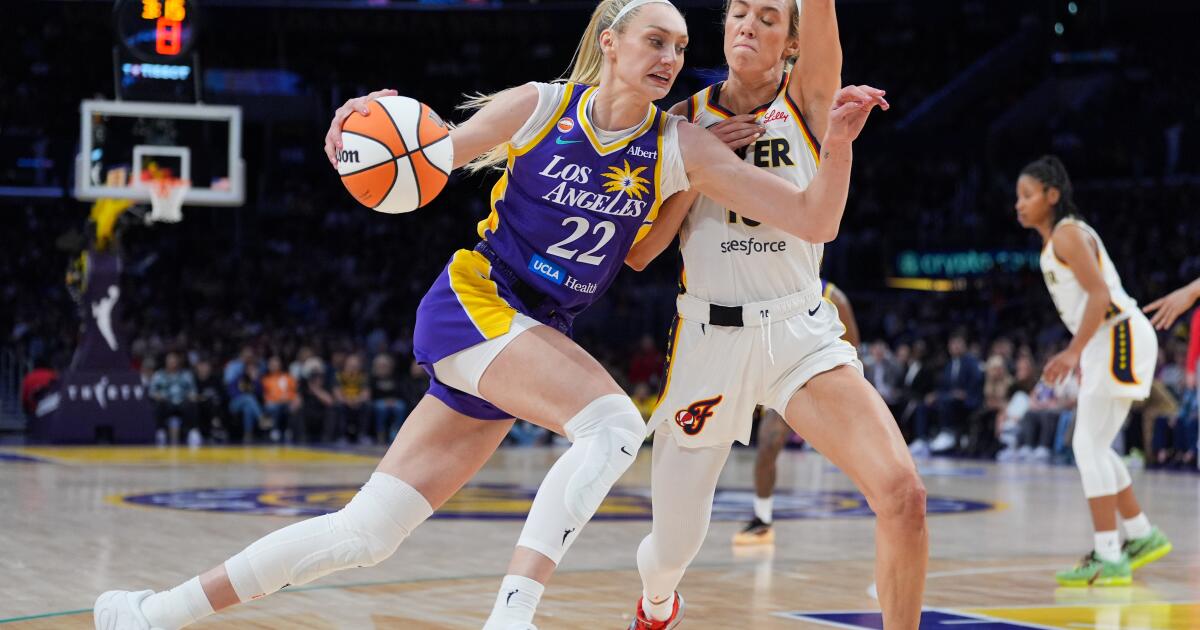
Cameron Brink said she’d appreciate some grace. She really would.
Sparks fans should give her some, because where else is she going to get it?
Certainly not from WNBA refs. Not from opponents with more to play for than ever. Certainly not from the game itself; basketball moves fast, and a bummer can become a bust in a blink.
But Brink, 24, is not on the brink of bust territory, no. Block that thought. Technically, it’s Year 3, but after a torn ACL derailed her as a rookie two summers ago, it’s practically like Year 2 for the former Stanford star. And by design, the WNBA is testing her confidence, her decision-making and her patience as she tries to reestablish herself as one of the WNBA’s best young players.
So, grace.
The recognizable 6-foot-4 forward — she’s the long-blond-haired hooper in the New Balance ads — was the No. 2 overall pick in 2024.
Now she’s her team’s No. 3 option in the post. She’s coming off the bench behind Nneka Ogwumike and Dearica Hamby for the Sparks, who are a modest 6-6 after wins this week over the expansion Portland Fire and the struggling Seattle Storm.
Against the Fire, Brink scored two points and picked up four fouls in nine minutes. Then she went to Seattle and had 15 points in 18 minutes but was pulled with more than five minutes left in the fourth quarter after getting her third, fourth and fifth fouls in 86 seconds. (WNBA players get six fouls before being disqualified.)
For the season, Brink has been called for 49 fouls in 208 minutes. A foul about every four minutes!
They’re silly fouls and they’re phantom calls. Egregious and ticky-tack. Costly and common. A real fouled-up buffet. She sets screens that get scrutinized as if by the most vigilant TSA agent. And sometimes, yes, she’s doing the accidental tripping. Other times, the officials are.
Her reputation precedes her, so everyone gets a superstar’s whistle when being defended by Brink. Opponents bake it into their game plans.
That can’t continue.
All that fouling is hindering Brink’s development because it’s robbing her of important in-game reps — which she needs, foremost, to figure out how to stop fouling.
Sparks forward Cameron Brink, left, blocks the shot of the Tempo’s Laura Juskaite during a game last month.
(Jeff Lewis / Associated Press)
“At the pro level,” said Tara VanDerveer, Brink’s coach at Stanford, “every young player always has a lot of work to do. And I saw her make a three. I see her block shots. She rebounds, she can handle the ball, she’s unselfish, she’s a terrific talent. But there’s always things players need to work on.”
We know what Brink’s thing is.
“She has to be disciplined,” VanDerveer said. “And if you want something so badly, if you want to be an All-Star someday or make the Olympic team, you’ve got to be dependable … and I think anyone can change, if it’s behavior they recognize is not in their best interests or not in their team’s best interests. It’s hard, but it’s something I think people can do.
“That’s what Cam is working on.”
And, VanDerveer added, “I’m really so excited that Nneka is there, because she will give her such great guidance and mentorship.”
And grace. Brink is getting that from Ogwumike — also a former Stanford star, the Sparks legend returned to L.A. this season after two seasons in Seattle — and her other teammates.
“I just do my best to lead by example,” Ogwumike, 35, said. “But then also let [Brink] know that she’s very capable, that she’s more than capable, which is exactly why she’s here with us and it’s exactly why we need her on this team.”

Sparks forward Cameron Brink, wearing a facemask, controls the ball while defended by Sun forward Raegan Beers.
(Joe Buglewicz / Getty Images)
But how long will Brink get grace from the Sparks in the what-have-you-done-for-me-lately business of basketball?
The foul trouble tells us why a win-now team wouldn’t trust her, why the Sparks would give meaningful minutes to two veteran post players ahead of her. Why they wouldn’t prioritize Brink’s development alongside winning as they strive to snap a previously unthinkable five-year playoff drought.
And what about fans? How patient will you all be with a player who was drafted immediately after Caitlin Clark and five spots in front of Angel Reese?
These days, that might depend on what the parlay calls for.
Or, preferably, whether you remember Brink’s first 15 WNBA games. All starts, all signs pointing to stardom. She showed up in 2024 throwing lavish block parties. Her 2.3 blocks per game were message-sending spikes, like what Lisa Leslie used to enthrall Sparks crowds with.
From the jump, she had guys coming to games at Crypto.com Arena wearing her No. 22 jersey and little girls arriving in groups with No. 22 painted on their cheeks and “I love Cam Brink” signs in hand.
And then the torn ACL cost her 25 games of her rookie season and another 25 last season, plus her spot on the United States’ Olympic 3×3 women’s basketball team in Paris in 2024.
She had to start over. Lost a lot of ground. But you see that masked woman stuck on the Sparks’ bench for all but 17 minutes per game?
You can’t miss her. She’s looking uncomfortable in protective facial gear that either hinders her breathing or her peripheral vision, her only options to protect the torn septum she suffered in a victory over the Las Vegas Aces last month.
She’s the one with the 6-8 wingspan who’s averaging 9.2 points, 4.3 rebounds and 1.5 blocks while shooting 52.1% from the field in her limited minutes.
She’s still Cameron Brink. Between fouls, she’s fluid and fast and covers more of the court than almost anyone in the WNBA, able to leap from defending guards to centers in a single bound.
“It’s just looking at every day as a new opportunity to learn and grow and not getting too bogged down when things don’t go exactly as you planned,” Brink told me. “Because more times than not, things are not going to go how you want them to. And that’s life. So I just want to be able to put my best effort out there every single night.
She knows what the Sparks need from her: “To perform, just come on the floor and compete.”
To prove she can stay on the floor to compete.

NEWYou can now listen to Fox News articles!
When will Team USA lose in the 2026 FIFA World Cup? Or, will it not lose at all?
Let’s check out the odds for the Americans’ stage of elimination at FanDuel Sportsbook, as of June 11.
Team USA — Stage of elimination odds
Last 32: +170 (bet $10 to win $27 total)
Last 16: +220 (bet $10 to win $32 total)
Group stage: +500 (bet $10 to win $60 total)
Quarterfinals: +500 (bet $10 to win $60 total)
Semifinals: +1200 (bet $10 to win $130 total)
Runner-up: +2800 (bet $10 to win $290 total)
Outright winner: +6000 (bet $10 to win $610 total)
This page may contain affiliate links to legal sports betting partners. If you sign up or place a wager, FOX Sports may be compensated. Read more about Sports Betting on FOX Sports.
The outlook appears to be … ho-hum?
If the odds ring true, the Americans are expected to make it out of the group stage but fall in the first knockout stage game.
How would that result stack up against previous results? Well, at the 2022 World Cup, Team USA made it to the Round of 16, which was viewed as a stellar accomplishment.
The U.S. men’s national team currently has 60-1 odds to lift the 2026 FIFA World Cup trophy this summer (Photo by Omar Vega/USSF/Getty Images).
In 2018, the USA did not qualify for the World Cup, and in 2014 and 2010, the Americans also made it to the Round of 16. Their best result this century occurred in 2002, when the Americans made it all the way to the quarterfinals before being eliminated.
In 1998, Team USA lost in the group stage, in 1994, it fell in the Round of 16, and in 1990, it also fell in the group stage.
With the expanded World Cup format, 32 teams will advance to the knockout stage (out of 48), giving teams a much better chance of getting out of the group stage than in previous tournaments. In past years, only 50% of the field advanced to the knockout round, but now 66.6% of teams will move on.
With that being said, anything less than a knockout round appearance on home soil would be viewed as a major failure this summer for Team USA.
The second result on the oddsboard is the “Last 16,” meaning the USA would make it out of the group stage and win one knockout stage game, before falling in the second knockout stage game. The third result is that the Americans failed to make it out of the group stage, and the fourth is that they made it to the quarterfinals, meaning they won two knockout stage games.
Making the semis, losing in the championship game and winning the championship are the three results with the longest odds.
The U.S. begins its World Cup journey on Friday as the Stars and Stripes face Paraguay at Los Angeles Stadium. Getting off to a fast start in the group is crucial for the team’s World Cup dreams of making a deep run this summer.
-

 Los Angeles, Ca2 hours ago
MLB to screen Hollywood classic at drive-ins nationwide
-

 Detroit, MI2 hours ago
Detroit at Le Mans: Cadillac favorite, Ford poised for 2027
-

 San Francisco, CA2 hours ago
Hudson Pacific lands SF’s biggest office lease in nearly a decade
-

 Dallas, TX2 hours ago
NFL Brazil tickets are available: Shop Cowboys vs. Ravens NFL Brazil tickets now
-

 Miami, FL2 hours ago
North Miami man accused of stabbing victim 7 times
-

 Boston, MA2 hours ago
Everything you need to know about Sail Boston 2026
-
Denver, CO2 hours ago
Broncos’ Jonathon Cooper arrested again on four charges, including harassment, violation of protection order
-

 Seattle, WA3 hours ago
Ribbon-cutting marks completion of mixed-income condos in Seattle’s Phinney Ridge


