Rhode Island
Half of Massachusetts residents support legalizing teachers’ strikes • Rhode Island Current

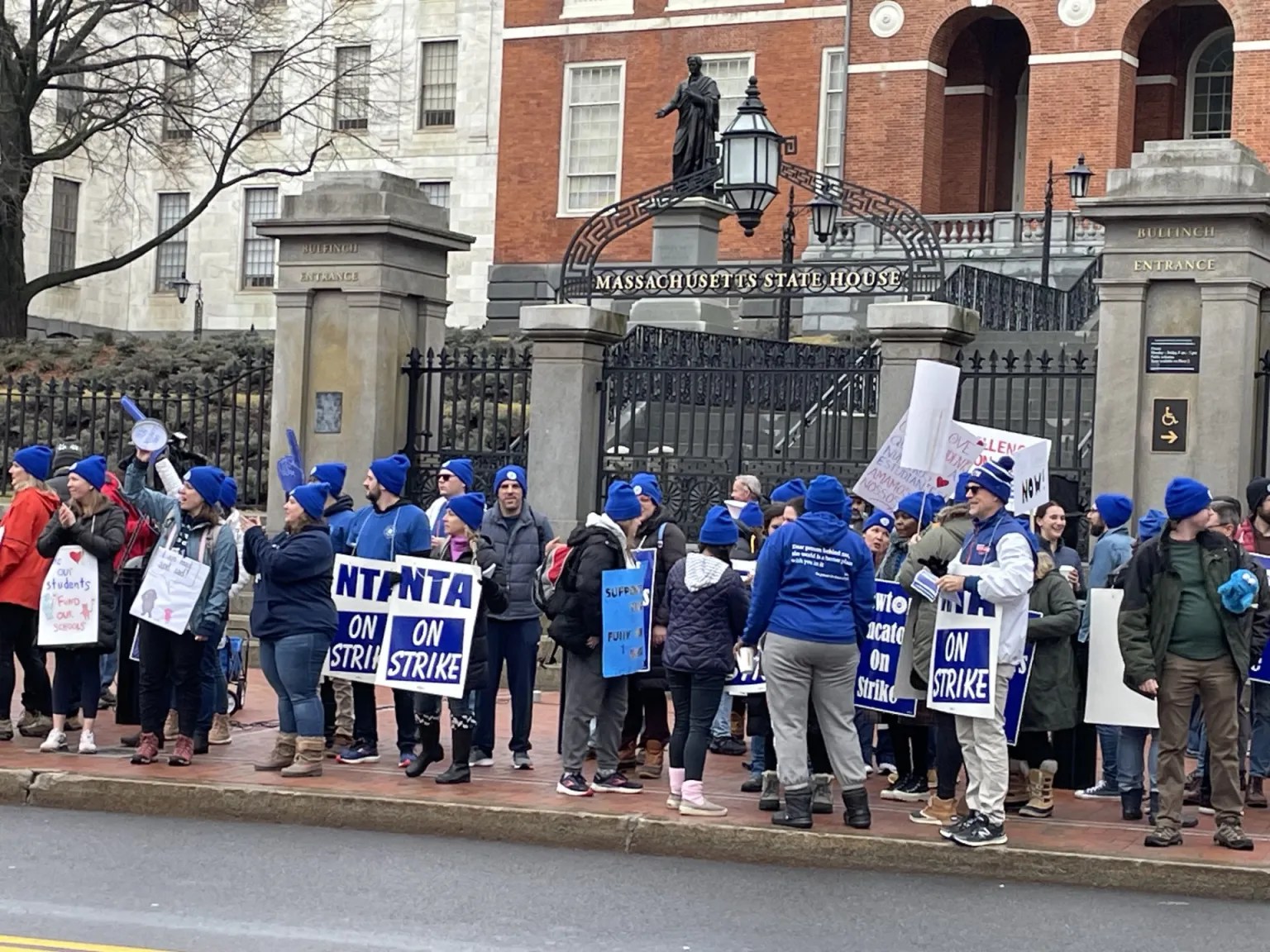
Massachusetts state leaders have said they have no appetite for changing Massachusetts law to make it legal for public teachers to go on strike, but public opinion is more on the union side. In a new CommonWealth Beacon/GBH News poll, 50% of state residents favored legalizing teachers’ strikes, while 34% said strikes should remain illegal, and 16% said they were unsure or did not answer (toplines, crosstabs).
The survey, conducted by the MassINC Polling Group, comes on the heels of strikes in five Massachusetts school districts over the last two years. It is illegal for public sector employees to strike in the state, but that hasn’t stopped a wave of walkouts signaling a more militant posture on the part of teachers’ unions. The longest – and most recent – strike closed schools in Newton for two weeks in late January and early February.
The poll results point to a strong degree of sympathy for teachers’ efforts to secure better pay and other changes, even if it means shutting down schools to get there.
“Even though strikes are disruptive and inconvenient for families, the polling suggests people in Massachusetts recognize that the ability to strike is a primary point of leverage that teachers have,” said Richard Kahlenberg, director of the American Identity Project at the Progressive Policy Institute, a Washington, DC-based think tank.
The push to change state law to legalize teachers’ strikes, which is being led by the Massachusetts Teachers Association, the state’s largest teachers’ union, is taking place amid a surge of favorable public opinion toward organized labor. Since the 1930s, Gallup has polled Americans on the broad question of whether they approve or disapprove of unions. The approval rating hit 71% in Gallup’s 2022 poll and was 67% in 2023, levels not seen since the mid-1960s.
Layered over that rise in sympathy for unions, said Michael Hartney, an associate professor of political science at Boston College, is the positive view many people hold of educators. “I think teachers are generally one of the professional groups that have a lot of latent trust among the public, maybe up there with physicians,” said Hartney, author of the 2022 book How Policies Make Interest Groups: Governments, Unions, and American Education.
The poll, conducted among 1,002 Massachusetts residents from March 22 to March 29, showed a strong partisan divide on the issue, with 60% of Democrats supporting legalizing teachers’ strikes and 26% opposed, compared with 42% of Republicans who favor legalizing strikes and 44% who oppose such a change. There was also stronger support for changing the law among Black respondents (63%) and Latino residents (62%) than among Whites (48%) or Asians (41%).
The widest demographic difference was by age, with 64% of those aged 18-29 in favor of making strikes legal compared with only 39% of those 60 and older, a 25-point swing. Among those 30 to 44, 55% support legalizing strikes and among those 45 to 59, 46% do so.
Part of the explanation for the strong support for legalizing strikes among younger people is that, as a group, they skew more Democratic. But young people have also been hit hard by rising economic inequality, the high cost of housing, and have been part of a new union push, still in its infancy, in sectors ranging from Amazon warehouse workers to Starbucks baristas.
While they have a much bigger presence in the public sector, unions represent only 10% of US workers today, half the rate of 40 years ago. Because of that steady decline, young people are “much less likely to have an uncle, an aunt, a parent – someone they know – who is in a union,” said Kahlenberg. “Union leaders feared that would translate into less sympathy for unions, but the economic conditions on the ground have shifted such that young people are rediscovering the importance of unions,” said Kahlenberg, author of a 2007 biography of Albert Shanker, a major figure in the US teachers’ union movement, who led the New York City teachers’ union and the national American Federal of Teachers from the 1960s to the 1990s.
Kahlenberg said teachers’ unions have also effectively sought to link their grievances when they strike with issues parents care about, such as smaller class sizes or more guidance counselors. “Obviously, in the short term, it’s not great for kids who are out of schools, but the argument teachers will advance is, the working conditions of teachers are the learning conditions of children,” he said.
How questions about teachers’ strikes are framed can have a big impact on poll results.
Just over a year ago, in March 2023, MassINC Polling Group asked about teachers’ strikes in a statewide survey commissioned by Democrats for Education Reform. Using wording similar to the new CommonWealth Beacon/GBH News poll, it explained that some teachers unions have gone on strike recently despite it being illegal under state law. Asked whether they favor legislation that would make it legal for teachers to strike, 45% of respondents said yes, while 40% said strikes should remain illegal.
A poll commissioned at the same time by Northwind Strategies, a Boston-based political consulting firm that generally works with left-leaning candidates and causes, found much stronger support for legalizing strikes when Massachusetts residents were asked whether they favor allowing teachers to strike “to fight for higher wages and improved working conditions.” When the question was posed with that language, 67% favored legalizing strikes and just 29% of respondents were opposed.
The Democrats for Education Reform poll revealed considerable confusion about basic facts concerning the teacher strike issue. Fully one-third of respondents thought it was already legal for teachers to strike compared with 45% who correctly said it was illegal.
While their unions are pushing legislation that would make it legal for teachers to strike, the prospects for the bill seem dim. The Democratic troika that sets the agenda on Beacon Hill – Gov. Maura Healey, House Speaker Ron Mariano, and Senate President Karent Spilka – all oppose changing the law.
“I think there’s a pretty clear rationale for not allowing public sector unions to strike, because they play a key role in the provision of public services and interruption of those can be pretty disruptive,” said Marty West, a professor at the Harvard Graduate School of Education and member of the state Board of Elementary and Secondary Education.
Paul Reville, a former state education secretary, said despite the fines handed out to striking teacher’s unions, the incentives not to engage in walkouts don’t appear to be strong enough to prevent them, and he thinks there will be more strikes in the future, even without a move to legalize them.
“Teachers have legitimate grievances and legitimate demands to be paid reasonably,” said Reville, a professor at Harvard Graduate School of Education. He said a new structure should be developed that “creates disincentives for school committees to drag the process out” in negotiating contracts and “at the same time, puts pressure on unions to bargain in good faith and not consider striking as an option.” Reville said such a system could involve a judge assigning an arbitrator to decide the terms of a new contract if no agreement is reached after a specified period of time.
“It’s in the public interest to avoid these kinds of strikes,” he said. “So if we create a policy that, in effect, mandates that they come to the table to settle or, if they can’t, turns over that power to an arbitrator, that would be best.”
This article first appeared on CommonWealth Beacon and is republished here under a Creative Commons license.
GET THE MORNING HEADLINES DELIVERED TO YOUR INBOX



The Rhode Island Lottery offers multiple draw games for those aiming to win big.
Here’s a look at June 28, 2026, results for each game:
Winning Numbers numbers from June 28 drawing
Midday: 7-7-1-0
Evening: 6-7-5-2
Check Numbers payouts and previous drawings here.
Winning Wild Money numbers from June 28 drawing
04-05-07-13-32, Extra: 18
Check Wild Money payouts and previous drawings here.
Winning Millionaire for Life numbers from June 28 drawing
04-11-31-54-58, Bonus: 03
Check Millionaire for Life payouts and previous drawings here.
Feeling lucky? Explore the latest lottery news & results
Are you a winner? Here’s how to claim your prize
- Prizes less than $600 can be claimed at any Rhode Island Lottery Retailer. Prizes of $600 and above must be claimed at Lottery Headquarters, 1425 Pontiac Ave., Cranston, Rhode Island 02920.
- Mega Millions and Powerball jackpot winners can decide on cash or annuity payment within 60 days after becoming entitled to the prize. The annuitized prize shall be paid in 30 graduated annual installments.
- Winners of the Millionaire for Life top prize of $1,000,000 a year for life and second prize of $100,000 a year for life can decide to collect the prize for a minimum of 20 years or take a lump sum cash payment.
When are the Rhode Island Lottery drawings held?
- Powerball: 10:59 p.m. ET on Monday, Wednesday, and Saturday.
- Mega Millions: 11:00 p.m. ET on Tuesday and Friday.
- Lucky for Life: 10:30 p.m. ET daily.
- Millionaire for Life: 11:15 p.m. ET daily.
- Numbers (Midday): 1:30 p.m. ET daily.
- Numbers (Evening): 7:29 p.m. ET daily.
- Wild Money: 7:29 p.m. ET on Tuesday, Thursday and Saturday.
This results page was generated automatically using information from TinBu and a template written and reviewed by a Rhode Island editor. You can send feedback using this form.

SEE IT: A great white shark feeds on a dead whale off the coast of Rhode Island, as the large creature comes across a whale carcass floating in the ocean.
RHODE ISLAND – It’s not often you can get so close to such a dangerous beast like a great white shark, but that is exactly what one boater was able to do in Rhode Island.
A large 15-foot great white shark was spotted feasting on a dead whale in the ocean off the coast of Rhode Island.
STAY SHARK SMART: WHAT TO KNOW WHEN YOU HEAD INTO THE WATER
Despite a reputation for inhabiting waters in Australia and South Africa, great white sharks can be found in temperate waters around the world, as their habitat preferences can change as they age, according to National Geographic.
Mexico, Great White Shark (Carcharodon Carcharias); Guadalupe Island.
(Dave Fleetham/Design Pics Editorial/Universal Images Group / Getty Images)
Video footage shared by Ian Shilosky shows many birds hovering around the whale carcass, trying to get a nibble without getting too close to the 15-foot beast.
SEE IT: SPERM WHALE CAUGHT ON CAMERA IN RARE ENCOUNTER OFF SOUTHERN CALIFORNIA COAST
The shark shows off its brutal strength, ripping large chunks from the whale with its 2 to 3-inch razor-sharp teeth, before diving underwater to consume its meal.
“White shark sightings are few and far between until a whale dies and then they seem to appear out of nowhere as this one did,” the Atlantic Shark Institute said on social media.
Great white shark (Carcharodon carcharias), attacking tuna bait. Neptune islands, South Australia. (Photo by Auscape/Universal Images Group via Getty Images)
(Auscape/Universal Images Group / Getty Images)
The great white shark grows slowly, with males maturing at around 26 years and females at around 33, according to NOAA.
These creatures range in age from 30 to over 70 years old, and they can weigh up to 4,500 pounds.
DEEP-SEA DISCOVERY UNCOVERS ONE OF THE LARGEST KNOWN WHALE GRAVEYARDS ON THE FLOOR OF THE INDIAN OCEAN
Great White Shark breaching at Seal Island, False Bay, South Africa
( Chris Brunskill Ltd/Corbis / Getty Images)
Adult great whites usually swim along shorelines where there is a known food source, such as seals or sea lions.
12-YEAR-OLD AMERICAN BOY ATTACKED BY SHARK WHILE VACATIONING IN THE BAHAMAS
As the largest predatory fish in the world, great white sharks tend to eat a variety of fish, rays, squid, seabirds, sea turtles, dolphins and more.

WARWICK, R.I. (WJAR) — Rhode Island’s Lego Fan Convention Returned to the West Warwick Civic Center.
Professional Lego artists from around the country displayed their creations and connect with fans.
There are meet and greet opportunities with Lego celebrities too.
JOIN THE CONVERSATION (2)
Fans can also show off their own skills in the event’s Brick Pits.
-

 Mississippi4 minutes ago
Mississippi’s Top High School Quarterbacks: 10 Passers to Watch in 2026
-
Missouri7 minutes ago
Missouri Lottery Pick 3, Pick 4 winning numbers for June 28, 2026
-
Montana12 minutes ago
French Montana, Rick Ross & Max B Turn the BET Awards Into “ – BET Awards 2026 | BET
-

 Nebraska19 minutes ago
"They've Built This": Nebraska commit Barrett Kitrell carries on family football legacy
-

 Nevada22 minutes ago
One dead, four hospitalized after head-on crash on I-15 in Clark County
-

 New Hampshire34 minutes ago
Nashua downtown apartment project earns Plan NH 2026 Merit Award of Excellence » Nashua Ink Link
-

 New Jersey36 minutes ago
Princeton Plasma Forge to power New Jersey innovation
-

 New Mexico41 minutes ago
Search operation continues to close area in Cochiti Lake


