Politics
Abortion ban has supercharged Arizona politics. What will GOP legislators do?

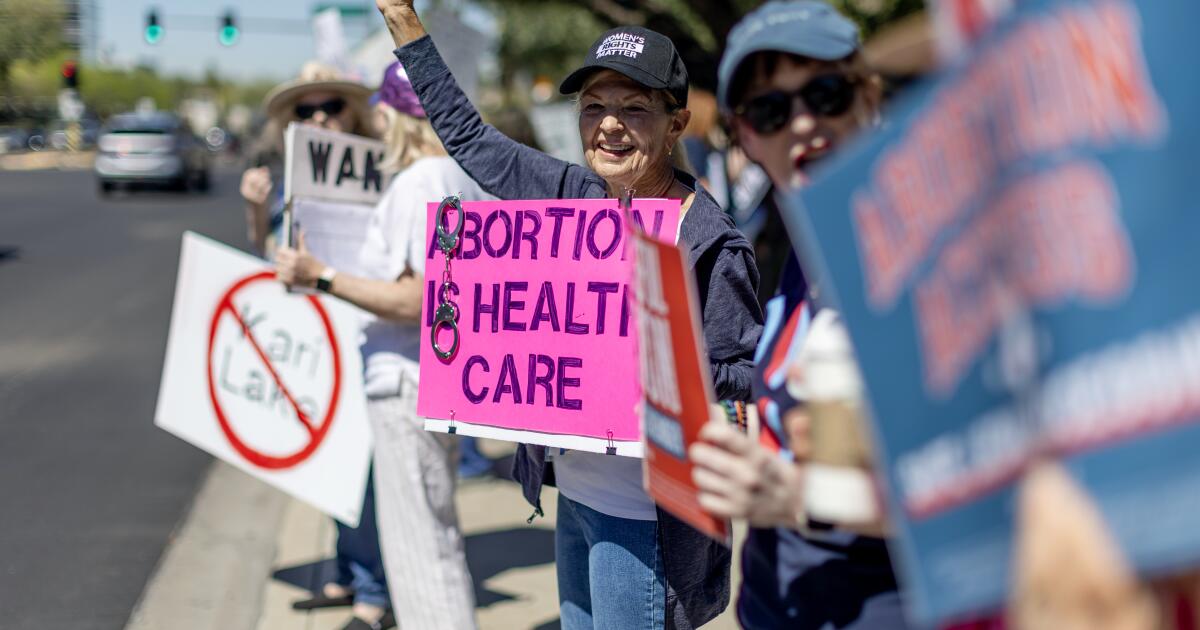
Abortion politics and policy are clashing here like in no other state as the Republican-led Legislature convenes Wednesday to sort out the aftermath of a ruling allowing a statewide ban to take effect within weeks.
It adds more uncertainty for a state that has sometimes felt like the center of the political universe since President Biden’s 2020 victory here helped seal his election, prompting the first false cries from former President Trump that the election was rigged.
Republicans here are anxious and divided over how to handle the newest political surprise, delivered last week when the state Supreme Court ruled that a nearly complete ban — which had been on the books since 1864, before Arizona became a state — could take effect. The state currently permits abortions until the 15th week of pregnancy.
The focus on abortion, already a rallying cause for Democrats, has bolstered that party’s belief that it can use its support for reproductive rights to overcome voters’ angst over the economy and immigration and win a state that has gone their way in only two presidential elections since 1948. But leaders of an abortion rights ballot measure are trying to keep the party at arm’s length because they believe they can win broader support from Republicans and independents.
Still, the increasing number of rallies, signature-gathering events and political speeches over the last week are making the November election feel much more urgent here than in other parts of the country, where campaigns do not normally draw attention until the early fall.
“This is a huge political situation,” said state Sen. Anna Hernandez, a Democrat from Phoenix, who said she has heard from constituents in both parties who are upset with the near-total ban.
A Tuesday morning rally on a highway beside a strip mall, one of dozens around the state in the last week, drew more than 30 people waving “Remember in November” signs and carrying handcuffs to underscore the 1864 abortion statute’s threat of arrest for people who perform or help a woman obtain one. One man held a picture of Trump’s face covered by a red slash.
“It’s horrifying. It’s absolutely dangerous for all women — whether they want to be pregnant, whether they don’t want to be pregnant,” said Nancy Gillenwater, 63, a Scottsdale resident who said she had an abortion when she was 14 and another at 41, after having children.
Gillenwater, who became an active Planned Parenthood volunteer and storyteller when the U.S. Supreme Court overturned nationwide abortion rights in 2022, said she worries that her daughter can’t safely start a family and that her son-in-law, an emergency room physician, will face criminal prosecution for saving women’s lives.
Tuesday’s rally was one of dozens held across the swing state by residents decrying the 1864 law and emphasizing: “Remember in November.”
(Gina Ferazzi / Los Angeles Times)
Mari Urbina, national managing director of Indivisible, the anti-Trump group that organized the rally, had flown in from Washington to support state efforts. She said that since the state Supreme Court’s decision, her group had signed up hundreds of volunteer organizers here who agreed to contact friends and neighbors. Other left-leaning groups reported similar spikes in fundraising and activism.
The Legislature is looking at a pair of issues that will shape the short-term and long-term future of abortion here: whether to repeal the 1864 law, and whether to add more ballot questions to put before voters in the November election to compete with the abortion rights measure.
But Republicans, who hold one-vote majorities in Arizona’s House and Senate, are internally conflicted between the desire to impose strict abortion restrictions and the political reality that the issue could cost them elections, including the presidency.
Those dynamics erupted into a chaotic session last Wednesday, the day after the state Supreme Court ruling, with cries of “Shame! Shame!” and no action.
Since then, Republicans have been strategizing behind closed doors, with public pressure from Trump, who had previously said states should decide abortion law on their own, “to remedy what has happened.”
Repealing the 1864 measure would draw unanimous support from Democratic lawmakers and need the votes of only two Republicans in each chamber.
Even before the court ruled last week, abortion rights proponents said they had gathered enough signatures to put a statewide measure on the ballot that would lift virtually all abortion restrictions, including the current legal ban after 15 weeks. Two of the state Supreme Court justices who supported last week’s ruling will also be on the November ballot, which could draw more interest from abortion rights voters.
Abortion is the top issue for suburban women in seven swing states, according to a Wall Street Journal poll in March, in which 39% of those respondents cited the issue, far surpassing immigration (16%) and the economy (7%) in the seven states polled, including Arizona.
“I’m not saying that’s the deciding factor. But it’s the biggest factor, because we women vote,” said Nancy Musser, a 69-year-old Democrat who works an administrative job in the Maricopa County probation department.
Republicans are worried about that abortion rights measure and are considering how to counter it.
An internal GOP strategy presentation, first reported by NBC, showed Republicans were considering placing one or two competing measures on the November ballot that would draw down support from the abortion rights measure.
One idea under discussion would ask voters to consider what the presentation called “a 14-week law disguised as a 15-week law.” The Legislature can place measures on the ballot directly, and Democratic Gov. Katie Hobbs has no legal right to veto them.
Dawn Penich, communications director for Arizonans for Abortion Access, which is sponsoring the abortion rights measure, accused the Legislature of “deception and political game-playing.”
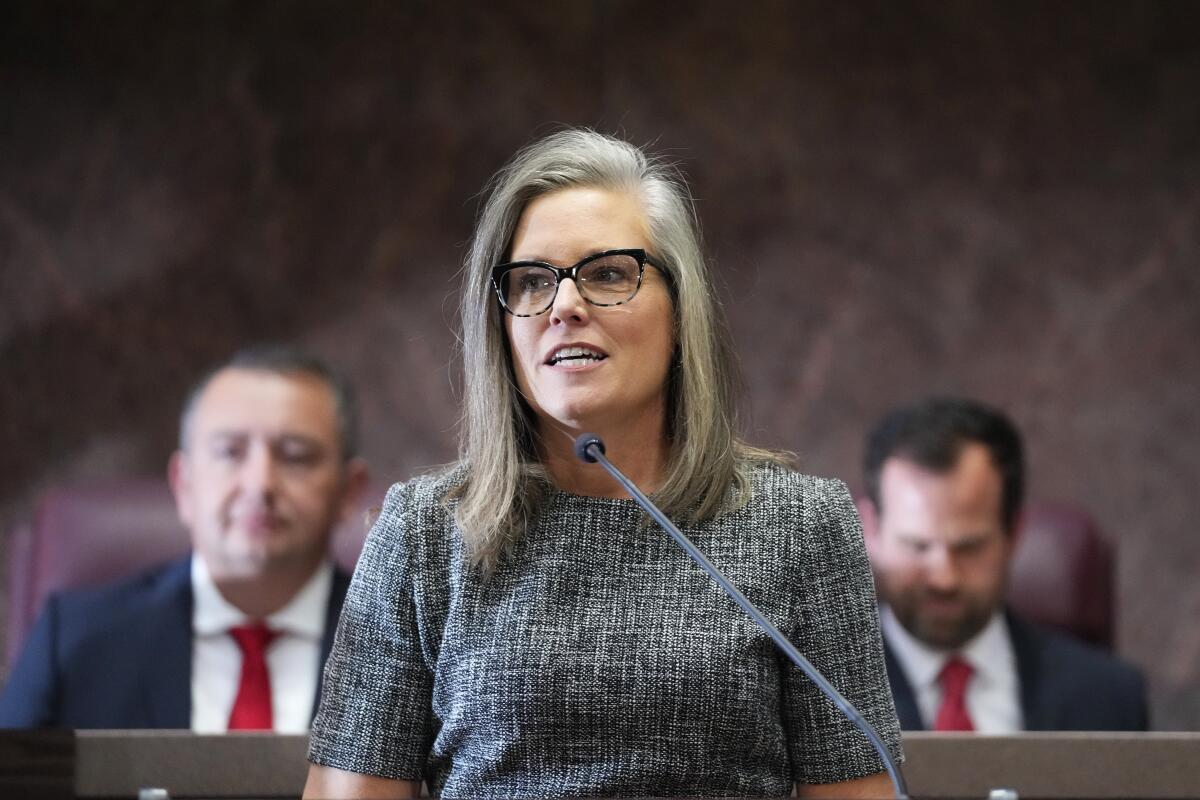
Democratic Gov. Katie Hobbs is powerless to stop the Republican-led Arizona Legislature if it decides to put an antiabortion measure or two on November’s ballot.
(Ross D. Franklin / Associated Press)
Republican House Speaker Ben Toma said in a statement: “The document presents ideas drafted for internal discussion and consideration within the caucus. I’ve publicly stated that we are looking at options to address this subject, and this is simply part of that.”
Even if the issue of abortion helps Democrats, there is no guarantee it will help Biden win the state, where many voters cite the economy as their top concern. The same Wall Street Journal poll of swing state voters found Trump leading in Arizona by 5 percentage points, and receiving much higher marks on the economy and immigration.
“Women should be able to decide,” said Nick Tsontakis, a 68-year-old architect. But he will vote for Trump, he said, feeling satisfied with Trump’s position that abortion laws should be up to the states.
Jose Salvador, a 42-year-old Democrat, agrees, calling the Supreme Court’s decision a mistake. But after voting for Biden in the last election, he has decided to vote for Trump, largely due to immigration and the economy, he said.
“Right now, the country is hurting financially,” he said. “And we need to take care of that first before we focus our resources on on this other issue.”

Politics
Jacob Frey praises Somali community as Minnesota faces renewed scrutiny over fraud investigations

NEWYou can now listen to Fox News articles!
Minneapolis Mayor Jacob Frey told members of the city’s Somali community over the weekend that they are “our family,” pledging solidarity and praising their contributions to the city during remarks celebrating Somali Independence Day.
Frey’s remarks came as Minnesota continues to face scrutiny over several high-profile fraud investigations and weeks after a Republican-led House Oversight Committee report alleged the Minnesota Governor Tim Walz’s administration failed to act on repeated warnings about widespread fraud in the state’s social services programs.
“Through the most difficult of times and through Operation Metro surge, we all saw that they tried to come for some of us,” Frey told members of the Somali community on Saturday. “And when that happens, we say that you’re coming for all of us.”
BLUE STATE’S ANTI-ICE PLEDGE COLLAPSES AS GOP WARNS OF NEW SANCTUARY ‘CONFEDERACY’
Minneapolis Mayor Jacob Frey speaks during a Somali Independence Day celebration in Minneapolis as attendees stand on stage holding Somali flags. (Credit: Mayor Jacob Frey X Post)
“In Minneapolis, we loved our neighbors. In Minneapolis, we do not see you as immigrants. We see you as our family,” he added. “You are our brothers. You’re our sisters. You have done so much for this incredible city, and for that, we stand with you.”
Frey appeared to reference Operation Metro Surge, the Trump administration’s immigration and public safety initiative in Minnesota.
The operation concluded in February after border czar Tom Homan announced it had resulted in the arrest of more than 4,000 people in the Minneapolis-St. Paul area and had reduced what he described as public safety threats.
BLUE STATE’S ANTI-ICE PLEDGE COLLAPSES AS GOP WARNS OF NEW SANCTUARY ‘CONFEDERACY’
Minneapolis Mayor Jacob Frey speaks to the media at City Hall on Jan. 9. (Aaron Lavinsky/The Minnesota Star Tribune via Getty Images)
Frey shared the video on X, writing, “Happy Somali Independence Day.”
“Here in Minnesota, home to one of the largest Somali communities in the United States, we celebrate the resilience, culture, and leadership that continue to enrich our city and community,” he said.
Earlier this month, a Republican-led House Oversight Committee report alleged Walz’s administration repeatedly failed to act on warnings about fraud involving state social services programs, including the Feeding Our Future scandal.
WALZ ADMINISTRATION IGNORED FRAUD WARNINGS AS BILLIONS VANISHED, HOUSE OVERSIGHT REPORT ALLEGES
Democratic Gov. Tim Walz speaks during a news conference on Tuesday, Jan. 6, 2026, in Minneapolis, Minnesota. (Alex Kormann/Star Tribune via AP)
The committee said more than 110 people have been charged in connection with various fraud schemes in Minnesota, including many defendants identified as members of Minnesota’s Somali immigrant community.
The report also alleged concerns about potential racial discrimination claims contributed to delays in addressing suspected fraud and estimated Minnesota lost roughly $300 million in stolen federal child nutrition funds during the COVID-19 pandemic.
CLICK HERE TO DOWNLOAD THE FOX NEWS APP
Walz administration officials have disputed the committee’s findings.
Fox News Digital’s Adam Pack contributed to this report.

For as long as I’ve been a journalist, which is a really long time, public entities have hated public records requests, even while claiming they don’t.
Ask your typical elected or hired official, from the governor to the animal control folks, and they’ll tell you transparency is vital and sunshine in government a key value.
Then turn in the most benign of public records requests — access to a calendar, for example — and prepare for weeks of delays and excuses. Want emails or financial records or, heaven forbid, anything from the police? Months or even years may pass before a single page is delivered, no joke.
That’s why I am deeply concerned about a bill winding its way through the California Legislature that would definitely slow down public records requests and likely make them more difficult and expensive. At its worst, it could push people into costly court battles just for having the audacity to ask for information.
The legislation, Assembly Bill 1821, is authored by Democratic Assemblymember Blanca Pacheco, whose district includes Norwalk, Downey and Bell, where legendary scandals are Example 1 of why public records matter.
Pacheco’s office told me Wednesday that the troubles with the bill are far from what Pacheco set out to do.
“It was never the author’s intention to take away people’s rights to a [Public Records Act] request,” said her chief of staff, Nikki Johnson.
Johnson said the bill was meant to curtail malicious records requests, which do happen, where a citizen goes after copious amounts of records just to be a jerk and cost the government time and money.
It was also meant to address the growing problem of artificial intelligence and other for-profit businesses requesting thousands of records with the intent of using the information to create money-making products — think of sites that already sell publicly available personal information as “background checks.”
I believe Johnson on the good intentions of the bill in addressing those real if nebulous difficulties, but you know what they say about the best-laid plans.
The bill passed through the Assembly recently with ease, largely because most of its problematic portions (I’ll get to those in a minute) were removed — though not all. Even in a watered-down form, which basically gave government more time to answer requests, I found myself in the unlikely position of agreeing with conservative Republican Assemblymember and Trump supporter Carl DeMaio of San Diego, who offered some of the only opposition from elected leaders during the Assembly vote.
“We cannot police the public’s right to know, and we want to err on the side of transparency in how government agencies operate,” DeMaio said.
Amen, brother.
But the Democratic-controlled Assembly erred on the side of secrecy and slowdown instead, and the measure sailed to the Senate, where seemingly out of the blue, a bunch of new provisions were added that fill it with loopholes, vague language and tons of room for abuse.
David Snyder, executive director of the First Amendment Coalition, said the bill as written now was “comprehensively bad for transparency and therefore for government accountability.”
Sean McMorris, transparency, ethics and accountability program manager for the advocacy organization California Common Cause, put it even more forcefully. He pointed out that “public records are the public’s records.”
“They’re not owned by the government,” he said. But this bill would shift that paradigm and make the public “prove why you need them.”
“It’s going to chill people who want to make requests, and it’s going to complicate the process, and it’s just wrong,” McMorris said.
In its new form, the bill basically allows government entities to decide if they feel a public records request is malicious or for commercial gain. If they do, they can petition a court to intervene — potentially sparking both legal costs and new fees associated with fulfilling the request.
It would also, Snyder said, force a requester to explain why they wanted the records — something California law has repeatedly avoided because it gives power to government to treat those it perceives as enemies differently.
In this age of fairness and reason, it’s hard to imagine a government official misusing power to keep secrets, but I’m told it happens. That makes it all the more crucial that people not be forced to explain why they want information, or if they will use it to, say, expose corruption — be it wrongdoing by a single individual or the entire system.
Faced with unintended consequences, Assemblymember Blanca Pacheco (D-Downey), shown in 2023, will seek to scale back the bill to its original form, according to her chief of staff.
(Rich Polk / Getty Images for Equality California)
“I have little doubt that some agencies will use that provision to overburden requesters that they view as political opponents, requesters that they view as just a hassle, requesters that ask for things the government doesn’t want to disclose,” Snyder said. “They can bring the requester into court, and at a minimum, slow down the process, and probably more likely get the requester to simply withdraw.”
As written, the bill also gives a shoddy carve-out meant to protect journalists, but which in reality could be used to curtail requests from freelancers, student journalists and more.
McMorris said access to public records is a “moral issue,” and fixing any problems with the current law requires “a scalpel, not a meat ax.”
This bill, he warned, is a meat ax.
“I don’t discount that there are abusive requests, and that there are requests that really are a burden on government agencies, but the law right now has ways for government agencies to address that,” he pointed out. “Once these laws go into place, they’re going to be hard to roll back.”
It could “fundamentally change” our access to public records, he said.
Johnson, Pacheco’s chief of staff, told me that faced with all these unintended consequences, the Assembly member is going to ask for the amendments to be removed, and for the bill to progress as it was written when it passed the Assembly. That could happen as early as next week, when the bill with the new provisions is scheduled to come up again in a Senate committee for debate.
Reverting to the bill the Assembly voted on would be better, but slowing down public records is in government’s best interests, not the people’s. The bill does nothing to address the problems it seeks to fix, but stretches out the time officials have to simply tell a requester if any records do exist — never mind delivering them.
So even back to its watered-down form, the bill remains a meat ax for a scalpel problem, chopping up transparency with good intentions.

NEWYou can now listen to Fox News articles!
Former President Joe Biden appeared to briefly seek directions before exiting the stage after delivering remarks at a Democratic gala Saturday night, capping his speech with an awkward onstage moment.
After delivering a roughly 10-minute keynote speech at the Maryland Democratic Party’s “Fight Back & Win Gala” near Baltimore, the 83-year-old paused onstage and looked toward the wings before pointing in two different directions, seemingly trying to determine where to exit. After receiving guidance, Biden turned and walked off the stage with his back to the audience.
Unlike several other speakers at the gala, who exited on the opposite side of the stage after their remarks, Biden left in a different direction.
EX-DEM INSIDER REVEALS SHE WILL EXPOSE DEMOCRATS WHO COVERED UP BIDEN’S COGNITIVE DECLINE IN NEW BOOK
Former President Joe Biden exits the stage after delivering remarks at the Maryland Democratic Party’s Fight Back and Win Gala near Baltimore on Saturday. (CSPAN)
The moment came after Biden delivered one of his sharpest public critiques of President Donald Trump since leaving office. During his remarks, Biden defended his own administration’s record while accusing the Trump administration of corruption. He also took aim at what he described as Trump’s “vanity projects,” including renovations to the White House, changes at the Kennedy Center and the ongoing saga with the reflecting pool on the National Mall.
“Whoa, what a loser,” Biden said.
After pausing several times to cough throughout his remarks, Biden concluded with a call for Democrats to “fight back,” saying the country could overcome its challenges by acting together.
“Folks, I guarantee we can do this. And we will. We just remember who in the hell we are. We’re the United States of America,” Biden said. “There’s nothing, nothing beyond our capacity if we act together. So let’s get up and fight back, God darn it.”
The latest onstage moment comes just days after another widely shared incident at the opening of the Obama Presidential Center in Chicago.
WATCH: BIDEN LEFT SEARCHING FOR FAMILY AFTER OBAMA PRESIDENTIAL CENTER CEREMONY
The star-studded ceremony brought together former Presidents Barack Obama, Bill Clinton and George W. Bush, along with former Secretary of State Hillary Clinton, former Vice President Kamala Harris and other political leaders and entertainers. At the conclusion of the event, Biden remained onstage after others had exited before calling out, “Where’s my granddaughter?”
Former First Lady Jill Biden then returned to the stage, took his hand and guided him off.
SIGN UP TO GET THE POLITICS NEWSLETTER
Former U.S. President Joe Biden and Former first lady Jill Biden appear on stage during the dedication ceremony for the opening of the Barack Obama Presidential Center in John Lewis Plaza on June 18, 2026 in Chicago, Illinois. (Scott Olson / Getty Images)
Biden has largely stayed out of the public eye since withdrawing from the 2024 presidential race after facing intense pressure from fellow Democrats to end his reelection bid.
CLICK HERE TO DOWNLOAD THE FOX NEWS APP
The former president has since made only occasional public appearances and recently disclosed that he is undergoing treatment for Stage 4 prostate cancer.
-

 Politics5 minutes ago
Jacob Frey praises Somali community as Minnesota faces renewed scrutiny over fraud investigations
-

 Sports13 minutes ago
J.T. Poston posts a 12 on a single hole at Travelers Championship in stunning meltdown
-

 Technology20 minutes ago
Midjourney’s wild body scanner scans you in water
-
 Business23 minutes ago
Why tech stocks are getting hammered
-
 Entertainment28 minutes ago
Sigh. Again? ‘Love Island USA’ confirms another contestant fired over apparent use of racial slur
-
Politics38 minutes ago
Commentary: This California bill is so bad it has me agreeing with a Trump Republican
-
 Sports50 minutes ago
Wife, kids of Dodgers’ Miguel Rojas in Caracas when earthquakes hit Venezuela
-

 World58 minutes ago
Stars, Stripes, VIPs and Protests: Brussels hosts US Independence bash

