Business
Money Talk with Liz Weston: Handling family property, when to take retirement and building credit history


Dear Liz: My wife and I plan to leave our house to our four children. My concern is that one may want to sell and split the proceeds; another may want to keep the house, rent it and divide up the income; and of course there’s always the real possibility that one may want to move in and live in it (we live in a nice community in California). My goal is to prevent doing anything that drives a wedge between them. Any advice on how best to approach this issue short of requiring the house be sold?
Answer: You’ve identified some of the complicating factors of leaving property to multiple heirs. There are many others, including changing circumstances and inclinations. The one who now wants to move into the property may be nicely settled elsewhere when the time comes. Or the one who’s keen on creating a rental may decide that screening tenants, collecting rent and fielding 3 a.m. calls about plumbing problems is too much hassle. Some of the heirs may be in a better position than others to absorb the ongoing costs of maintaining the home, including taxes, insurance and repairs. Even if their financial circumstances are roughly equal, they may have trouble agreeing on the timing and cost of repairs or improvements. And that’s assuming there are no reversals of fortune. Someone who is adamant about keeping the home may find themselves in need of funds later. And so on.
Your life isn’t immune to change either, by the way. You, or your widow, may want to downsize someday or need to sell the house to fund long-term care needs.
An experienced estate planning attorney can help you sort through your options because this is a common scenario and one that can be approached in different ways, including requiring the house to be sold, creating a trust or forming a family partnership to manage the property.
The attorney also can help you frame the discussion you’ll want to have with the kids. Knowing their current preferences and circumstances may be helpful, but given your goal, it’s also a good opportunity to emphasize the importance of family unity. Let your kids know you expect them to put family first and that harmonious relationships are worth more than any piece of real estate could be.
Dear Liz: I am recently divorced but was married for 20 years. My ex is 12 years older and he waited until 70 to start collecting Social Security benefits. I am 62 and self-employed. My retirement benefit is greater than half of his (but not by much). It is my understanding that after his death I can collect his full benefit, provided I am at least 67 when I apply, even if I start taking my own benefit now at 62. Is that correct?
Answer: Yes, but he could live a long time. Starting your own benefit now means you’ll get much smaller checks for years, perhaps even decades, compared with what you’d get by waiting. Plus, any benefit you take before your full retirement age would be subject to the earnings test, with $1 withheld for every $2 you make over a certain amount ($22,320 in 2024).
You may not have much choice, but if you do, waiting to apply is usually the best option.
Dear Liz: You recently answered a question from someone who was rejected for a credit card because of a lack of credit history. Years ago, my wife was rejected for similar reasons. She signed up for a card with a local retailer, then successfully reapplied for the credit card six months later. Maybe the industry has consolidated enough that this won’t work anymore, but it did then.
Answer: Retail cards are often easier to get than credit cards, although these days people also can start their credit histories using secured cards or credit-builder loans. Secured cards offer a credit line equal to a deposit made to the issuing bank. With a credit builder loan, the borrowed amount is stored in a savings account or certificate of deposit that the borrower can claim after a set number of monthly payments.
The original questioner already had a credit history, however, along with high credit scores. The issuer that rejected their application cited a lack of an installment loan history. In other words, there was no mortgage, student, auto or personal loan showing on their credit reports. That’s not something that typically would keep someone from getting approved for a credit card, hence the recommendation that the questioner call the issuer and ask for a reconsideration.
Liz Weston, Certified Financial Planner®, is a personal finance columnist for NerdWallet. Questions may be sent to her at 3940 Laurel Canyon, No. 238, Studio City, CA 91604, or by using the “Contact” form at asklizweston.com.


A federal jury sided with OpenAI and its top executives on Monday in a feud with Elon Musk, who accused them of betraying a shared vision for it to guide artificial intelligence’s development as a nonprofit.
The nine-person jury unanimously found that Musk waited too long to file his lawsuit and missed the deadline for the statute of limitations.
Musk, the world’s richest man, was a co-founder of OpenAI, the company that launched in 2015 and went on to create ChatGPT. After investing $38 million in its first years, Musk accused OpenAI CEO Sam Altman and his top deputy of shifting into a moneymaking mode behind his back.
The jury served in an advisory role, but Judge Yvonne Gonzalez Rogers accepted the verdict Monday as the court’s own and dismissed Musk’s claims.
The trial that began on April 27 in Oakland shed light on the bitter falling-out between the two Silicon Valley titans and the origins of OpenAI, now a company valued at $852 billion and poised to become one of the largest initial public offerings in history.
The high-profile high-stakes showdown between two of the most powerful companies and leaders in technology was billed as a battle that could change the trajectory of AI.
There were two weeks of testimony from the dueling entrepreneurs and other key players in OpenAI’s history, providing a rare inside glimpse into the company, which evolved from a startup to one of the world’s most influential companies.
Musk had fallen out with his fellow co-founders, then, after OpenAI became arguably the most important company in AI, he decided he was not happy with how the trailblazer was managed after he left.
Musk claimed Altman, the startup’s chief executive officer, and OpenAI President Greg Brockman “stole a charity” by exploiting his early support for an altruistic research project so that they could later get rich by turning into a regular for-profit company.
OpenAI and its leaders said Musk was suing them to gain a competitive advantage for his own startup, xAI.
Musk was seeking more than $100 billion in damages — to be awarded to OpenAI’s nonprofit arm instead of to himself — as well as the removal of Altman and Brockman.
The case was seen as an existential threat to OpenAI. If the decision had gone the other way, it would have sparked a shakeup that would have destabilized the company just as it is working to ensure the U.S. takes the lead in AI and prepares for a public offering with a valuation approaching $1 trillion.
Associated Press and Bloomberg contributed to this article.

In 1926, director Cecil B. DeMille hired hundreds of workers to build a set of Jerusalem inside the DeMille Studios in Culver City for the classic silent film “The King of Kings.”
A century later, Jon Erwin filmed his biblical epic ‘The Old Stories: Moses,’ starring Ben Kingsley, on the same studio lot now owned by Amazon MGM Studios.
Except now, much of the architecture, desert location, and supernatural parts of the three-episode miniseries were generated through artificial intelligence. The prequel to ‘The House of David’ series debuts on Amazon Prime on Thursday.
-
Share via
A production that traditionally would have taken months to shoot and require multiple locations was filmed entirely in one week with a crew of just 100 people — who never left Los Angeles.
“We did this massive sword-and-sandal epic, and we never left a soundstage, very similar to how James Cameron does Avatar or how Jon Favreau does ‘The Mandalorian,’” said Erwin, the director of the series. “When you preserve the performance and the work of the crews and the department heads, then you can do things that are incredibly cost-effective for studios.”
As Hollywood grapples with rapid technological change, a growing number of filmmakers and companies in Southern California are using AI tools to radically rethink how films and TV shows are made.
“Some are still resisting, but many are recognizing that, for better or worse, AI is here and not going anywhere and it is important to reimagine what film creation can look like in light of the new possibilities AI creates,” said Victoria Schwartz, director of the entertainment, media, and sports law program at Pepperdine Caruso School of Law.

A screen of LED panels called “the Volume” is used to film scenes for director Jon Erwin’s series “The Old Stories: Moses.”
(Genaro Molina / Los Angeles Times)
Erwin is among the first working directors at a major streaming platform to fully integrate AI into a commercial production.
Last month, he launched Innovative Dream, a Manhattan Beach production services company backed by Amazon. The company will rent its virtual production facilities to other studios and develop training programs for emerging filmmakers.
Although much of Hollywood is bracing for AI to hollow out jobs, Erwin argues the opposite: that AI, applied ethically around human performances, can return at least some production jobs that have been outsourced even as other positions are eliminated.
“I think the greater threat of job loss in our industry is actually just how expensive things have gotten and how long they take to make,” Erwin said. “If you can make things quicker, and you can make things at a price point that studios will say ‘yes,’ you can employ more people in aggregate and create jobs.”
Although computer graphics have been essential to Hollywood since the 1990s, they traditionally required hundreds of artists and months of post-production work to place actors or crowds in digital worlds. Much of the labor-intensive visual effects work known as rotoscoping was outsourced to shops in India and other countries with much lower labor costs than in California.
By 2019, productions such as Disney’s “The Mandalorian” series advanced this further by using massive LED screens to project images of photorealistic digital worlds — “Star Wars” ships, forests, or deserts — as actors’ performed in costume in front of them. A virtual art department spent months designing the digital environments, and then loading them onto the large screen on the day of the shoot.
AI takes the process a step further.
Through “Moses,” Erwin is championing what he calls “hybrid” filmmaking: a workflow that marries live-action with AI-enhanced workflows in virtual production. The process combines what used to be separate phases — filming with actors and visual effects — to occur almost simultaneously. Scenes shot on set is made available to multiple editors and AI artists within minutes on the production floor, as they show near-finished sequences back to the cast and director.
“You can create assets in three or four days, not 10 weeks. And that means you can actually kind of generate the environment while you’re shooting,” he said.
Erwin, 43, grew up in Alabama and built his career around faith-based films such as ‘I Still Believe’ and ‘Jesus Revolution.’ He had spent years trying to tell biblical stories at the scale portrayed in the source material.
When he pitched “House of David,” a drama about the life of King David, studio executives were initially skeptical. “I was told to just come up with a smaller idea,” he said.
To portray Goliath’s origin story, actors were filmed on green screens and AI was used to generate a mythical sequence involving dark sky, rain, mountains and angels with wings.
It marked one of the first integrations of generative AI in a major commercial production. The series, which premiered last year was viewed by 44 million viewers worldwide and reached No. 1 on Prime Video in the U.S.
By Season 2, the team used 30 different tools, both traditional and AI, to generate images, sounds and video. They pivoted from shooting solely on location in Greece to filming some parts in L. A. in front of an LED wall.
AI was used to generate battle scenes and expand the background crowd size to thousands of people in a fraction of the time traditional CGI required. The use of AI-generated scenes jumped from 70 in Season 1 to 400 shots in the second season.
Jeff Thomas, a generative AI filmmaker who directed two episodes of Season 2, said each episode was made for less than $5 million, defying studio consensus that the show required a “Game of Thrones”-level budget of $12 million to $15 million per episode. Erwin declined to disclose the budgets for the “House of David” series or the “Moses” prequel..
“The Bible describes that battle as there was 100,000 people on each side. Well, it’s never been portrayed like that because we’ve never had the resources,” Erwin said. “We’re finally able to show that scope and scale.”
Erwin conceived of the idea of “Moses” over Christmas, wrote the script in January and created a four-minute trailer entirely created by AI. Amazon greenlighted the series later that month.
Kingsley had a short window before his next commitment, so Erwin prepared and shot all three episodes on a soundstage in a week — a project that would have previously taken six months to prepare.
For the pivotal Red Sea scene, Erwin generated the water volumes and tidal waves in less than hour using AI models from Chinese company Kling AI and Palo Alto-based Luma AI, which would have taken weeks in the traditional process. They wrote text prompts that explored 18 different variations of the sea parting and discarded the ones that didn’t work, enabling Kingsley to react to a tidal wave projected onto a 360-degree LED wall screen.
“‘Moses’ really represented a whole new method of filmmaking for me,” Erwin said.

For “The Old Stories: Moses,” director Jon Erwin used AI for wide shots, stunt-heavy battle sequences and to generate large crowds to showcase the grand scope of biblical stories. The red line he said he wouldn’t cross is using it in place of actors.
(Genaro Molina / Los Angeles Times)
For crucial scenes portraying the palace hallway in Egypt, where Moses talks to the Pharaoh, they built cardboard boxes as the columns in the palace, and “reskinned” them with intricate carvings using AI. Although the set could accommodate only 20 extras, they used AI to create hundreds of background actors.
Erwin also used generative AI to synthetically expand partially built sets featuring sand and rocks and to “de-age” Kingsely to appear as a young Moses.
But some things were off limits for AI, including Kingsley’s performance.
“I just think our faces are so intricate and the micro expressions are so intricate, so that’s always real,” he said.
Instead, AI was used to co-design the character: Erwin originally imagined a bald Moses, but based on Kingsley’s feedback, they fine-tuned the look with weathered hair and mustache.
“The line in the sand for me is replacing an actor,” Erwin said. “I don’t want to be in the industry if I can’t work with actors.”

Jon Erwin’s “hybrid” production involves generating a variety of environments such as forests, deserts, or battle sequences using AI, and projecting them on the LED screen.
(Genaro Molina / Los Angeles Times)
When asked about the background extras displaced by AI crowd generation, Erwin said that’s the wrong way to think about it.
“It’s not a comparison of what would “Moses” have cost otherwise. It’s a comparison of “Moses” would have never been made otherwise, and that’s the way you have to think about it,” he said.
Overall contraction in Hollywood has led to fewer films being shot on location in Los Angeles, and a 30% drop in entertainment industry jobs since its 2022 peak.
“I think you can do those things three to five times faster, at less than 30% the cost,” he said. “I actually see this tool set as an antidote to the job loss problem in our industry.”
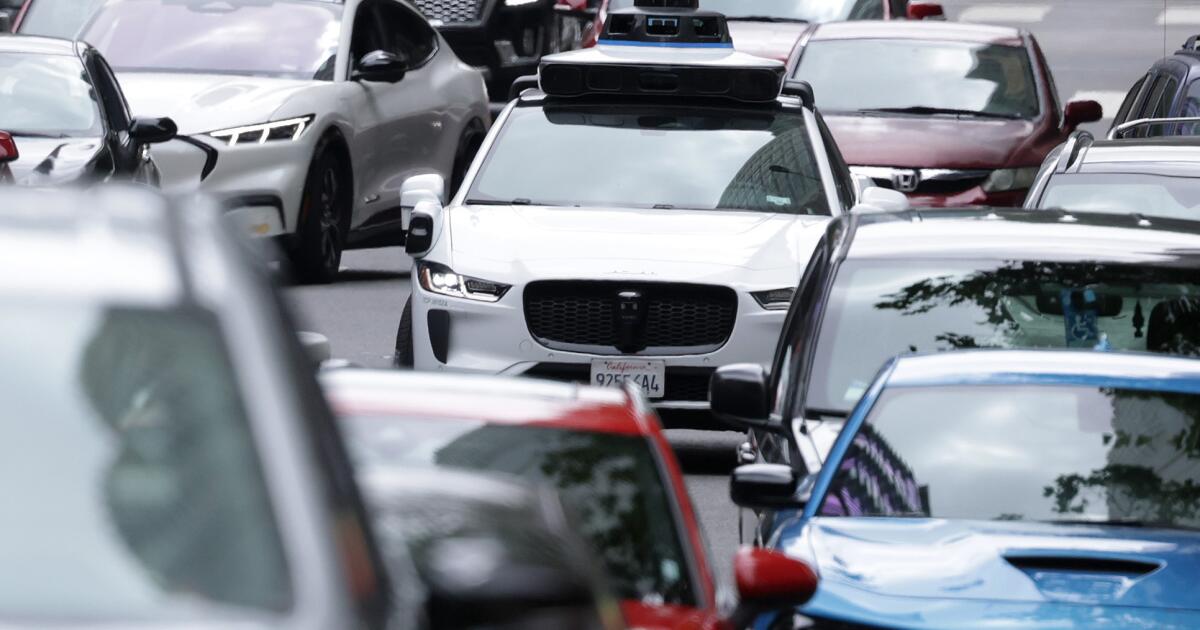
Waymo is recalling 3,791 autonomous taxis after a software defect caused some vehicles to drive into flooded roadways, according to a recall report from the National Highway Traffic Safety Association.
The voluntary recall filed April 30 affects Waymo vehicles operating on the company’s fifth and sixth generation Automated Driving System. The software “may allow the vehicle to slow and then drive into standing water on higher speed roadways,” a NHTSA report said.
“Entering a flooded roadway can cause a loss of vehicle control, increasing the risk of a crash or injury,” NHTSA said.
The recall followed severe weather in San Antonio, during which a Waymo entered a flooded and impassable road, the company said.
In response, Waymo has increased weather-related constraints on its vehicles and says it is working on additional software safeguards.
“We have identified an area of improvement regarding untraversable flooded lanes specific to higher-speed roadways, and have made the decision to file a voluntary software recall with NHTSA related to this scenario,” a Waymo spokesperson said. “Waymo provides over half a million trips every week in some of the most challenging driving environments across the U.S., and safety is our primary priority.”
Waymo operates in 10 major cities and has issued prior safety-related recalls. Last year, the company recalled more than 1,200 autonomous vehicles after minor crashes involving obstacles in the road.
The Alphabet-owned company has also come under fire for safety incidents, including striking a child outside a school in Santa Monica earlier this year and fatally running over a neighborhood cat in San Francisco.
According to data collected by Waymo over 170 million fully autonomous miles driven, Waymo is 13 times safer than human drivers in crashes involving pedestrians.
The Mountain View-based company is currently ahead in the race to scale robotaxis across the country, with thousands of vehicles transporting paying customers in cities including Los Angeles, Miami and Phoenix.
Competitors Zoox and Tesla are trying to catch up with their own self-driving technology, but have yet to match Waymo’s scale and reach.
According to NHSTA, all affected Waymo vehicles received an interim software update to mitigate the issue, but a full remedy for the recall is still under development.
-

 Technology7 minutes ago
Musk v. Altman proved that AI is led by the wrong people
-

 World13 minutes ago
Bodies of four missing Italian divers found inside ‘shark cave’ in Maldives days after they vanished
-

 Politics19 minutes ago
Dem who welcomed socialist mayor’s ‘change’ now sounding alarm over billionaire exodus: ‘Gravely concerned’
-

 Health25 minutes ago
New pancreatic cancer pill could reshape treatment as early trial results stun researchers
-

 Sports31 minutes ago
Ex-NFL star implores Russell Wilson to hang it up: ‘Do your TV thing’
-

 Technology37 minutes ago
Amazon recall text scam comes with red flags
-
Business43 minutes ago
Jury rejects Elon Musk’s lawsuit, sides with OpenAI in bitter feud over AI future
-
 Entertainment49 minutes ago
Anderson Cooper bids ’60 Minutes’ a final goodbye

