Connect with us

New Hampshire

More NH water systems need to treat for PFAS chemicals under new federal rules

Published

on

More NH water systems need to treat for PFAS chemicals under new federal rules


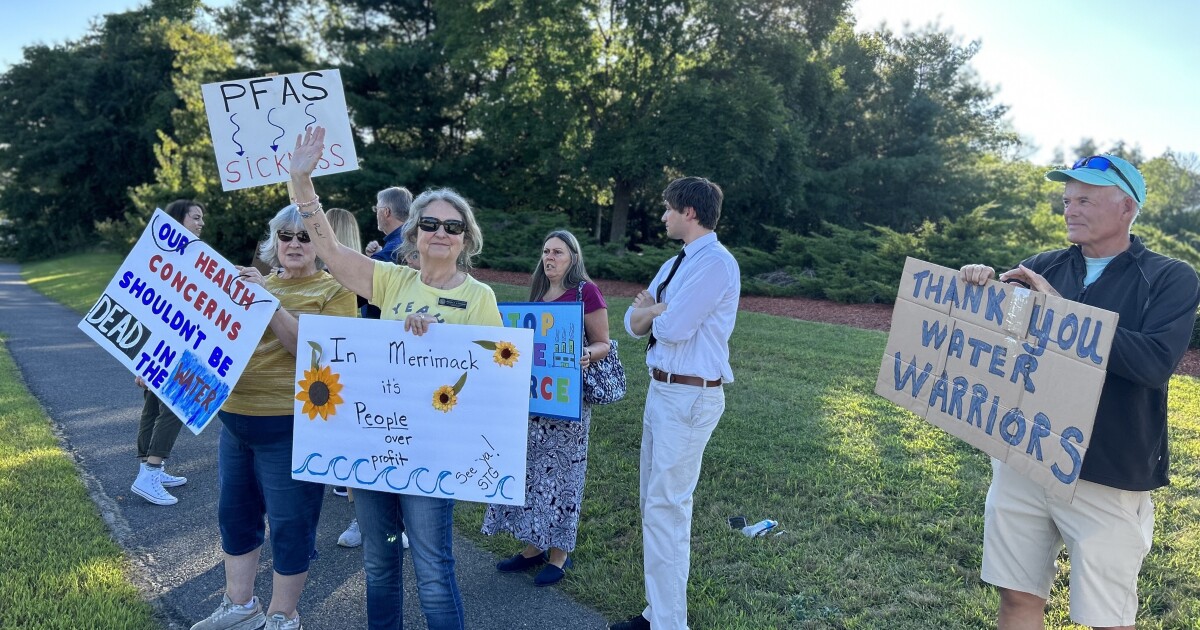
Advocates in New Hampshire are celebrating new federal regulations to limit PFAS chemicals in drinking water, after years of fighting for stronger protections for communities that have suffered from contaminated water.

That group of man-made chemicals have been used for decades in consumer products — especially those that are waterproof, stain resistant, or non-stick. They’re often called “forever chemicals,” because they persist and accumulate in the environment and in peoples’ bodies.

Studies show most people in the U.S. have some PFAS in their blood, and long-term exposure can cause cancer or other negative health effects.

New Hampshire was the first state to require local water systems, landfills, and wastewater plants to test for PFAS and treat water that had been contaminated on a regular basis. In 2019, the state adopted the strictest standards in the U.S. at the time.

Advertisement

But the federal regulations announced Wednesday limit certain kinds of PFAS to lower levels than New Hampshire does currently — limiting two main PFAS chemicals, PFOA and PFOS, to 4 parts per trillion, others to 10 parts per trillion, and implementing limits on mixtures of certain PFAS.

“This certainly isn’t the end of the road; there’s a lot more work to be done, but this is a humongous step in the right direction and one that will benefit so many people,” said Andrea Amico, a longtime advocate who started the group Testing for Pease after her family was exposed to PFAS on the former Pease Air Force Base on the Seacoast.

Next month, Amico said, it will have been a decade since she first learned about the contamination.

“I was shocked 10 years ago when I first learned about PFAS contamination in our public drinking water and couldn’t understand how these chemicals weren’t regulated, how there were no laws to protect people from drinking this,” she said. “Ten years is a long time. But I’m just really grateful that we’re at this point and that this is a huge milestone that we can continue to build off of.”

Implementing new standards

Under the new federal rules, regulated water systems will have three years to monitor for chemicals and five years to treat the water to reduce levels. That treatment could include installing technologies like granular activated carbon or reverse osmosis in contaminated water systems, or shutting down contaminated wells and finding uncontaminated sources of water.

Advertisement

The EPA says $9 billion will be available through the Bipartisan Infrastructure Law to fund PFAS remediation and another $12 billion is available for general drinking water improvements that could include PFAS.

In New Hampshire, state officials said the new regulations could double the number of water systems and private wells in New Hampshire that exceed legal standards.

New Hampshire Department of Environmental Services Commissioner Bob Scott said the state anticipated the new federal standards — but, he said, there could be barriers to implementing them.

“We expect that these lower federal drinking water standards will result in more water systems and private well owners needing financial assistance to be in compliance, which will require a greater commitment on behalf of the federal government than the funding mentioned in their announcement,” he said in a written statement.

State officials said addressing PFAS contamination in New Hampshire has already cost more than $300 million, a cost they say has fallen on state and local governments. In the statement from the Department of Environmental Services, officials said the cost of complying with the new regulations would be more than what state and federal assistance could cover.

Advertisement

In their fact sheet on the new rules, the EPA said the benefits of addressing PFAS exposure would justify the costs.

“Fewer people will get cancer or liver disease, pregnant women will have reduced risks, and more and children and infants will be stronger and grow healthier,” the agency said.

Federal officials estimated that compliance with the new rules would cost $1.5 billion per year nationally — a cost they said was equal to the avoided expenses of medical bills, income lost to illness and death.

For communities whose PFAS contamination comes from a specific source — like the Department of Defense, at the former Pease Air Force Base — the party that created the contamination should be responsible for the cost of cleaning it up, said Amico with Testing for Pease.

New Hampshire lawmakers have tried to implement other measures to limit the amount of PFAS residents are exposed to, including an effort this year to place restrictions on products with intentionally added PFAS, and another to require notice of PFAS contamination prior to selling property.

Advertisement

Laurene Allen, a co-founder of Merrimack Citizens for Clean Water, said the news of federal regulations was welcome. She’s hoping New Hampshire’s timeline for implementing them will be faster than other parts of the country.

“I’m really relieved and happy. And I also strongly urge the state of New Hampshire to adopt these standards as soon as possible, not to wait for the full phase in period, because we don’t need to. We are ahead of the nation, we have done the testing,” she said. “We can lead the nation. We can do right by the people of New Hampshire.”

She said the town of Merrimack’s success in addressing PFAS contamination in public water and minimizing local financial impacts shows that it is realistic and attainable to remediate on a larger scale.

“Lives are at stake here,” she said. “That’s what we have to remember.”

Advertisement


Source link

New Hampshire

High winds, heavy rains lead to scattered NH outages

Published

on

High winds, heavy rains lead to scattered NH outages


High winds and widespread rain contributed to more than 12,000 power outages Saturday as a low pressure system passes over New Hampshire.

A high wind advisory remains in effect for southeastern New Hampshire until midday.

There is a high surf advisory in effect for the Seacoast area until 8 p.m. Saturday, with large-breaking waves in the range of 6-9 feet, according to the National Weather Service.

The forecast warns of dangerous wintry winds for hikers and campers, with heavy wet snow likely at higher elevations and a foot of snow possible on summits in the White Mountains.

Advertisement

In southeastern New Hampshire, the wind advisory calls for steady winds of 15-25 mph, and potential wind gusts up to 50 mph.

Eversource reported over 10,000 outages as of 9:30 a.m. Unitil had about 1,400 outages at that time.

The Mount Washington Observatory has recorded winterlike weather over the past 24 hours. Weather observers there say over half a foot of snow and sleet has fallen at the summit.

The Mount Washington Observatory reported Saturday morning that half a foot of sleet and snow was recorded in the past w4 hours at the summit.


Source link

Advertisement
Continue Reading

New Hampshire

Opinion: The farm bill passed the House. Western New Hampshire got the bill. – Concord Monitor

Published

on

Opinion: The farm bill passed the House. Western New Hampshire got the bill. – Concord Monitor


In 1794, George Washington wrote that he knew of “no pursuit in which more zeal and important service can be rendered to any Country than by improving its agriculture.” Two hundred and thirty years later, the House just passed a farm bill that proves his successors stopped believing it. 

Drive Route 12 through Walpole. Take Route 10 up through Haverhill. Cut across to Littleton, past the diner that has been feeding the town since 1930. The farms are there. Lush land that produces. People who work till their sweat and blood soak the ground they nurture. A region with every ingredient to feed itself.

What is not there is the processing facility that makes it worth raising the animal. The cold storage that keeps the crop from spoiling before it finds a buyer. The regional market that pays a price worth planting for. I want to believe Washington did not forget to build those things. Regardless, it built something else instead — a system that works beautifully for an operation running 10,000 acres in the Midwest and leaves the farmer on Route 12 doing the math at the kitchen table at midnight wondering if this is the last season.

Advertisement

And the 2026 Farm Bill just made that system more expensive to survive. Large commodity operations received a $54 billion subsidy increase over the next 10 years, with individual payment caps that can exceed $900,000 per operation. Is the farmer at your farmers market in position for this kind of payout?

The bill guarantees money, codified by law, for the people who need it least. Local food programs were reauthorized with zero mandatory funding, but plenty of empty words. They exist on paper and nowhere else. It means a farmer in Plainfield cannot count on them. It means Coos County, where one in seven people cannot reliably put food on the table, keeps waiting for help that has been promised and deferred so many times the promise itself has become an insult. Especially when supermarkets and superstores — just 15% of SNAP-accepting establishments — vacuum up nearly 74% of every food assistance dollar, while the local farm stand sees almost none of it.

And that is before the input costs.

Local farmers know this better than most. You buy fuel and fertilizer on global markets you have no vote in and no say over. Russia invaded Ukraine in 2022, causing record high prices for fertilizers globally, all because Russia is the world’s top exporter and suddenly it wasn’t exporting. And while that news cycle is long buried, remember that the Iran war has closed the Strait of Hormuz, through which a third of the world’s seaborne fertilizer travels. Diesel recently crossed $5 a gallon, which large trucks that move food and tractors rely on. Fertilizer went from $500 a ton to $850. One tractor cost $350 more than it did last year. You did not start either of those wars, yet you pay for both of them. And that is not even accounting for the sharp sting of tariffs on the inputs you depend on to plant next season.

Chapter 12 farm bankruptcies rose 55% in 2024. Then another 46% in 2025, and those numbers only count the farms that qualified for Chapter 12, which requires the majority of family income to come from farming. The ones that don’t qualify quietly disappear, not even a balance sheet to mark the years of struggle, labor and community these farmers gave. They just stop. Since 2018, this country has lost more than 158,000 farms, with every size category shrinking except operations over a million dollars in annual revenue. Those are still growing, and will do so as long as the policy is written to grow them. Another example of an unlevel playing field where the rich get richer.

Advertisement

To be clear about something: large-scale agriculture feeds a lot of people and nobody sat in a room and decided to destroy the small farm. But does intent matter when these are the results? The system produces what it was designed to produce. That is exactly the problem. It was not designed with you in mind, and after enough years of that, the results look intentional even when they are not.

I got involved locally here because I believe western New Hampshire has everything it needs to feed itself and then some. Four thousand farms, nearly half a million acres, led by a direct-sales culture that leads the entire country. What is missing is not the land or the people or the will. What is missing is a representative who walks into bill negotiations fighting for the farmer on Route 12 instead of the operation collecting a $900,000 subsidy check in a state they have never visited, and pretending it actually helps their constituents.

I have a specific plan for how existing federal dollars already flowing into this district get redirected toward processing, storage and regional market access that actually serves the farms here. No new appropriations. No new programs. A full breakdown is at livefreenh02.com/food-independence.

Daniel Webster, born thirty miles from where I am writing this, put it in the Capitol: “The farmers, therefore, are the founders of human civilization.” Washington and Webster were not just statesmen. They farmed. They understood what was at stake when the land stopped producing for the people who worked it. The authors of the 2026 farm bill apparently do not.

Robbie Mahrou is an independent candidate for U.S. Congress in New Hampshire’s Second District and a Walpole resident. She can be reached out robbie@livefreenh02.com.

Advertisement


Source link

Continue Reading

New Hampshire

RFK Jr. visits NH to unveil new federal actions to fight Lyme disease

Published

on

RFK Jr. visits NH to unveil new federal actions to fight Lyme disease


U.S. Health Secretary Robert F. Kennedy Jr. visited Concord on Friday to discuss a new health initiative to prevent and combat Lyme disease.

The visit was part of the “Take Back Your Health” campaign tour, a multimillion dollar initiative to promote dietary changes and exercise as preventative measures for chronic illness. Kennedy has been traveling the country to outline projects, including changing federal dietary guidelines, gut microbiome research, and addiction recovery.

Kennedy said his goal was to reduce Lyme disease by 25% by 2035.

Kennedy announced that over $2 million of federal funding will be up for grabs for projects focused on the prevention and treatment of Lyme disease. The grants, through a program called LymeX, will be available to businesses, scientists, and the public.

Advertisement

At the press conference Friday, Kennedy said the grants will go to projects including education tools and public awareness campaigns, front-line solutions like medication, and AI technology.

“This initiative will harness artificial intelligence and open data to help patients with Lyme disease and other invisible illnesses. Get answers faster and connect to care sooner,” he said.

Lyme in NH

New Hampshire has long been one of the epicenters for Lyme disease. The state has the seventh highest rate of Lyme disease in the country, according to the most recent data from 2023.

Read more: It’s tick season in New England. Here’s how to stay safe.

Tick season is a well-established time of year in New England, with an increase in cases and hospital visits in April and May. Research from Dartmouth shows half of adult blacklegged ticks in the Northeast carry the bacteria that causes Lyme disease.

Advertisement

In a health advisory issued on Wednesday, State Epidemiologist Benjamin Chan pointed out that Lyme disease is one of the most common infections spread through tick bites. Other tick-borne infections include anaplasmosis, babesiosis, and Powassan virus.

Lyme is also the most common tick-borne illness in America, with an estimated 476,000 people getting the disease each year nationwide, according to the New Hampshire Department of Health and Human Service.

Kennedy’s record on Lyme disease

In the past, Kennedy has promoted a conspiracy theory that Lyme disease was bioengineered by the U.S. military. Late last year, he advocated for an investigation into a possible link between the military and the disease as part of a provision in a new defense bill, Scientific American and Politico reported.

Around that time, Kennedy said many patients’ claims were ignored, and he announced that “the gaslighting of Lyme patients is over.”

As an anti-vaccine activist, Kennedy launched a bid for the Democratic nomination for president in 2024. He then ran briefly as an independent before quitting and endorsing Donald Trump.

Advertisement

Trump later nominated him for health secretary, and he was confirmed by the Senate in early 2025 on a party-line vote.

Kennedy is the nephew of former President John F. Kennedy, and a son of Robert F. Kennedy, who was slain during his campaign for president in 1968. In his own bid for the White House, RFK Jr.’s name was never on the ballot in New Hampshire. In mid-2024, a UNH Survey Center poll found he mustered only 3% support among likely voters.

More resources

What to do if you’ve been bitten by a tick: Step one, don’t panic.

Tick season: How not to get bit

Advertisement


Source link

Continue Reading
Advertisement

Trending