Business
Momofuku responds to chili crunch backlash: 'We wanted a name we could own'

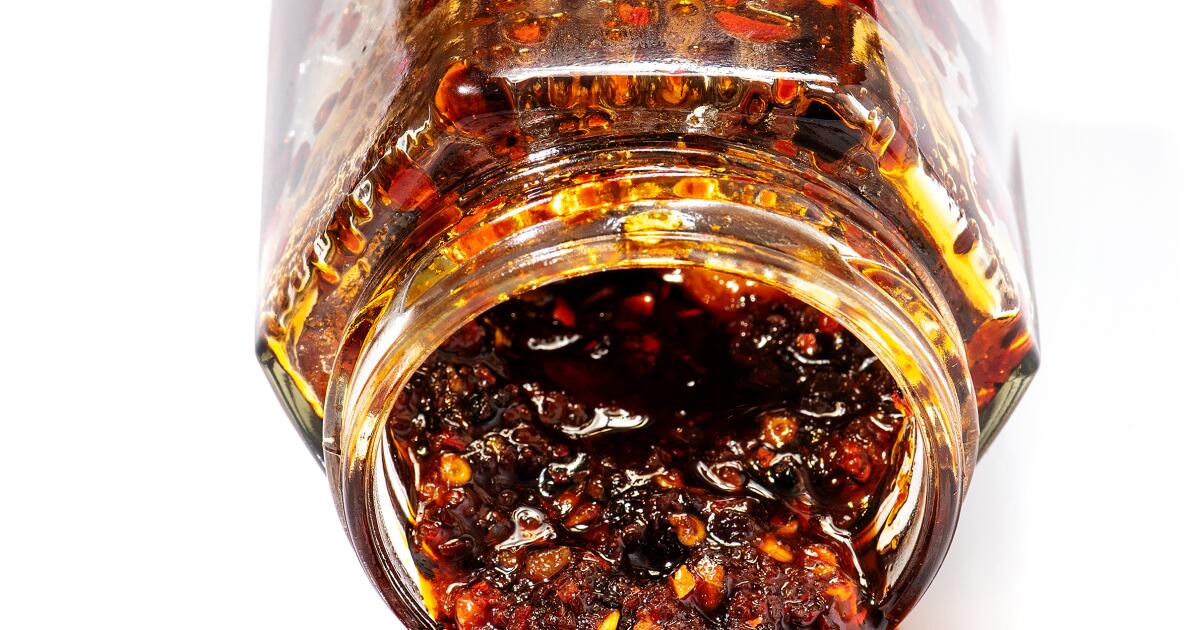
Imagine walking into a grocery store and seeing a single brand of each item. Identical squeeze bottles of “Ketchup.” One company’s “Mustard.” One brand of “Salsa.” Just one maker’s “Hot Sauce.” What a bland world it would be.
If Momofuku has its way, the only “Chili Crunch” on store shelves will bear the name Momofuku.
Momofuku, founded by chef David Chang, acquired the rights to use “chile crunch,” spelled with an “e,” last year from Chile Colonial LLC, a Denver company that registered the trademark in 2015 with the United States Patent and Trademark Office after making a Mexican-inspired chile crunch sauce since 2008. Then on March 29, Momofuku filed a trademark application for the term “chili crunch,” spelled with an “i,” and started sending cease and desist orders to multiple businesses selling chili crunch products, the Guardian first reported.
A jar of Momofuku chili crunch.
(Mariah Tauger / Los Angeles Times)
Social media backlash immediately followed. Actor Simu Liu, who serves as the chief content officer for MìLà, a food and beverage company that makes frozen dumplings and chili crunch, challenged Momofuku to a blind taste test on Twitter last week: “Winner keeps the name, loser (it’ll be you) backs off.”
In a statement to The Times, a spokesperson for Momofuku said the company has seen multiple chili crisp products rebranded as chili crunch over the last year, and that the trademark was never intended to “stifle innovation in a category that we care deeply about.”
“When we created our product, we wanted a name we could own and intentionally picked ‘Chili Crunch’ to further differentiate it from the broader chili crisp category,” the spokesperson wrote in an email. “We worked with a family-owned company called Chile Colonial to purchase the trademark from them. They have defended the trademark previously against companies like Trader Joe’s.”
One of the voices critical of Momofuku threatening legal action against other chile sauce businesses was Fly by Jing chef and entrepreneur Jing Gao. She started bottling Sichuan chili crisp in 2018, and is often credited as the catalyst for the mainstreaming of chili crisp. She is also an investor and advisor in Homiah, one of the brands that received a cease and desist letter.
Gao’s own company, as multiple outlets reported, filed to trademark “Sichuan Chili Crisp” in 2019 only to see its application dismissed in 2020.
“The ‘chile crunch’ trademark should also not have been granted,” wrote Gao in a Substack newsletter titled “On Trademark Bullies.” “It is a descriptive term for a cultural product, one that has existed in Chinese cuisine for hundreds of years.”
A jar of Fly by Jing Sichuan Chili Crisp by Jing Gao. Gao is credited with starting the current chili sauce craze with the introduction of her chili crisp in 2018.
(Mariah Tauger / Los Angeles Times)
What the newsletter and other stories did not mention , however, is that last week, on April 3, Fly by Jing filed again to trademark “Sichuan Chili Crisp,” according to the U.S. Patent and Trade Office. Then on Monday, Gao said in a statement to The Times that she requested to withdraw the application.
Gao said Fly by Jing reapplied for “Sichuan Chili Crisp” as well as “Chengdu Crunch” “to safeguard against the potential that we need to defend ourselves against a larger power that may be threatened by our existence. In light of the events of the last two days however, we now believe that there’s been enough awareness raised about the descriptive nature of the term, that the USPTO will reconsider the chili/chile crunch trademarks, and we felt comfortable with filing a request to abandon the application for our product’s name, which we have already done as of Saturday.”
“Even if we were granted the trademark for Sichuan Chili Crisp, which we have now abandoned, Fly By Jing would not have used it to intimidate small businesses,” wrote Jing.
Yet if Fly by Jing had been granted a trademark, the company would be responsible for enforcing it, as outlined by the United States Patent and Trademark Office. By not protecting your trademark, you could lose it.
If I had my way, neither term would be trademarked.
David Tran, founder of the Huy Fong Foods Sriracha sauce, never sought to exclusively own the term “Sriracha.” Instead, he trademarked his signature rooster logo and bottle.
I reject the notion that someone could exclusively own something so ingrained in my culture, a food I consider an intrinsic part of my identity. These trademarks will limit who can profit off a food with a connection to entire cultures. It would be like someone trying to trademark salsa macha and salsa verde. Wait, inexplicably somebody did trademark salsa verde, signaling a serious problem with the USPTO lacking the knowledge to accurately or fairly determine what’s descriptive or confusing when it comes to certain foods.
I, like many Chinese Americans, feel a sense of pride and ownership over the condiment typically made with garlic, other alliums, chiles and oil. Whether you call it crisp, oil, crunch or sauce, it’s a condiment that’s integral to the cuisines, cultures and experiences of Asian Americans around the world.
Michelle Tew, founder and CEO of Homiah foods, called receiving her cease and desist letter a “punch in the gut.”
“Homiah’s Sambal Chili Crunch product is personal and based on a family recipe from my Granny Nonie dating back to countless generations of Nyonya heritage in Penang, Malaysia,” Tew wrote in a statement on LinkedIn. “I was shocked and disappointed that a well-known and respected player in the Asian food industry would legally threaten me — a one-woman show operating on a much smaller scale — from selling a product that is part of my family’s history and culture.”
The move to trademark “chili crunch,” whether intentional or not, will only serve to whitewash an entire genre of chile sauces. Although some of the sauce companies have strong financial backing — according to Forbes, Momofuku raised $17.5 million in funding last year with $50 million in sales, MìLà recently raised $22.5 million and Fly by Jing raised 12 million last year — many of these products are made by small AAPI-owned companies.
All deserve a piece of the more than $3 billion hot sauce industry in the United States. And that number is expected to nearly double in the next decade, according to a market report by Fortune Business Insights.
A jar of chile sauce can be found on most tables at restaurants serving dumplings in the San Gabriel Valley.
(Mariah Tauger / Los Angeles Times)
Melody and Russ Stein’s pizza company Pi00a (pronounced pie-oh-ah) started selling jars of chili crunch when they launched a ghost kitchen in Koreatown last year with their children, Taysia and Rylan. Pi00a is a Deaf- and family-owned business, selling Neapolitan pizzas with Asian influences and a mission to provide jobs for the hard of hearing.
For a soppressata pizza, Melody came up with her own version of chili crunch, something “sweet and spicy” that goes with the Italian dry salume, she said over the phone with her daughter as interpreter. “People liked it and started asking for jars of it,” and Pi00a now sells about 100 jars a week through its online business and 40 retailers.
“We just started our small business, it costs a lot of money to rebrand. It’s very difficult to absorb any added expense. We just hope [Momofuku] realizes the impact this has on the community and they drop the trademarks.”
Kansas City chef James Chang, who makes a chili crunch of his own, wrote in an Instagram post referencing the cease and desist letters, “While I have not received one yet it’s only a matter of time. … For someone that has railed against how ethnic aisles in grocery stores do not have enough minority-owned brands [David Chang] is doing just the goddamn same. Instead of creating a community he wants to create a monopoly.”
A collection of chile oil, crisp and crunch.
(Mariah Tauger / Los Angeles Times)
You can find a jar of chile sauce that’s half oil, half chile-and-garlic sediment on the tables at most restaurants serving dumplings in the San Gabriel Valley. Many make the sauce themselves.
Before it was a trendy condiment found at every superette (and even Costco), there were half-empty jars of Lao Gan Ma spicy chili crisp with crust around the lids in my fridge and on my family dinner table. My Chinese grandmother and uncle introduced me to Lao Gan Ma spicy chili crisp in the late ‘90s. It’s a sludge-like combination of dried chiles, crispy onions, MSG and fermented soybeans. For years I called it chili crunchy. I could never remember the name, and simply asked for more of that “chili crunchy stuff with the stern lady.”
The sauce was created by Tao Huabi in Guizhou, China, in 1984. Hers is the face on every bottle.
Nearly a decade ago, I brought Lao Gan Ma to a hot sauce taste-off with the late Jonathan Gold and Kogi BBQ chef Roy Choi. The chili crunchy stuff with the stern lady on the bottle was the clear winner.
“Sauce invented by our ancestors, our version perfected for 30+ years … ,” wrote the makers of Bowl Cut chili crisp on Instagram. “No one should own a trademark for the description of a sauce that’s been around forever.”
Chili crunch belongs to everyone.
Deputy Food editor Betty Hallock contributed to this report.


Gov. Gavin Newsom signed a law Thursday to crack down on inflated profits stemming from car crash lawsuits, blessing a hard-fought compromise between Uber and the state’s trial attorneys that averts a November showdown between two of California’s most powerful and moneyed lobbying forces.
The deal, the fruit of months of negotiations, takes aim at the lucrative way doctors can charge for procedures on patients referred to them by personal injury lawyers.
If a law firm has a client who was hurt in a car accident, the lawyer will often send them to a doctor who will perform surgery on a “lien” basis, meaning the doctor will be paid from money that comes from a lawsuit settlement rather than through insurance.
Uber contends this arrangement has created an incentive for doctors and attorneys to collude to dramatically inflate medical bills. The more expensive the bill, they say, the bigger the resulting payout.
The law, SB 623, caps how much these doctors can charge when their patient is involved in a lawsuit against a ride-share company, which are frequent targets of litigation due to their top-of-the-line insurance policies. The new law will also require Uber to ramp up background checks of its drivers.
“We’re going to have a much safer state both for medical patients and passengers in Ubers,” said Nicholas Rowley, a prominent Texas attorney who helped bankroll the fight and took a leading role in the negotiations.
The law only applies to cases that involve ride-share accidents that take place after Jan. 1, 2027.
“This legislation puts meaningful guardrails in place to better protect accident victims, increase transparency and accountability in the medical lien system and strengthen safety,” said Ramona Prieto, Uber’s head of public policy for the Western U.S., in a statement.
For months, Uber and lawyers from across the state poured tens of millions into dueling ballot measures that threatened to devastate the profits of whichever side lost.
Uber fired the first shot with a ballot measure that sought to cap how much attorneys can earn in lawsuits involving auto accidents. The company argued attorneys were swindling their own clients, inflating medical bills of car crash victims to increase the value of the settlement and then pocketing a hefty chunk of the payouts.
The state’s trial attorneys countered that the fee cap would make small or difficult cases a money-losing endeavor and block scores of accident victims from the courts. They shot back with their own ballot measure that would increase legal liability for ride-share companies if a passenger or driver is sexually assaulted while on a ride, seizing on investigative reporting that highlighted assaults in Ubers.
“They were waiting for us to blink and we didn’t,” said Douglas Saeltzer, the head of the Consumer Attorneys of California, the lawyer trade group that pushed for the measure against Uber. “Their starting place, I don’t believe, was in the interest of protecting victims — it was in the interest of protecting Uber.”
With the passage of Thursday’s law, both sides have agreed to pull their respective measures from the November ballot, halting campaigns that had both parties amassing tens of millions in funding and blanketing the airwaves with ads.
“Now we can stop seeing all the commercials,” said Assemblymember Blanca Pancheo (D-Downey) at a Tuesday hearing.
The law, put forward by Assemblymember Diane Papan (D-San Mateo) and Sen. Thomas Umberg (D-Santa Ana), also caps the amount that can be earned by third-party investors who buy out a doctor’s lien in a personal injury case. These companies will purchase a doctor’s stake in the case at a reduced rate, then pocket a share of the payout if the case settles.
“Private equity and hedge funds buy them at a steep discount, then turn around and collect the full inflated amount,” Saeltzer said at a Tuesday hearing on the bill. “That’s money flowing to Wall Street investors, not patients.”
The law will require annual background checks for ride-share drivers and expand the list of offenses that disqualify someone from the job.
In addition to the ballot battle, has Uber sued two of LA’s most well-known personal injury firms — the Law Offices of Jacob Emrani and Downtown L.A. Law Group — accusing them of inflating medical bills and forcing clients to undergo needless and expensive surgeries to inflate the value of the claim. The firms asked the judge to dismiss the case Wednesday, arguing Uber had failed to prove fraud. Both firms have vehemently denied wrongdoing.
The lawsuit, filed last year, has put the plaintiff lawyers in the unusual position of playing defense. Listening in the audience at Wednesday’s hearings were the partners of Downtown L.A. Law Group and Jacob Emrani.
“Let’s be clear about what this Uber case really is,” said John Hueston, outside counsel for Emrani. “It’s brought by a $150 billion dollar company … to intimidate the plaintiff’s bar, exhaust its resources and chill the suits that hold Uber accountable.”
Michael Huston, one of the lawyers who represents Uber, countered that the case is “not an attack on the plaintiff’s bar.”
“We have brought suit against the two in this state … that are engaged in naked fraud,” he said.
Business
Snap CEO Evan Spiegel and Miranda Kerr help erase $550 million in medical debt for Californians

Snap Chief Executive Evan Spiegel and his wife, supermodel Miranda Kerr, have helped pay off $550 million in medical debt for more than 261,000 Californians.
The couple made a multimillion-dollar donation to Undue Medical Debt, a nonprofit that provides debt relief to people in financial need. The organization acquires medical debt in bulk from hospitals, physician groups, collection agencies and other groups for a fraction of the cost.
“When someone you love is sick. All you want to do is focus on helping them get better,” Kerr said in a video with Spiegel. “That’s why we wanted to support this effort and help relieve medical debt, so families can focus on caring for their loved ones and really supporting their healing.”
The couple and the nonprofit didn’t disclose the exact amount of the donation, but a small gift can go a long way. Every $10 donated to Undue Medical Debt relieves an average of $1,000 in medical debt.
The gift comes as Americans struggle with the medical debt and rising cost of living. California is one of the most expensive states to live in because of soaring housing costs and energy prices. Concerns about wealth inequality have sparked heated political debates about how much billionaires should contribute.
In the United States, 1 in 4 adults are in medical debt, said Undue Medical Debt President and Chief Executive Allison Sesso in a statement.
“It’s a growing crisis undermining healthcare access, economic wellbeing and mental health and we’re so grateful that Evan Spiegel and Miranda Kerr share our belief that no one should go bankrupt because of a cancer diagnosis and no family should have to choose between insulin and groceries,” she said.
Californians whose medical debt have been paid off will start receiving a letter in mid-July from Undue Medical Debt informing them of the debt relief. Individuals can’t request debt relief because the nonprofit acquires bundled debt for thousands of people at once. Those who qualify for debt relief either earn at or below 400% of the federal poverty level or have medical debt that is more than 5% of their income, the nonprofit says on its website.
San Diego County residents benefited the most from the donation with total medical debt relief through the couple’s gift totaling roughly $99 million and affecting 40,369 people. In Los Angeles County, the gift provided $26.7 million in medical debt relief to 17,466 people, according to the nonprofit.
Spiegel, whose net worth is roughly $2 billion, and Kerr have helped relieve debt for others in the past. In 2022, the couple paid off the student loans for the Otis College of Art and Design’s graduating class.
In 2025, Spiegel was among business leaders and philanthropists who helped form the Department of Angels, a group that aims to help L.A.’s fire recovery efforts. The California Community Foundation, Snap, Spiegel and Snapchat co-founder Bobby Murphy committed $10 million to help start that group.
Roughly 200,000 people lost their homes in the January 2025 Los Angeles County wildfires. Spiegel, who grew up in Pacific Palisades and lost his childhood home in the fires, donated $5 million in immediate aid with Snap and Murphy that month.
He said in a statement that California has given so much to him and his family and that he cares “deeply about the wellbeing of our communities.”
“At a time when many families are already facing rising costs across nearly every aspect of daily life, an unexpected medical bill can create financial stress that lasts for years,” Spiegel said.
Undue Medical Debt said it’s abolished more than $40 billion of medical debt in all 50 states.

The electric vehicle company Slate Auto set out in 2022 to make the most affordable electric truck in the country. This week, it unveiled the price tag: $24,950.
At a time when demand for new electric vehicles is cooling and cars are getting harder to afford, Slate’s customizable truck could bring a fresh wave of excitement to the industry.
Deliveries will begin later this year and accelerate in 2027, the company said. Slate’s vehicle is built around a simple concept — pay only for what you actually want.
Buyers will start with a basic truck without power windows or even paint and can then customize it however they like. They can tailor-make their “blank slate” by paying extra for smart phone-compatible screens, speakers, colored wrap or paint. A $5,000 kit even converts the truck into an SUV.
Slate’s design team is based in Los Angeles County and recently moved into a new space in Carson, which employs about 50 workers. The company’s headquarters are in Troy, Mich., and its vehicles will be produced in Warsaw, Ind.
Squeezing out as much cost as possible while making it as easy as Legos to snap on different options has required complex engineering, which is why the company decided to set up its design studio in Southern California. The region is full of experts.
“Slate has done something smart,” said auto industry analyst Brian Moody. “Their EV isn’t only about price, there’s also a strong personalization element. In Southern California, the boxy, retro look will earn it a lot of attention.”


Slate is an EV startup that makes electric trucks and SUVs. Customers buy only the features they want. Photographed on Friday, Dec. 19, 2025. (Myung J. Chun/Los Angeles Times)
The company is building a marketplace of accessories for customers to choose from, including 54 basic wraps that cost less than $500 each. In contrast, a paint job on a car can cost thousands of dollars. The marketplace also offers roof stacks, zip-on seat covers and stereos.
For just under $30,000 total, customers can get a basic SUV in a fastback or squareback style. Whether it’s configured as a truck or SUV, the EV will have an estimated range of 205 miles and will be compatible with Tesla chargers.
“This is the first time in automotive history that consumers are going to get to choose,” said Slate Chief Executive Peter Faricy, who joined the company in March after 13 years with Amazon.
“It started with design, then engineering, and eventually manufacturing, and we figured out innovations in all three of those phases that make the vehicle less expensive,” he said.
For example, Slate vehicles were designed from the beginning to be wrapped instead of painted. The company will offer more than 100 colors of wrap at its launch, or customers can choose a custom color.
Slate did not disclose financial information or how much the vehicles cost to produce. However, Faricy said the company will generate a positive gross margin on its vehicles, meaning they are selling for more than what they cost to make.
“Whether Slate succeeds or fails, it has already influenced the conversation … forcing the industry to ask why affordable vehicles have become so rare,” said Jesse Toprak, an industry analyst and founder of OptiCar.ai. “They are betting on making higher profit margins on the accessories and do-it-yourself angle.”
Slate says it has already received more than 180,000 reservations. The earlier a customer placed their reservation, the sooner they’ll get their vehicle. Pre-orders opened Wednesday for $300, or $250 if the customer has already paid a $50 reservation fee.
Despite the hype, Slate is still a startup that has yet to prove itself in the market. The company has about 750 employees and has raised more than $700 million from Amazon’s Jeff Bezos and others.
“For the vehicle itself, the concept is brilliant,” Toprak said. “I think the execution risk is enormous.”
The EV industry has been under fire from the Trump administration, which has removed incentives for ownership and clean-car goals. Major automakers including Ford and Stellantis have pared back their EV offerings, and other startups have struggled to turn a profit.
The Irvine-based EV company Rivian, which hasn’t reached profitability since its founding in 2009, recently laid off hundreds of workers. It launched its highly anticipated R2 SUV earlier this month, which will eventually be available for less than $45,000.
Lucid, the luxury electric vehicle maker based in Newark, Calif., announced this week that it’s reducing its workforce by 18%. The cuts come just months after it laid off 319 Bay Area employees in February.
Faricy, Slate’s chief executive, said the company’s vehicle will appeal to a wide range of customers.
“There will be a lot of people that are attracted to the affordability but have never had an EV before,” he said.
According to Cox Automotive, the average transaction price for a new EV in the U.S. is $55,000, compared with $49,000 for a gas-powered vehicle.
“The EV market at this point doesn’t have a technology problem anymore,” Toprak said. “It has an affordability problem. Slate is one of the first companies built entirely around solving that.”
-

 Minneapolis, MN2 minutes ago
Reform, money and trust: Council members’ key criteria for Minneapolis’ next police chief
-

 Indianapolis, IN6 minutes ago
Ciara Myst is Indianapolis’ shapeshifting superstar on social media, too
-

 Pittsburg, PA11 minutes ago
Woman accused of stealing nearly $300,000 from Penn Hills refrigeration company
-

 Augusta, GA18 minutes ago
Augusta leaders take another look at downtown paid parking
-

 Washington, D.C21 minutes ago
DC unveils new government website to ‘eliminate alphabet soup’ – WTOP News
-

 Cleveland, OH26 minutes ago
Koby Altman Admits Meleek Thomas Doesn’t Perfectly Fit Cavs’ Roster
-

 Austin, TX33 minutes ago
When and where can I pop fireworks in Texas?
-

 Alabama36 minutes ago
Dale County superintendent named Alabama’s superintendent of the year

