Politics
California unlikely to meet landmark goals for reducing greenhouse gas emissions


Wind turbines rise above an array of solar panels at the Los Angeles Department of Water and Power’s Tree Wind Farm and Solar Power Plant in Kern County’s Tehachapi Mountains.
(Irfan Khan/Los Angeles Times)
California is poised to fail to meet its ambitious greenhouse gas reduction goals by the end of the decade unless it can triple its efforts to reduce carbon emissions statewide, according to a critical new report.
Although the state has pledged to slash planet-warming emissions by 40% of 1990 levels by 2030, the state is not on track to meet that commitment, according an analysis by the nonprofit group Next 10 and Beacon Economics, an L.A.-based consulting firm.
Based on the most recent data available from the state, emissions have fallen just 11.5% below those of 1990.
“Policymakers have set this goal and now need to make difficult decisions about trade-offs if they want to meet it,” said Stafford Nichols, research manager at Beacon.
While pollution plummeted after stay-at-home orders were issued during the pandemic in 2020, the state’s carbon emissions increased by 3.4% the following year, according to the analysis.
That will make it harder to meet the goal set by state lawmakers in a 2016 bill known as SB 32.
Based on the trajectory of reductions since 2010, California won’t attain the mandated goal until 2047, according to report authors.
The rise in 2021 emissions was driven by an increase in electric power generation, the report said. Because of the drought that year, the state used less hydropower and compensated with more energy from natural gas-fueled power plants, Nichols said.
That year there was also a 7.4% jump in emissions from transportation as the pandemic restrictions were loosened. Not only did Californians get back in their cars in 2021, but more people avoided public transit. Ridership in 2022 was 40% below what it was before the pandemic, the researchers found, setting back the state’s progress in reducing passenger vehicle emissions.
The report, called the California Green Innovation Index, provides an annual snapshot of the state’s decarbonization efforts. Nichols said researchers had become frustrated as state officials have taken longer to release emissions data. The numbers from 2021 were released just a couple months ago, he said.
He said calculations using more recent data would likely result in the need for an even quicker pace of carbon reductions to meet the 2030 goal.
The chairwoman of the California Air Resources Board — the agency tasked with overseeing greenhouse gas reductions — has taken issue with the study’s conclusion and insists that California is on track to meet its goals.
“Our preliminary data show that in 2022 the emissions started to move back down,” said Liane Randolph, who was appointed to lead the board by Gov. Gavin Newsom.
Randolph pointed out that even though the California economy rebounded in 2021 by 8%, emissions increased by just 3.4%.
“To me, that shows our programs are working,” she said. “It shows that we’re not only growing our economy, but we’re growing a fundamentally cleaner economy.”
Added Alex Stack, a spokesperson for Newsom: “We don’t shy away from ambitious goals, because that’s what it’ll take to make a difference. Our administration and CARB are taking the actions necessary to hit these goals.”
Details in the new report show how far the state has yet to go. The researchers calculated that the state had reduced emissions an average of 1.5% annually between 2010 and 2021. To reach the 2030 goal it would now have to reduce emissions by 4.6% a year.
California has only reduced emissions by more than 4% annually twice in the last two decades, and both years — 2009 and 2020 — were times of economic recession.
Despite the report’s prognosis, authors acknowledged that California is the third-most carbon-efficient state, after New York and Massachusetts. California’s carbon intensity is 8.8% lower than the national average, according to the report.
And while emissions from electricity production rose in 2021, they are still down more than 40% since 2000 and 12% since 2016.
The state also met its 2025 goal of having 1.5 million zero-emission vehicles on the road two years early, although sales of electric vehicles dropped for the first time in more than decade late last year.
“While California is well-positioned as a leader on climate, there are substantial obstacles to accelerating our decarbonization efforts in an equitable way that benefits all Californians,” said F. Noel Perry, Next 10’s founder. “These are not insurmountable, but we need to act urgently.”
The researchers highlighted how California could eliminate emissions by finding ways to decarbonize the the state’s cement factories. That industry accounts for 2% of the state’s emissions. Greenhouse gases from the eight plants that produced nearly all of the state’s cement increased by 26% from 2011 to 2021.
While the California plants are marginally more efficient than the average American cement factory, they emit about 33% more pollutants than those in China and India, the report said.
The new report was not the first to detail how the state was falling short of its climate goals.
In a report released last year, the nonpartisan Legislative Analyst’s Office, which advises state lawmakers, estimated that emissions had been falling an average of about 1% a year over the last decade and would need to fall 4% annually. That report said the California Air Resources Board lacked “a clear strategy” for meeting the 2030 goal.
The agency’s “estimated reductions are driven primarily by assumptions developed by CARB, without specifying how those assumed outcomes might be achieved,” that report said.


new video loaded: Steve Hilton Holds Slim Early Lead in California Governor’s Race
transcript
transcript
Steve Hilton Holds Slim Early Lead in California Governor’s Race
Steve Hilton, a Republican and former Fox News host, held a narrow lead in early votes over two Democratic opponents in California’s nonpartisan primary for governor. The top two candidates will advance to the general election in November.
-
“Change is coming to California, and it’s long overdue. I want to just say something from my heart to every single person who’s voted for me. We’re not — We’re not there yet, but it’s looking good.” [cheers] “Tonight, the people of the great state of California, in the greatest nation on earth, have spoken. [cheers] Loudly and proudly. [cheers] And while I take nothing for granted, there are lots of ballots left to be counted, it appears that we are on track to advance to November.” [cheers] “It might take some time to figure out where this is going. We’re going to wait until every ballot is counted. We’re going to give democracy a time to work, and we know we finished really strong.” [cheers]
By Axel Boada
June 3, 2026
Politics
Spencer Pratt surges to runoff in LA mayor’s race after angry voters send message to Karen Bass

NEWYou can now listen to Fox News articles!
Reality television personality Spencer Pratt appears on track to clear a key hurdle in Los Angeles’ mayoral race as he seeks to unseat incumbent Mayor Karen Bass in November.
Bass, who has led the city since 2022 amid a turbulent stretch rocked by her response to wildfires, advanced to a runoff after failing to secure a majority of the vote in Tuesday’s primary election. With no candidate surpassing the 50% threshold, the top two finishers will face off in a November runoff.
The anticipated runoff is a symbolic blow to Bass, who was endorsed by Gov. Gavin Newsom, D-Calif., and former Vice President Kamala Harris and has spent decades serving California in a series of elected Democratic offices.
Pratt, a first-time candidate known for the MTV reality show “The Hills,” was running in second place as of Wednesday morning.
Los Angeles Mayor Karen Bass attends the Women for Bass Phone bank event in the Baldwin Hills area of Los Angeles on June 1, 2026. (Louise Barnsley/Splash for Fox News Digital)
REALITY TV STAR SPENCER PRATT TESTS LA VOTERS’ APPETITE FOR POLITICAL OUTSIDER
“Obviously, God wanted five more months of me exposing the failures of our mayor,” Pratt gloated to reporters as the returns came in Tuesday evening.
Pratt has relentlessly hammered Bass on issues that have long plagued the city, including fire recovery, street homelessness and crime. The insurgent candidate holds Bass personally responsible for devastating wildfires that destroyed more than 18,000 structures in the city, including his Pacific Palisades home.
Pratt’s surge appears to have shut out Los Angeles City Council member Nithya Raman, a former ally of Bass who challenged the incumbent from the left and was once viewed as a threat to her bid for a second term. Raman is a member of the Democratic Socialists of America and has argued for steering the city in a more progressive direction.
Raman has not yet conceded despite running well behind Bass and Pratt as of Wednesday morning.
Pratt, a registered Republican, faces an uphill battle to defeat Bass in November if he advances to the runoff election.
Less than 20% of voters in the heavily Democratic city identify with the GOP, though Los Angeles’ mayoral contest is officially nonpartisan.
Media personality and independent candidate Spencer Pratt, left, pictured alongside LA mayor Karen Bass, right. (Robert Gauthier/Los Angeles Times via Getty Images; Justin Sullivan/Getty Images)
KAREN BASS GRILLED OVER BROKEN HOMELESSNESS PROMISE, BLAMES BUREAUCRACY FOR SLOWED PROGRESS
Rep. Darrell Issa, R-Calif., who represents a San Diego-anchored seat, told Fox News Digital that Pratt has won a following in the mayoral contest due to widespread voter discontent with Bass’ leadership.
“He’s catching fire among ardent historic Democrat voters because Karen Bass has been so ineffective,” Issa said in an interview. “And every time she opens her mouth, she’s talking about more of the same to people who have seen their streets, both crime-ridden and in fact … ineffectively managed.”
Bass, conversely, argues that her leadership is leading Los Angeles in the right direction.
“Los Angeles is at a turning point. After decades of rising homelessness, under-built housing and a shrinking police force, it’s Mayor Karen Bass who finally stepped up to change how City Hall works,” Bass’s website reads.
Los Angeles City Councilmember Nithya Raman appears likely to finish in third place, keeping her out of the November runoff. (Eric Thayer/Getty Images)
CLICK HERE TO DOWNLOAD THE FOX NEWS APP
“Homelessness is down, more housing is being built, and the LAPD is hiring new officers,” it also claims.
Fox News Digital’s Leo Briceno contributed reporting.
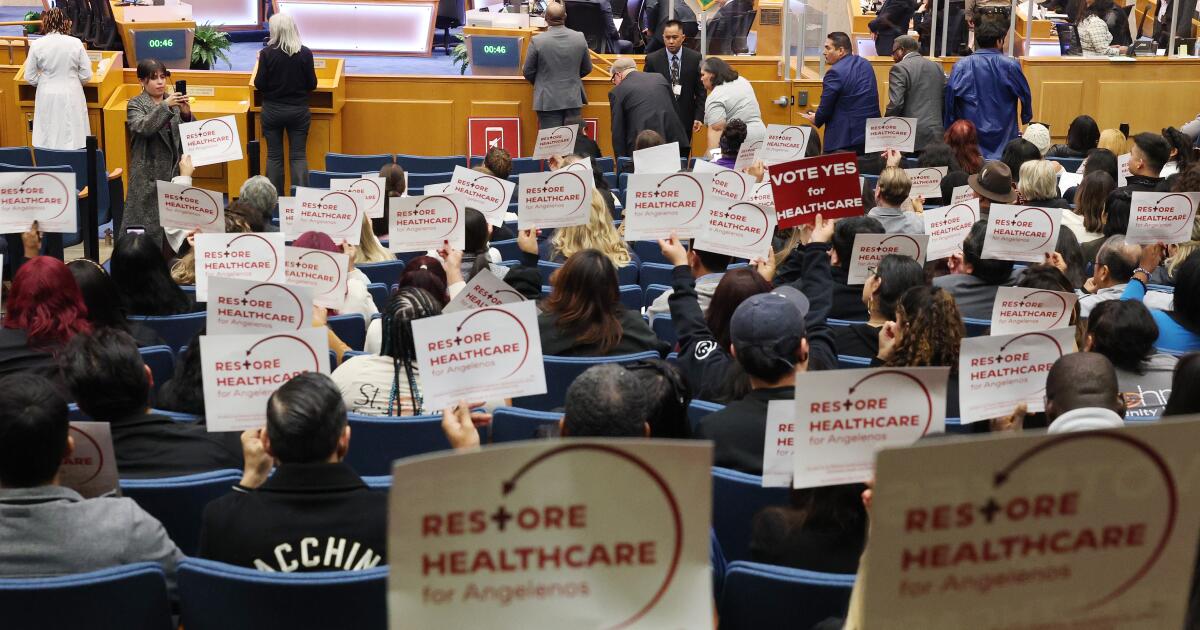
Los Angeles County’s half-cent sales tax to fund healthcare services was trailing Tuesday, with early returns showing a majority of voters rejecting the measure.
The tax — a half-penny of every dollar spent in the county — is meant to prop up local hospitals and clinics that are hemorrhaging funding after recent federal cuts.
The sales tax, which needs a simple majority to pass, would take effect Oct. 1 and last five years. Officials say it would pull in $1 billion annually to help plug the budget holes hitting local hospitals and clinics.
L.A. County health officials anticipate the One Big Beautiful Bill Act, signed into law by President Trump last summer, will slash more than $2 billion from the county’s health services budget within the next three years. Due to eligibility changes, the county will no longer be able to get reimbursements for many Californians who have lost Medi-Cal.
The measure was championed by a coalition of healthcare advocates called Restore Healthcare for Angelenos who warned that mass layoffs and emergency room closures could be imminent if new funding didn’t come fast. The Department of Public Health recently closed seven clinics — a grim sign, supporters said, of service cuts to come.
Voters haven’t rejected a sales tax hike since 2012, when a transportation measure fell just short with 66.1% support. It needed 66.7% to pass.
A majority of county supervisors had supported the new tax proposal, voting 4 to 1 this February to put it on the ballot. But the measure faced significant opposition from local cities, with opponents arguing the sales tax hike would unfairly burden the poorest county residents and encourage people to spend their dollars across the county line.
Supervisor Kathryn Barger, the board’s lone opponent of the tax, said she was concerned it was a “general” tax, meaning the money wouldn’t be earmarked for healthcare costs. Instead, she argued, politicians would have final say over how the money gets spent.
The supervisors have created a plan for spending the tax money, with the largest chunk of the money meant to cover the costs for patients without insurance. The measure also asked voters to sign off on a nine-member oversight committee.
The county currently has a base sales tax rate of 9.75%, and cities impose local taxes on top of that.
-

 Detroit, MI3 minutes ago
Detroit Tigers sweep Tampa Bay Rays in win as Dillon Dingler stays hot
-

 San Francisco, CA13 minutes ago
Retired San Francisco firefighter dies from lung cancer after Blue Shield denies treatment claims
-

 Dallas, TX18 minutes ago
Trackdown: Dallas 7-Eleven robbery suspect wanted
-

 Miami, FL25 minutes ago
This new Italian restaurant in Brickell only has 10 items on the menu
-

 Boston, MA28 minutes ago
Visiting Boston this summer? Here are 8 navigation tips you need to know.
-

 Denver, CO33 minutes ago
Denver-ish Central Market? RiNo food hall vendors claim they’ve been pushed out
-

 Seattle, WA40 minutes ago
New Ben & Jerry’s location opening at Seattle waterfront’s Pier 54
-

 San Diego, CA43 minutes ago
Padres designate Nick Castellanos for assignment

