Politics
Opposition concedes that Newsom likely to eke out a win on Proposition 1 in California

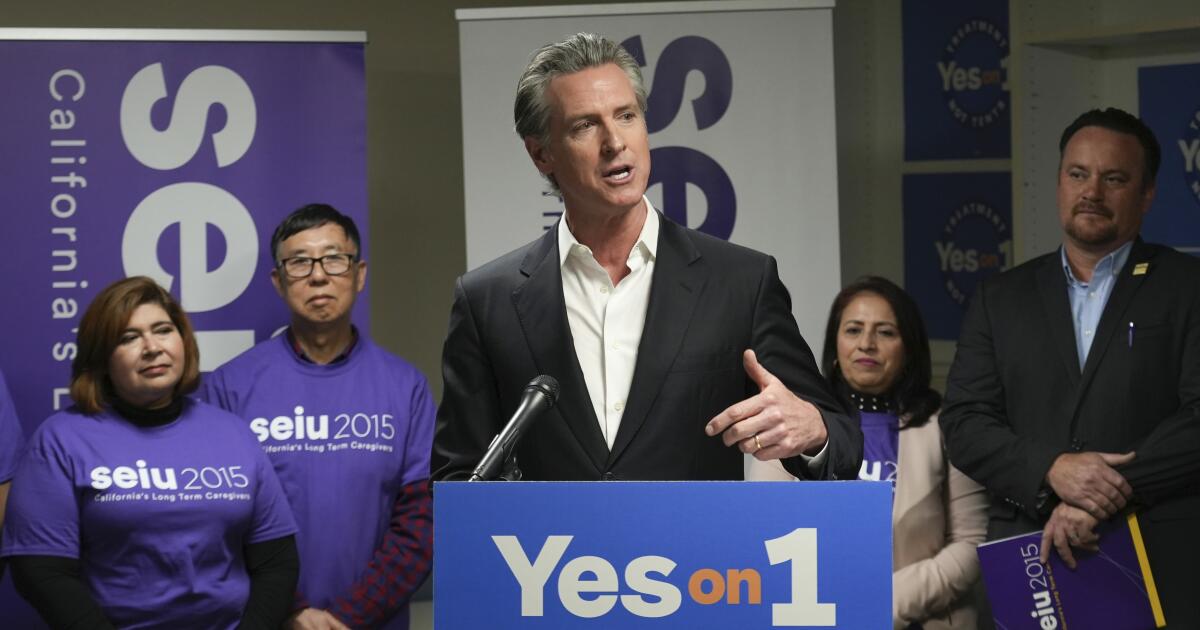
Gov. Gavin Newsom brimmed with confidence about Proposition 1 in January as he sat in a Costa Mesa Motel 6 room that was converted into housing for homeless veterans.
“I think it’s going to win overwhelmingly,” the governor said in an interview with The Times. “Period. Full stop.”
Nearly two months later, Newsom’s cockiness appears misplaced.
Despite millions spent by his campaign, Newsom’s ballot proposal to increase care for drug addiction and fund more treatment beds has held only a narrow lead since the March 5 primary. Still too close to officially call more than a week after the election, preliminary tallies from the California secretary of state showed Proposition 1 ahead by less than a percentage point.
Even with that uncertainty, the meagerly funded opposition campaign conceded Tuesday morning that the measure was “almost certain” to pass.
“We almost took down the bear, but it looks like we will fall short,” the Californians Against Prop 1 campaign said in a statement.
Newsom’s campaign said it was “optimistic” about the outcome, but there are still ballots to be tallied. More than 1.5 million ballots remain uncounted statewide in an election expected to exceed 7.5 million votes in all, which could be one of the lowest turnouts in state history.
The Associated Press, which member news organizations rely on to read results and call elections, said in a statement that “the race could flip if ‘No’ does just 1.5 percentage points better among the outstanding votes.”
“AP has determined that is too much uncertainty to make a call at this time as results across the state are uneven.”
Pollsters say Proposition 1 — and most Democratic candidates — underperformed on election day because of lower than expected voter turnout that inflated the Republican share of the electorate. Election returns showed inland counties and parts of Southern California opposed the measure, while a majority of voters in Los Angeles and the Bay Area backed the plan.
“It was the angry versus the apathetic,” said Jim DeBoo, a consultant for Proposition 1. “Republicans are angry and they showed up.”
Though Newsom’s proposal received rare bipartisan support from Central Valley Republicans and San Francisco Democrats in the state Legislature, that political harmony didn’t extend to voters. The measure was criticized by civil rights groups on the left who were concerned about the repercussions of funding secure mental health facilities and his GOP opponents on the right who scoffed at the estimated $14-billion price tag amid a massive state budget deficit.
Proposition 1 would approve a new $6.4-billion bond to support 10,000 treatment and housing beds and reconfigure a 20-year-old tax for mental health services to also fund services for drug addiction. The plan is essential to Newsom’s strategy to address California’s homelesness crisis, a persistent obstacle for the state and political vulnerability for the Democratic governor.
Under mounting pressure to clean up encampments and get people into treatment, the governor has adopted a series of policy positions that depart from the liberal model of voluntary treatment to a more moderate approach of compelling people with severe mental illness and substance disorders into care.
Newsom signed a law last year to expand conservatorship to allow courts to appoint someone to make decisions for people struggling with severe substance use disorders. Counties began implementing his CARE Court program, which gives families an opportunity to request that courts require treatment for a loved one, last year.
The lack of treatment beds and places to house an influx of patients has been the primary argument against Newsom’s strategy. In her state of the city address days after the election, San Francisco Mayor London Breed touted that the passage of Proposition 1 would provide “a real opportunity to add hundreds more” treatment beds.
“So when the state opens the pipeline for new beds, San Francisco is ready and first in line,” Breed said.
Civil rights organizations and advocates for the disabled community opposed the measure and raised alarm bells in 2023 over a last-minute change to Proposition 1 that allows counties to use the bond money for “locked facilities,” where patients cannot voluntarily leave.
American Civil Liberties Unions in California and League of Women Voters of California urged voters to reject the measure, arguing that community mental health services are more effective than institutionalization.
“I think the governor and mayors often just want the encampments to disappear by any means necessary,” said Katherine Wolf, a doctoral student in society and environment at UC Berkeley, who said she voted against Proposition 1.
Wolf said she believes that community programs that provide stability to some mentally ill Californians will lose funding if money shifts to involuntary treatment. Similar to the ACLU and League of Women Voters, she also opposes forcing people into care.
“For them to sneak it in at the last minute after promising all summer that the bond would only be used for community-based voluntary unlocked treatment, I think is really underhanded and I think they did it specifically to avoid objections from the groups and people who they knew would object,” Wolf said.
Newsom cast the measure as an opportunity to get more people off the streets and into treatment. The measure, he argued in an interview with The Times, addressed the most important issues to voters — crime, homelessness, substance abuse and mental health — and “90% of the boxes that unite the vast overwhelming majority of Californians.”
Early polls seemed to suggest Newsom was right. A survey conducted by the Public Policy Institute of California in November, for example, suggested that two-thirds of likely voters approved of Proposition 1, 30% opposed and a mere 2% remained undecided.
But despite the governor’s bullish stance publicly, behind the scenes his campaign predicted the final result would end up tighter than polls showed and sought to lower expectations in the months and weeks before the election.
Support dropped to 59% among likely voters in a second PPIC poll conducted in February.
By the end of the month, the measure teetered with only 50% support in a UC Berkeley Institute of Governmental Studies poll co-sponsored by the Los Angeles Times. More than one-third of voters were opposed and 16% remained undecided. A large majority of Republican voters who responded to the Berkeley poll opposed the measure, raising concerns about how Proposition 1 would fare in an election with higher GOP turnout.
In a memo sent days before the election, David Binder, a pollster hired by Newsom’s campaign, suggested the PPIC polling was optimistic given low turnout and underperformance among Democrats.
“It is likely that even as yes-on-Proposition 1 may have polled in the low 60s when first introduced in 2023 that the yes vote could end up in the low 50s, given the history of erosion in support for bond and tax measures and the specifics regarding low turnout and disproportionate Republican turnout that California is experiencing for the March 5th election,” Binder wrote.
Mark DiCamillo, director of the IGS poll, said that despite the bipartisan support at the state Capitol, it should come as no surprise that Republican voters didn’t rally behind Proposition 1.
Republicans tend to oppose big-ticket ballot measures. Voters of all political affiliations who remain undecided in the final days before an election also often end up voting against a measure if their mind isn’t made up, he said. Complicated measures, such as Proposition 1, can easily confuse voters as well.
“One other difference that probably worked against it in this election was that the turnout was so low that you basically have three times as many older voters, who tend to be more conservative than younger voters,” DiCamillo said.
Newsom’s campaign said the governor intentionally chose to place the measure on the March ballot because they believed it could “withstand a more conservative electorate and still pass on election day” and due to the urgency of the issue.
Anthony York, a spokesperson for the campaign, said — and pollsters agreed — that the measure would have performed better if placed on the November ballot where Democratic turnout is projected to be higher.
But Democrats in Sacramento are also eyeing several other bond measures on housing, schools and climate to put before voters in November that could total tens of billions of dollars. With the state struggling to offset a budget deficit of at least $37.9 billion, bonds act as a method of sorts for government to take out loans paid back over time to fund big-ticket policies.
Voting on Proposition 1 in March instead of November was a strategic decision that allowed Newsom to avoid a crowded ballot in the fall, said Paul Mitchell, vice president of Political Data Inc.
“Voters do, if you accumulate ballot measures that have spending, start to kind of collectively go ‘no’ on them,” Mitchell said.
Times staff writer Hannah Wiley contributed to this report.

Politics
EXCLUSIVE: FBI adds alleged COVID fraudster accused of taking $5M from kids’ meal program to Most Wanted list

FBI makes first arrest from its ‘most wanted fraudsters’ list
FBI Director Kash Patel announces the first arrest on the “Most Wanted Fraudsters” list. Said Ereg, a Minneapolis man, is accused of stealing over $4.2 million from a federal child nutrition program during the COVID-19 pandemic. Minnesota Senate candidate Michele Tafoya emphasizes the need for accountability for fraudulent activities.
NEWYou can now listen to Fox News articles!
EXCLUSIVE: The FBI is adding Fahad Mohamed Nur to its Most Wanted Fraudsters List, accusing the Minnesota businessman of allegedly stealing more than $5 million that was intended to feed children during the COVID-19 pandemic.
Nur has been on the run since 2022 and is wanted for his alleged role in a fraud scheme that exploited Minnesota’s Federal Child Nutrition Program during the COVID-19 pandemic, according to the FBI. The bureau alleges he owned a vendor and purported food supplier that received more than $5 million in fraudulent program funds by submitting fake invoices before laundering the proceeds.
The Bureau believes Nur has ties to Somalia and may currently be living there.
The FBI is offering a reward of up to $150,000 for information leading to Nur’s arrest and conviction.
OWNER OF DAYCARE IN VIRAL NICK SHIRLEY VIDEO CHARGED IN $4.6M DAYCARE FRAUD SCHEME, PROSECUTORS SAY
Fahad Mohamed Nur has been on the run since 2022 and may be in Somalia, according to the FBI. (Federal Bureau of Investigation)
Nur is the latest addition to the FBI’s Most Wanted Fraudsters List, which officials say has already resulted in the arrests of two fugitives within weeks of its launch.
“Under President Trump’s and Vice President Vance’s leadership with the White House Task Force to Eliminate Fraud, the FBI’s historic ‘Most Wanted Fraudsters list’ has already seen tremendous success – with two subjects brought to justice in a matter of weeks, apprehended out of Somalia and the Philippines,” FBI Director Kash Patel said in a statement to Fox News Digital.
Patel said the early arrests demonstrate that the FBI is aggressively pursuing fugitives accused of stealing from American taxpayers.
FBI ADDS 2 FUGITIVES TO ‘MOST WANTED FRAUDSTERS’ LIST AMID HISTORIC $6.5B HEALTHCARE TAKEDOWN: PATEL
FBI Director Kash Patel conducts a news conference at the Department of Justice on Thursday, December 4, 2025. (Tom Williams/CQ-Roll Call, Inc via Getty Images)
“Our newest subject – Fahad Mohamed Nur – has been on the run since 2022 for allegedly stealing over $5 million from a child nutrition program in Minnesota.”
Patel added: “Collectively, the Task Force has already uncovered more than $13 billion in fraud, and the rapid success of the Most Wanted Fraudsters List should show all Americans that this FBI will [be] at the forefront pursuing the worst of the worst who stole from hardworking American taxpayers.”
DR OZ WARNS MEDICARE SCAMMERS ARE STEALING BILLIONS — AND YOUR PERSONAL INFORMATION COULD BE NEXT
Federal agents enter an office building as a search warrant is executed at Ultimate Home Health Services over potential Medicaid fraud, on December 18, 2025 in Bloomington, Minnesota, United States. (Christopher Juhn/Anadolu via Getty Images)
Federal officials say the investigation is part of a broader government effort targeting pandemic-era fraud.
“The Department’s robust partnership with the FBI and the White House Task Force to Eliminate Fraud has already delivered historic results. That partnership grows even stronger today with the addition of this latest subject to the Most Wanted Fraudsters list,” said Acting Attorney General Todd Blanche. “President Trump has made it clear: Fraudsters no longer have a safe haven in America. Law enforcement will continue to use every tool at its disposal to bring those who steal from American taxpayers to justice.”
The White House Task Force to Eliminate Fraud, led by Vice President JD Vance, has already uncovered more than $13 billion in fraud, according to the FBI.
CLICK HERE TO DOWNLOAD THE FOX NEWS APP
Anyone with information about Nur’s whereabouts is urged to contact the FBI at 1-800-CALL-FBI, their local FBI office, the nearest U.S. Embassy or Consulate, or submit a tip online at tips.fbi.gov.

With the 2026-27 season premiere of “60 Minutes” just two months away, CBS News leadership is getting closer to deciding who will fill the recent departures of longtime correspondents Scott Pelley, Sharon Alfonsi, Cecilia Vega and Anderson Cooper.
Seth Doane, a longtime correspondent based in Italy who is often seen on “CBS Sunday Morning,” is under consideration, along with chief investigative correspondent Jim Axelrod, who currently has a lead role in the “Eye On America” series featured on the “CBS Evening News with Tony Dokoupil.”
Sir Trevor Phillips, a British journalist and former politician who recently joined CBS News as senior global affairs correspondent, is expected to have a role on the program, according to people briefed on the plan. Phillips had a long career in the U.K., producing and writing documentaries and most recently hosted the Sky News program “Sunday Morning with Trevor Phillips.”
Phillips received a knighthood in 2022 for his service to equality and human rights for the U.K. But he also generated controversy over his career for comments about the British Muslim community, which led to a yearlong suspension from the Labour Party in 2020.
A CBS News representative declined comment beyond saying the division is looking at a number of internal and external candidates.
Dokoupil is expected to deliver four “60 Minutes” pieces a season. Major Garrett, the network’s chief Washington correspondent, will also have a contributor role.
Matt Gutman, hired from ABC News last year as national correspondent, is under strong consideration. He is being put in front of test audiences, according to several people at the network.
Holly Williams, a foreign correspondent working out of Istanbul for CBS News since 2012, and Mariana van Zeller, a journalist for National Geographic Channel, are both said to remain in contention.
The newcomers will join Bill Whitaker, Leslie Stahl, Jon Wertheim and Norah O’Donnell, who are all returning as correspondents. O’Donnell will also continue in her role as senior correspondent for the network, occasionally anchoring specials.
The rebuild of the talent line-up comes after the upheaval at the program that has occurred since Bari Weiss joined CBS News as edtior in chief in October.
Longtime correspondent Scott Pelley was fired last month after confronting management about the May 28 dismissal of his colleagues Alfonsi and Vega along with the program’s executive producer Tanya Simon and her second-in-command Draggan Mihailovich.
In February, Cooper decided not to sign a new deal as a “60 Minutes” contributor, as the CNN anchor cited a desire to spend more time with his family. But Cooper has reportedly told colleagues that he does not want to work for Weiss.
The internal disruption at “60 Minutes” followed a highly successful season. In its 57th season, “60 Minutes” was the most watched news program on television with an average of 9.1 million viewers a week according to Nielsen data. The program bucked the overall decline in traditional TV viewing by growing 9 percent over the previous season.
After the dismissal of his “60 Minutes” colleagues, Pelley accused Weiss of trying to “murder” the program and claimed she was putting “her thumb on the scale” for more favorable coverage of the Trump administration. He was fired with cause after confronting management at a June 1 meeting.
Weiss came to CBS when parent company Paramount acquired her digital web site The Free Press, known for its criticism of progressive policies and its strong support of Israel.
Weiss was hired by Paramount Chief Executive David Ellison with a mandate to move the news division to the political center. The pronouncement has created the perception that CBS News is looking to placate the Trump administration as Paramount sought regulatory approval for its $111 billion acquisition of Warner Bros. Discovery, which will also give the company ownership of CNN.
The noise surrounding Weiss has hurt CBS News despite strong reporting that is often far from being pro-MAGA. This past weekend’s “CBS Sunday Morning” featured a segment from national security correspondent David Martin about the Department of Defense interfering with the editorial independence of Stars & Stripes, the military newspaper.
Trump complained vehemently about his last interview with O’Donnell on “60 Minutes,” — conducted the day after a gunman tried to enter the White House Correspondents Assn. dinner in Washington on April 25.
Politics
Abbott orders probe after Texas hospital advertises ‘birth packages’ in Mexico: ‘Citizenship is not for sale’

NEWYou can now listen to Fox News articles!
Texas Gov. Greg Abbott ordered an investigation into a Texas hospital Tuesday after it confirmed to Fox News that it advertised Spanish-language “Birth Packages in South Texas” on billboards in Mexico promoting childbirth services to pregnant foreign nationals near the U.S.-Mexico border.
Mission Regional Medical Center confirmed to Fox News that it was responsible for the advertising campaign, which promoted deliveries starting at $3,950 for a natural birth and $5,525 for a C-section and directed viewers to a website, havemybabyinTEXAS.com, that has since been taken offline.
The billboards also displayed a telephone number beginning with “001,” the country code used to place calls to the United States from Mexico.
‘WEAPONS OF MASS REPRODUCTION’: WATCHDOG UNVEILS ACTION PLAN TO CURB BIRTH TOURISM AFTER SUPREME COURT RULING
Gov. Greg Abbott speaks during a bill signing in the State Capitol on April 23, 2025, in Austin, Texas. (Brandon Bell/Getty Images)
“The marketing materials regarding maternity services are no longer in use due to any unintended misunderstanding,” a hospital spokesperson said in a statement to Fox News. “We do not support or facilitate any unlawful activity and work to comply with all applicable federal and state laws and regulations.”
The spokesperson said the campaign included two billboards located within approximately five miles of the hospital near a U.S.-Mexico border crossing. The hospital said both billboards and the website were removed Monday after images began circulating on social media. The spokesperson also said the campaign began in 2021 but did not specify when the billboards were installed.
Abbott on Tuesday directed Texas Health and Human Services Commission Executive Commissioner Stephanie Muth to investigate Mission Regional Medical Center for potential violations of state law and contractual obligations.
REPUBLICAN ACCUSES SCOTUS OF BETRAYING US, PUSHES BILL RESTRICTING BIRTHRIGHT CITIZENSHIP, PREGNANT VISITORS
A Spanish-language billboard promotes birth packages at Mission Regional Medical Center, advertising pricing for natural deliveries and C-sections in South Texas. (Right Angle News)
Images of the billboard circulated on social media before the hospital said it removed the advertisements Monday.
“Birth tourism’ is an illegal practice that exploits the extraordinary hospitality that the United States and Texas offer to millions of foreign travelers each year,” Abbott wrote in a July 7 letter obtained by Fox News. “Unfortunately, thousands of foreign travelers come to the United States under false pretenses to give birth and secure citizenship for their children.”
TRUMP SUFFERS MAJOR SUPREME COURT DEFEAT AS JUSTICES UPHOLD BIRTHRIGHT CITIZENSHIP
An English-language billboard promotes birth packages at Mission Regional Medical Center, advertising pricing for natural deliveries and C-sections in South Texas. (Right Angle News)
Abbott directed HHSC to “immediately and thoroughly investigate” the hospital and said any violations should be referred to the Texas Attorney General for civil enforcement and to the appropriate district or county attorney for potential criminal prosecution.
“American citizenship is not for sale and Texas will not permit our healthcare system to be used as a magnet for birth tourism,” Abbott wrote.
The governor also said he plans to work with the Texas Legislature during its next session “to strengthen state law and eliminate birth tourism in Texas.”
“Unfortunately, birth tourism operations are not a new phenomenon,” General Counsel of the Oversight Project Kyle Brosnan said to Fox News Digital in a statement. “The Supreme Court’s egregiously wrong decision in the birthright citizenship case is going to open the floodgates to the birth tourism industry. Our country is much more than a pile of magic dirt. The only answer to these type of practices are criminal investigations and the mass deportation of illegal aliens.”
Mission Regional Medical Center also said it intends to cooperate with state officials.
CLICK HERE TO DOWNLOAD THE FOX NEWS APP
“We intend to work cooperatively and transparently with local and state officials,” the hospital said in a statement obtained by Fox News. “Our focus remains on delivering safe, high-quality care to every patient who seeks our services.”
The investigation comes as President Donald Trump’s executive order seeking to limit automatic birthright citizenship for some children born in the United States remains the subject of ongoing legal challenges.
-

 Finance2 minutes ago
How Natura &Co Is Transforming Finance with Generative AI on SAP S/4HANA
-

 Fitness7 minutes ago
This 30-second walking habit can make every walk more effective and boost your fitness in less time
-

 Movie Reviews18 minutes ago
Film Review: ‘Gail Daughtry and the Celebrity Sex Pass’ Throws a Ton of Jokes at the Wall (and Enough Stick) – Awards Radar
-

 World33 minutes ago
‘The Kitchen’ Director Alonso Ruizpalacios at BAM: ‘We Need More Trojan Horses’
-

 News38 minutes ago
Manhattan Building’s Columns Buckled Beneath New Addition, Images Show
-
 Lifestyle1 hour ago
Can you say no to a friend’s wedding? : It’s Been a Minute
-

 Technology1 hour ago
The robotaxi law that could ban Tesla
-

 World1 hour ago
US urges donors to abandon UNRWA funding as UN defends agency’s mission

