
⚽ Get the latest World Cup news
Receive updates on the 2026 FIFA World Cup

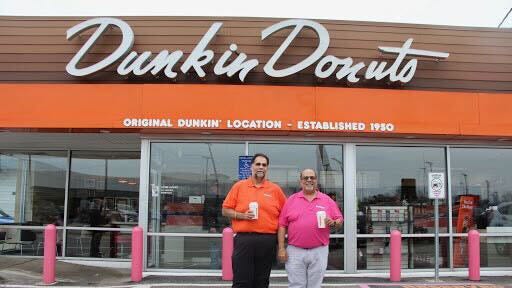
An immigrant family in Massachusetts keeps alive a beloved American culinary landmark.
Brothers Victor and Octavio Carvalho own the original Dunkin’ Donuts in Quincy, Massachusetts.
It’s a bucket-list destination and popular selfie-spot for coffee and donut fans from around the world.
ANCESTRY, GUINNESS RELEASE TROVE OF RECORDS TRACING HISTORY OF MILLIONS OF IRISH AMERICANS
“We feel a sense of pride and responsibility,” Victor Carvalho told Fox News Digital.
The Carvalho brothers are first-generation Portuguese-Americans — and the second generation of their family entrusted with the landmark.
Victor, left, and Octavio Carvalho are the owners of the original Dunkin’ location in Quincy, Massachusetts. Their parents, immigrants from Portugal, took over the location in 1979 from the Rosenberg familiy that founded this first Dunkin’ Donuts here in 1950. (Courtesy Carvalho family)
Dunkin’ Donuts was founded by Boston-area entrepreneur William Rosenberg on this spot in 1950.
Victor and Octavio’s parents, Jose and Maria, arrived from the Azores in 1966.
They bought the original Dunkin’ from the Rosenberg family in 1979; it’s been in the Carvalho family ever since.
MEET THE AMERICAN WHO INVENTED THE DONUT
“Dunkin’ means so much to our family because it changed our lives,” said Victor Carvalho, the first among five siblings born in the United States.
“My parents lived the American dream and were able to pass it down to us. It’s a passion for us now.”
A sign at a Dunkin’ in Trier, Germany, showing the original Dunkin’ location in Quincy, Massachusetts. (Kerry J. Byrne/Fox News Digital)
Dunkin’ now boasts over 13,000 locations in 40 nations around the world.
The original is something of a tourist attraction, drawing donut and coffee lovers from across the United States and from as far away as Saudi Arabia, said Carvalho.
‘CAKE BOSS’ BUDDY VALASTRO SOUNDS STARSTRUCK AS HE OPENS ON BROADWAY: ‘LIKE THE AMERICAN DREAM’
The original is also an international icon. Its picture is often displayed on the walls of Dunkin’ locations around the world as a tribute to its legacy.
Yet Dunkin’ remains a local brand in the eyes of people in Greater Boston and to the customers who are regulars at the original on Southern Artery (Route 3A).
The first Dunkin’ Donuts, founded in Quincy, Massachusetts, in 1950, remains a roadside attraction today that draws visitors from as far away as Saudi Arabia, said franchisee Victor Carvalho. (Dunkin’)
Dunkin’ Super Bowl ads in recent years have featured New England icons such as Ben Affleck, Matt Damon and Tom Brady — often affecting a Boston accent to drive home the local roots of the international brand.
SMALL FAMILY FARMS MAKE AMERICAN-GROWN ROASTED COFFEE THE WORLD’S BEST BREW
Massachusetts residents, meanwhile, remain deeply devoted to Dunkin’.
The state boasts 3,162 Dunkin’ locations, according to data site ScrapeHero.com.
That’s an amazing coffee-saturated 1 Dunkin’ for every 2,200 Bay State residents.
It’s easily the highest Dunkin’ density of any state in the Union.
New York has more locations (4,287), yet its total equals just 1 Dunkin’ for every 4,500 residents.
The original Dunkin’ is open 24 hours a day, seven days a week.
For more Lifestyle articles, visit www.foxnews.com/lifestyle.
Read the full article from Here


The only notable change in the top-seven of the Varsity Maine baseball poll is that Gorham now has eight first-place votes, two more than last week. The order of the seven teams is identical. In fact, the only change in the top-seven over the past three polls is the swap at the top after Gorham’s win over South Portland on May 19.
Furthermore, Gorham, South Portland, Oxford Hills, Cheverus, Bangor, Mt. Ararat and Fryeburg have been ranked in the top seven for four straight weeks, and six of those squads have been among the top seven in every poll this spring.
Meanwhile, Scarborough is ranked for the first time since May 5, and Ellsworth and Thornton swapped spots.
The Varsity Maine baseball poll is based on games played before June 2, 2026. The top 10 teams are voted on by the Varsity Maine staff, with first-place votes in parentheses, followed by total points.
1. Gorham (8) 89
2. South Portland 79
3. Oxford Hills (1) 75
4. Cheverus 55
5. Bangor 42
6. Mt. Ararat 41
7. Fryeburg Academy 30
8. Ellsworth 27
9. Thornton Academy 25
10. Scarborough 12
Also receiving votes: Washington Academy 8, Monmouth Academy 4, Cony 4, Leavitt 2, Falmouth 2.

Local News
Massachusetts lawmakers are considering a measure that would allow cities and towns to temporarily extend bar and restaurant hours during the summer, as the state prepares to host FIFA World Cup matches and celebrations marking the nation’s 250th anniversary.
The legislation (H.5465) filed by state Rep. Carole Fiola, would allow licensed establishments to sell alcohol one hour later than their normal closing time, up to 3 a.m., between June 1 and Aug. 31, 2026. The bill would also allow communities to establish designated public consumption districts where alcohol could be consumed in approved public spaces.
In a press release announcing the bill, Fiola said the summer’s threefold events lineup — the World Cup, Tall Ships, and July 4th — is an economically significant moment that the state should take advantage of.
“We should capitalize on these events that will generate economic benefits for small businesses and the state as a whole. It’s a local opt-in idea worth exploring that’s being done in other states,” Fiola said.
The proposal has received support from Boston Mayor Michelle Wu and most recently Gov. Maura Healey, who submitted written testimony Monday to the Joint Committee on Economic Development and Emerging Technologies urging lawmakers to advance the measure.
“Massachusetts is planning for a once-in-a-generation summer,” Healey wrote, according to the Boston Globe. “In 2026, we will celebrate the 250th anniversary of our nation’s founding, welcome tall ships from around the world to Boston Harbor for Sail Boston, and host seven FIFA World Cup matches in Foxborough, along with watch parties across the Commonwealth.”
The governor argued that the added flexibility could help local economies benefit from an influx of visitors.
“That flexibility can help communities capture more visitor spending, support jobs, keep downtowns active, and strengthen Massachusetts’ image as a dynamic destination ready to host the world and a place our residents, including our young professionals, are proud to call home,” Healey wrote.
She also urged lawmakers to move the legislation forward, saying it will “help Massachusetts meet the full economic and cultural opportunities for the summer ahead.”
In Rhode Island, a similar bill to allow bars and restaurants to remain open until 4 a.m. during the World Cup was signed into law on Friday.
Fiola’s bill remains before the Joint Committee on Economic Development and Emerging Technologies. Any final version would require approval from both the House and Senate before reaching Healey’s desk.

Receive updates on the 2026 FIFA World Cup

Thomas Moulton, the Seacoast entrepreneur, proposed converting a vacant warehouse on Route 4 into a data center to the Nottingham planning board in May, which was first reported by InDepthNH.
In the days leading up to the planning board meeting, a petition online garnered more than 25,000 signatures.
Moulton withdrew his application hours before the meeting last Wednesday, where he was slated to discuss the proposal.
He cited the fierce criticism from local residents, which included a planned protest outside the meeting.
Protestors still gathered outside the meeting on May 27, and dozens of residents spoke out against data centers during the meeting’s public comment section.
Kristen Lamb, who serves on the town’s conservation committee and master plan update subcommittee, said she was concerned about water quality impacts, increased electricity bills and noise pollution. She said Nottingham residents care deeply about protecting the natural landscape.
“We have a history of prioritizing our natural history, our natural resources and water quality” she said.
Numerous studies have found the energy consumption of data centers could place a serious strain on water infrastructure and power grids.
Plus, Lamb argued that building a data center would violate the town’s zoning ordinances.
In the days leading up to last week’s meeting, Lamb spoke out online and wrote letters detailing her concerns to the planning board and Gov. Kelly Ayotte.
Data centers have become an increasingly hot-button issue in state legislatures across the country.
In New Hampshire, Democratic legislators introduced Senate Bill 439 earlier this year, which would have created a statewide definition of data centers and granted local municipalities more authority over regulating them. Sen. Debra Altschiller co-sponsored the bill.
“[Building data centers is] one of the fastest growing and, quite frankly, most disruptive forms of industrial development in the country,” said Altschiller. “It’s something brand new, and we can’t treat the development of AI data centers as if it is just any other kind of manufacturing.”
In a Senate committee in January, Sen. Timothy Lang, a Republican, introduced an amendment that pushed the legislation in the opposite direction.
“Basically, what the amendment does is rewrite the bill,” he said during the committee meeting on Jan. 20. The amended bill would instead limit towns’ ability to regulate data centers, and allow them in commercial and industrial zones.
The amended bill passed the House Committee on Municipal and County Government along party lines on May 5.
However, it died in a bipartisan floor vote in the House, 304-11, meaning there was no real movement in state laws or regulations on data centers this year.
“Municipalities are left with whatever they have in place right now, today,” said Altschiller. “And it’s not a whole lot.”
Democrats in the House also introduced a bill that would prohibit building data centers in the state and create a committee to study their environmental impact. It failed in committee.
Despite Moulton’s withdrawal, Kristen Lamb said he could still reintroduce the proposal in the future or another developer could try a similar plan, so she and other residents are continuing their fight.
“Our town is interested in moving forward with a moratorium or exploring what we can do to make it explicit that data centers or any kind of commercial industry that has that kind of impact on our water, residents income and way of life and wildlife doesn’t get passed,” she said.
The planning board’s workshop meeting will be held at 7 p.m. on June 3 at the town office building.


Louisiana drivers soon will say goodbye to inspection stickers


Stalwart 7 in Varsity Maine baseball poll

Maryland Governor calls out Apple over Towson Town Center store closure – 9to5Mac


Sterling Heights to consider opposing Michigan House tax policy bills


Gov. Healey backs bill to keep Mass. bars open until 3 a.m. this summer


Minnesota GOP disavows Chauvin moment of silence at convention


Jackson mayor claims victory after water authority ruling. What he said


Date set for Missouri basketball vs Kansas in Border War game

