Crypto
Revealed: Cryptocurrency firm in UK transfers $4.2m to Russian arms dealer’s wallet


The transactions involving Copper Technologies raise concerns about whether UK crypto laws have kept pace with the rapidly evolving sector, which has faced growing scrutiny for its potential to provide anonymity
Recent findings reveal that a cryptocurrency company transferred over $4.2 million in digital assets to a crypto wallet linked to a member of an alleged Russian arms-dealing network, who later faced US sanctions.
According to a report, the transactions involving Copper Technologies raise concerns about whether UK crypto laws have kept pace with the rapidly evolving sector, which has faced growing scrutiny for its potential to provide anonymity.
Analysis of crypto records by the Guardian and the International Consortium of Investigative Journalists (ICIJ) reveals a connection between Copper Technologies and Jonatan Zimenkov, an Israeli-born Russian national.
Zimenkov, 29, faced US sanctions in February 2023 for allegedly aiding the Russian military in the invasion of Ukraine as part of the “Zimenkov network,” led by his father, Igor Zimenkov.
Copper transferred millions of dollars worth of digital currency in May 2021 to a wallet belonging to Jonatan Zimenkov, who was later sanctioned. Although Copper was based in London at the time of the transfer, it has since relocated to Switzerland.
While Zimenkov wasn’t under sanctions when the transaction occurred, the US Treasury Department stated that the network had been active for several years before imposing restrictions on individuals and entities involved.
Copper stated that it takes compliance seriously and acted within all regulatory standards at the time of the transaction.
The revelation highlights the opaque nature of cryptocurrency and raises questions about regulating digital assets within the financial system.
Zimenkov wasn’t a Copper client, relieving the company of regulatory obligations to verify his identity.
Financial firms can file suspicious activity reports for transactions raising concerns, even if rules aren’t violated. It’s unclear if Copper filed such a report.
The UK adopted a travel rule in late 2023, requiring crypto firms to conduct checks on funds transferred to external parties.
Blockchain logs show that Copper transferred over 1,700 units of ethereum to Jonatan Zimenkov in May 2021. The purpose and original source of the assets remain unclear.
The owner of the receiving wallet is not named in blockchain records, which only display a digital currency address.
The same address was included in a US Treasury announcement in February 2023, detailing sanctions against the Zimenkov network.
The alleged sanctions evasion network’s details revealed by the US underscore the importance of verifying the identities of individuals involved in asset transfers.
Jonatan Zimenkov, who held Russian, Israeli, and Italian citizenship, was identified as part of the network involved in projects connected to Russian defense capabilities.
The US Treasury stated that Igor Zimenkov, Jonatan’s father, worked closely with his son and others to facilitate Russian defense sales to third-country governments.
Both men are accused of corresponding with sanctioned Russian defense firms and participating in deals for Russian cybersecurity and helicopter sales abroad.
Sanctions apply to several companies involved in the arms trade, including GBD Limited, described as a “Zimenkov network company” attempting to supply weapons systems to an African government.
Russian public records show Jonatan Zimenkov registered as an “individual entrepreneur” in 2019, engaging in wholesale trade of ships, aircraft, and vehicles.
Last year, Copper Technologies was implicated in a share sale benefiting a Russian banker facing US sanctions, as reported by the Guardian.



Key Takeaways
- Bitcoin erased its plunge to a 2026 low of $58,035 on Thursday morning, staging a rapid relief rally.
- Forced liquidations across the crypto market topped $1 billion, wiping out $484 million in bitcoin bets.
- Boris Alergant of Babylon Labs warns that AI competition may pressure bitcoin prices through the summer.
Volatility Grips Bitcoin After Fresh YTD Low
After plummeting to a fresh year-to-date (YTD) low of $58,035 Thursday morning, bitcoin rebounded to erase its 24-hour losses. While the flat net performance paints a stable picture, the daily chart tells a different story—revealing violent price swings that triggered the moment bitcoin crossed below $59,000 on Wednesday.
Data shows bitcoin breached $61,000 less than three hours after tumbling to what was then its YTD low. Although it subsequently dropped below this level, the cryptocurrency traded close to it until shortly after midnight, when another rally eventually pushed it past $61,800. While it lost momentum before reaching $62,000, it nonetheless managed to hold above $61,000 until 9:20 a.m. EDT.
While its plunge to $58,000 took less than 30 minutes, a relief rally saw the cryptocurrency reclaim $59,000 about half an hour later. At the time of writing (1:42 p.m. EDT), the top cryptocurrency traded slightly above $59,500, translating to a mere 0.4% drop over 24 hours. This marginal drop left its market capitalization still under the $1.2 trillion mark.
With the June curtain closing, bitcoin is increasingly poised to clock 30-day losses north of 20% and leave the first half of 2026 bleeding out by more than 30%. The retreat exposes just how far the mighty have fallen; since scaling an all-time high of over $126,000 in October 2025, bitcoin has seen more than half of its peak value utterly erased.
A Crypto Crisis or a Macro Realignment?
Meanwhile, on the derivatives market, bitcoin’s price action over 24 hours saw $484 million in leveraged positions liquidated, with long bets accounting for approximately 70%, or $339 million. Overall, the crypto economy saw $1.01 billion in leveraged positions wiped out, with long bets accounting for $715 million.
As bitcoin continues to slide to fresh yearly lows, investor panic is palpable, forcing many to scramble for the exits. However, seasoned analysts argue this is a macro story, not a fundamental failure. Boris Alergant, head of GTM at Babylon Labs, maintains that the sell-off mirrors a broader, market-wide risk-off reset rather than an isolated crypto event. If anything, Alergant suggests, this volatility proves bitcoin is no longer an island—it is deeply integrated into the traditional financial machine.
“It reacts to liquidity, rates, positioning, and institutional flows in the same way other major macro assets do. Near term, I do think the market could remain under pressure through the summer. AI has been absorbing a significant amount of investor mindshare, capital, and talent that might otherwise have flowed into crypto. With major AI companies moving closer to the public markets, there also appears to be some repositioning happening across growth and technology exposure more broadly,” Alergant said.
Crypto
The cryptocurrency industry has entered the “Show Me” era: merely relying on vision is no longer enough | WEEX Crypto News

Author: Paul Cafiero, a16z PR Partner
Compiled by: Hu Tao, ChainCatcher
For decades, the tech industry has gained public recognition and external praise through its emerging interesting ideas.
So much so that the entrepreneurial concept of “Minimum Viable Product” has received the same abbreviation as Jalen Brunson (New York Eternal) —— MVP.
However, in the past decade, especially in recent years, the tech field has undergone tremendous changes: Minimum Viable Products (MVPs), brilliant ideas, and excellent teams can no longer attract external audiences. The cryptocurrency industry has been particularly hard hit —— regulatory issues and bad actors frequently making headlines have intertwined —— which has heightened people’s ability to discern authenticity, as they are increasingly overwhelmed by various noise and begin to filter.
When traditional finance (TradFi) participants take cryptocurrencies seriously —— for example, BlackRock launching tokenized money market funds, Fidelity applying to issue cryptocurrency ETFs, and JPMorgan conducting trading settlements on its self-developed blockchain —— the focus of discussion has shifted. This is not only about the essence of cryptocurrencies but also about how to gain recognition in the industry.
This is the moment we find ourselves in now. This moment quietly rewrites the rules for all those building in this field. Welcome to the era of “Show Me.”
What has changed? Why now?
Throughout much of the development of the cryptocurrency industry, it has followed a logic of commitment: vision equals product. You only need a white paper and a token to launch a project, and the media and cryptocurrency community will flock to it. People have always bet on the potential future direction of things, rather than what has already been proven. But this dynamic has shifted.
Why? In short, I believe this shift in communication is the result of several factors working together: a deepening skepticism about the sustained existence of this technology (which has been developing for over twenty years); traditional financial institutions entering the cryptocurrency space on a large scale, not just nominally but actually launching related products; and the artificial intelligence industry (whose overnight fame was actually built over decades) launching viable consumer-facing products.
Large institutions are no longer just spectators or limiting innovation efforts to their respective independent “innovation departments,” but are beginning to build scalable solutions: BlackRock and Larry Fink fully embracing tokenization; Fidelity’s custody and ETF infrastructure; JPMorgan’s Onyx network; Franklin Templeton’s on-chain money market fund.
These are no longer experiments —— they are real products, backed by corresponding traditional financial compliance frameworks, institutional clients, and balance sheets.
The large-scale influx of TradFi has raised the bar for “serious” projects in the cryptocurrency space. When the world’s largest asset management company begins to tokenize government bonds, the level of proof a credible project needs to demonstrate to the media, partners, and the market also increases.
From a policy perspective, the industry has also entered the mainstream view. With stablecoin legislation (the genius bill passed last year, now comprehensive market structure legislation with the “CLARITY Act” expected to go for a full Senate vote), the way products are communicated will further change. If the “CLARITY Act” is passed, founders will be able to publicly discuss the products they are developing with an unprecedented level of specificity.
In summary, the industry has matured regardless of whether it is ready.
The resulting communication environment no longer starts with “What are you building?” but rather:
“What have you built? Who is using it?”
In fact, this means that merely having an engaging story is no longer enough to change the status quo. We need evidence.
The New Proof Stack
The previously effective sales pitch —— “We are building X for Y, and here’s why” —— now needs an upgrade. I call it “layered evidence”: it can transform hypothetical abstract narratives into credible, concrete realities.
So, what does this proof stack look like?
Real, tangible partnerships —— not “in discussions.” Actual integrations, signed contracts, and partners willing to publicly state their reasons for choosing you. In the past, announcing partnerships was merely a perfunctory way to measure actual influence. Today, it is only truly effective when the partnership itself is a manifestation of influence. That is to say, a significant institution, protocol, or platform has chosen you among many alternatives; and you can clearly explain why.
This also means sharing more hard data, such as transaction volumes on the mainnet (not the testnet), active wallet counts, revenue, and user retention curves. Not “rapid growth,” but specific percentages, time spans, and baseline figures. Journalists covering this field are becoming increasingly professional, and they will conduct on-chain verification. If your data cannot withstand scrutiny from Dune, CoinMarketCap, or other analytical tools, your reporting will not hold up.
The verification stack also involves sharing real signals about product-market fit: who is using your product? Why do they (including other market clients) continue to use it?
I believe the best proof of product-market fit is not a product launch announcement, but an organically growing community that existed before the PR push.
If your most enthusiastic users are your investors or stakeholders, that is a red flag, as they have financial incentives to promote. But if they are people who found you through word of mouth, that is definitely a story worth telling.
All of this relates to reporting before, rather than after, media hype —— third-party verification, audits, and independent research. The most credible evidence is not fabricated, but rather what others tell the world is true.
So, what does this mean for startup communication?
In the early stages —— when the product is still taking shape but the vision is clear —— it is easy to want to throw out the vision first and write a manifesto. This feels sincere, and it is indeed sincere.
But in the current environment, this is seen as a risk.
A better approach is to build your narrative around what you can prove. Start with your most confident data points, even if they are small: a thousand daily active users who do not know the founders is more persuasive than a million-dollar strategic investment. A protocol that processed $50 million in transaction volume in the first 90 days is more attractive than one that can only handle large volumes after “scaling up.”
This also means you need to express your points more precisely. “We are building the future of payments” is an argument, not a proof. “We have reduced cross-border settlement time from three days to four minutes, and today three companies are using this service” is a proof that conveniently includes the argument.
For teams and founders responsible for communication, the practical implication is that the story should start from facts, not the other way around. This is a different way of writing —— in some ways more difficult, requiring more discipline —— but it is what is truly effective. Especially in the current climate.
Long-term Strategy
But this does not mean that vision is unimportant. The best crypto communication still follows two paths simultaneously: one is to introduce what we have built, and the other is to explain why it is just the beginning of a larger plan. The difference lies in the order of information and the proportion of delivery.
The “proportion” I refer to is that in 2021, you could measure success with 80% vision and 20% substance. But now, that ratio has completely flipped.
You can still publish white papers, manifestos… but that is not enough. Vision is still important —— it makes the argument more persuasive and provides material for journalists and analysts —— but the vision must be supported by the substance behind it.
The “Show Me Era” is not a temporary adjustment in the industry. The cognitive level of the cryptocurrency audience —— including media, institutions, and retail investors —— is increasingly rising, and this trend has become a foregone conclusion.
The best developers in this field have realized that this is actually good news. If you have real user growth, authentic data, and genuine partners, then a higher bar is actually beneficial to you; it filters out distracting information and makes your signal clearer and louder.
The question is whether your communication strategy is designed to prove this, or if it is still just designed to make promises.

Key Takeaways
- AI models forecast bitcoin in 30-day, 90-day and year-end ranges.
- Bitcoin’s 40% annual drop kept AI forecasts cautious and mostly bearish.
- BTC’s next move hinges on $61,000 support, exchange-traded fund (ETF), and corporate flows alongside macro easing.
Bitcoin prices for this AI test editorial were logged on June 23, 2026, before BTC plunged below $60,000 on Wednesday, June 24.
AI Models Face a Stripped-Down Bitcoin Forecast Test as Bearish Pressure Builds
Since the start of June, bitcoin has remained locked below the $70,000 zone after touching a 2026 low of $59,100. With that backdrop, analysts and prediction markets have been split on BTC’s next move, while bearish odds continue to darken the forecast, so we consulted a broad roster of today’s top AI models to see where they place BTC in 30 days, three months from now, and by year’s end.
In our past AI model experiments, we gave the chatbots a large body of information to ground their forecasts. This time, we stripped the prompt down so each chatbot could deliver an unbiased, clear prediction on where the leading crypto asset may trade across three distinct timeframes.
A total of 14 AI chatbots were consulted, including several models from the same developer. The lineup tested in this experiment included Claude Sonnet 4.6 Low Intelligence, Microsoft Copilot Think Deeper, Venice AI, ChatGPT 5.5 High Intelligence, Grok Expert, Claude Opus 4.8 High Intelligence, Deepseek Deepthink, Pi AI, Qwen 3.7 Plus, Kimi K2.6, Meta AI, Mistral AI Lechat Fast, ChatGPT 5.5 Medium, and Gemini 3.1 Pro.
Every AI model received the exact same prompt. The prompt given was:
“You are a neutral bitcoin market analyst. Do not use search, web browsing, live data, external sources or current news. Use only the market context provided below and make an unbiased, probability-based forecast.
Current context: Bitcoin is down 40% over the last year and traded between $62,171 and $65,994 this past week.
Provide only three predictions: a 30-day price prediction, a 90-day price prediction and a year-end price prediction. Your answer must be no more than 3-4 sentences total, include clear price targets or ranges for each timeframe and briefly state the main bullish and bearish factors that could affect the forecast.”
Claude Sonnet 4.6 Low Intelligence answer:
Microsoft Copilot Think Deeper answer:
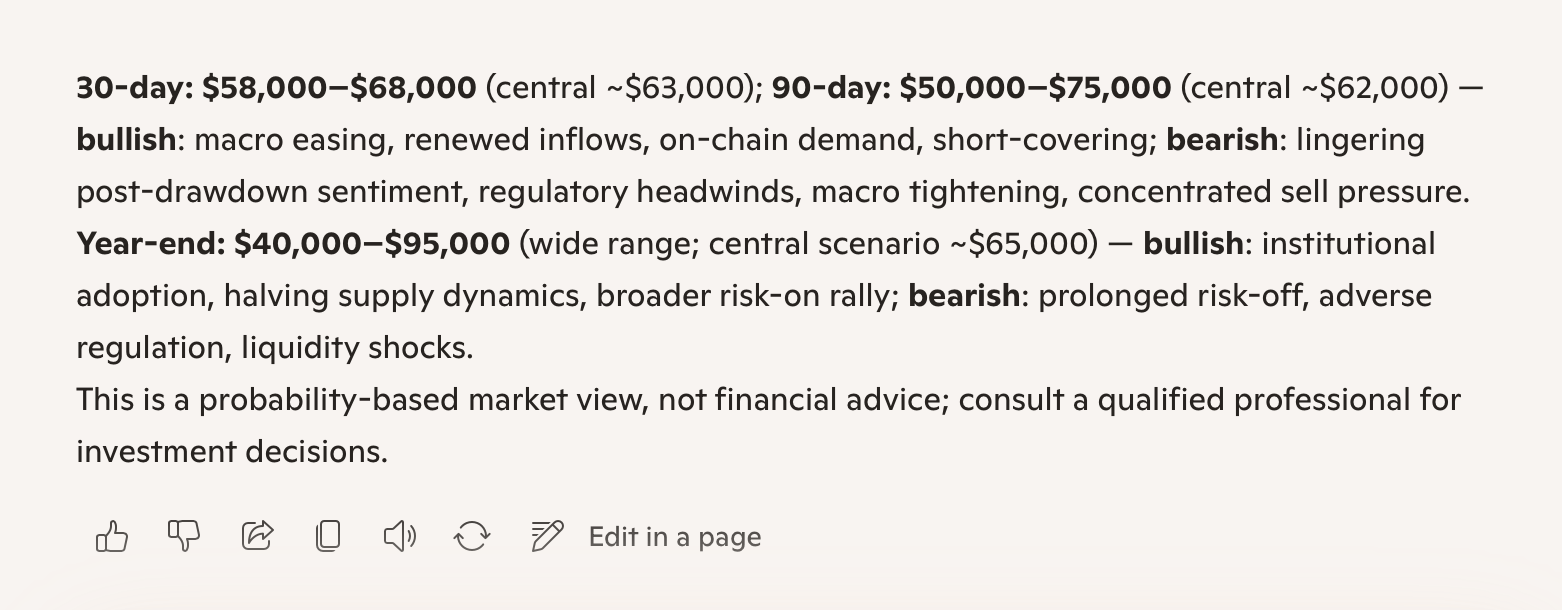
Venice AI answer:

ChatGPT 5.5 High Intelligence answer:

Grok Expert answer:
Based on bitcoin’s 40% decline over the past year and its recent consolidation between $62,171 and $65,994, the 30-day forecast points to a probable trading range of $61,000-$67,000 with a base case near current levels. Extending to 90 days, increased volatility could push the range to $58,000-$70,000 as the longer-term downtrend exerts influence. By year-end, the expected range is $50,000-$75,000, where the primary bullish factor is the potential for stabilization following the recent tight range and the main bearish factor remains the persistent yearly downward momentum.
Claude Opus 4.8 High Intelligence answer:

Deepseek Deepthink answer:
30-day: $60,000–$66,000; 90-day: $58,000–$70,000; year-end: $55,000–$75,000. Bullish factors include potential support near the weekly low and mean-reversion buying after a steep yearly decline, while bearish factors center on the persistent 40% yearly downtrend and resistance at the weekly high capping upside. Probabilities lean moderately bearish over the longer horizon given the existing trend, but near-term range-bound action is the most likely outcome.
Pi AI answer:

Qwen 3.7 Plus answer:
Given the 40% annual decline, the 30-day prediction is a consolidation between $60,000 and $68,000, the 90-day forecast ranges from $58,000 to $72,000, and the year-end target is $65,000 to $80,000. Bullish factors include oversold conditions and potential accumulation following the significant drawdown, which could drive a mean reversion. Conversely, bearish factors involve lingering downtrend momentum and immediate overhead resistance near the $66,000 weekly high.
Kimi K2.6 answer:

Meta AI answer:

Mistral AI Lechat Fast answer:
30-day: $63,000–$66,000 (range-bound, with resistance at $66K and support at $62K). 90-day: $60,000–$70,000 (potential rebound if macro sentiment improves, or further decline if selling pressure persists). Year-end: $55,000–$75,000 ( bullish: institutional adoption; bearish: prolonged macro downturn or regulatory headwinds).
ChatGPT 5.5 Medium answer:
30-day prediction: bitcoin likely trades between $63,000 and $68,500, with modest upside if buyers defend the weekly range and downside risk if momentum weakens below $62,171.
90-day prediction: bitcoin likely trades between $58,000 and $72,000, with a base case near $66,000 as mean reversion battles the broader 40% yearly decline.
Year-end prediction: bitcoin likely finishes between $55,000 and $78,000, with bullish pressure from range recovery and accumulation potential, while bearish pressure comes from the sustained annual drawdown and failure to reclaim higher levels decisively.
Gemini 3.1 Pro answer:
Given the 40% annual decline and recent tight consolidation, the 30-day prediction places bitcoin between $60,000 and $68,000 as the market tests near-term support. The 90-day forecast projects a broader $55,000 to $75,000 range, depending entirely on whether buyers can defend the current $62,171 low. A probability-based year-end prediction targets a recovery toward $70,000 to $85,000, assuming the prolonged sell-off has finally exhausted major supply. A potential mean-reversion bounce from these depressed levels acts as the primary bullish catalyst, whereas a decisive break below the weekly low presents the main bearish risk of further capitulation.
Wide AI Forecasts Reveal a Market Still Searching for Conviction
What stands out across these responses is the sheer width of the price bands. Most models offered year-end ranges stretching $40,000 or more, a spread that signals uncertainty rather than precision. That ambiguity closely mirrors the current divide among analysts and prediction markets, though the broader tilt remains mostly bearish.

The consistency across models is also difficult to ignore. Although the responses came from different developers, they followed similar structures, used similar framing, and leaned on familiar talking points, from halving-driven supply dynamics to ETF inflows and macro easing. That convergence suggests these systems are drawing from overlapping pools of training data and often produce consensus-style outputs when handed identical prompts.
Ultimately, the experiment says as much about AI forecasting as it does about bitcoin. The models clustered around cautious ranges, not bold calls, reflecting a market defined by damaged momentum, fragile support and limited conviction. Their shared assumptions point to a consensus machine that can map uncertainty clearly, but not resolve it. For readers, the takeaway is simple: prediction bands are wide because bitcoin’s next move remains unsettled for now.
-

 Alabama2 minutes ago
Millions in SNAP Overpayments: Alabama and Florida Required to Submit Corrective Action Plans
-

 Alaska5 minutes ago
Pilot’s quick thinking averts disaster in Alaska emergency landing
-
 Arizona10 minutes ago
Wired Up: 400 Marines in southern Arizona ‘reinforcing’ border wall
-

 Arkansas17 minutes ago
Arkansas Governor joins national A.I. workforce initiative
-

 California20 minutes ago
CDFW News | California Fish and Game Commission Takes Emergency Action to Prevent White Shark Take and Reduce Potential Interactions Between Hooked Sharks and Swimmers
-

 Colorado25 minutes ago
Kids escape unscathed after van slips off Colorado mountain road and down Blue River embankment
-

 Connecticut32 minutes ago
Workers say violent disturbances followed staffing shortages at CT youth psychiatric facility
-

 Delaware35 minutes ago
Thousands moving to Delaware County fuels need for more housing

