Politics
Opinion: We can't count on the courts to hold Trump accountable before November. It's up to us

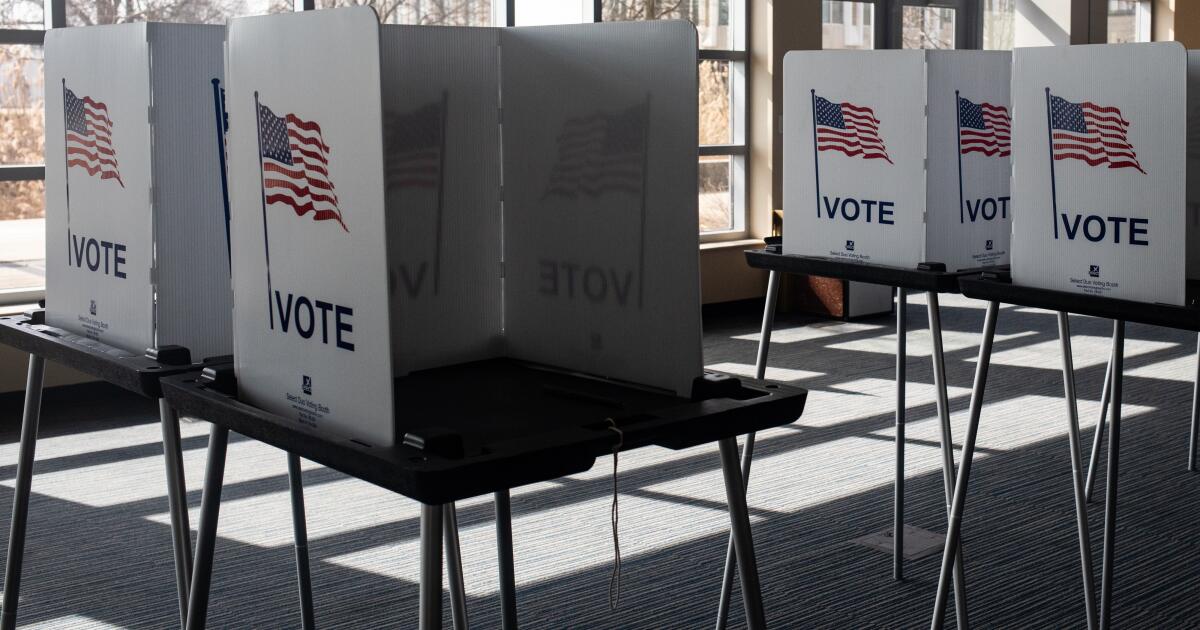
Well, my fellow Americans, it’s up to us to hold Donald Trump accountable at the ballot box. We can’t count on the courts before election day.
This was supposed to be the opening week of Trump’s Jan. 6 trial, the first ever of a former president facing criminal charges, for his unprecedented attempt to overturn a U.S. election and remain in power. A verdict could have come down well before November.
Opinion Columnist
Jackie Calmes
Jackie Calmes brings a critical eye to the national political scene. She has decades of experience covering the White House and Congress.
But there is no trial today in Washington, thanks to the Republican-super-majority Supreme Court, one-third of whose members are Trump appointees. The court’s decision last week to spend months considering Trump’s spurious claim of absolute immunity from criminal charges will likely postpone the Jan. 6 trial so long that a verdict before Nov. 5 is nearly impossible.
Pundits who suggest otherwise underestimate Trump’s talent for forcing delays and the willingness of some judges and justices to accommodate him.
Whether there’s a preelection verdict obviously matters. Polls consistently show a significant number of voters would spurn the presumptive Republican presidential nominee if he’s a convicted felon, enough of them to swing a close election to President Biden. (Trump has, remember, already been found liable for financial fraud and for sexual assault and defamation in civil courts.)
Only the least significant of the four criminal trials Trump faces seems likely to start anytime soon. The New York state case, alleging that he falsified business records to cover up hush money paid to adult-film star Stormy Daniels before the 2016 election, is scheduled for March 25.
Meanwhile, the Georgia election-skullduggery case is up in the air as the judge considers whether Fulton County Dist. Atty. Fani Willis can keep trying it amid questions the Trump side raised about her conduct.
And most of us long ago gave up hope that rookie federal Judge Aileen Cannon, a Trump appointee, would do anything other than what she’s done: indulge his stalling tactics in the Mar-a-Lago case, in which he’s charged with taking top-secret documents, lying about it and obstructing justice.
But it is the Jan. 6 case that is — was — the most crucial, preelection. Americans deserve to see whether a jury would find Trump guilty of conspiring to subvert the 2020 election before they vote on returning him to office in 2024.
Rarely has the saying “justice delayed is justice denied” seemed so apt. In this instance, the wrong will be done to us, the voters.
We can spread the blame around. Atty. Gen. Merrick Garland has been so consumed with erasing the stain of politicization that the Trump gang left at the Justice Department (a thankless task, as Republicans’ baseless yammering about its “weaponization” attests) that he dallied before naming special counsel Jack Smith to investigate Trump. Willis indeed has shown bad judgment. And Cannon appears to be auditioning for promotion to a higher court by a reelected Trump.
Smith, at least, moved with alacrity, along with the federal judge in the Jan. 6 case, Tanya Chutkan. But the Supreme Court has all but foiled their efforts.
The justices could have — should have — taken up Trump’s immunity claim in December. That month Chutkan rejected Trump’s argument for what she called “a lifelong ‘get out of jail free’ pass” and when Trump appealed, Smith urged the Supreme Court to cut out the middleman — the D.C. appeals court — and quickly decide the historic matter. It refused.
Then, after the appeals court panel unanimously ruled against Trump, the justices could have — should have — accepted its widely praised opinion as the final word. They didn’t.
Worse, in a case that’s more consequential to a presidential election’s outcome than any since Bush vs. Gore, one of the Supreme Court’s members, Clarence Thomas, has a clear conflict of interest, and he’s refusing to recuse himself. Thomas’ wife has been implicated in the pro-Trump machinations to overturn Biden’s victory.
A ruling from the justices could come as late as the end of June. They aren’t expected to support Trump’s immunity claim but they could send the case back to the appeals court, further postponing a trial. A verdict on Trump’s attempt to hold onto power is now “much more unlikely” before the election, conservative former appeals court Judge J. Michael Luttig told MSNBC.
That’s why the voters’ verdict is all the more critical. As Liz Cheney often says, Trump shouldn’t be allowed to get “anywhere near the Oval Office again.” If he does get reelected, he can scuttle the federal cases against him, and he’s vowed to pardon those already convicted for their actions on Jan. 6.
Dan Pfeiffer, the former Obama White House advisor, told readers of his newsletter on Thursday that Democrats “should make some chicken salad out of this chicken s—.” Call out the already unpopular Supreme Court, he argued, and hammer the argument that “Donald Trump is running for president for one reason and one reason only — to avoid accountability for crimes he committed.”
We should stop looking at calendars and calculating on fingers when Trump can be convicted in a courtroom. We’re the jury we’ve been waiting for.
And then, once Trump is defeated again, the trials can play out. And those other juries can finish the job of holding Citizen Trump accountable.


new video loaded: Steve Hilton Holds Slim Early Lead in California Governor’s Race
transcript
transcript
Steve Hilton Holds Slim Early Lead in California Governor’s Race
Steve Hilton, a Republican and former Fox News host, held a narrow lead in early votes over two Democratic opponents in California’s nonpartisan primary for governor. The top two candidates will advance to the general election in November.
-
“Change is coming to California, and it’s long overdue. I want to just say something from my heart to every single person who’s voted for me. We’re not — We’re not there yet, but it’s looking good.” [cheers] “Tonight, the people of the great state of California, in the greatest nation on earth, have spoken. [cheers] Loudly and proudly. [cheers] And while I take nothing for granted, there are lots of ballots left to be counted, it appears that we are on track to advance to November.” [cheers] “It might take some time to figure out where this is going. We’re going to wait until every ballot is counted. We’re going to give democracy a time to work, and we know we finished really strong.” [cheers]
By Axel Boada
June 3, 2026
Politics
Spencer Pratt surges to runoff in LA mayor’s race after angry voters send message to Karen Bass

NEWYou can now listen to Fox News articles!
Reality television personality Spencer Pratt appears on track to clear a key hurdle in Los Angeles’ mayoral race as he seeks to unseat incumbent Mayor Karen Bass in November.
Bass, who has led the city since 2022 amid a turbulent stretch rocked by her response to wildfires, advanced to a runoff after failing to secure a majority of the vote in Tuesday’s primary election. With no candidate surpassing the 50% threshold, the top two finishers will face off in a November runoff.
The anticipated runoff is a symbolic blow to Bass, who was endorsed by Gov. Gavin Newsom, D-Calif., and former Vice President Kamala Harris and has spent decades serving California in a series of elected Democratic offices.
Pratt, a first-time candidate known for the MTV reality show “The Hills,” was running in second place as of Wednesday morning.
Los Angeles Mayor Karen Bass attends the Women for Bass Phone bank event in the Baldwin Hills area of Los Angeles on June 1, 2026. (Louise Barnsley/Splash for Fox News Digital)
REALITY TV STAR SPENCER PRATT TESTS LA VOTERS’ APPETITE FOR POLITICAL OUTSIDER
“Obviously, God wanted five more months of me exposing the failures of our mayor,” Pratt gloated to reporters as the returns came in Tuesday evening.
Pratt has relentlessly hammered Bass on issues that have long plagued the city, including fire recovery, street homelessness and crime. The insurgent candidate holds Bass personally responsible for devastating wildfires that destroyed more than 18,000 structures in the city, including his Pacific Palisades home.
Pratt’s surge appears to have shut out Los Angeles City Council member Nithya Raman, a former ally of Bass who challenged the incumbent from the left and was once viewed as a threat to her bid for a second term. Raman is a member of the Democratic Socialists of America and has argued for steering the city in a more progressive direction.
Raman has not yet conceded despite running well behind Bass and Pratt as of Wednesday morning.
Pratt, a registered Republican, faces an uphill battle to defeat Bass in November if he advances to the runoff election.
Less than 20% of voters in the heavily Democratic city identify with the GOP, though Los Angeles’ mayoral contest is officially nonpartisan.
Media personality and independent candidate Spencer Pratt, left, pictured alongside LA mayor Karen Bass, right. (Robert Gauthier/Los Angeles Times via Getty Images; Justin Sullivan/Getty Images)
KAREN BASS GRILLED OVER BROKEN HOMELESSNESS PROMISE, BLAMES BUREAUCRACY FOR SLOWED PROGRESS
Rep. Darrell Issa, R-Calif., who represents a San Diego-anchored seat, told Fox News Digital that Pratt has won a following in the mayoral contest due to widespread voter discontent with Bass’ leadership.
“He’s catching fire among ardent historic Democrat voters because Karen Bass has been so ineffective,” Issa said in an interview. “And every time she opens her mouth, she’s talking about more of the same to people who have seen their streets, both crime-ridden and in fact … ineffectively managed.”
Bass, conversely, argues that her leadership is leading Los Angeles in the right direction.
“Los Angeles is at a turning point. After decades of rising homelessness, under-built housing and a shrinking police force, it’s Mayor Karen Bass who finally stepped up to change how City Hall works,” Bass’s website reads.
Los Angeles City Councilmember Nithya Raman appears likely to finish in third place, keeping her out of the November runoff. (Eric Thayer/Getty Images)
CLICK HERE TO DOWNLOAD THE FOX NEWS APP
“Homelessness is down, more housing is being built, and the LAPD is hiring new officers,” it also claims.
Fox News Digital’s Leo Briceno contributed reporting.
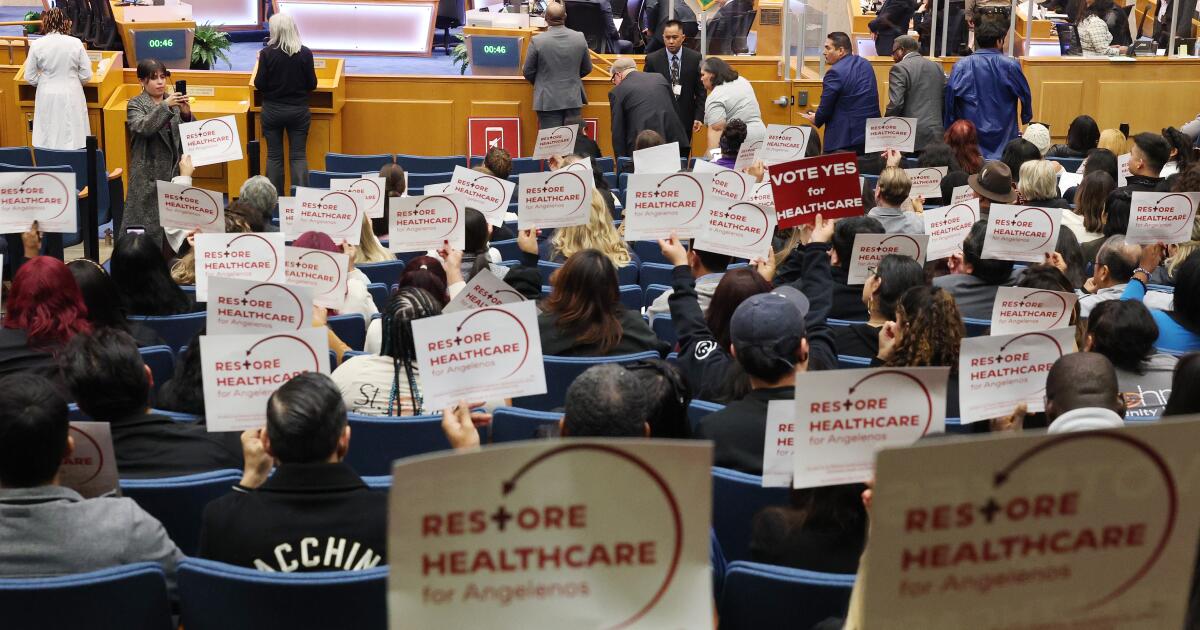
Los Angeles County’s half-cent sales tax to fund healthcare services was trailing Tuesday, with early returns showing a majority of voters rejecting the measure.
The tax — a half-penny of every dollar spent in the county — is meant to prop up local hospitals and clinics that are hemorrhaging funding after recent federal cuts.
The sales tax, which needs a simple majority to pass, would take effect Oct. 1 and last five years. Officials say it would pull in $1 billion annually to help plug the budget holes hitting local hospitals and clinics.
L.A. County health officials anticipate the One Big Beautiful Bill Act, signed into law by President Trump last summer, will slash more than $2 billion from the county’s health services budget within the next three years. Due to eligibility changes, the county will no longer be able to get reimbursements for many Californians who have lost Medi-Cal.
The measure was championed by a coalition of healthcare advocates called Restore Healthcare for Angelenos who warned that mass layoffs and emergency room closures could be imminent if new funding didn’t come fast. The Department of Public Health recently closed seven clinics — a grim sign, supporters said, of service cuts to come.
Voters haven’t rejected a sales tax hike since 2012, when a transportation measure fell just short with 66.1% support. It needed 66.7% to pass.
A majority of county supervisors had supported the new tax proposal, voting 4 to 1 this February to put it on the ballot. But the measure faced significant opposition from local cities, with opponents arguing the sales tax hike would unfairly burden the poorest county residents and encourage people to spend their dollars across the county line.
Supervisor Kathryn Barger, the board’s lone opponent of the tax, said she was concerned it was a “general” tax, meaning the money wouldn’t be earmarked for healthcare costs. Instead, she argued, politicians would have final say over how the money gets spent.
The supervisors have created a plan for spending the tax money, with the largest chunk of the money meant to cover the costs for patients without insurance. The measure also asked voters to sign off on a nine-member oversight committee.
The county currently has a base sales tax rate of 9.75%, and cities impose local taxes on top of that.
-

 Detroit, MI5 minutes ago
Detroit Tigers sweep Tampa Bay Rays in win as Dillon Dingler stays hot
-

 San Francisco, CA15 minutes ago
Retired San Francisco firefighter dies from lung cancer after Blue Shield denies treatment claims
-

 Dallas, TX20 minutes ago
Trackdown: Dallas 7-Eleven robbery suspect wanted
-

 Miami, FL27 minutes ago
This new Italian restaurant in Brickell only has 10 items on the menu
-

 Boston, MA29 minutes ago
Visiting Boston this summer? Here are 8 navigation tips you need to know.
-

 Denver, CO34 minutes ago
Denver-ish Central Market? RiNo food hall vendors claim they’ve been pushed out
-

 Seattle, WA41 minutes ago
New Ben & Jerry’s location opening at Seattle waterfront’s Pier 54
-

 San Diego, CA44 minutes ago
Padres designate Nick Castellanos for assignment

