Business
Column: Trumponomics? He would impose the equivalent of a huge tax hike

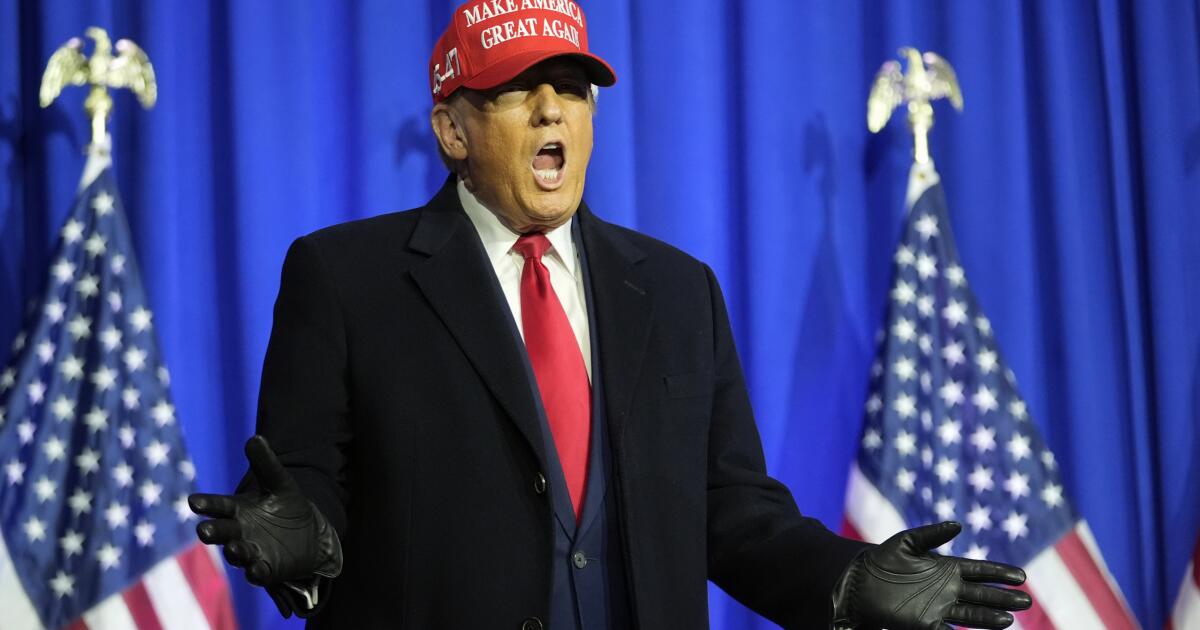
If Donald Trump becomes president again, one of his first moves will take money out of your pocket just as a tax hike would.
Trump hasn’t outlined much of an economic program, but he has promised to impose a massive increase in tariffs on imports from almost all foreign countries — everything from bananas and baby formula to computer chips and machine parts.
And that’s the equivalent of a tax hike, because the costs of tariffs are paid almost entirely by the buyers of imported goods, whether they are Walmart shoppers or U.S. businesses that rely on foreign components.
Trump boasts that the tariffs he imposed in 2018 and 2019 brought billions of dollars into the Treasury, and promises a similar revenue increase in a second term. “The United States will make an absolute FORTUNE,” his campaign website says.
Here’s the problem: Contrary to what the former president seems to think, tariffs aren’t paid by foreign companies or governments. They’re initially paid by the U.S. companies that import the goods, but those importers almost always pass the cost on to consumers in the form of higher prices.
This time, Trump is proposing a “universal” tariff of 10% on goods from every country in the world. He has also mused about megatariffs of more than 60% that he wants to slap on China in hopes of forcing Beijing to lower its tariffs and treat U.S. companies fairly.
Economists say that either of those proposed tariffs would produce price increases and push inflation upward.
That’s why traditional free-trade Republicans like Nikki Haley and Mike Pence think Trump’s proposal is a bad idea, as does almost every practicing economist.
“It’s lunacy,” said Adam Posen, president of the Peterson Institute for International Economics.
But wait — there’s more.
Those increased costs would hit low-income people hardest, because they spend a larger share of their income on goods.
“If baby formula goes up 25%, low-income earners will feel it more than people on Wall Street,” Posen said. “The burden of the tax falls disproportionately on poor people.”
And when the United States imposes tariffs, the targeted country almost always reciprocates.
“They’re not just going to roll over,” Posen said. “And they’re going to be strategic; they’ll pick industries where the U.S. will lose huge market share, because the retaliatory tariffs will drive the price of American products up.”
We have recent experience with all of these problems, thanks to Trump’s earlier tariffs. Take California almonds, the state’s most valuable export crop.
Until 2018, China bought almost all its almonds from California. But after Trump slapped tariffs on a range of Chinese products that year, China retaliated with tariffs on U.S. agricultural exports, including nuts.
California almond sales plummeted, and Australian growers rushed in to fill the gap. In a report for the Giannini Foundation of Agricultural Economics at UC Davis, economists Sandro Steinbach and Colin A. Carter calculated that the episode cost the state’s almond growers about $875 million in lost income.
Other U.S. exporters to China, from soybean farmers to truck manufacturers, took similar hits.
Those costs might have been tolerable if the tariffs had accomplished their main goal, which was to protect and promote manufacturing jobs in the United States.
But they didn’t. A slew of economic studies found that Trump’s tariffs had little or no positive effect on the industries they were designed to protect — and that the negative consequences for the economy resulted in a net loss of jobs.
“Import tariffs on foreign goods neither raised nor lowered U.S. employment in newly-protected sectors,” a team of economists led by David Autor of MIT reported last month.
For example, Trump wanted to protect steel industry jobs from foreign competition, but his tariffs on foreign-made steel didn’t help much. By the end of his presidency in 2021, the steel industry had lost several thousand jobs.
Meanwhile, those tariffs hurt the more numerous jobs in industries that buy foreign-made steel, including automakers and appliance manufacturers.
“For every one steel-producing job, we have about 80 steel-consuming jobs,” Erica York of the conservative-leaning Tax Foundation noted. “All those industries got hit by higher costs, and many of them lost jobs ” — about 75,000 total positions, according to one study.
But Trump’s tariffs had an important side effect, Autor and his colleagues reported.
“Despite the trade war’s failure to generate substantial job gains, it appears to have benefited the Republican Party” in the Rust Belt, the economists wrote.
Trump “may have garnered support from voters who were skeptical about the favorable economic consequences of tariffs, but who appreciated [his] intention to confront Chinese competition and protect U.S. jobs,” they wrote.
Trump has long described himself as a “Tariff Man” — convinced, in his words, that protectionism “will always be the best way to max out our economic power.”
He’s wrong about that.
The new tariffs he’s proposed won’t save the economy. But they may help Trump win industrial states like Pennsylvania, Ohio, Michigan and Wisconsin — and that may have been the point all along.



Dear Mr. Pelley:
I meant what I said in my letter last week to the 60 Minutes team: joining 60 Minutes is the honor of my career and I am grateful to be working alongside the people who have contributed to the most important television journalism brand this country has ever produced. While I’m new to 60 Minutes, I’ve devoted my career to investigative journalism and storytelling. I started this job excited to collaborate and to benefit from the wisdom and experience of the 60 Minutes veterans, with you among them. For that reason, one of the first things I did in my new role was call you to talk and invite you to dinner. It is a profound disappointment that you rejected that overture and chose ambush instead. Yesterday, you hijacked my first meeting with staff to disparage me, my qualifications, and my intentions with remarkable incivility and contempt. I welcome a diversity of viewpoints and respectful debate among the team, but this was nothing of the sort. Yesterday’s performative display of hostility enacted in front of the staff instead of in a civil, private conversation-demonstrated that you have no interest in contributing to the future success of the show, or approaching my new tenure with a mind open to collaboration and progress. I am here to deliver first-in-class news programming, not to make headlines about newsroom drama. I am eager to work alongside those who share this goal.
Despite yesterday’s misconduct, I had hoped that in sitting down with you today we could find a path forward together. You made clear that you are not interested in such a path.
Your antipathy to the future of the show has come through loud and clear. And I have heard you. I therefore write on behalf of CBS News, Inc. (“CBS”) to inform you that your employment with CBS is terminated for cause effective immediately. Enclosed is your formal termination letter.
Sincerely,
Nick Bilton
Executive Producer, 60 Minutes

The co-founder of Aspiration, Joseph Sanberg, was sentenced to 14 years in prison on Monday after defrauding investors and lenders of over $248 million.
The startup, an eco-friendly digital banking company boasting fossil fuel-free investments, carbon offsets for gas purchases, and a debit card with cash-back benefits for shopping at clean companies, was founded by Sanberg and Andrei Cherny. Cherny left the company in 2022 and has not been charged.
Sanberg, an Orange County native, pleaded guilty to wire fraud in October after being arrested in March last year. Aspiration subsequently filed for bankruptcy and liquidated all of its assets by July.
Sanberg and venture capitalist Ibrahim AlHusseini, who also faces charges, together forged a series of bank statements in order to obtain loans. From 2020 to 2021, the pair forged AlHusseini’s bank statements to show millions of dollars in assets in order to obtain millions of dollars from lenders.
Additionally, they forged a letter from their audit committee stating that $250 million in funds were available, when in reality Aspiration had less than $1 million. The amount of loans defrauded exceeded $248 million.
In 2021, Sanberg artificially inflated Aspiration’s 2021 revenue by $44 million by recruiting 27 fake customers to sign letters of intent pledging tens of thousands of dollars per month for tree planting services. Sanberg himself funded the contracts and used the inflated revenue numbers to obtain more loans.
The charges sparked an NBA investigation into salary cap allegations due to Aspiration’s connections with Clippers owner Steve Ballmer.
Ballmer personally invested $60 million in Aspiration, all of which was lost. He is now the target of a civil lawsuit alleging his participation in the scheme. Ballmer denies the allegations.
The team announced a $300-million sponsorship deal with Aspiration, and Clippers player Kawhi Leonard signed a four-year, $28-million marketing contract with the company, which reportedly performed no duties. The issue has raised concerns about how players are circumventing the NBA’s salary cap.
The team lost the $300-million sponsorship deal and an additional $20 million paid for carbon offset purchases.
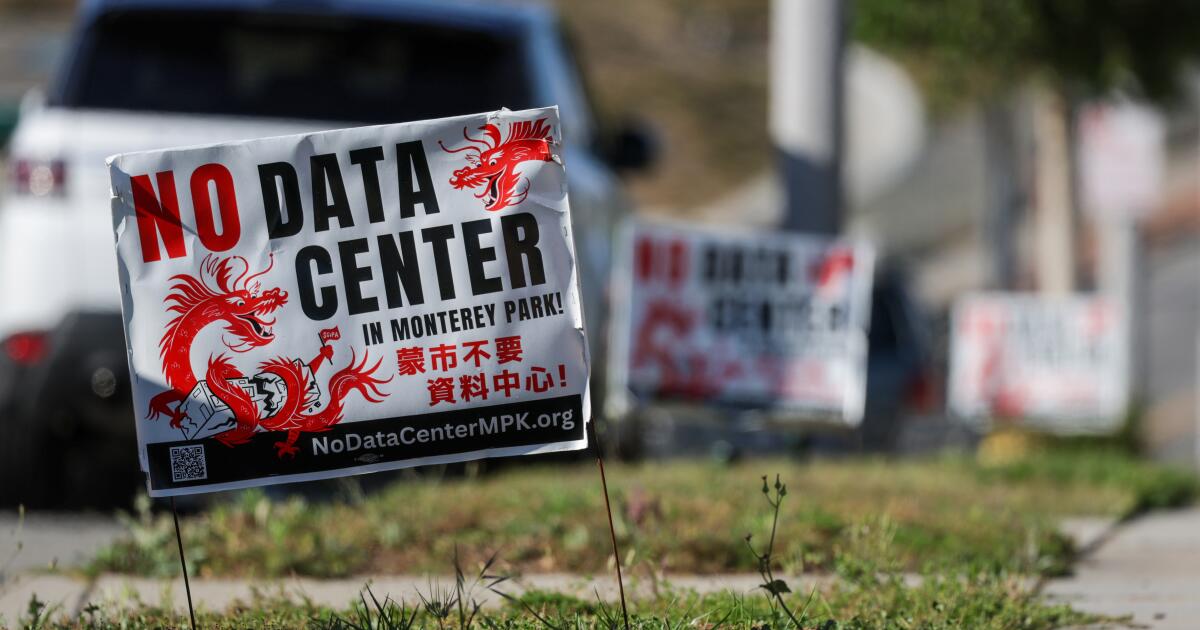
Residents in the city of Monterey Park will be the first in the nation to vote on a permanent ban on data centers Tuesday.
If approved, Measure NDC would prohibit data centers within the city limits and could only be overturned by another vote.
Yard signs saying “No Data Center” in English and Chinese with images of dragons line sidewalks in the San Gabriel Valley city.
As a wave of data center opposition sweeps the country, numerous towns and counties across the U.S. have instituted temporary moratoria and other restrictions on the facilities. But only a handful have instituted indefinite bans, and just four other towns have sent related matters to the ballot.
Supporters are hoping the vote will set a precedent for the rest of the region, where residents are fighting proposals in Vernon and City of Industry.
“This is about as permanent a ban as we can get,” said Steven Kung, co-founder of the group No Data Center Monterey Park. “Winning Measure NDC would send a huge message to the rest of the San Gabriel Valley about how residents don’t want data centers.”
The ballot measure emerged from the fight against a 247,000-square-foot center proposed in 2024 by the Australian-owned investment firm HMC StratCap for a residential area in Monterey Park.
The facility would have sat less than 500 feet away from the nearest home and used three times the electricity of the 60,000-person, predominantly Asian American city.
While the developer touted the potential for jobs and tax revenue, residents expressed concerns about noise and air pollution, rising electricity rates and a potential to lower property values.
The company pulled its plans in late March following public outcry and a March 4 city council vote to extend a temporary data center moratorium and place a ban on Tuesday’s ballot.
In a letter to the city council, HMC StratCap said it would pursue a different use for the land and would not engage in a ballot measure fight.
The city council later banned data centers indefinitely, the first in California to do so, said Mayor Elizabeth Yang. But she’s still been out campaigning for the measure with all four other council members.
“If a council puts in an ordinance, a future council can reverse it too,” said Yang. “With the ballot measure, unbanning it is a lot harder because you need the entire city to vote on it.”
The measure proposes the ban “to protect air quality, drinking water resources, and public health” and “prevent impacts to electricity and water rates.”
While California places third in the country for existing data centers with about 300 facilities, it hasn’t been a hot spot in the recent AI-driven data center boom. High electricity rates, expensive land and regulatory hurdles mean that fewer, and smaller, facilities are currently planned than in Virginia, Texas, Georgia, Illinois or Arizona.
“Most of California’s data centers are small by today’s standards,” said Shaolei Ren, an engineering professor at UC Riverside who studies how to reduce the environmental impacts of data centers. “Ten years ago, they would be medium-sized, but the power demand for new AI data centers has increased a lot.”
The average operating data center demands 45 megawatts, according to the Washington Post, while the average planned one would draw 430 MW. The one proposed for Monterey Park would have required about 50 MW at peak demand.
As proposals crop up in SoCal, they’re met with fierce opposition. Montebello, El Monte and Baldwin Park have all enacted temporary moratoria, and Alhambra recently banned data centers as part of a zoning code update. City of Industry, Vernon, City of Commerce and Santa Fe Springs are moving in the other direction, trying to court developers and streamline data center approvals. Community groups are fighting that.
Outside the San Gabriel Valley, residents of Coachella and Imperial County are showing up in droves to protest local proposals.
Matthew Shaw, a volunteer with the Coalition for Responsible Data Center Development, who recently published a report on opposition to AI data centers, said a vote to ban them in Monterey Park “would lead to copycats, partially because so many groups are just opposed to any data center development at all.”
While there is no formal opposition to Measure NDC, some building trades like Ironworker Local 433 supported the Monterey Park data center when it was still live before city council. Those in the data center industry are lamenting the state of public opinion.
“These are multi-billion-dollar assets that are built by multi-trillion-dollar companies. These things will get done,” said Mehdi Paryavi, chairman of the International Data Center Authority. “My biggest problem is that our industry does not invest enough in community engagement.”
Paryavi said towns that seek to limit data centers are missing out on thousands of jobs generated by data center construction, operations and customers, as well as faster artificial intelligence speeds and better performance.
Kung said local community organizers are “looking at the empirical evidence” and seeing a ban as a win.
“We’ve never seen a city that embraces a data center and is like, ‘Look how our quality of life has increased, look how all the revenue has gone into citywide improvements,’” he said. “That just doesn’t exist.”
-
 News15 minutes ago
California’s primary for governor is undecided as candidates vie to be in the top two
-

 Los Angeles, Ca2 hours ago
California primary election results: governor and L.A. mayor races
-

 Detroit, MI2 hours ago
Another bribery scandal hits Detroit. It involves the People Mover
-

 San Francisco, CA2 hours ago
What’s Worth More Than Cash in San Francisco Real Estate? Anthropic Stock
-

 Dallas, TX2 hours ago
Dallas weighs $500 million‑plus repair plans as City Hall’s future comes up for debate
-

 Miami, FL2 hours ago
Miami biotech executive was followed into his condo by man who allegedly threw him from 25th floor
-

 Boston, MA2 hours ago
What a World Cup ‘fan zone’ is and what Boston fans can expect in 2026
-

 Denver, CO3 hours ago
Defensive lineman Jordan Miller has a tough battle to make the Broncos’ final 53-man roster

