
Connect with us

Entertainment

FBI analyst describes damage to Alec Baldwin's 'Rust' gun in armorer criminal trial

Published

on

FBI analyst describes damage to Alec Baldwin's 'Rust' gun in armorer criminal trial

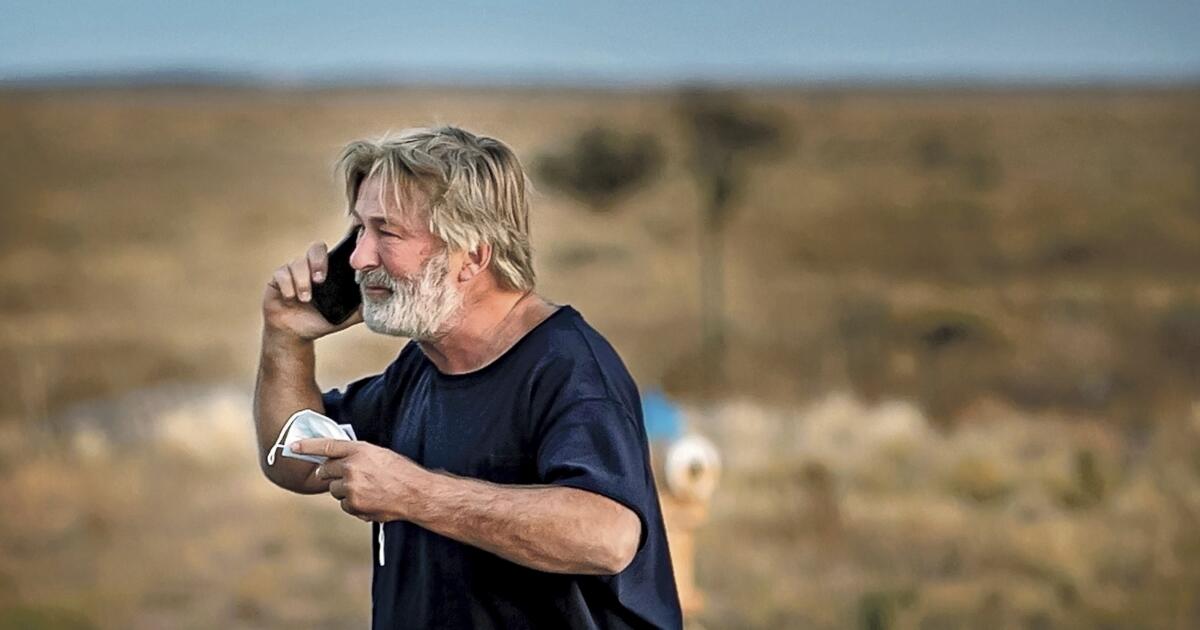
New Mexico prosecutors attempting to prove that Alec Baldwin was criminally negligent in the fatal shooting of the “Rust” movie cinematographer must grapple with a complicating piece of evidence: a damaged gun.

Baldwin has long maintained that he did not pull the trigger of his prop gun — a Colt .45 revolver — on Oct. 21, 2021, while rehearsing a scene on the movie set outside Santa Fe, N.M. Cinematographer Halyna Hutchins was standing a few feet away when Baldwin’s gun discharged, firing a lead bullet that fatally struck her in the chest. The shot also injured film’s director, Joel Souza, who recovered from his wound.

A month after the accident, Baldwin told ABC News anchor George Stephanopoulos: “I didn’t pull the trigger. … I would never point a gun at anyone and pull the trigger at them.”

Persistent questions about the gun’s condition at the time of the shooting have proved to be thorny for prosecutors. Baldwin’s defense team has suggested the actor’s prop gun was faulty and may have malfunctioned, leading to its discharge — a theory that is expected to be a centerpiece of the actor’s defense. His lawyers have pointed to the weapon’s failure during testing to support Baldwin’s recollection of his role in the tragic shooting.

Last month, a Santa Fe County grand jury indicted Baldwin on involuntary manslaughter charges. If convicted, the 65-year-old actor could serve up to 18 months in prison. On Monday, New Mexico First Judicial District Court Judge Mary Marlowe Sommer scheduled Baldwin’s trial to begin with jury selection on July 9.

Advertisement

However, two ballistics experts have cast doubt on Baldwin’s claims, including an FBI forensic examiner who testified Monday in the criminal trial of Hannah Gutierrez, the “Rust” armorer who loaded the actor’s weapon that day. Gutierrez is facing involuntary manslaughter and evidence tampering charges in connection with the “Rust” shooting. This week’s testimony, in a Santa Fe County courtroom, comes as New Mexico special prosecutors look to fortify their felony cases against Gutierrez and Baldwin.

Baldwin has pleaded not guilty to the charges. His trial is expected to last eight days.

On Monday, the third day of Gutierrez’s trial, FBI forensic examiner Bryce Ziegler took the stand.

Ziegler testified that he was responsible for damaging the gun during testing at the FBI Laboratory in Quantico, Va., nearly two years ago.

The FBI analyst said Monday that he performed a rigorous set of tests, including striking Baldwin’s prop gun several times with a “rawhide mallet.”

Advertisement

Ziegler said he used the rawhide mallet to strike the gun, while the hammer was pulled back, from several directions. The tests were intended to determine whether bumping or jostling the weapon would result in a discharge. He said he was trying to simulate scenarios for the gun to go off — without the handler pulling the trigger.

During that test, he broke several components of the gun. The fractured parts included the tip of the trigger, the sear and the hammer.

Hannah Gutierrez, left, with her attorney Jason Bowles, leaves New Mexico’s First District Court, last week after jury selection in her trial on involuntary manslaughter charges.

(Eddie Moore / Albuquerque Journal)

Advertisement

Ziegler said he was only able to get the gun to fire during two of the tests, including at the fully cocked hammer position. “Some of the internal components of the firearm actually broke to allow that hammer to fall and fire the primed cartridge case,” Ziegler said.

Baldwin’s attorneys, through a spokesperson, declined to comment on the testimony.

Ziegler testified that the gun damage occurred during his testing at the FBI Lab.

“It was functioning normally when I received it,” Ziegler testified Monday. “As a result of the testing, it was damaged.”

Ziegler was one of three FBI experts who testified during Gutierrez’s trial on Monday. The proceedings were broadcast by Court TV.

Advertisement

The “Rust” weapons and ammunition provider, Seth Kenney, testified during a deposition last year that the gun — an Italian-made pistol designed to look like a vintage 1873 single-action revolver — was fully functional when he sent it to the production. Kenney has said that he purchased the gun for “Rust.”

But, for the prosecutors, the fractured gun parts have raised nettlesome questions about the integrity of the firearm. Special prosecutors separately hired an Arizona gun expert to review the broken pieces, among other evidence, and determine whether the gun was faulty during the “Rust” production.

That expert, Lucien C. Haag, studied the gun and rebuilt it with new parts. “The trigger had to be pulled or depressed sufficiently to release the fully cocked or retracted hammer of the evidence revolver,” Haag wrote in his August 2023 report.

Baldwin maintains that it wasn’t his job to inspect the revolver to make sure the bullets inside were inert “dummy” rounds. That position was affirmed by SAG-AFTRA, the performers union that includes Baldwin. When Baldwin was handed the gun, he was told that it was “cold,” meaning it had no ammunition.

However, the gun contained five so-called dummy rounds and one live bullet.

Advertisement

“Mr. Baldwin had no reason to believe there was a live bullet in the gun — or anywhere on the movie set,” his attorney Nikas said previously. “He relied on the professionals with whom he worked, who assured him the gun did not have live rounds. We will fight these charges, and we will win.”

Gutierrez, the armorer, told sheriff’s investigators that she loaded the gun but thought all of the bullets inside were dummies. Special prosecutor Jason J. Lewis, in his opening statement, last week said the trial would feature “Rust” crew members who would testify that Gutierrez was “sloppy” and “unprofessional.”

Gutierrez’s attorney, Jason Bowles, disputed the characterization, saying the young armorer was being made “a scapegoat” by prosecutors and film producers looking to find blame for Hutchins’ tragic death. The film set had other issues, including a walk-off by camera crew members.

“What you are seeing in this courtroom today, is trying to blame it all on Hannah, the 24-year-old,” Bowles said during his opening statement on Thursday. “Why? Because she’s an easy target. She was the least powerful person on that set.”

Gutierrez has pleaded not guilty. Her trial is expected to last through March 6.

Advertisement

Entertainment

Ray J says his heart is ‘only beating like 25%’ due to damage from heavy use of drugs, alcohol

Published

on

Ray J says his heart is ‘only beating like 25%’ due to damage from heavy use of drugs, alcohol

Ray J says his days are numbered — and the number he’s citing is 2027.

“Just almost died!! I’m alive because of your prayers and support!!” the singer wrote in an Instagram caption posted Sunday.

“I wanna thank everyone for praying for me. I was in the hospital,” he said in the accompanying video. “My heart is only beating like 25%, but as long as I stay focused and stay on the right path, then everything will be all right, so thank you for all your prayers.”

It was a different story in another livestream, however, captured in clips on the @Livebitez Instagram page.

“2027 is definitely a wrap for me,” the 45-year-old, real name William Ray Norwood Jr., said in one video posted Tuesday, making a “cut off” motion across his neck.

Advertisement

“No, don’t say that, brother,” a friend says off camera.

“That’s what the doctor says,” Ray J replied meekly, then seemingly grew frustrated as his friend talked loudly over him and insisted he was going to live long enough to see his children’s children.

In the next clip, the singer says, “It don’t matter if my days are counted. But guess what — my baby mama gonna be straight. My kids are gonna be straight. If they want to spend all the money they can spend it, but I did my part here.”

Then he looks up and tells his friend, “I shouldn’t have went this hard, bro. I shouldn’t have went hard. And then, when it’s all done, burn me, don’t bury me.”

In clips assembled on the next Livebitez post, Ray J admits heavy alcohol and drug use and says that messed up his heart “on the right side, here, it’s like, black. It’s like done.” He said he might go to Haiti to “do some voodoo” because he thinks “they got the cure.”

Advertisement

He also said he thought he was “bigger” and “had more weight” to put up against the onslaught of substances. “I thought I could handle all the alcohol, I could handle all the Adderall.”

Cut to the next clip where he says he thought he “could handle all the drugs, but I couldn’t. … And it curbed my time here.”

In a final collection of clips, Ray J mentions the criminal protective order put in place by the court after a run-in with the law in November. .

Ray J was arrested in Los Angeles on suspicion of making criminal threats, an LAPD spokesman told The Times in late November. The singer allegedly pointed a gun at ex-wife Princess Love during a heated argument that happened during a livestream at Thanksgiving.

Because of the protective order related to that incident, he isn’t allowed to see her or their kids, Melody, 7, and Epik, who turned 6 last month. He said in court documents reviewed by Page Six that he pointed the gun at her to keep her from driving the kids away from his house after a drunken family holiday.

Advertisement

In the final batch of clips, he says his parents were picking him up “tomorrow” for a doctor appointment. He mentions that sister Brandy had paid his bills “for the rest of the year. That’s crazy.”

Despite the singer-actor picking up his tab, Ray J says his kids have “at least $10 million” in their trust fund account.

The R&B singer was hospitalized in early January in Las Vegas, sidelined by heart pain and pneumonia, according to TMZ. Four years ago, he battled pneumonia as well.

Advertisement
Continue Reading

Movie Reviews

The Wrecking Crew review: Momoa, Bautista buff up Amazon actioner

Published

on

The Wrecking Crew review: Momoa, Bautista buff up Amazon actioner

Who could have predicted that “Lethal Weapon” would turn out to be one of the most influential films ever made?

The film’s writer, Shane Black, probably guessed. He never lacked confidence. The original draft of “Lethal Weapon” included smart-alecky asides, like a description of a cliffside mansion as “the kind of house I’ll buy when this movie is a huge hit.” It was, and the result turbocharged the buddy action formula that powered a string of box office hits, from “Butch Cassidy and the Sundance Kid” and “Uptown Saturday Night” through “48 HRS” and “Running Scared.” Mel Gibson’s long-haired, widowed, suicidal loner cop Martin Riggs gets partnered with Danny Glover’s older, wiser, more measured family man Roger Murtaugh. Although they start out hating each other, by the end each man has gained a new friend, and the once isolated Riggs is welcomed into the Murtaugh family.

The Prime Video movie “The Wrecking Crew” is another entry in that vein, complete with story beats familiar from Black’s first produced script (especially in the final half-hour) and an overall Blackesque vibe, especially in the dialogue. Dave Bautista plays the rock-solid family man, James Hale, a former Navy SEAL turned drill instructor who has a house near Honolulu, a beautiful and charming child psychologist wife, Leila (Roimata Fox), and two adorable kids. Jason Momoa plays the loose cannon partner, James’ half-brother Jonny, a long-haired, hard-drinking, impetuous cop on an Oklahoma reservation who is introduced getting dumped by his long-neglected girlfriend Valentina (Morena Baccarin) on her birthday. (When she asks Jonny if he knows what day it is, he pauses nervously, then guesses “Wednesday?”)

The brothers have been estranged for more than 20 years. But when their father, Walter, a sleazy private eye, gets killed in a hit-and-run accident while working a case in Honolulu, Jonny swallows his pride and flies to Hawaii for the funeral, setting up the inevitable reconciliation, plus lots of skillfully choreographed, sometimes slyly funny action sequences.

It’s all sprinkled with banter, some of it openly hostile, some profane and teasing but affectionate deep down, like stuff brothers would say to each other while roughhousing. Of course, the mystery turns out to be one more variant of “Chinatown,” involving a very sketchy real estate deal/land theft and intimations of a conspiracy that goes right to the top. Temuera Morrison plays Hawaii’s fictional governor, Peter Mahoe, who, of course, is part of the conspiracy. A governor doesn’t show up at the funeral of a bottom-feeding private detective that even his sons loathed unless he’s connected to the main story and the family guiding us through it.

Advertisement

Claes Bang plays real estate mogul Marcus Robichaux, an heir to a sugar fortune who hopes to get even richer from his crimes. Naturally, there’s a small army of security guys and henchmen for the brothers to punch, shoot, stab, and incinerate—a mix of city-roaming Yakuza foot soldiers (a band of whom attacked Jonny in Oklahoma, demanding a thumb drive his dad supposedly sent him) and a squad of gym-burly Caucasian dudes with quasi-military haircuts. An yes, there’s weird, repulsive, deranged chief henchman, Nakamura (Miyavi), a reptilian dandy who snorts cocaine off a drink tray at one of Robichaux’s glammed-out parties, then taunts James, who is posing as a caterer, right to his face.

What makes “The Wrecking Crew” worth seeing is what the cast and filmmakers do with the material. Simply put, this movie is better than its synopsis suggests, though not good enough to entirely overcome the familiarity of the component parts and the alternately jokey and sentimental tone (which is harder to pull off than studio executives seem to think). More so than “Lethal Weapon,” this evokes two less successful (yet still much-loved) Shane Black movies, “Kiss Kiss Bang Bang” and “The Nice Guys.” Some of the action is ludicrous, but most of it is modestly scaled. And the characters are written and performed in a way that makes them recognizably human, even though the Hale brothers are, to quote Stephen Root‘s cop character, “two guys who look like they eat steroid pancakes for breakfast.”

Momoa and Bautista are two of the best actors to become movie stars by passing through the superhero factory, and they get a chance to prove that here, while still delivering what most viewers will expect: chases, shootouts, explosions, frat-house insults, moments of manly vulnerability, and a scene where the brothers get into a huge brawl. The leads are convincing as a straightlaced but too-tightly wound older brother with a stable home life and a flamboyantly self-destructive younger sibling whose adulthood has been defined by rage at the horrors visited upon the brothers in their youth (including the old man’s affairs, one of which produced Jonny). Jonny has PTSD for sure, and it seems a safe bet that James has a touch as well.

It’s an indicator of the movie’s specialness that the most impressive scene isn’t the brother-on-brother street fight in pouring rain, but the aftermath when they sit together on the pavement, bruised and bloody, and talk about the sources of their pain. Runner-up is the moment when the brothers embrace at the end of their mission, beaten and spent, and the mask of adulthood falls away, revealing the scared little boy who needed more love than he got and the older brother who failed to provide it.

Jonathan Tropper, who adapted “This is Where I Leave You” and co-created the action series “Banshee” and “Warrior,” wrote the script, which has more nuance and depth than you’d expect in a movie where trucks and cars fly through the air before exploding. It has a binding theme, forgiveness, and is filled with journalistic details of modern Hawaiian culture, locating the initial killing in a Honolulu neighborhood where such things have happened in real life; sending the brothers to the Hawaiian Home Land, which is stewarded under the Aha Moku system of resource management; reserving soundtrack slots for Indigenous music (like Ka’Ikena’s “Brains”); and peppering conversations with local idioms and slang. Jonny calls another character a squid, out-of-state speculators are referred to as “haole,” and the family name Hale is pronounced “HALL-ay” and translates as “home.”

Advertisement

Indeed, the entire movie is a tribute to the specifics of distinct cultures and the richness of a society that brings them together, while acknowledging that the fusion was forced by colonialism and crony capitalism, and that the conquered have justified resentments over that. The cast is filled with actual Hawaiians, especially Indigenous actors, including Momoa, who is half Native Hawaiian. (Bautista is Greek-Filipino, but should be welcomed under the Pacino as Latino Act of 1983) Even Baccarin gets to honor her own roots; half-Brazilian, she briefly speaks Portuguese, setting up another good joke on Jonny.

Director Angel Manuel Soto, who came to Hollywood by way of San Juan, Puerto Rico, has made three films in a row (“Charm City Kings,” “Blue Beetle,” and this one) that are culturally specific within genres that haven’t traditionally been welcoming to people like him. He’s good at everything the movie requires, including quiet moments of character development that you don’t normally find here. Although it looks backward to previous Hollywood hits, in all the ways that count, this movie is the future.

Continue Reading

Entertainment

Why the Nitty Gritty Dirt Band’s musical bridge between generations still matters today

Published

on

Why the Nitty Gritty Dirt Band’s musical bridge between generations still matters today

Jeff Hanna, Nitty Gritty Dirt Band founder and de facto leader, is tucked into a nondescript booth at El Palenque, a 30-years-plus local restaurant in a Nashville strip mall, talking about “Nashville Skyline,” a pensive track from their EP, “Night After Night.” The family-owned Mexican restaurant is the kind of place he’s gravitated toward since starting a jug band with friends in Long Beach before migrating to Los Angeles’ folk/rock scene.

Threaded with fiddle, piano and lead vocal by his son Jaime, “Nashville Skyline” is an elegy for Nashville’s rapacious gentrification as well as a love lost to time. The metaphor isn’t lost on the elder Hanna, who recognizes what’s been lost with a dignity and sweetness.

“It’s more reflective,” he allows. “But [capturing moments is] what we do best.”

For the dark-haired 78-year-old, this scene’s played out countless times across a career that’s spanned a number of genres related to folk, pop and country: meeting a journalist to talk about the band’s singular brand of American music. Yet little about the NGDB’s sound has changed across six decades.

Advertisement

Beyond “Mr. Bojangles,” written by Jerry Jeff Walker, and “The House at Pooh Corner,” written by Kenny Loggins, the regulars of the Troudadour/Ash Grove clubs would have pop success as the ‘70s became the ‘80s with “Make a Little Magic,” featuring Nicolette Larson, and “Viola! An American Dream,” with vocals from Linda Ronstadt. But it was the multi-generational and genre-bridging Grammy-nominated “Will the Circle Be Unbroken,” recorded with Nashville royalty Roy Acuff, Maybelle Carter and Earl Scruggs among many others, that grounded the band’s future as a mainstream country act in the ‘80s and ‘90s, as well as what’s become Americana.

“Will the Circle Be Unbroken, Vol. 2” (1989) and “Will the Circle Be Unbroken, Vol. 3” (2004) continued that trend. Both brought home Grammys, while featuring Rosanne Cash and John Hiatt, Johnny Cash, Willie Nelson and Tom Petty, Randy Scruggs, John Prine, Bruce Hornsby, Dwight Yoakam and Hanna’s son Jaime. Also, a wunderkind dobro player named Jerry Douglas.

Hanna talks animatedly about Douglas’ production on their five-song EP: “Like a lot of guys who came up in the second wave of bluegrass after Bill Monroe, Flatt & Scruggs, the Stanley Brothers, Jerry’s part of a progressive musical heritage with New Grass Revival, Tony Rice and New South where genre- and cultural-crossing makes you super open-minded, so what we do is very fluid for him.”

The Grammy-winning dobro icon/master — Douglas receives name-billing as part of Alison Krauss & Union Station — has history with the Dirt Band. Beyond playing on “Long Hard Road,” their first country No. 1, Douglas has loved their music since “seeing them in Mole Lake, Wisconsin, at a festival on an Indian Reservation.”

Advertisement

“It was 1973, I was 19 and playing with the Country Gentlemen. Everybody was smoking; there was even a paraquat-testing booth. The Vietnam War was happening. But ‘Will the Circle Be Unbroken’ was out; they had Vassar Clements playing with them — and the honesty of their music stuck out.”

That honesty and being in the moment carried the Dirt Band across cultural upheavals, changing technology and tastes by allowing songs and their sheer joy of playing to define a career marked by over 100 shows a year, scattered recorded projects that featured songs by Marshall Crenshaw, Steve Goodman, Bruce Springsteen and 2022’s “Dirt Does Dylan.”

“I feel really good about ‘Night After Night ‘as a moment in time,” Hanna says. “It’s a good combination of what we do, where we are. It’s a little reflective, but I love the way the songs flow together … and as much as I wanted to be (Don) Henley in ’75, I made my peace with that for something that’s truer.”

Truer means blending founder Jimmie Fadden (drummer/writer/harmonica), 40-years-plus member Bob Carpenter (keyboards/vocals) and longtime pal Jim Photoglo (bass/vocals) with stand-out next-gen players multi-instrumentalist Ross Holmes (Mumford + Sons, Bruce Hornsby) and Hanna’s son, guitarist/vocalist Jaime (the Mavericks, Gary Allen). Hanna says, “Jaime’s one of my best friends in the world and we share a lot of music, but his chops are substantial. I sometimes look over, hearing him play what were my solos and smile. He’s got the three T’s in electric guitar: tone, taste and timing.”

Beyond the EP’s romping Paul Kennerly/Daniel Tashian title track ruminating on love lost’s impact, a poignant sense of reckoning with the passage of time and loss of places that matter is tempered with grace and acceptance. Featuring prominent acoustic guitar picking, Fadden’s signature harmonica and lyrics stained with philosophical nostalgia, the project gilds the band’s current Farewell Tour celebrating 60 years of music-making that rooted when “Buy for Me the Rain” became a regional Los Angeles hit.

Advertisement

Douglas concurs about the fingers-on-strings magic. “We recorded all this at Oceanway, sitting in a circle, running the songs and looking at each other. It’s a little more organic than some projects; we didn’t do 20 takes, but created dynamics … I’ve played music my whole life, and this was one endorphin rush after another.”

That rush can’t be machined or algorithmed. Both Country Music Hall of Fame Chief Executive Kyle Young and Americana Music Assn. Executive Director Jed Hilly point to the Dirt Band as a groundbreaking influence.

Young enthuses, “I grew up in Nashville, and it took them to show me Nashville’s musical history and heritage; I was listening to everything but country. That first ‘Circle,’ you can’t overemphasize its impact enough,” while Hilly raves, “They were legendary when I was 10 years old in Vermont, going to the Craftsberry Fiddle and Banjo Contest! It was Neil Young’s ‘Harvest,’ [Grateful Dead’s ‘Working Man’s Dead,’ Doc Watson and ‘Circle.’]”

Hilly continues, “I’ve heard T Bone Burnett talk about ‘Oh Brother,’ how great music cuts through. But the Dirt Band? They were pivotal, like John Prine, who just made his music … reaching into the past, but bringing it to the present so it’s very current. And the happiness onstage? No one’s like them.”

Advertisement

And there’s Darius Rucker, a contemporary country star and leader of ubiquitous ‘90s rock/roots Hootie & the Blowfish, who emailed, “I learned so much about the true roots of country and how to apply it when we started making records in college.

“They were a great pop band, and ‘Circle’ was such an important moment for bringing old-school country and bluegrass artists — Maybelle Carter, Roy Acuff, Doc Watson, and Merle Travis — into the room with ‘hippie kids’ … It allowed for country and California rock to come together. “

Laughing when the praise is shared, Hanna demurs. “The amount of eye rolls you get from saying ‘Farewell Tour,’ because it’s so abused. But the rigors of touring, especially with travel the way it is … Fadden’s always been one to remind us how grateful we are when it’s three hours of sleep, the food choices aren’t so good and something’s lost, because we are.

“We’ve never stopped making music,” Hanna continues. “Sometimes we were the Toot Uncommons with Steve Martin, or playing as Linda Ronstadt’s back-up band for a minute, but it was always great music. Even when record company people would suggest something to make us ‘cool with the kids,’ we knew, and don’t have too many cringe moments.

“With ‘Night After Night,’ I got to co-write most of this record with my son, my wife (Nashville Songwriter Hall of Famer Matraca Berg) and friends like Mac McAnally. Jaime brought us some cool songs, too. Everybody played great. We had the same kind of fun we did when we started. Sixty years in, what more is there?”

Advertisement
Continue Reading
Advertisement

Trending
