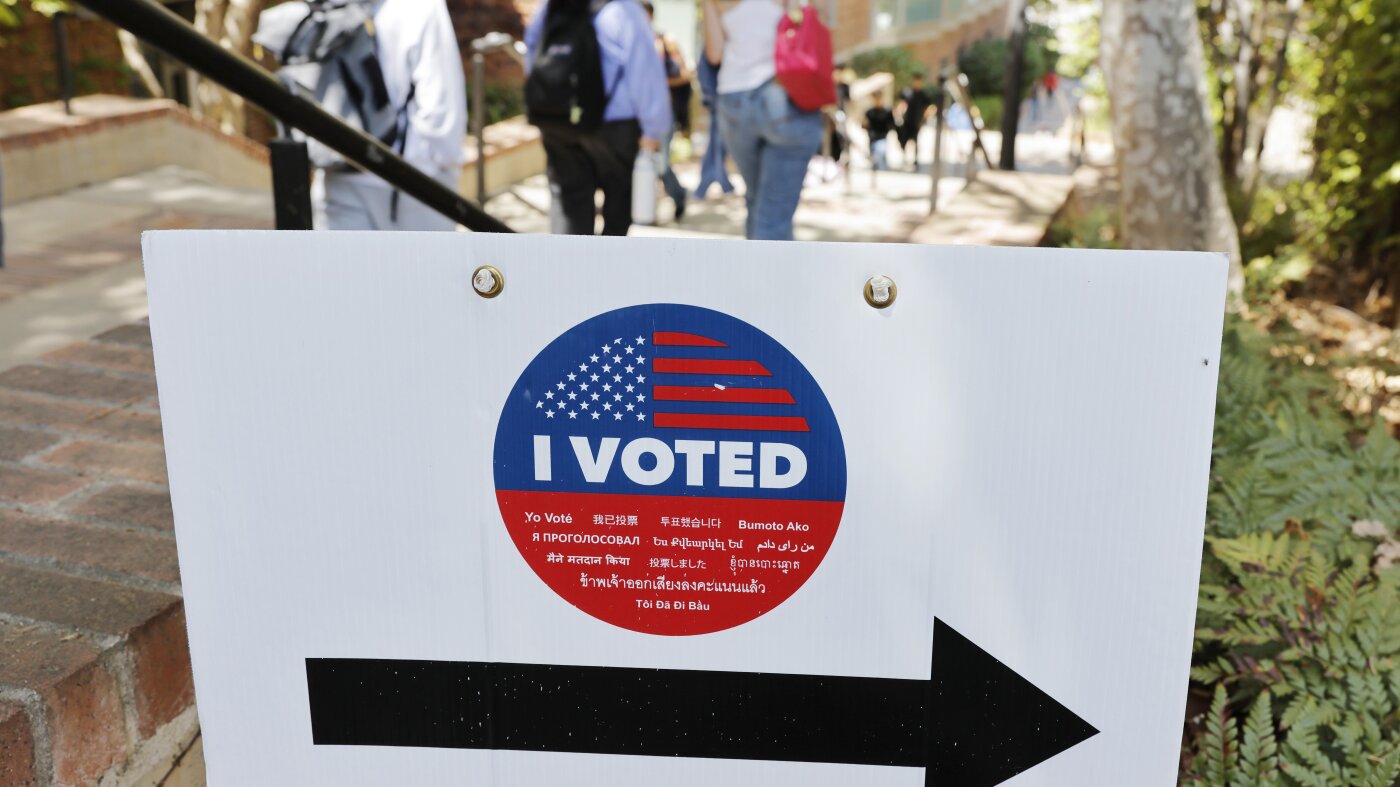
An “I voted” sign points to a Vote Center on June 1 in Los Angeles.
Mario Tama/Getty Images
hide caption
toggle caption
Mario Tama/Getty Images
Six states — California, Iowa, Montana, New Jersey, South Dakota and New Mexico — hold elections on Tuesday. Most of the attention is on California and Iowa, where there are competitive primaries for governor. In both states, the Democratic Party also sees a road map to control of Congress in the fall.
In California’s unique primary system, voters send the top two vote-getters to November’s general election, regardless of candidates’ political parties. Democratic Gov. Gavin Newsom is term limited, and California voters will also pick who should move on to the general election in five new Democratic-leaning congressional districts.
In Iowa, Democratic voters will choose a candidate in a key Senate race — the Republican in the race is already the de facto nominee. In order to win a majority in the Senate, Democrats must pick up four seats, forcing the party to win in Republican-leaning states like Iowa. For governor, the race is the first good chance Democrats have to win the office in years, but Republicans still need to select their nominee.
Here are key races to follow:
Or skip to specific races:
California governor | California U.S. House | Iowa governor | Iowa U.S. Senate | New Jersey and Montana
You can also check out June 2 voter resources from the NPR network.
California decides top two gubernatorial contenders
It’s been a chaotic scramble to pick the next leader of the country’s largest state. After three prominent Democrats — former Vice President Kamala Harris, Sen. Alex Padilla and state Attorney General Rob Bonta — decided not to run, Democratic voters haven’t had a clear front-runner for the first time in decades. Voters have more than 60 candidates to choose from, but only a fraction of those are considered serious contenders. Only the top two vote-getters will move on to the general election in November.
California Democratic gubernatorial candidate Xavier Becerra hugs a supporter at the Long Beach Arena on May 31 in Long Beach, Calif.
Apu Gomes/Getty Images
hide caption
toggle caption
Apu Gomes/Getty Images
The race got a shakeup when former Democratic Rep. Eric Swalwell, the presumed favorite, dropped out of the race after he was accused of sexual misconduct by several women. Most recently, polls show the contest could be between two Democrats — the Health and Human Services secretary under former President Joe Biden, Xavier Becerra, and billionaire philanthropist Tom Steyer.
Before Becerra was appointed to Biden’s Cabinet, he served 12 terms in Congress and was elected as the California attorney general in 2016. He’s considered by many as the candidate with the strongest political background. Becerra’s pitch is that he is a proven leader who can hold his own and protect California from President Trump.
Steyer has forked over more than $213 million of his own fortune on the race and is also financially backed by Our Revolution, a group aligned with Sen. Bernie Sanders, I-Vt. Steyer’s platform is centered on taking a stand against special-interest groups in politics.
Polling just a few points behind Becerra and Steyer is Republican Steve Hilton. The former Fox News host was endorsed by President Trump in April, after which Riverside County Sheriff Chad Bianco, another Republican in the race, quickly dropped in the polls. Hilton’s platform focuses on increasing affordable housing supply for first-time homebuyers, bolstering tech industries and reviving California’s film industry.
Democratic gubernatorial candidate Tom Steyer speaks with students during a Get the Youth Vote with Bruin Democrats event at UCLA’s campus on June 1 in Los Angeles, Calif.
Mario Tama/Getty Images
hide caption
toggle caption
Mario Tama/Getty Images
The outcome of California’s new congressional districts
In response to Texas redrawing its congressional lines to create five Republican-leaning districts at the behest of President Trump, Californians approved Proposition 50 in November last year. The measure temporarily sidestepped the independent redistricting commission tasked with drawing nonpartisan influenced congressional boundaries, in favor of politically gerrymandered districts. That allowed state Democrats to redraw their map so five previously Republican-held districts now lean Democratic.
This has left those Republican incumbents figuring out their political futures. Rep. Ken Calvert, the longest-serving Republican from California, and Rep. Young Kim are running in the same district, for example, in a race that’s gotten quite heated.
Then there’s Rep. Kevin Kiley. After being drawn into a much more Democratic-leaning district, he decided to run in a new seat and announced he was leaving the Republican Party and running as an independent instead, though Kiley said would still caucus with the Republicans.
Because of California’s primary system, some of these more competitive seats are creating competitive primaries between Democrats, allowing primary voters to signal to the party what kinds of candidates speak to them most in places that have the most to lose — and gain.
Iowa’s GOP gubernatorial primary
Iowa Republican voters could decide the party’s nominee for governor in the state’s first open race for the office since 2011, as sitting Gov. Kim Reynolds opted not to run for reelection.
With five Republicans on Tuesday’s ballot, Rep. Randy Feenstra is the only one endorsed by Trump. The race will test whether Trump’s endorsement holds weight in a state where his approval rating has slipped over the economy and the war in Iran. Feenstra’s lead may be declining, as one recent poll shows political newcomer and Iowa businessman Zach Lahn could have a shot at winning the GOP primary.
There is a good chance, though, that Iowans won’t know the outcome of the race on Tuesday because a candidate must secure 35% of the vote to win outright. If no one clears that threshold, the nominee will be decided at a Republican convention where delegates — not primary voters — make the final choice.
But the Republican-backed candidate isn’t a shoo-in come November. Cook Political Report categorizes the governor’s race as a toss-up with a slight Republican advantage. Whatever Republican wins on Tuesday will face unopposed Democratic State Auditor Rob Sand in the general election. Sand is popular among voters and has, so far, outraised any other candidate for governor.
Democrats look to flip Iowa Senate seat
Democratic voters in Iowa will pick which candidate they think has the best shot at beating the Republican nominee for Senate, expected to be Trump-endorsed Rep. Ashley Hinson, on Tuesday. This is a seat that Democrats believe they have a shot at flipping come November. It’s part of a larger strategy of expanding their map — and winning in states currently held by Republican senators — if they want a chance to retake the Senate majority.
Iowa Democrats have a choice between state Rep. Josh Turek and state Sen. Zach Wahls. Both candidates are courting different Iowa voters, though. Turek is vying for the independent-leaning vote, while Wahls is hoping to gain the support from committed Democrats. Turek flipped a state House district held by a Republican, while Wahls represents a Senate district that is solidly blue. Both argue they are the candidate who has the right message to win in November.
And with three competitive congressional races on the ballot, some Democrats in the state are feeling like the road to a Democratic majority in Congress runs through Iowa.
Looking beyond Tuesday
New Jersey and Montana also have competitive races that could decide which party has control of Congress.
In New Jersey, all eyes are on Congressional District 7. Four Democrats are hoping to oust Republican Rep. Thomas Kean Jr. The sitting congressman has been notably absent from Washington for weeks due to what Kean cites as unspecified medical issues. He has missed more than 100 House votes since his last recorded vote on March 5.
Two races in Montana may be more competitive than originally expected with the last-minute announcements — shortly before the filing deadline — by Republicans, Sen. Steve Daines and Rep. Ryan Zinke, that neither would seek reelection.
While an open Senate seat does not make Montana, which has long been considered a Republican stronghold, necessarily competitive for Democrats, an independent candidate is outraising candidates in both major parties. Seth Bodnar, Iraq war veteran and former president of the University of Montana, is hoping voters will send him instead, mostly on the message that he won’t work for either party and is focused on changing the direction America is heading. In Bodnar’s case, he has enough voter signatures to land himself on the November ballot, but the Montana Secretary of State’s Office hasn’t yet certified those signatures.
Democrats are working to flip Montana’s 1st Congressional District as well. When Zinke announced he was retiring from Congress, it was seen as an opening for Democrats to compete. Now, four Democrats are angling for the open seat, including front-runner Sam Forstag, a smokejumper who is endorsed by popular progressive Rep. Alexandria Ocasio-Cortez, D-N.Y.
June 2 voter resources from the NPR Network
California | Iowa | Montana | New Jersey | New Mexico | South Dakota