Business
Column: Taxpayer 'protection' or taxpayer 'deception'? A new ballot measure aims to destroy the California state budget


It’s indisputable that the decline of state fiscal management in California began with the passage of Proposition 13 in 1978.
The tax-cutting initiative upended the tax structure that provided most of the revenues needed by localities and school districts, undermining the locals’ control of their own spending.
It was sold to voters as relief for beleaguered middle-class homeowners, but that was largely a scam: The chief beneficiaries have been the richest homeowners and commercial and industrial property owners, who have received billions of dollars in property tax breaks at the expense of residential owners.
These provisions discourage new government efforts no matter how urgent the problem to be addressed,…[and] hang like a shadow over budgets to be adopted in summer 2025.
— League of California Cities, et al
So it may be unsurprising that the heirs of Proposition 13’s proponents are trying to pull another fast one on California taxpayers.
Their tool, pushed chiefly by the California Business Roundtable, apartment developers and others of that ilk, is the so-called Taxpayer Protection and Government Accountability Act.
The Business Roundtable spent $6.375 million in 2022 pushing the initiative and an additional $770,000 last year; about $310,000 came in 2022 from the Howard Jarvis Taxpayers Assn., named after the chief promoter of Proposition 13, and about $400,000 last year from R.W. Selby & Co., a big apartment developer.
The initiative has been scheduled for the November ballot and will appear there unless the state Supreme Court throws it off; that’s what the measure’s critics have asked, citing numerous technical reasons.
The state’s political leadership is striking back in another way: through a public campaign targeting the Business Roundtable and its leading corporate members, and endorsed by Gov. Gavin Newsom, the Democratic legislative leaders, and organizations such as the League of California Cities, the Service Employees International Union, the California Medical Assn. and the California Teachers Assn.
Their strategem is to redefine the measure as the “Taxpayer Deception Act” and assert in public outreach that it would eliminate state funding for “paid family leave, disability insurance, gun violence prevention, and climate programs,” as well as funding for road and infrastructure maintenance.
Is this a fair assessment? It largely conforms to the judgment of the Legislative Analyst’s Office, which found that it would result in “lower annual state and local revenues, potentially substantially lower.”
As is so often the case when the business lobby starts whining about its difficulties operating in the largest economy and most vigorous consumer market in the United States, “deception” is an understatement.
But let’s start with the text of the initiative itself. Fundamentally, it would change the rule for the enactment of a tax increase from current law, which requires a two-thirds vote of each legislative chamber or passage by a majority of voters, to two-thirds of each chamber and a majority of voters. Obviously this raises the bar significantly.
The initiative also would redefine numerous governmental fees as taxes subject to the new rule. Perhaps most damaging, it would retroactively invalidate any revenue measures passed since Jan. 1, 2022, unless they’re re-ratified in 2025.
Taken together, “these provisions discourage new government efforts no matter how urgent the problem to be addressed, … hang like a shadow over budgets to be adopted in summer 2025, … and impair California governments’ ability to borrow,” a coalition of government advocacy organizations led by the League of California Cities told the Supreme Court in a friend-of-the-court letter. The prospect of passage is “already undermining certainty and impairing planning in government finance,” they wrote.
The initiative backers are plainly intent on riding generalized discontent with taxes to victory. The text bristles with shibboleths of the anti-tax movement, for example by blaming higher taxes on “unelected bureaucrats, empowered by politicians and the courts.” It ties itself to Proposition 13 by stating that its purpose is “to further protect the existing constitutional limit on property taxes” — i.e., Proposition 13.
Let’s take a closer look at the promoters’ lead slogans. One is that the initiative “stops politicians from using ‘hidden taxes’ disguised as fees to drive up the cost of government services.” This absurdly turns reality on its head. Taxes don’t “drive up” the cost of services — they’re levied to pay for government services, almost all of which are favored by taxpayers, and the disappearance of many of which would elicit a taxpayer revolt.
Another slogan holds that Californians are struggling with the “highest income tax, state sales tax, gas taxes, and poverty rate.”
It’s true that California’s top marginal income tax rate is the highest in the nation. But one can hardly blame that on “unelected bureaucrats”: Voters specifically endorsed the current top rates at the ballot box in 2004, 2012 and 2016 — the last by a 63%-37% vote.
The truth, moreover, is that the vast majority of California taxpayers don’t pay anywhere near the top rate, according to the Institute on Taxation and Economic Policy. Who does? The special interests behind this initiative. The highest marginal rates, ranging from 10.3% to 13.3%, kick in for single filers with incomes over $350,000 and couples with incomes of nearly $700,000 and higher.
California’s income tax is steeply progressive, meaning those who earn the most pay disproportionately more. The lowest-income 95% of households, with incomes of less than $25,200, pay less than about 4% of family income in state income tax; the highest 1%, with earnings of $862,000 or higher, pay nearly 9% of their earnings in income taxes.
If you’re wondering why executives sitting around the Business Roundtable might be agitating for lower taxes, there’s your answer.
It is true that the state sales tax rate of 7.5% is the highest in the nation. It’s also our most regressive tax, meaning it burdens lower-income Californians the most — costing the lowest-earning 20%, with household incomes of $25,200 or less, an average 7.6% of family income. That burden drops steadily as income rises, reaching a mere 1% for the blessed top 1% of earners.
One might reasonably ask why the income and sales tax rates are so high in California. The answer is Proposition 13, which eviscerated the property tax that was once the most stable and productive revenue source for local government. With the passage of Proposition 13, the revenue-raising responsibilities devolved to the state, which had no option for covering local needs except through the income and sales tax.
It should come as no surprise that the tax initiative backers don’t mention the property tax in their spiel. The reason is that California’s effective average property tax rate ranks only 33rd among the states; Texas and Florida, which boast of imposing no income tax, are both higher (6th and 26th, respectively, according to Census Bureau figures).
One other point bears mentioning, for perspective. It concerns who the beneficiaries are of these states’ tax structures. In Texas and Florida, it’s the rich. As a share of family income, the total tax burden in Texas falls heaviest on the lowest-income households — 12.8% of family income for those earning $21,700 or less — and lightest on the wealthiest — 4.6% of family income on the top 1%, earning $744,800 or more.
Florida looks the same: Households with earnings of $19,600 or less pay 13.2% of their income in state taxes, but the top 1%, earning $735,700 or more, fork over a mere 2.7% of their income in taxes.
California’s structure is much more equitable. All blocs in the income range, from the lowest 20% (less than $25,200) to the top 1% ($862,000 or more) shoulder burdens ranging from 10.3% to 12%.
Make no mistake: The promoters of the tax initiative want California to look more like Texas and Florida.
Gas taxes, which the initiative promoters also target, are a special case. It’s true that California’s gas tax is the highest in the country, at about 78 cents per gallon. But they also pay for benefits that most Californians would probably regret losing, including clean air, clean gas technology and road and bridge maintenance.
Also, a sizable contributor to the price Californians pay for gas is what Severin Borenstein of UC Berkeley has identified as the “mystery surcharge.” That’s a difference in gasoline prices, currently more than 40 cents per gallon extracted by oil producers, refiners or retailers at an unidentifiable point of the gasoline economy.
Borenstein originally traced the surcharge to a price spike following an explosion at Exxon Mobil’s Torrance refinery in 2015 that led to a more than year-long shutdown — but the spike never disappeared after the refinery came back online.
We can set aside the poverty rate for two reasons: First, its relationship to taxes is dubious, since households in poverty generally pay the lowest taxes (other than sales taxes) in California’s progressive system.
Second, according to the Census Bureau, California’s official poverty rate ranks 22nd among all states as measured by the percentage of residents living below the official poverty line, far better than states such as Mississippi, Alabama, Arkansas and West Virginia.
California does lead the nation in a calculation known as the supplemental poverty measure, but tax rates play almost no role in that calculation, which is based on factors such as housing costs.
Where does that leave us?
Proposition 13 was the child of legislative failure. Homeowners in the 1970s faced ever-higher property tax assessments due to a sharp run-up in home values. The Legislature could have crafted any of a myriad of solutions to deal with the crisis, but didn’t. The result was an outburst of voter fury at the ballot box in 1978, enacting the worst option of all.
Proposition 13 is what launched an era of government fees, for the simple if not obvious reason that the services and amenities California voters value have to be paid for somehow and Proposition 13 left few other options for doing so.
If California homeowners are struggling, one reason is that Proposition 13 shifted the burden of property taxes onto them: In 1975, single-family residences accounted for 39.9% of assessed values in Los Angeles County, and commercial-industrial properties for 46.6%. By 2018, the ratio had more than reversed, with houses accounting for 57.6% and commercial-industrial properties for 28.9%.
The “Taxpayer Protection Act” will make things worse. California voters will still want their services and amenities, but funding them will be much harder, so they’ll deteriorate. Voters will get angrier, but where will they turn and who will they blame?
The enduring rule of ballot measures applies here: If you want to know who will benefit from an initiative, just look who’s putting up the cash for it, and vote accordingly. The backers of the initiative say it’s “simple,” which is the clearest sign of all that it’s anything but.



Dear Mr. Pelley:
I meant what I said in my letter last week to the 60 Minutes team: joining 60 Minutes is the honor of my career and I am grateful to be working alongside the people who have contributed to the most important television journalism brand this country has ever produced. While I’m new to 60 Minutes, I’ve devoted my career to investigative journalism and storytelling. I started this job excited to collaborate and to benefit from the wisdom and experience of the 60 Minutes veterans, with you among them. For that reason, one of the first things I did in my new role was call you to talk and invite you to dinner. It is a profound disappointment that you rejected that overture and chose ambush instead. Yesterday, you hijacked my first meeting with staff to disparage me, my qualifications, and my intentions with remarkable incivility and contempt. I welcome a diversity of viewpoints and respectful debate among the team, but this was nothing of the sort. Yesterday’s performative display of hostility enacted in front of the staff instead of in a civil, private conversation-demonstrated that you have no interest in contributing to the future success of the show, or approaching my new tenure with a mind open to collaboration and progress. I am here to deliver first-in-class news programming, not to make headlines about newsroom drama. I am eager to work alongside those who share this goal.
Despite yesterday’s misconduct, I had hoped that in sitting down with you today we could find a path forward together. You made clear that you are not interested in such a path.
Your antipathy to the future of the show has come through loud and clear. And I have heard you. I therefore write on behalf of CBS News, Inc. (“CBS”) to inform you that your employment with CBS is terminated for cause effective immediately. Enclosed is your formal termination letter.
Sincerely,
Nick Bilton
Executive Producer, 60 Minutes

The co-founder of Aspiration, Joseph Sanberg, was sentenced to 14 years in prison on Monday after defrauding investors and lenders of over $248 million.
The startup, an eco-friendly digital banking company boasting fossil fuel-free investments, carbon offsets for gas purchases, and a debit card with cash-back benefits for shopping at clean companies, was founded by Sanberg and Andrei Cherny. Cherny left the company in 2022 and has not been charged.
Sanberg, an Orange County native, pleaded guilty to wire fraud in October after being arrested in March last year. Aspiration subsequently filed for bankruptcy and liquidated all of its assets by July.
Sanberg and venture capitalist Ibrahim AlHusseini, who also faces charges, together forged a series of bank statements in order to obtain loans. From 2020 to 2021, the pair forged AlHusseini’s bank statements to show millions of dollars in assets in order to obtain millions of dollars from lenders.
Additionally, they forged a letter from their audit committee stating that $250 million in funds were available, when in reality Aspiration had less than $1 million. The amount of loans defrauded exceeded $248 million.
In 2021, Sanberg artificially inflated Aspiration’s 2021 revenue by $44 million by recruiting 27 fake customers to sign letters of intent pledging tens of thousands of dollars per month for tree planting services. Sanberg himself funded the contracts and used the inflated revenue numbers to obtain more loans.
The charges sparked an NBA investigation into salary cap allegations due to Aspiration’s connections with Clippers owner Steve Ballmer.
Ballmer personally invested $60 million in Aspiration, all of which was lost. He is now the target of a civil lawsuit alleging his participation in the scheme. Ballmer denies the allegations.
The team announced a $300-million sponsorship deal with Aspiration, and Clippers player Kawhi Leonard signed a four-year, $28-million marketing contract with the company, which reportedly performed no duties. The issue has raised concerns about how players are circumventing the NBA’s salary cap.
The team lost the $300-million sponsorship deal and an additional $20 million paid for carbon offset purchases.
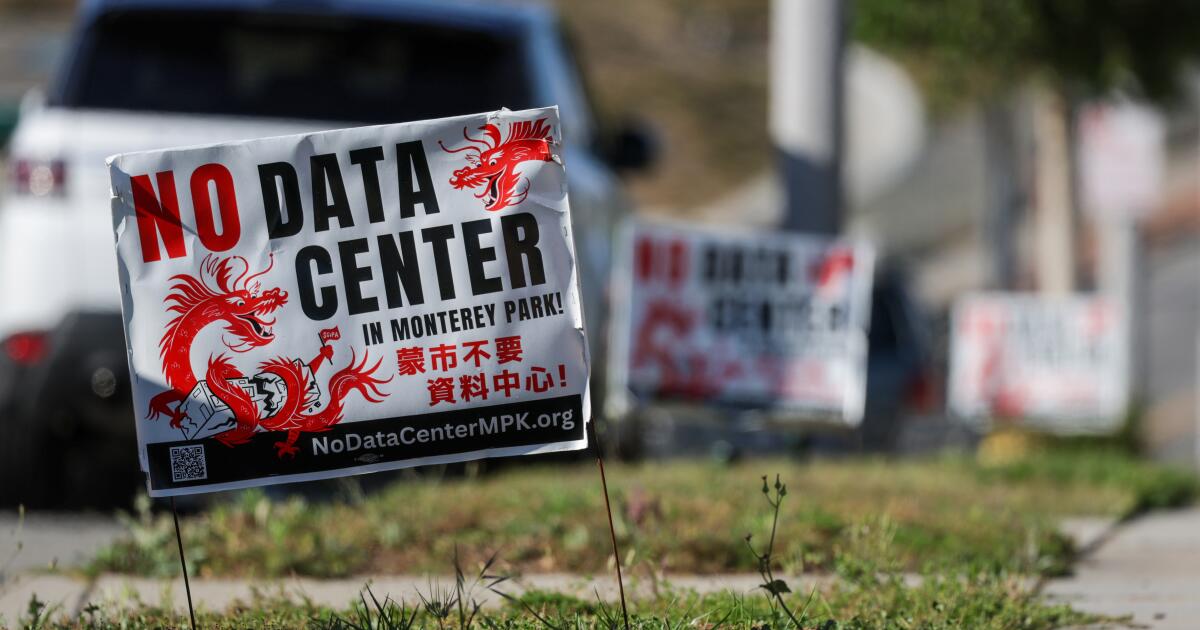
Residents in the city of Monterey Park will be the first in the nation to vote on a permanent ban on data centers Tuesday.
If approved, Measure NDC would prohibit data centers within the city limits and could only be overturned by another vote.
Yard signs saying “No Data Center” in English and Chinese with images of dragons line sidewalks in the San Gabriel Valley city.
As a wave of data center opposition sweeps the country, numerous towns and counties across the U.S. have instituted temporary moratoria and other restrictions on the facilities. But only a handful have instituted indefinite bans, and just four other towns have sent related matters to the ballot.
Supporters are hoping the vote will set a precedent for the rest of the region, where residents are fighting proposals in Vernon and City of Industry.
“This is about as permanent a ban as we can get,” said Steven Kung, co-founder of the group No Data Center Monterey Park. “Winning Measure NDC would send a huge message to the rest of the San Gabriel Valley about how residents don’t want data centers.”
The ballot measure emerged from the fight against a 247,000-square-foot center proposed in 2024 by the Australian-owned investment firm HMC StratCap for a residential area in Monterey Park.
The facility would have sat less than 500 feet away from the nearest home and used three times the electricity of the 60,000-person, predominantly Asian American city.
While the developer touted the potential for jobs and tax revenue, residents expressed concerns about noise and air pollution, rising electricity rates and a potential to lower property values.
The company pulled its plans in late March following public outcry and a March 4 city council vote to extend a temporary data center moratorium and place a ban on Tuesday’s ballot.
In a letter to the city council, HMC StratCap said it would pursue a different use for the land and would not engage in a ballot measure fight.
The city council later banned data centers indefinitely, the first in California to do so, said Mayor Elizabeth Yang. But she’s still been out campaigning for the measure with all four other council members.
“If a council puts in an ordinance, a future council can reverse it too,” said Yang. “With the ballot measure, unbanning it is a lot harder because you need the entire city to vote on it.”
The measure proposes the ban “to protect air quality, drinking water resources, and public health” and “prevent impacts to electricity and water rates.”
While California places third in the country for existing data centers with about 300 facilities, it hasn’t been a hot spot in the recent AI-driven data center boom. High electricity rates, expensive land and regulatory hurdles mean that fewer, and smaller, facilities are currently planned than in Virginia, Texas, Georgia, Illinois or Arizona.
“Most of California’s data centers are small by today’s standards,” said Shaolei Ren, an engineering professor at UC Riverside who studies how to reduce the environmental impacts of data centers. “Ten years ago, they would be medium-sized, but the power demand for new AI data centers has increased a lot.”
The average operating data center demands 45 megawatts, according to the Washington Post, while the average planned one would draw 430 MW. The one proposed for Monterey Park would have required about 50 MW at peak demand.
As proposals crop up in SoCal, they’re met with fierce opposition. Montebello, El Monte and Baldwin Park have all enacted temporary moratoria, and Alhambra recently banned data centers as part of a zoning code update. City of Industry, Vernon, City of Commerce and Santa Fe Springs are moving in the other direction, trying to court developers and streamline data center approvals. Community groups are fighting that.
Outside the San Gabriel Valley, residents of Coachella and Imperial County are showing up in droves to protest local proposals.
Matthew Shaw, a volunteer with the Coalition for Responsible Data Center Development, who recently published a report on opposition to AI data centers, said a vote to ban them in Monterey Park “would lead to copycats, partially because so many groups are just opposed to any data center development at all.”
While there is no formal opposition to Measure NDC, some building trades like Ironworker Local 433 supported the Monterey Park data center when it was still live before city council. Those in the data center industry are lamenting the state of public opinion.
“These are multi-billion-dollar assets that are built by multi-trillion-dollar companies. These things will get done,” said Mehdi Paryavi, chairman of the International Data Center Authority. “My biggest problem is that our industry does not invest enough in community engagement.”
Paryavi said towns that seek to limit data centers are missing out on thousands of jobs generated by data center construction, operations and customers, as well as faster artificial intelligence speeds and better performance.
Kung said local community organizers are “looking at the empirical evidence” and seeing a ban as a win.
“We’ve never seen a city that embraces a data center and is like, ‘Look how our quality of life has increased, look how all the revenue has gone into citywide improvements,’” he said. “That just doesn’t exist.”
-

 Milwaukee, WI2 minutes ago
MPS staffer who got plea deal in slapping case had earlier incident
-

 Atlanta, GA9 minutes ago
19 new metro Atlanta restaurants opened in May, but 11 closed
-

 Minneapolis, MN12 minutes ago
Motorcyclist seriously injured in north Minneapolis hit-and-run
-

 Indianapolis, IN17 minutes ago
New stores in Indianapolis include indoor kid’s playground, cafe
-

 Pittsburg, PA23 minutes ago
Blanche says DOJ
-
Augusta, GA26 minutes ago
Amy Elizabeth Black Obituary May 29, 2026 – Platt’s Funeral Home
-
Washington, D.C27 minutes ago
Sherry Abedi has been appointed as General Manager at LINE DC
-

 Cleveland, OH39 minutes ago
Man shot on Cleveland’s West Side


