


- President Donald Trump is expected to sign executive orders reducing the size of Utah’s Grand Staircase-Escalante and Bears Ears national monuments on Monday.
- The monuments have shifted in size between administrations, with Trump reducing them in 2017 and President Joe Biden restoring their original boundaries in 2021.
- Environmental groups and Utah officials are divided over the potential reduction, with critics threatening legal challenges and supporters seeking more local control.
Utah
Lakebed dust is a worry in Utah. For California’s Salton Sea, it’s a full-blown problem


Editor’s note: This article is published through the Great Salt Lake Collaborative, a solutions journalism initiative that partners news, education and media organizations to help inform people about the plight of the Great Salt Lake — and what can be done to make a difference before it is too late. Read all of our stories at greatsaltlakenews.org.
MECCA, Calif —Sitting on the couch next to his mom inside their mobile home in Mecca, California, 5-year-old Ruben Mandujano lets out a gurgled cough while playing on a tablet. The phlegm stuck in his throat is noticeable. But the constant cough is something he’s used to.
Ruben Mandujano, who has asthma and is autistic, uses a nebulizer with albuterol at his home near the Salton Sea and Mecca, California, on Thursday, Dec. 14, 2023. Ruben, 5, doesn’t like the nebulizer, as it often makes him throw up, but knows it is necessary when he is sick. (Kristin Murphy, Deseret News)
His mother, Rosa Mandujano said he came down with some kind of illness about “eight out of the 12 months of the year” when he was younger. Now, after various surgeries, an asthma diagnosis, medications and a nebulizer, Mandujano estimates her son is sick “five months out of the 12.”
The family has grown accustomed to the frequent infections. Both of their children suffer from asthma. A cupboard in their kitchen is dedicated to dozens of over-the-counter and prescription drugs.
Mandujano said her son’s problems get worse when the air quality is awful – another common issue for Coachella and Imperial Valley residents. Mecca, where the Mandujano family lives, is enveloped by agricultural fields and a short distance from the north shore of the declining Salton Sea, a saline lake facing similar turmoil as Utah’s Great Salt Lake.
Dust storms have become the norm being so close to agricultural fields and the Salton Sea, she said. Winds reaching 75 miles per hour whip through predominantly low-income and immigrant communities. The dust gets so bad, Mandujano said, that “you can’t see what’s in front of you.”
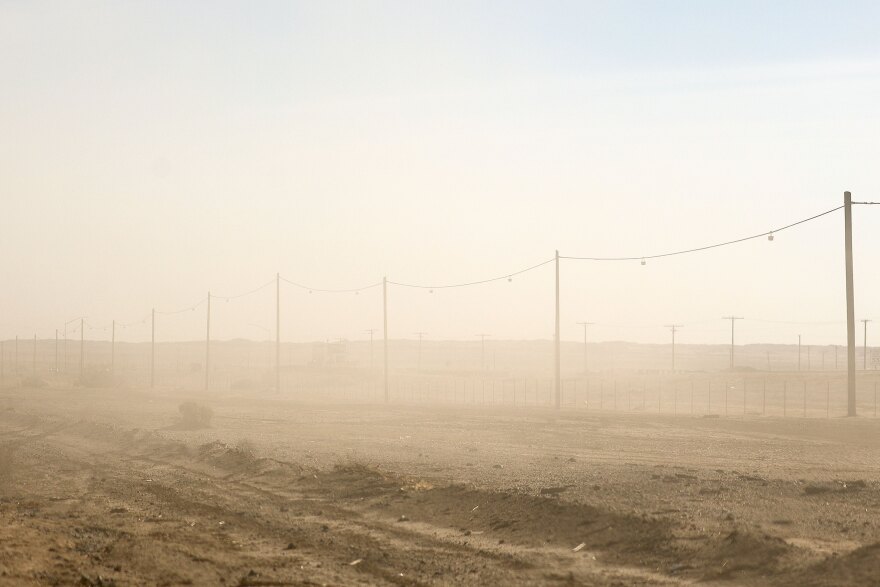
Dust lingers after OHVs drove by in West Shores, Calif., on Friday, Dec. 15, 2023. (Kristin Murphy, Deseret News)
With the exposed Salton Sea lakebed and the loose dirt and pesticides from the surrounding fields, Mandujano said it’s rare to find a Coachella Valley resident who doesn’t suffer from allergies or asthma. But the impact of the bad air quality and dust storms is worse for some, like Ruben.
“His asthma and his allergies combine, it’s a ticking bomb for him,” Mandujano said. “He says that everything hurts. His ears hurt, his eyes hurt, his nose hurts. He doesn’t even want to get touched.”
When the phlegm won’t leave his throat, Ruben has to use a nebulizer, which circulates well-known asthma medications like Albuterol or Pulmicort through a mask. Mandujano said she hooks her son up to the nebulizer about 121 times a year.
“He hates it because it makes him throw up because it gathers all of the phlegm,” Mandujano said. “He knows he’s going to start throwing up. So he just says, ‘Mommy, I don’t like this,’ and keeps trying to take it off.”
While Rosa Mandujano fights to keep her family healthy, California state leaders, scientists and community advocates are trying to identify solutions to clean up the air, especially as it pertains to the dust accumulated from the Salton Sea. Like Great Salt Lake, there are toxins in the sediment of the exposed lake bed.
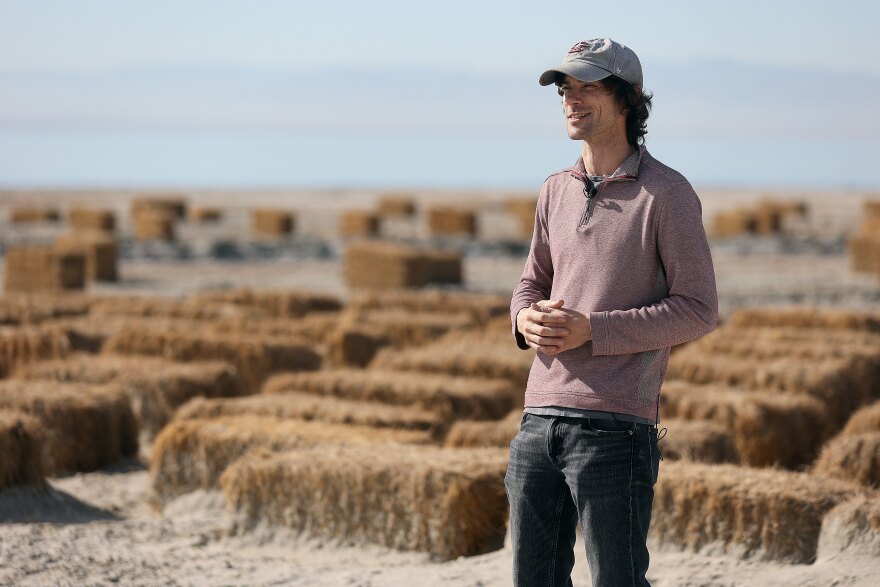
Charlie Diamond, University of California, Riverside, Earth and Planetary Sciences Department academic coordinator, talks about the Salton Sea during an interview in front of hay bales used for dust mitigation by Bombay Beach, Calif., on Tuesday, Dec. 12, 2023. (Kristin Murphy, Deseret News)
Scattered near the roughly 27,000 acres of exposed Salton Sea playa are lines of hay bales.
Charlie Diamond, a researcher with the Salton Sea Task Force at the University of California Riverside, said it’s a “dust suppression project” aimed to “break up the flow of air right at the ground level.” The goal, Diamond said, is for the hay bales to “suppress the dust production or emission.”
During high wind events, Diamond said toxins and other sediments like gypsum and salt get “blown around in the surrounding communities, [and] causes a lot of problems with respiratory health, especially in young folks.”
Usually, Diamond said, the hay bales are planted with native vegetation, which the shoreline severely lacks. That acts as another dust suppressant. But “these projects are really contingent on some external source of freshwater,” Diamond added, and that’s the crux of the issue – in the arid climate, there isn’t enough fresh water making its way to the Salton Sea to begin with.
With an exorbitant amount of dried lakebed, it’s unlikely hay bales will prevent all the dust from pummeling community members.
“That’s not a solution, it’s a band-aid,” Diamond said.
Local officials are working on other remedies. The Imperial Irrigation District, which oversees the hay bale projects, is also planting and germinating natural vegetation near the shoreline. Environmental specialist Ross Wilson said the district is using groundwater to hydrate the plants.
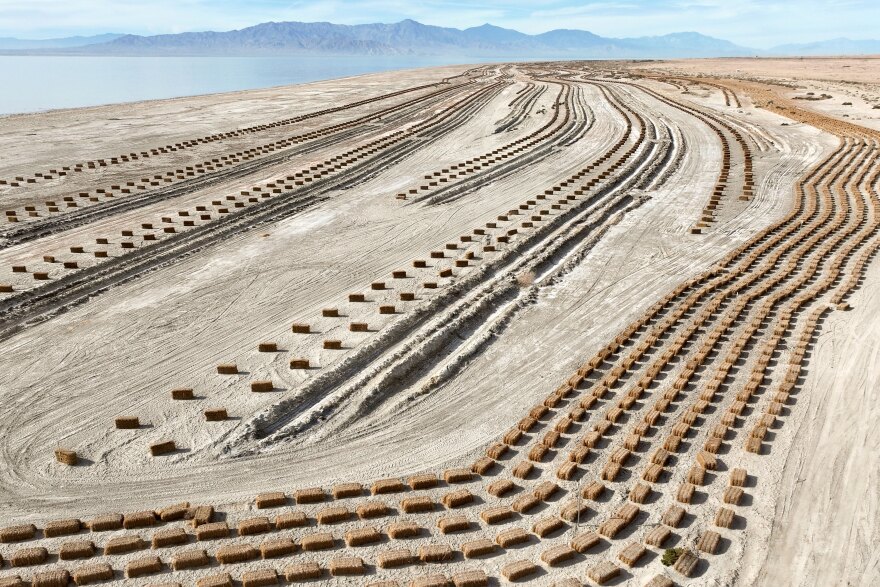
Hay bales used for dust mitigation in a Salton Sea Management Program project are pictured on approximately 68 acres near Bombay Beach, Calif., on Monday, Dec. 11, 2023. (Kristin Murphy, Deseret News)
Some corresponding seeding to establish vegetation was attempted during last year’s rains, but further planting is on hold until a water source is confirmed. Wilson said there isn’t a way to “necessarily make less dust,” the hope is the natural vegetation “catches the dust” like the hay bales and results in better air quality.
The agency also uses a Portable In-Situ Wind ERosion Lab, also known as a PI-SWERL, to figure out what exactly is in the dust. The device, which resembles an industrial floor polisher, replicates wind speeds and collects air quality measurements. Wilson added it also tracks which areas produce the most emissions.
“No one has the money to just mitigate the entire sea. So if we can dial down which areas actually are emissive and which areas are the problem, then we can really nail down our resources to those specific areas,” he said.
If more water isn’t funneled into the Salton Sea, the Imperial Irrigation District predicts upward of 70,000 acres of bare lakebed within the next 10 years.
Utah’s Great Salt Lake is up against the same fate as the Salton Sea when it comes to dust.
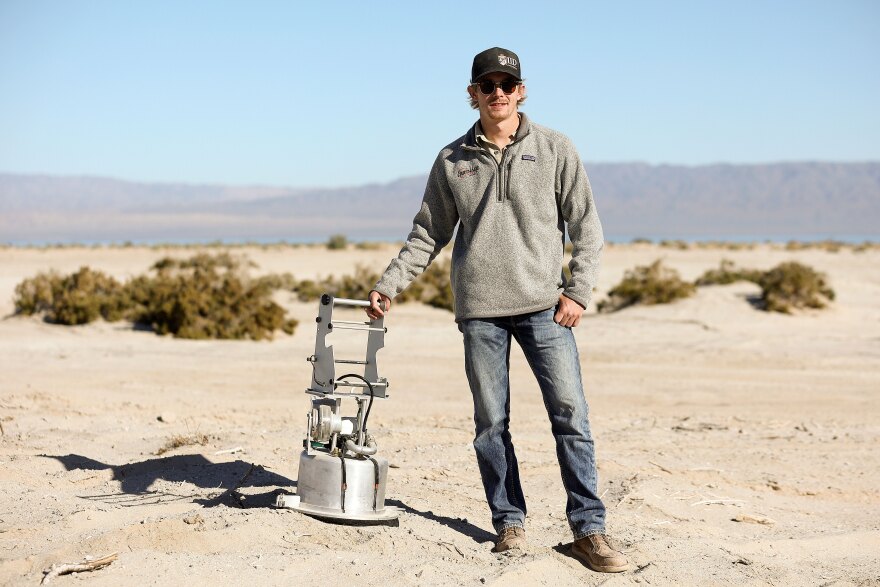
Ross Wilson, Imperial Irrigation District environmental specialist, poses for a portrait with a PI-SWERL, which stands for Portable In-Situ Wind ERosion Lab, in Salton City, Calif., on Wednesday, Dec. 13, 2023. (Kristin Murphy, Deseret News)
Great Salt Lake Commissioner Brian Steed noted in the state’s first Great Salt Lake Strategic Plan that the lake’s low water levels are increasing dust emissions. He added the accumulation from the estimated 800 square miles of the exposed lake bed poses a public health risk and is causing snow to melt approximately 17 days sooner than normal.
Steed told KUER’s RadioWest that he believes dust from Great Salt Lake is “going to be the hardest one [problem] to solve.”
“When you have an exposed lake bed that weathers over time, which has happened over years, you see additional dust days and problems with PM 2.5 and PM 10,” he said. “And we know that we’ve had a problem [with air quality] along the Wasatch Front especially.”
The Utah Office of Legislative Auditor General highlighted in the Great Salt Lake Strategic Plan that it would cost a minimum of $1.5 billion to keep the lake’s dust at bay, along with $15 million each year for ongoing maintenance.
Steed recognizes the price tag associated with dust mitigation. In an ideal world, “the lowest cost alternative” is lifting Great Salt Lake’s water levels so the crust “keeps that dust in place.”
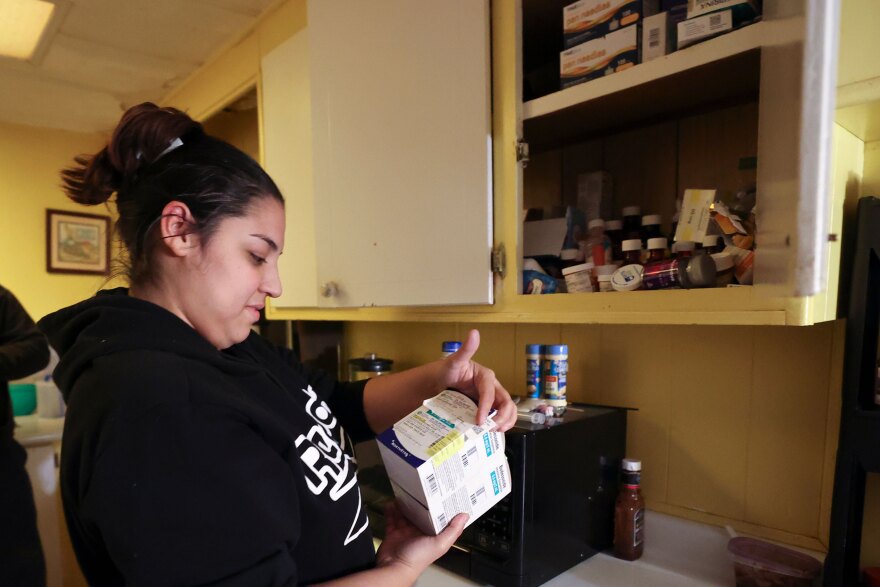
Rosa Mandujano shows a cupboard full of medicine related to her two children’s asthma at their home near the Salton Sea and Mecca, California, on Thursday, Dec. 14, 2023. (Kristin Murphy, Deseret News)
Utah is just beginning to grapple with its looming dust problem, but for Rosa Mandujano in California, the dust is enough to make her contemplate if it’s worth staying in her hometown. Her two kids love to be outdoors, but the air quality often triggers adverse reactions, especially for Ruben, forcing them to remain inside.
“I’ve talked to my husband and said if we get a good job opportunity and we would have to move out of the state, I mean, let’s go,” Mandujano said. “I know it’s scary because my family’s here. All his family’s here, but I’ve seen friends done it. It’s nothing out of the world. You have to start somewhere.”
KSLTV5’s Alex Cabrero contributed to this report


SALT LAKE CITY — A Riverton woman is proving that one moment of compassion can change a life.
On May 21, LaCinda Thackeray was flying home to Utah from Southern California after attending a family funeral when someone outside the window caught her attention.
As she waited to board her plane at John Wayne Airport, she noticed an airport worker struggling to walk across the tarmac.
“I just saw somebody who needed a little bit of support and love and kindness,” Thackeray said. “What really was hard for me was just the conditions he was in, and I didn’t even know his story at that point.”
Before her flight departed, Thackeray recorded a short video of the man and shared it on TikTok, asking if anyone knew who he was.
“Immediately when I sat on the airplane, my thought was, if anybody knew who he was, could we get him retired?” Thackeray said. “I didn’t know it was going to take off. I had no idea.”
Within a few hours, the video had been viewed more than a million times. Thousands of people shared it, and strangers from around the world began asking how they could help.
The internet soon identified the man as 64-year-old James Blair, a Navy veteran who works as a fuel injector and fuel mechanic at the airport.
By all accounts, Blair has lived a life of service. He served in the Navy from 1980 to 1990.
“We were 20 minutes from launching against Iran when the hostages were in Iran. We had all of our planes loaded with bombs and missiles on our ship and were just waiting for President Reagan to give the go-ahead,” Blair said.
After the Navy, Blair said he worked at LAX airport for 13 years and, after a three-year stint as a truck driver, returned to working on planes at John Wayne Airport.
“I’ve been at John Wayne Airport since April of 2006,” Blair said.
Though Blair turned 64 in March, retirement is not on his horizon.
“My plan was to work until I can’t work, until I physically can’t work,” he said. “I have inquiries out about getting knee operations; I’m working on that right now.”
Despite ongoing knee problems, Blair said his priority is his elderly mother, whom he lives with.
Thackeray said much of Blair’s income goes toward her hospice care.
“She has her good days, and she has her bad days,” Blair said.
Encouraged by people online, Thackeray started a GoFundMe campaign. She said donations quickly poured in.
“At one point, I remember telling my husband, ‘What did I do?’” Thackeray said. “When we needed to get him the money, that is when we were a little panicky, but then it changed really fast.”
The overwhelming support, Thackeray said, presented an exciting opportunity but also some challenges in ensuring that Blair would receive the money.
Until recently, Blair didn’t have a smartphone or social media accounts.
His boss volunteered to drive 1.5 hours to his home to help him set up a GoFundMe account so that he could receive the funds as a beneficiary.
“When his boss went out there, it eased so much anxiety,” Thackeray said.
Recently, Thackeray returned to California to personally deliver a $174,000 check to Blair.
For Blair, the support from complete strangers has restored his faith in humanity.
“Not in a million years,” Blair said when asked if he ever imagined something like this would happen.
“I’m just a person trying to do a job, trying to survive, and the way people give their own money. I have a hard time working to pay bills, so other people probably have the same problems. When they’re giving money they really can’t spare, that amazes me. I’m just blown away.”
Thackeray said the generosity extended far beyond the United States.
“I was speechless because I felt like the world showed up, and I think in these times we need people like that.” She said.
“I’ve been speaking to people all over the world, and they’re just, ‘Tell James hi!’ Give him a hug for us!” she said.
Blair also reflected on how deeply the experience has affected him personally.
“I believed in God, but I didn’t really believe in God. But now, with the angel sitting next to you, it’s amazing,” Blair told Thackeray. “I can’t believe how God works in mysterious ways.”
Although Blair is still going to work, he recently used some of the funds to buy himself a bed. He continues to care for his mother.
“I mean, I don’t know what Salt Lake City living is now, but California is really expensive,” Blair said.
What began as a brief glance through an airplane window has grown into an unlikely friendship — and a powerful reminder that a single act of kindness can inspire thousands of people to make a difference.
“I’m so happy for him and that he gets to experience this,” Thackeray said.
“I told him, I’m just a little part of your story, I’m happy that I could do that, but I hope you can always remember the ones that showed up and donated.”
To date, nearly 6,000 people have donated to the fundraiser. It has raised $180,521.00 for Blair.
Thackeray’s TikTok video of Blair has been viewed more than 9 million times, garnering nearly 800,000 likes and 8,000 comments.
For more information about the fundraiser, visit: https://gofund.me/51f1c9e16
*KSL.com does not assure that the money deposited to the account will be applied for the benefit of the persons named as beneficiaries. If you are considering a deposit to the account, you should consult your own advisers and otherwise proceed at your own risk.
The Key Takeaways for this article were generated with the assistance of large language models and reviewed by our editorial team. The article, itself, is solely human-written.

Not only the Utah that we are today, but the Utah that we can choose to become.
(Rick Egan | The Salt Lake Tribune) Gabriel Meneses makes one of the limited edition flags for the United States 250th anniversary at Colonial Flag in Sandy on Monday, June 1, 2026.

President Donald Trump plans to sign an executive order on Monday afternoon shrinking the size of two national monuments in Utah, which currently cover a combined 5,094 square miles, the Deseret News confirmed on background with a Utah source.
The two national monuments — Grand Staircase-Escalante and Bears Ears — have oscillated in size through the previous several presidential administrations.
Grand Staircase-Escalante National Monument was created by President Bill Clinton in September 1996. Bears Ears National Monument was created by President Barack Obama in December 2016. Both designations received a mixed reception among Utahns.
In 2017, Trump reduced Bears Ears by about 85% and Grand Staircase by about 46%.
Then when former President Joe Biden took office in 2021, he restored them to their original sizes.
Trump is expected to sign the executive orders in the Oval Office on Monday at 4:30 EST.
In a statement to the Deseret News on Friday, the White House said, “Any policy announcement will come directly from the President. This reporting about potential executive orders is pure speculation.”
National monument designations place restrictions on what recreational and economic activity residents and visitors can do on the land. The designation also prohibits anyone from pursuing new mining claims, oil and gas leasing, coal exploration or new commercial infrastructure projects.
However, the Bureau of Land Management previously found that Bears Ears and Grand Staircase have little to offer in terms of oil and gas potential, the Deseret News previously reported.
For nearly three decades since Clinton designated the first monument, Utah’s federal delegation has asked for reductions in land size for more local control, recreation and grazing.
Recently, Utah Rep. Celeste Maloy challenged the monument’s resource management plan to return to a plan the first Trump administration outlined in 2020 with help from local Utahns.
However, her bill died after missing a key deadline to make it to the Senate for a vote.
People react to the potential land reduction

Based on an initial report by ABC4, environmental groups are already vocalizing their disapproval over a potential reduction of monument land.
Southern Utah Wilderness Alliance Executive Director Scott Braden described the potential executive order as “unlawful, unwise and unacceptable,” in a press release sent to the Deseret News.
“This action will only bring uncertainty and chaos to places that should instead be protected for their rich biodiversity, unique geology, and remarkable cultural values,” he wrote. Braden said SUWA was preparing to fight the executive order through lawsuits or by lobbying in Congress.
On X, former Utah state Sen. Nate Blouin referenced the land reduction in conjunction with the Babylon Fire, which as of Friday is 25% contained and has covered more than 100,000 acres in southeastern Utah.
“As the largest wildfire in the U.S. burns pristine landscapes in southeastern Utah, Trump is threatening to shrink both Grand Staircase & Bears Ears National Monuments,” Blouin wrote. “This unprecedented move is happening without input from the region’s ancestral inhabitants.

-

 San Francisco, CA6 minutes ago
Giants select Barry Bonds’ nephew Peyton in third round
-

 Dallas, TX13 minutes ago
Mark Cuban takes legal action against the Dallas Mavericks ownership over proposed arena deal
-

 Miami, FL16 minutes ago
South Florida businesses report economic boom, as FIFA officials estimate a billion dollar economic impact
-

 Boston, MA21 minutes ago
Forecast: Looking ahead to toasty temps next week
-

 Denver, CO28 minutes ago
Denver weather: Warming trend continues this weekend and into next week
-

 Seattle, WA31 minutes ago
Tech Investor Vinod Khosla to Acquire the NFL’s Seattle Seahawks for $9.6 Billion
-

 San Diego, CA36 minutes ago
Endo injury overshadows 2-0 Angel City victory over San Diego – Equalizer Soccer
-

 Milwaukee, WI43 minutes ago
IndyCar drivers make a pit stop at the Milwaukee Mile

