Virginia
Virginia's multibillion-dollar plan to lure the Wizards and Capitals away from DC clears first hurdle in legislature


Legislation underpinning a plan to relocate the NBA’s Washington Wizards and NHL’s Washington Capitals across the Potomac River to northern Virginia easily cleared an early hurdle in the state legislature Friday.
Lawmakers on the Virginia House Appropriations Committee voted 17-3 to advance the measure, a top priority of Republican Gov. Glenn Youngkin, to the floor of the House of Delegates. Though the bill passed overwhelmingly, several senior Democratic legislators took care to say that their support for the measure at this point was in the interest of keeping negotiations over the deal going.
“This process is going to take the rest of our session at a minimum to enact or not enact this legislation,” Democratic Del. Mark Sickles of Fairfax County, who supported the bill, said before the committee vote.
The legislation could result in a legacy-defining project for Youngkin, a former college basketball player. Virginia is the nation’s most populous state without a major pro-sports franchise, something government officials of both parties over the course of decades have sought to change.
Youngkin and entrepreneur Ted Leonsis, an ultrawealthy former AOL executive and the CEO of the teams’ parent company, Monumental Sports and Entertainment, announced in December that they had reached an understanding on a deal to relocate the Capitals and Wizards.
The plan calls for the creation of a $2 billion development in the Potomac Yard section of Alexandria that would include an arena, practice facility and corporate headquarters for Monumental, plus a separate performing arts venue, all just miles from Capital One Arena, where the teams currently play in Washington.
Monumental and the city of Alexandria would put in upfront money under the terms of the deal, but about $1.5 billion would be financed through bonds issued by a governmental entity this year’s legislation would create.
The bonds would be repaid through a mix of revenues from the project, including a ticket tax, parking fees, concession taxes, income taxes levied on athletes performing at the arena, and naming rights from the district, among other sources. Proponents say those sources will more than cover the debt. But about a third of the financing would be backed by the “moral obligation” of the city and state governments, meaning taxpayers could be on the hook if the project revenues don’t come through as expected.
Critics of the project, including some who spoke against the bill Friday, asked why any tax subsidy was appropriate.
“This is a bad deal for every taxpayer in Virginia. We are saddling our children and grandchildren with 40 years of debt payments to help a billionaire get wealthier and wealthier,” said Andrew Macdonald, a former Alexandria city council member and an organizer of the Coalition to Stop the Arena at Potomac Yard, which held a rally on Capitol Square a day earlier.
The committee advanced a substitute version of the legislation that was initially introduced by Democratic Del. Luke Torian. It included a newly added provision that would require legislators to sign off on the deal again next year in order for the legislation to go into effect, something critics of the project cheered.
Monica Dixon, president of external affairs and chief administrative officer for Monumental, said the company was “very pleased” with Friday’s developments.
“We’ll take a look at it, but don’t expect we’ll have any major concerns,” Dixon said of the revised bill, which is likely to see further revisions as it goes through the legislative process.
Democratic legislative leaders, who control the General Assembly, have generally signaled openness or even optimism about the passage of the arena legislation this year. But they have stopped short of a full-throated endorsement of the project, both citing concerns still to be worked out and making clear the proposal is a bargaining chip in broader discussions about their own priorities.
Sen. L. Louise Lucas, who chairs the Senate finance committee, has said she wants consideration of increased public school funding, toll relief for her Hampton Roads region and legalized recreational cannabis sales in conjunction with the arena deal.
A Senate committee had at one point been expected to take up that chamber’s version of the bill on Thursday. But the hearing was delayed, and by Friday afternoon it was unclear when the bill might be heard ahead of Tuesday’s “crossover” deadline by which non-budget bills need to clear their chamber of origin.
Senate Majority Leader Scott Surovell, the sponsor of that chamber’s bill, said in a text message that his caucus is still working to reach consensus about changes to the legislation as introduced.
Many critics of the project have focused on the transportation impacts in an already congested part of Virginia.
The state released a transportation plan last week to address Alexandria residents’ concerns about traffic. Officials say they will commit $200 million to transportation improvements in the corridor, which is already seeing expanded use with a new Amazon headquarters and a new Virginia Tech campus under construction.
The plan seeks to have half of arena patrons arrive by transit, bike or walking and relies heavily on a newly built, $370 million Potomac Yard Metro station. But plan data shows that the station, as currently configured, would be overwhelmed at peak hours on game nights with “extreme crowding” lasting for 60 to 90 minutes.
The plan estimates that improvements to the station and increased service could reduce crowding to 30 to 45 minutes.
____
Barakat reported from Falls Church, Virginia.



RICHMOND, Va. — Jerrod Buford first picked up a paintbrush as a kid, never imagining that same creative outlet would carry him through his darkest days in prison.
Buford, who grew up in Williamsburg, was convicted and arrested as a young man and spent almost a decade behind bars. During that time, he struggled deeply.
“Turning to drugs and alcohol to kind of shadow over emotions,” Buford said. “Looking for acceptance, approval. Not just from my parents, but from friends, from, you name it. I mean, I tried to commit suicide, I don’t even know how many times,” Buford said.
WTVR
It was inside prison walls that art became more than a hobby.
“Throughout my prison time, I learned, the freedom that I desired, I’ve always had it. I got, I found it, in a box,” Buford said.
More than three years after his release, Buford continues to advocate for art as a tool for healing. He describes his work as a gift he feels called to share.
“I received a blessing from God that just allowed me to display what he’s given me,” Buford said.
For Buford, creating art is also a way of processing his past.
“That’s what art has done for me. It’s given me the ability to look at parts of my life, all parts of my life, and find the good and the negative, learn from the negative,” Buford said.
He shares his story and artwork with a wide audience through social media, including live sessions on TikTok, and holds art classes with new communities.
The Story Cafe
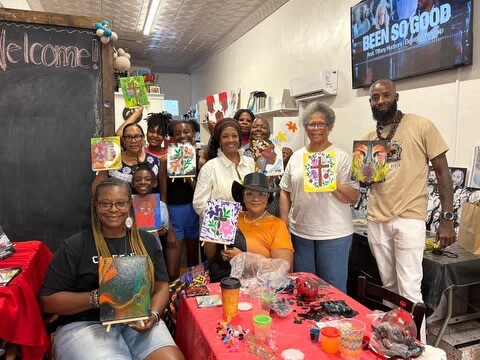
Buford said his mission is to help others find their own path toward healing — whatever form that takes.
“What I strive to do is guide this person to just create, man. Don’t care what people think about your creation, you just need to get it out,” Buford said. “Whether it’s with art, addressing your mental health, getting your life right — just do it.”
CBS 6 is committed to sharing community voices on this important topic. Email your thoughts to the CBS 6 Newsroom.
📲: CONNECT WITH US
Blue Sky | Facebook | Instagram | X | Threads | TikTok | YouTube

This story was initially reported by a journalist and has been converted to this platform with the assistance of AI. Our editorial team verifies all reporting on all platforms for fairness and accuracy. To learn more about how we use AI in our newsroom, click here.

Lovingston, VA (7News) — Good Morning Washington interviews Amanda Beckwith of Virginia Distillery Company- one of the contributing distilleries to the Virginia Spirits Board’s 250th Celebration Trio Pack, a special, exclusive release created to commemorate America’s upcoming 250th anniversary. This limited-edition package features a curated collection of a rum, a gin, and a whiskey, all crafted from scratch by distillers in Virginia to celebrate the rich history and current state of distilling within the Commonwealth.
Beckwith elaborates on VA Distillery Company’s role in the project, noting her focus on Virginia-grown grain to make the bottle of unique whiskey that is included in the Trio Pack. It is also worth noting that the Trio Packs themselves were bottled and produced right here at Virginia Distilling Company!
American single malts are the newest official category of American whiskey, distilled from one grain and from a single distillery. Virginia Distillery Co specializes in this new category of whiskey and crafted their contribution to the Trio Pack with this very specialty. Given the limited remaining availability of the Trio Pack, its historical value and collectible nature, the message it loud and clear encouraging viewers to grab a pack before they are all gone!
BE THE FIRST TO COMMENT
21+ Please drink responsibly, this content is sponsored by Virginia Distillery Company.


Powerball, Mega Millions jackpots: What to know in case you win
Here’s what to know in case you win the Powerball or Mega Millions jackpot.
Just the FAQs, USA TODAY
The Virginia Lottery offers multiple draw games for those aiming to win big.
Here’s a look at June 24, 2026, results for each game:
Powerball
Powerball drawings are held Monday, Wednesday and Saturday at 11 p.m.
13-14-16-21-38, Powerball: 14, Power Play: 2
Check Powerball payouts and previous drawings here.
Saturday, June 27, 2026
Pick 3
DAY drawing at 1:59 p.m. NIGHT drawing at 11 p.m. each day.
Night: 3-1-5, FB: 8
Day: 7-8-8, FB: 4
Check Pick 3 payouts and previous drawings here.
Pick 4
DAY drawing at 1:59 p.m. NIGHT drawing at 11 p.m. each day.
Night: 4-7-2-1, FB: 7
Day: 7-3-4-6, FB: 3
Check Pick 4 payouts and previous drawings here.
Pick 5
DAY drawing at 1:59 p.m. NIGHT drawing at 11 p.m. each day.
Night: 7-5-2-6-9, FB: 0
Day: 6-9-4-0-7, FB: 0
Check Pick 5 payouts and previous drawings here.
Cash Pop
Drawing times: Coffee Break 9 a.m.; Lunch Break 12 p.m.; Rush Hour 5 p.m.; Prime Time 9 p.m.; After Hours 11:59 p.m.
Coffee Break: 12
After Hours: 08
Prime Time: 13
Rush Hour: 01
Lunch Break: 14
Check Cash Pop payouts and previous drawings here.
Cash 5
Drawing every day at 11 p.m.
09-12-15-24-43
Check Cash 5 payouts and previous drawings here.
Bank a Million
Bank a Million draws are held every Wednesday and Saturday at 11 p.m.
18-21-25-33-36-39, Bonus: 13
Check Bank a Million payouts and previous drawings here.
Millionaire for Life
Drawing everyday at 11:15 p.m.
03-04-10-36-37, Bonus: 05
Check Millionaire for Life payouts and previous drawings here.
Feeling lucky? Explore the latest lottery news & results
This results page was generated automatically using information from TinBu and a template written and reviewed by a Center for Community Journalism (CCJ) editor. You can send feedback using this form.
-

 Maine56 seconds ago
High bacteria advisories reported at multiple Maine swimming spots
-

 Maryland6 minutes ago
Maryland governor vows special session to redraw congressional maps after election
-

 Michigan13 minutes ago
Michigan Recruiting Intel: Quarterback updates, notes on top targets
-

 Massachusetts16 minutes ago
Reed: Fight for tax relief is far from over
-

 Minnesota21 minutes ago
Children’s Minnesota doctor warns of Benadryl challenge dangers
-

 Mississippi28 minutes ago
Mississippi Lottery Mississippi Match 5, Cash 3 results for June 25, 2026
-
Missouri31 minutes ago
Missouri Lottery Pick 3, Pick 4 winning numbers for June 25, 2026
-

 Montana36 minutes ago
‘Hannah Montana’s Mitchel Musso On Why He Missed 20th Anniversary

