Science
Halfway through Medicaid purge, enrollment is down about 10 million

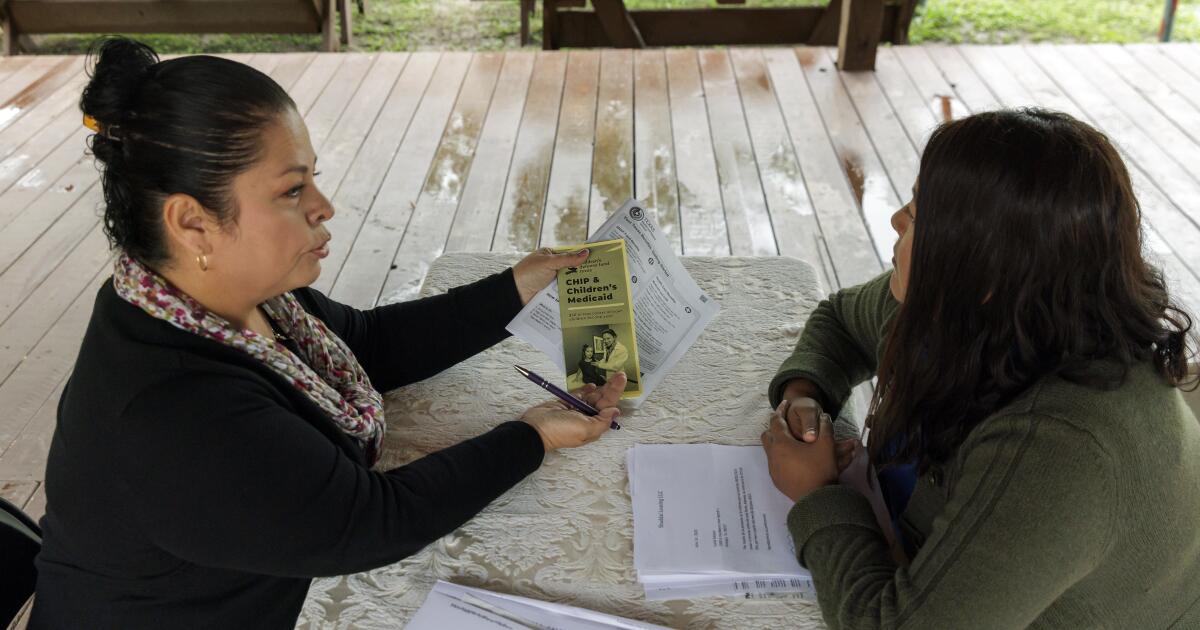
Halfway through what will be the biggest purge of Medicaid beneficiaries in a one-year span, enrollment in the government-run health insurance program is on track to return to roughly pre-pandemic levels.
Medicaid, which covers low-income and disabled people, and the related Children’s Health Insurance Program grew to a record 94 million enrollees as a result of a rule that prohibited states from terminating coverage during the nation’s public health emergency.
But since last April, states have removed more than 16 million people from the programs in a process known as the “unwinding,” according to KFF estimates compiled from state-level data.
While many beneficiaries no longer qualify because their incomes rose, millions of people have been dropped from the rolls for procedural reasons like failing to respond to notices or return paperwork. But at the same time, millions have been reenrolled or signed up for the first time.
The net result: Enrollment has fallen by about 9.5 million people from the record high reached last April, according to KFF. That puts Medicaid and CHIP enrollment on track to look, by the end of the unwinding later this year, a lot like it did at the start of the coronavirus pandemic: about 71 million people.
“What we are seeing is not dissimilar to what we saw before the pandemic — it is just happening on a bigger scale and more quickly,” said Larry Levitt, executive vice president for health policy at KFF.
Enrollment churn has long been a feature of Medicaid. Before the pandemic, about 1 million to 1.5 million people nationwide fell off the Medicaid rolls each month — including many who still qualified but failed to renew their coverage, Levitt said.
During the unwinding, many people have been disenrolled in a shorter time. In some ways — and in some states — it’s been worse than expected.
The Biden administration predicted about 15 million people would lose coverage under Medicaid or CHIP during the unwinding period, nearly half due to procedural issues. Both predictions have proved low. Based on data reported so far, disenrollments are likely to exceed 17 million, according to KFF — 70% due to procedural reasons.
But about two-thirds of the 48 million beneficiaries who have had their eligibility reviewed so far got their coverage renewed. About one-third lost it.
The federal government has given most states 12 months to complete their unwinding, starting with the first disenrollments between last April and October.
Timothy McBride, a health economist at Washington University in St. Louis, said the nation’s historically low unemployment rate means people who lose Medicaid coverage are more likely to find job-based coverage or be better able to afford plans on Obamacare marketplaces. “That is one reason why the drop in Medicaid is not a lot worse,” he said.
There are big differences between states. Oregon, for example, has disenrolled just 12% of its beneficiaries. Seventy-five percent have been renewed, according to KFF. The rest are pending.
At the other end of the spectrum, Oklahoma has dumped 43% of its beneficiaries in the unwinding, renewing coverage for just 34%. About 24% are pending.
States have varying eligibility rules, and some make it easier to stay enrolled. For instance, Oregon allows children to stay on Medicaid until age 6 without having to reapply. All other enrollees get up to two years of coverage regardless of changes in income.
Jennifer Harris, senior health policy advocate for Alabama Arise, an advocacy group, said her state’s Medicaid agency and other nonprofit organizations communicated well to enrollees about the need to reapply for coverage and that the state also hired more people to handle the surge. About 29% of beneficiaries in Alabama who’ve had eligibility reviews were disenrolled for procedural reasons, KFF found.
“Things are even keel in Alabama,” she said, noting that about 66% of enrollees have been renewed.
State officials have told the legislature that about a quarter of people disenrolled during the unwinding were reenrolled within 90 days, she said.
One of a handful of states that have refused to expand Medicaid under the Affordable Care Act, Alabama had about 920,000 enrollees in Medicaid and CHIP in January 2020. That number rose to about 1.2 million in April 2023.
More than halfway into the unwinding, the state is on track for enrollment to return to pre-pandemic levels, Harris said.
Joan Alker, executive director of the Georgetown University Center for Children and Families, said she remains worried the drop in Medicaid enrollment among children is steeper than typical. That’s particularly bothersome because children usually qualify for Medicaid at higher household income levels than their parents or other adults.
During the unwinding 3.8 million children have lost Medicaid coverage, according to the center’s latest data. “Many more kids are falling off now than prior to the pandemic,” Alker said.
And when they’re dropped, many families struggle to get them back on, she said. “The whole system is backlogged and the ability of people to get back on in a timely fashion is more limited,” she said.
The big question, Levitt said, is how many of the millions of people dropped from Medicaid are now uninsured.
The only state to survey those disenrolled — Utah — discovered about 30% were uninsured. Many of the rest found employer health coverage or signed up for subsidized coverage through the Affordable Care Act marketplace.
What’s happened nationwide remains unclear.
KFF Health News, formerly known as Kaiser Health News, is a national newsroom that produces in-depth journalism about health issues.


California researchers are leading a nationwide effort to find out why some Asian American communities have high rates of certain cancers.
It comes as health experts see rising rates of lung cancer among Asian American women who have never smoked and increasing rates of early-onset breast cancer.
“Asian Americans are actually the first racial and ethnic group for whom cancer is the leading cause of death,” said Scarlett Gomez, a cancer epidemiologist at UC San Francisco and a lead on the project.
UCSF joins researchers from UC Irvine, UC Davis, Cedars-Sinai and Temple University in launching a $12.5 million National Cancer Institute-funded study called the ASPIRE Cohort, that will follow 20,000 Asian Americans over time. Researchers say it’s the first large-scale longitudinal cancer study focused on Asian Americans.
Lung cancer incidence has declined across much of the United States as smoking rates have fallen. However, researchers have observed a slight increase among Asian Americans, despite relatively low smoking rates, particularly among women. More than half of Asian American women diagnosed with lung cancer are nonsmokers, they say.
Many existing studies of lung cancer risk among nonsmokers have been conducted in Asia, where exposure patterns can differ significantly from those in the United States, said Iona Cheng, a molecular epidemiologist at UCSF and also a lead on the project.
Researchers know that outdoor air pollution, secondhand smoke and cooking oil fumes can contribute to lung cancer risk. But it’s not clear if these explain disease patterns among Asian Americans in the United States.
Rising rates of breast cancer among Asian American women are also driving the push.
“Early onset breast cancer” — diagnosed before age 50 — “is going up the fastest among Asian Americans,” Gomez said. Recent data show rates among Asian Americans, Native Hawaiians and Pacific Islanders are approaching those of non-Hispanic white women, she said. Cancer experts don’t know why.
One of the central goals of the ASPIRE study is to move beyond treating Asian Americans as a single category. The term can include people with roots in dozens of countries from Sri Lanka to China’s border with Russia to Pacific islands, with completely different exposure patterns and cuisines.
“When we separate and look at all the distinct Asian ethnicities, we see a wide variation,” Cheng said.
Filipino women have a higher incidence of thyroid cancer, and stomach cancer has been more common among some Korean and Japanese people. Combining all Asian Americans into one category can make those differences impossible to detect.
The study also seeks to address longstanding gaps in representation. Although Asian Americans make up nearly 8% of the U.S. population, they have historically received little research funding.
Existing cancer studies have also often included too few Asian Americans to draw meaningful conclusions about specific ethnic groups, researchers said. Salma Shariff-Marco, a social and behavioral scientist at UCSF and also a lead on the projects, aid that has made it hard to show the need for more targeted research. The ASPIRE cohort, she said, is designed to show the variation by including a broader range of ethnic groups and more contemporary exposures than previous work.

Last summer, a NASA-funded asteroid impact warning system detected a mysterious object speeding through the solar system.
Scientists determined the object had entered the solar system from deep space, making it the third known object to have come from another star system.
NASA called it Comet 3I/ATLAS and said it didn’t pose a threat. But its discovery in July led to wild speculation that the object was a piece of extraterrestrial technology — maybe even an alien spacecraft.
The SETI Institute, a nonprofit that explores the origins of life and searches for extraterrestrial intelligence, said this week that a team of scientists had used a radio telescope to try to detect signals that could indicate extraterrestrial life on the comet.
But they found none.
“While observations strongly indicate that 3I/ATLAS is a natural object, interstellar visitors are also compelling technosignature targets because an artificial object — however unlikely — could represent detectable extraterrestrial technology and potentially provide the first evidence of life beyond Earth,” the institute said in a news release.
SETI scientists said they used the Allen Telescope Array at the Hat Creek Radio Observatory in Northern California to scan the object for seven hours, covering a spectrum of 1 to 9 gigahertz.
“This broad range allows scientists to search for narrowband radio signals, which are not produced in nature and would be evidence of technology,” the news release said.
The institute said the team identified nearly 74 million narrowband signals, but ultimately traced them back to technology on the Earth’s surface or orbiting satellites.
“The results from 3I/ATLAS show how realistic it is to detect a signal with the technology we have today,” said Valeria Garcia Lopez, one of scientists on the SETI team. “That is why it is important to keep searching for technosignatures, even from objects we might not expect to have signals.”
The institute said the researchers also can learn more about the natural properties of interstellar objects as they travel through our solar system.
“As more interstellar objects are discovered, each offers a new opportunity to probe the cosmos for technosignatures, advancing our understanding of both natural and possible technological phenomena beyond our Solar System,” the SETI statement said.
Science
Emergency room visits during heat waves available to the public in ‘near-real time’ in L.A. County

For the first time, Los Angeles County residents can see how many people are ending up in emergency rooms, their bodies pushed past the limit, during heat waves.
The county Department of Public Health says its new Heat-Related Illness and Mortality Dashboard will provide heat illness counts in “near real time,” which means weekly. That might seem like a lag, but until now the data were only provided upon request and in ad hoc reports.
Heat is the leading cause of weather-related death in the United States and heat waves are only getting more frequent and intense as the climate changes.
Public health experts called the tracker a meaningful step toward assessing how well county programs are addressing heat risks.
“It’s showing the county’s commitment to reducing the burden of heat on people’s health,” said David Eisenman, director of UCLA’s Center for Public Health and Disasters. “As the county puts more resources into that, this is a metric that allows the public to judge the effectiveness of the work.”
“There’s a handful of other places that also do this, but they’re all relatively new,” said Bharat Venkat, director of the UCLA Heat Lab, noting as examples Imperial and Riverside counties in California, Harris County in Texas and Maricopa County in Arizona. “It is very much welcome.”
The tracker takes heat illness data from patient complaints and doctor diagnoses provided by a countywide monitoring project that was previously available only to public health officials. The website says that what it provides is an undercount. The records often fail to count people when heat exacerbates more obvious health problems.
“Heat piggybacks off of preexisting health conditions,” Venkat said. “Say you go to the ER and you’re experiencing an intense psychotic episode, or a heart attack or a stroke. It’s very likely that the doctor is going to diagnose that as a psychotic episode, heart attack or stroke, and less likely that they’ll note that heat is contributing to that.”
Heat-related deaths are counted from death certificates, which present similar issues for undercounting. Those numbers will be reported monthly on the dashboard.
L.A. County has a recently approved heat action plan that aims to educate the public and reduce indoor and outdoor temperatures with strategies such as opting for shade and air conditioning.
The new tracker breaks down daily heat-related emergency room visits and deaths by age group, geography, and race and ethnicity.
It shows that people over 65 are more vulnerable to heat illness. For Black residents, heat is disproportionately fatal. And people in the San Fernando, San Gabriel, and Antelope valleys see the most heat-related emergency room visits.
Kelly Turner, a professor of urban planning at UCLA, stressed that heat sickness tracks closely with social inequality and is preventable.
“A heat death or heat illness is dependent on who you are and what assets you have,” Turner said. “If you have air conditioning or not, if you work outside or you don’t, all of those factors factor in.”
She noted that there is more risk in the San Fernando and San Gabriel valleys because of the combination of hotter days and more people who are unprotected. “When you map those two things on top of each other, you get a hot spot of vulnerability,” she said.
California already has a tool called CalHeatScore that uses historical hospital records and temperatures to forecast risk for different ZIP Codes in the state during heat events.
Public health officials hope to use the new dashboard to target messaging and public outreach when extreme heat strikes.
“If we’re having an extended heat event we can show that, ‘Hey, we’re having heat impacts’ as they’re happening,” said Dr. Nicole Quick, chief science officer at the L.A. County Department of Public Health.
Venkat said he would like to see the tool become more robust, in line with Maricopa County’s dashboard, widely viewed as the current gold standard for heat illness and mortality tracking. He said the Arizona county, which includes Phoenix, dives deeper into health records and conditions surrounding hospitalizations and deaths to better reflect the role of heat.
“They do scene investigations and send someone out to take notes about where the body was found,” Venkat said. “What was going on? Did they have air conditioning? Were they outside? Did they have access to water? What medications were they taking? All those things provide important context.”
Eisenman said he would like to see the county train physicians on recording heat-related illness, as it has been “clear for a long time” that doctors don’t make the diagnosis enough.
“It would have to be more than just a handout or a few slides. You’d really have to have each institution make some effort to change physicians’ behaviors,” Eisenman said. He added that it probably hasn’t been done because of the costs involved.
-

 Lifestyle18 minutes ago
Taylor Swift and Travis Kelce’s Wedding: Try Our Fantasy Wedding Planner
-

 Technology28 minutes ago
Meta made its own AI-generated clickbait news feed
-

 World33 minutes ago
Jeff Bartos says UN reform is no longer an ‘oxymoron’ after $570M in cuts
-

 Politics40 minutes ago
Top House Democrat says there’s ‘no way’ Platner didn’t know tattoo’s Nazi origins
-

 Health43 minutes ago
Can alkaline water actually improve your health? Experts separate fact from fiction
-

 Sports48 minutes ago
Maxx Crosby plans to attend America 250 UFC fight, talks White House, Fernando Mendoza, Tom Brady and Olympics
-

 Technology55 minutes ago
A wheeled robot may beat humanoids into your home
-
 Business58 minutes ago
California falls behind Texas in Fortune 500 ranking

