Maine
Free clinics in Maine are seeing an increasingly high demand for care

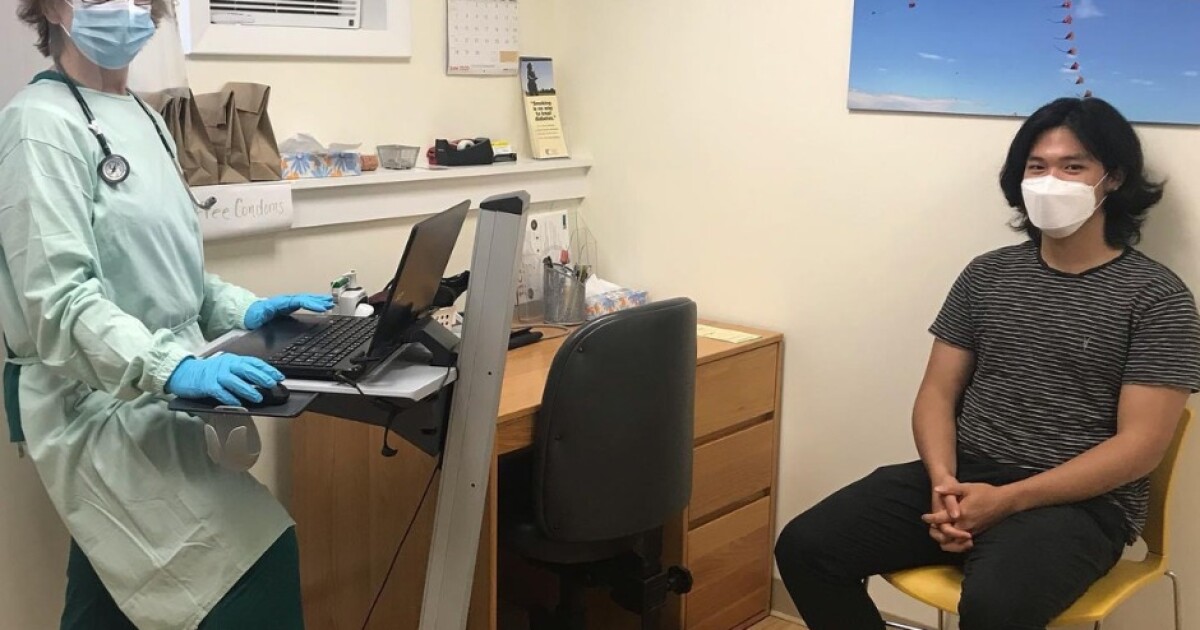
At the Oasis Free Clinic in Brunswick, the rapport between nurse practitioner Bronwyn Sewell and patient Alex Vale is evident. They laugh even as Vale, who prefers the pronouns they/them, describes pain they’re experiencing.
Vale has been coming to Oasis since last summer. Before that, they were living in Florida, and had health insurance.
“I lived a relatively normal, I think what you would consider to be standard lifestyle at the time,” Vale said. “I had a job and a car and a partner and an apartment.”
Then, Vale’s dad got sick. They became his caretaker, and within the span of a year, Vale says they lost it all: their dad, their job, their partner, home, car, and insurance.
“So this has been a dramatic, like, falling off a cliff,” they said.
Vale moved back home to Maine, feeling physically sick and also needing mental health support. Despite not having insurance, they were able to get that care at Oasis. The clinic provides free primary, dental, and optometry care, and up to 12 weeks of counseling. And because it doesn’t accept insurance, it can offer longer appointment times, which Vale said has made a huge difference.
“I was working hard leading up to the point where I decided to take care of my dad, and this stuff could happen to anybody,” Vale said. “And like, this place here, was able to recognize like, here’s a person who wants to get well and had the resources to actually like, just put a base underneath me.”
“It takes a lot for a patient to call us, to need help,” said Oasis nurse practitioner Michelle Barber. “We often have patients say, I never thought I’d need a free clinic.”
Barber said Oasis is getting those calls more often. Some patients are asylum seekers, others are traditional Mainers.
Patty Wight
/
Maine Public
“People who are underemployed, working either as lobster fishermen, or self employed doing odd jobs, or working at a gas station,” she said. “They are people who make enough to survive.”
But earn too much to qualify for MaineCare and not enough to afford health insurance. To meet the need, Executive Director Anita Ruff said Oasis is expanding into a larger space in Brunswick this summer, with the help of federal funding.
“And so our hope is that by adding more space that we’ll see at least 25% more patients in the medical clinic,” Ruff said. “Our hope is to add 50% more patients in the dental clinic and really begin to serve more of the need in the community than we do right now.”
Oasis is among a handful of clinics in Maine that offer free care. Two others in Rockland and Ellsworth said they’re also seeing high demand. It comes at a time when there are more options for coverage. The state expanded MaineCare in 2019, and the Affordable Care Act’s online marketplace has offered subsidized health insurance plans for a decade.
“I wouldn’t say we’re losing ground,” said Ann Woloson, Executive Director of Consumers for Affordable Health Care. “I’d say we have more to do.”
Woloson said health care costs are rising and need to be addressed. But she also suspects that some people are missing out on affordable plans because choosing insurance can be confusing.

Patty Wight
/
Maine Public
“And are maybe sticker shocked by what they first see but don’t understand how much subsidy might be available to them and that they have limited cost sharing. Like, very low deductibles, if any,” she said.
But Anita Ruff at Oasis said there’s another factor beyond insurance that’s driving up demand for their services: a lack of primary care providers. She said when an Oasis patient qualifies for MaineCare, the clinic used to transition them to providers in the community. But Ruff said they’ve stopped doing that.
“Because right now there’s nowhere for them to transition to in the community,” she said.
Taryn Walker, who has auto-immune issues, is one of those patients. “Every single place that I called, they said they’re not taking new patients under MaineCare,” Walker said. “Every single place.”
Walker said as she tried unsuccessfully to find a doctor, she started to panic.
“Does this mean I’m not going to have care again?” she said she thought. “Oh no. I’m not going to be able to go to Oasis anymore and I can’t find any place that will take me, so therefore I’m back to not having any care.”
Walker was relieved when Oasis told her she could continue to go to the clinic for primary care.
“I’m just so grateful for the care,” she said. “If I had great insurance, I would still want to go there for the care that I get.”
Walker said she’s had all kinds of insurance – including employer-based and marketplace plans. But the care she’s received at Oasis has been the best.

The Maine Marine Patrol has launched the newest and largest patrol vessel in its fleet, the 57-foot P/V Allegiance, which will support safer and more effective offshore patrols, according to the Maine Marine Patrol, in a news release. The vessel was officially put into service on Thursday, June 11, during a christening event at Perry’s Lobster in Surry.
“Maine Marine Patrol routinely patrols commercial fishing activity offshore and hauls and inspects tens of thousands of lobster traps annually,” said Marine Patrol Colonel Matt Talbot, in the news release.
“While still capable of supporting Marine Patrol’s mission near shore, the new vessel will better position Marine Patrol to conduct offshore commercial fisheries enforcement, including the ability to safely haul and inspect large lobster trawls in federal waters,” said Colonel Talbot.
The vessel will also be used to respond to search and rescue incidents, monitor fisheries in addition to Lobster including scallop, Atlantic Herring, Menhaden, and Groundfish, and others.
The P/V Allegiance will be based in Boothbay Harbor and assigned to Marine Patrol Specialist Evan Whidden. It replaces the 29-year-old, 35-foot P/V Vigilant.
The P/V Allegiance was constructed and finished by Wesmac Custom Boats in Surry.
“This is the fifth patrol vessel built or refitted by Wesmac and we are once again very pleased with the quality of work and attention to detail by the Wesmac team,” said Colonel Talbot.
The P/V Allegiance is powered by a low-emission Tier 4 Man Diesel V-12 1450hp engine which can cruise in excess of 20 knots. It is equipped with state-of-the-art Furuno navigation electronics, and a heavy duty 17-inch hauler. It has significant deck space and an open stern which will allow Officers to safely handle and set back the larger offshore lobster trawls Marine Patrol Officers will be inspecting. The vessel is also equipped to carry a 15-foot Ribcraft Rigid Hull Inflatable boat on deck, which can be used for at-sea boardings to check vessels for compliance with marine resources laws.

PORTLAND (WGME) — Maine Governor Janet Mills has not yet decided whether the state will opt into a new federal tax credit program that would help fund private school tuition, tutoring and other educational services.
The program, called the Educational Choice for Children Act, would start next year. In states that opt in, individuals can receive up to $1,700 in tax credits for donations they make to scholarship-granting organizations, also known as SGOs. Those SGOs would then award grants to students to cover private school tuition, tutoring and other educational services.
Families earning up to 300 percent of the area median income can qualify for the scholarships in states that opt in.
Under the current framework, donors contribute to SGOs and receive federal tax credits, and SGOs use the funds to award scholarships for qualifying educational expenses, including tuition, fees, tutoring, curriculum materials and educational therapy for K-12 students. SGOs can also use donated money to award scholarships for educational expenses, including everything from private school tuition to special needs services and educational therapy.
Each state’s governor must opt in by filing IRS Form 15714. Once opted in, the state designates SGOs to operate within its borders and distribute EFTC scholarships to eligible families.
Republican State Senator James Libby of Cumberland, a member of the Education and Cultural Affairs Committee, says he is interested in bringing the program to Maine.
“What it really does is it takes dollars that would normally go to pay for taxes and put them directly into education,” Libby said. “The program itself allows for expenditures for other things besides school choice, so the states can set it up the nonprofit to have goals for whatever they want. There’s a lot of good parts to this legislation and I truly hope Maine will get involved.”
Democratic Rep. Kelly Murphy, who chairs the state’s education committee, says she believes the program would hurt Maine students.
“The Education Freedom Tax Credit favors families that already have the ability to pay for private schools at the expense of families with students enrolled in public schools,” Murphy said. “A decline in public school enrollment would result in a loss of state funding for local SAUs, as the costs for running schools continue to increase, putting additional pressure on property taxpayers to make up the gap. This program and others like it would hurt the majority of Maine students, especially those in small, rural schools across our state.”
The U.S. Department of the Treasury is in the process of finalizing rulemaking for the program. Currently, 30 states have opted into the program, and four states have opted out. In New England, New Hampshire is the only state that has opted in so far.
It is unclear if there is a hard deadline for states to opt in, but Mills is facing pressure to sign off this year so the Department of the Treasury can approve scholarship organizations before scholarships become available in January.

A 51-year-old man was fatally struck by an Amtrak train in Old Orchard Beach, Maine, on Thursday afternoon, and police believe alcohol was a factor.
Old Orchard Beach Police say they responded around 2:18 p.m. to the area of the railroad tracks located off from the roadway near 133 Temple Avenue. The victim, who had been struck by a train traveling northbound, was pronounced dead at the scene.
Information obtained from witnesses suggests the man was traveling alone and walking nearby the railroad tracks moments before being struck by the train, according to police, who didn’t say why they believe alcohol was a factor in the incident.
The victim’s name is being withheld pending further investigation and notification, with police saying only that he was from Old Orchard Beach.
Amtrak said in a statement obtained by NBC10 Boston affiliate News Center Maine that the individual was trespassing when he came into contact with the train.
Amtrak urged the public in its statement to stay off railroad property and use caution around railroad tracks and grade crossings, writing, “These incidents can affect everyone involved—those who are injured or die and their families, our train crews, and our passengers.”
There were no reported injuries among the 135 passengers and crew members abord the No. 683 train that was traveling from Boston to Brunswick until the incident happened on Thursday.
The added that preventing railroad incidents and fatalities is a priority for them. Amtrak is working with local authorities investigating this latest incident.
An investigation remains ongoing by the Old Orchard Beach Police Department, Amtrak Police and Saco Police Department, which responded to assist.
-

 Indiana5 minutes ago
How to watch Indiana Fever vs Los Angeles Sparks: Time, channel
-

 Iowa12 minutes ago
After two decades, Iowa Events Center could get a new operator
-

 Kansas15 minutes ago
Meet Mohammad Abualnadi: The Kansas City native making World Cup history with Jordan
-

 Kentucky20 minutes ago
Kentucky Arts Council's Celebrating the Black Experience Art Exhibit to visit NKY in November
-

 Louisiana27 minutes ago
Polls open for Louisiana runoff election | Everything you need to know
-
Maine30 minutes ago
Maine Marine Patrol launches newest, largest patrol vessel in its fleet
-

 Maryland35 minutes ago
Off-and-on weekend showers before intense heat builds in Maryland
-

 Michigan42 minutes ago
4-star WR recruit commits to SEC power over Michigan Football

